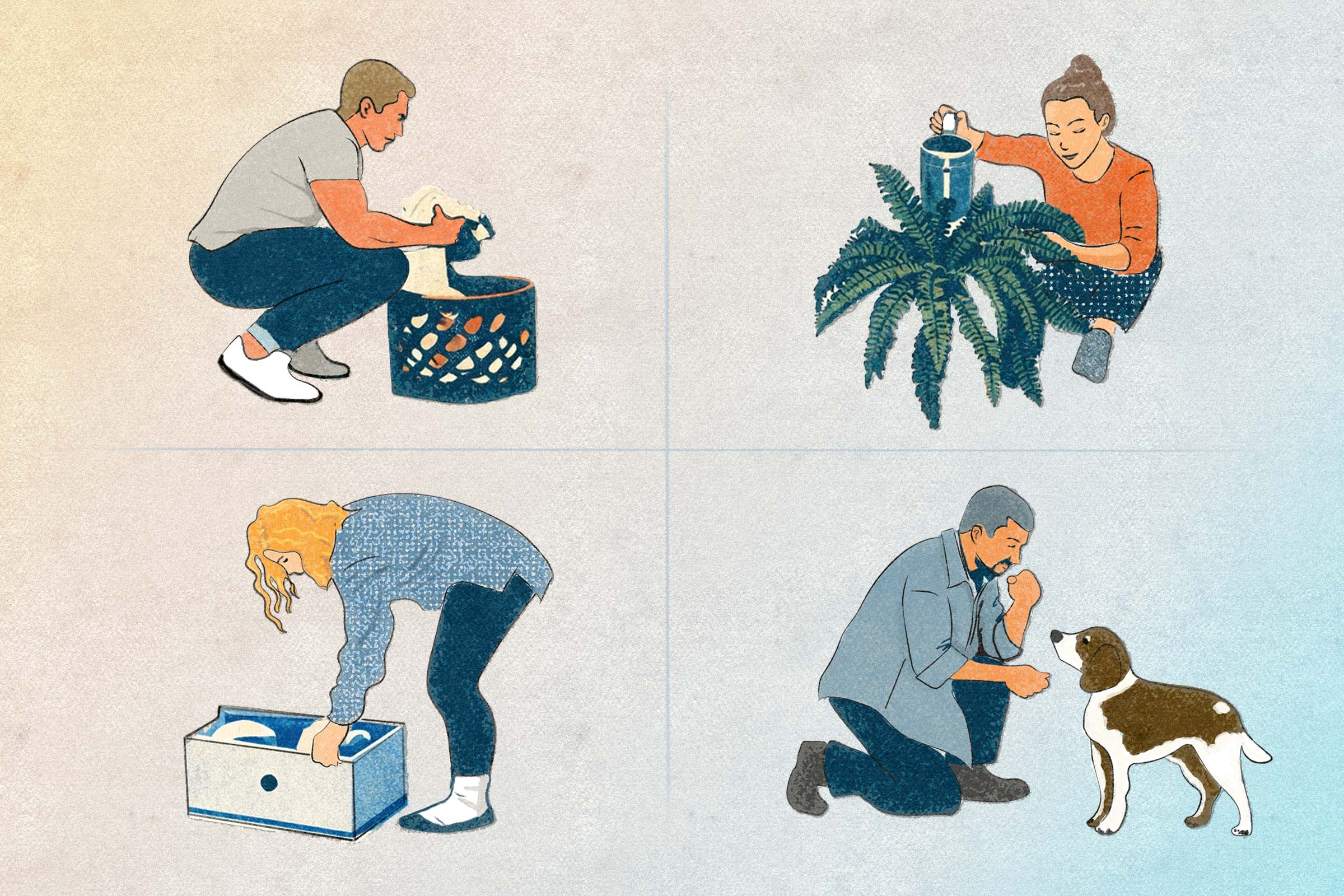
A specific kind of afternoon feels quietly good—when you drift from room to room, doing small things for no particular reason, and end up feeling inexplicably uplifted.
Such is the power of puttering.
Far from being time-wasters, research suggests that light, leisurely, unstructured tasks can improve mood, support metabolic and cardiovascular health, and even help you live longer.
What Is Puttering?
Puttering. Piddling. Tinkering. Doing this and that. Fussing around. Whatever you call them, informal activities differ from exercise or household chores in one important way: They’re not about being productive. Puttering is about settling into a state of flow, moving from one self-chosen activity to the next, regardless of whether the tasks are completed.
According to a large cohort study published in JAMA Network Open, replacing sedentary time with light, physical activity was associated with significant health benefits.
The Case for Light Movement
Modern life has become more sedentary—and more convenient—than our bodies were designed to handle.
Keith Diaz, a certified exercise physiologist and assistant professor of behavioral medicine at Columbia University Medical Center, said he believes that one of the simplest solutions is also one of the most overlooked: taking breaks to putter.
“For the past several decades, there has been this huge focus on going to the gym—‘no pain, no gain,’” Diaz told The Epoch Times. “More recently, it has come to light that all movement is healthy and has benefits.”
Diaz led a national cohort study on the potential effects on mortality of replacing sedentary time with short bouts of physical activity. The results showed that replacing 30 minutes of sitting with 30 minutes of light-intensity movement was associated with a 17 percent lower risk of death over time. Another study he worked on found that light movement noticeably reduces both blood sugar and blood pressure.
Movement can also fight fatigue and reduce brain fog. However, post-COVID-19 pandemic, society has drifted toward a “convenience culture,” outsourcing errands that once required us to move, such as ordering groceries to be delivered instead of going out to shop, Diaz said.
“Go shop,” he said. “Putter around the house. Don’t feel it has to be all or nothing. All movement counts. Our bodies are not meant to be idle.”
Something for Everyone
Movement isn’t only about preventing disease. It’s also about remaining active and independent, according to Carolyn Baum, professor emerita of occupational therapy, neurology, and social work at Washington University School of Medicine in St. Louis. At 83, she is a compelling example of her own philosophy.
“Puttering around gets people up and about, and helps them to do things a bit differently, which promotes cognitive function and neuroplasticity,” she told The Epoch Times.
Researchers agree that keeping the brain active is one of the most important things we can do as we get older. To that end, Baum encourages people to vary their routines as they go.
“Try new things,“ she said. ”Even something as simple as sprucing up a favorite family recipe by adding different spices will have a positive effect.”
Why Do We Feel Guilty About Puttering?
If puttering is so good for us, why do we often feel guilty for not being “more productive"?
It all comes down to motivation, according to Bobby Hoffman, who holds a doctorate in educational psychology and is an associate professor of educational psychology at the University of Central Florida.
People often underestimate the importance of slowing down, Hoffman, who is also a speaker and an author of books on bridging behavioral science with everyday habits, said. In his 2017 book “Hack Your Motivation,” Hoffman wrote that slowing down is a productive strategy, not a sign of laziness. It helps your brain rest and relax so you can be more energetic later.
Another powerful force of movement is dopamine. In fact, it is so important, Hoffman said, that a deficit can keep us on the couch.
Fortunately, small satisfying actions, especially those chosen freely, can activate the brain’s reward system in sustainable ways. Even wiping a counter or rearranging a shelf provides a feeling of accomplishment that reinforces forward momentum. Over time, those quiet reinforcements may help regulate dopamine, supporting steadier mood and motivation.
A Modern Doorway Back to Healing
Celebrity nutritionist and wellness speaker Mona Sharma came to her philosophy the hard way, through medical issues that required heart surgeries and a complete rethinking of how she approached health.
“So many people come to me exhausted, not from doing too little, but from trying to do too much in the name of health,” Sharma told The Epoch Times. “Wellness has quietly become another performance. Another box to check.”
What puttering offers is something the wellness industry rarely sells: permission to stop optimizing. Low-effort activities are grounding, she said.
“When you’re watering plants, tidying a drawer, walking without a destination, or simply looking up at the sky, your nervous system gets a rare message: You are safe, and nothing needs to be optimized right now,” she said.
Physiologically, Sharma said, puttering activates the parasympathetic nervous system by lowering cortisol, softening the stress response, and helping the brain shift out of hyper-vigilance.
There’s also something deeper happening, she added. In many ancient traditions, healing was found in repetition, ritual, and presence.
“Puttering may just be a modern doorway back to that wisdom,” she said.
Puttering signals regulation instead of demand. What’s remarkable, Sharma said, is what happens when people truly permit themselves to slow down; not as a reward, but as a biological necessity.
“Their breath deepens,” she said. “Their thoughts soften. Cravings change. Creativity returns.”
Sharma’s tips for putting puttering into practice:
- Listen to Your Body: Your body doesn’t heal when it’s being judged; it heals when it’s being listened to. Slowing down is a form of intelligence. It’s the space in which the body remembers how to self-regulate.
- Move in Rhythm: When people release the pressure to be constantly productive, they often become more effective, present, in flow, and aligned—not because they’re pushing, but because they’re finally moving in rhythm with themselves.
- Schedule Time for Puttering: It’s important to schedule permission and time for puttering so it becomes a daily, lifelong ritual. Imagine feeling lighter, clearer, and more motivated in just 10 to 20 minutes per day.