Have you ever experienced, even without intense exercise, your shoulders and neck feeling stiff and your lower back being tight? Or perhaps two days after a workout, your muscles are so sore that even walking feels awkward.
Physical therapist Duke Pan told The Epoch Times that such soreness isn’t always a “muscle” problem. Recent research has shown that the health of the fascia—a specialized, continuous web of connective tissue throughout the body—plays a crucial role in overall comfort.
Pan highlights two fascial lines that most commonly cause problems in clinical practice, along with stretches that can help maintain them in daily life.
Muscle Soreness vs. Fascial Adhesions
Many people instinctively think that soreness is due to “fascial adhesions.” However, delayed-onset muscle soreness after exercise and fascial adhesions are distinct concepts.
Delayed Onset Muscle Soreness
- Commonly occurs one to two days after exercise
- More common after high-intensity or unfamiliar training
- Soreness is concentrated in the muscle groups used that day
- Particularly noticeable when pressing or contracting the affected muscle
- Naturally recovers within a few days
Fascial Adhesions
When soft tissues undergo repeated long-term inflammation or certain areas are overused, the fascia may develop restricted gliding and tension imbalances.
Common characteristics of fascial discomfort include:
- Pain or soreness over a broader area
- Symptoms that often involve multiple regions
- Discomfort that may extend to distant areas
For example, shoulder and neck soreness accompanied by lower back stiffness, or tightness in the back of the legs that extends to the entire back, is often related to imbalances in tension along the “entire fascial line.”
Can Fascia Relaxation and Stretching Relieve Muscle Tension?
In the past, soreness was often thought to be simply the result of tight muscles, Pan said, so treatment focused mainly on “pressing or massaging the muscles.” Considering that muscles contain many pressure receptors, applying pressure can help regulate their tension.
Research has found that fascia contain mechanoreceptors that respond to manual pressure. Following the 2001 publication of “Anatomy Trains” by Thomas Myers, the concept of interconnected fascial lines gained broad popularity in fields such as manual therapy and movement training.
His book suggests that when dealing with issues such as plantar fasciitis, treatment need not focus solely on the foot. Working on other muscles along the same fascial line may also help relieve symptoms. According to Pan, this approach also evokes the concepts of meridians (energy pathways) and acupuncture in traditional Chinese medicine.
Pan also noted that more pressure doesn’t necessarily lead to better results. Excessive heavy pressure can cause secondary injury. In clinical treatment, therapists usually begin with a superficial assessment of muscle tension. After releasing tightness in the superficial layers, they gradually address deeper issues. Once the superficial fascia relaxes, the deeper muscles are often easier to release.
Stretching can indeed help regulate fascial tension, Pan said. As for the commonly used fascia massage gun, it is mainly suitable for superficial, localized relaxation and can provide temporary relief from tightness. For example, if your calf is about to cramp, a brief use may help ease the cramp quickly. However, massage guns are not effective for deep muscle groups as they cannot reach those tissues.
2 Fascial Lines Often Cause Clinical Problems
Among the many fascial lines, the ones that require the most daily maintenance are the “superficial back line” and the “spiral line.”
The superficial back line starts at the soles of the feet, passes through the posterior calves, posterior thighs, buttocks, and spine, and extends to the head, governing overall tension on the posterior side of the body. Prolonged sitting, slouching, and looking down can keep this line tight for long periods. Common symptoms include lower back pain, neck and shoulder soreness, and stiffness along the back of the legs.
The spiral line, on the other hand, spans a much broader area. It wraps around the body in crossing patterns, extending from one side of the skull across the front and back of the body to the opposite ankle. The spiral line helps coordinate gait, maintain postural stability, and control movement—for example, the natural coordination of the right arm swinging with the left leg while walking, maintaining balance while standing, or holding specific positions in sports.
Daily Stretches for Fascial Maintenance
Pan recommended the following maintenance exercises:
1. Superficial Back Line Stretch–Beginner Version
Step 1: Sit upright on a chair.
Step 2: Lift your right leg and straighten it. Slowly lean your upper body forward, and extend your right hand forward to touch the inner side of your right foot.
Step 3: Lower your head downward, and hook up the sole of your right foot. Hold for three to five seconds, then switch to straightening and stretching the left leg.
2. Superficial Back Line Stretch–Advanced Version
Step 1: Sit upright on the floor.
Step 2: Extend both legs forward, and slowly lean your upper body toward your legs, reaching your hands forward to grasp the insides of your feet or as far as you can reach.
Step 3: Lower your head to align with your spine. Hold for three to five seconds, then lift your upper body back up.
3. Spiral Line Stretch–Beginner and Advanced Versions
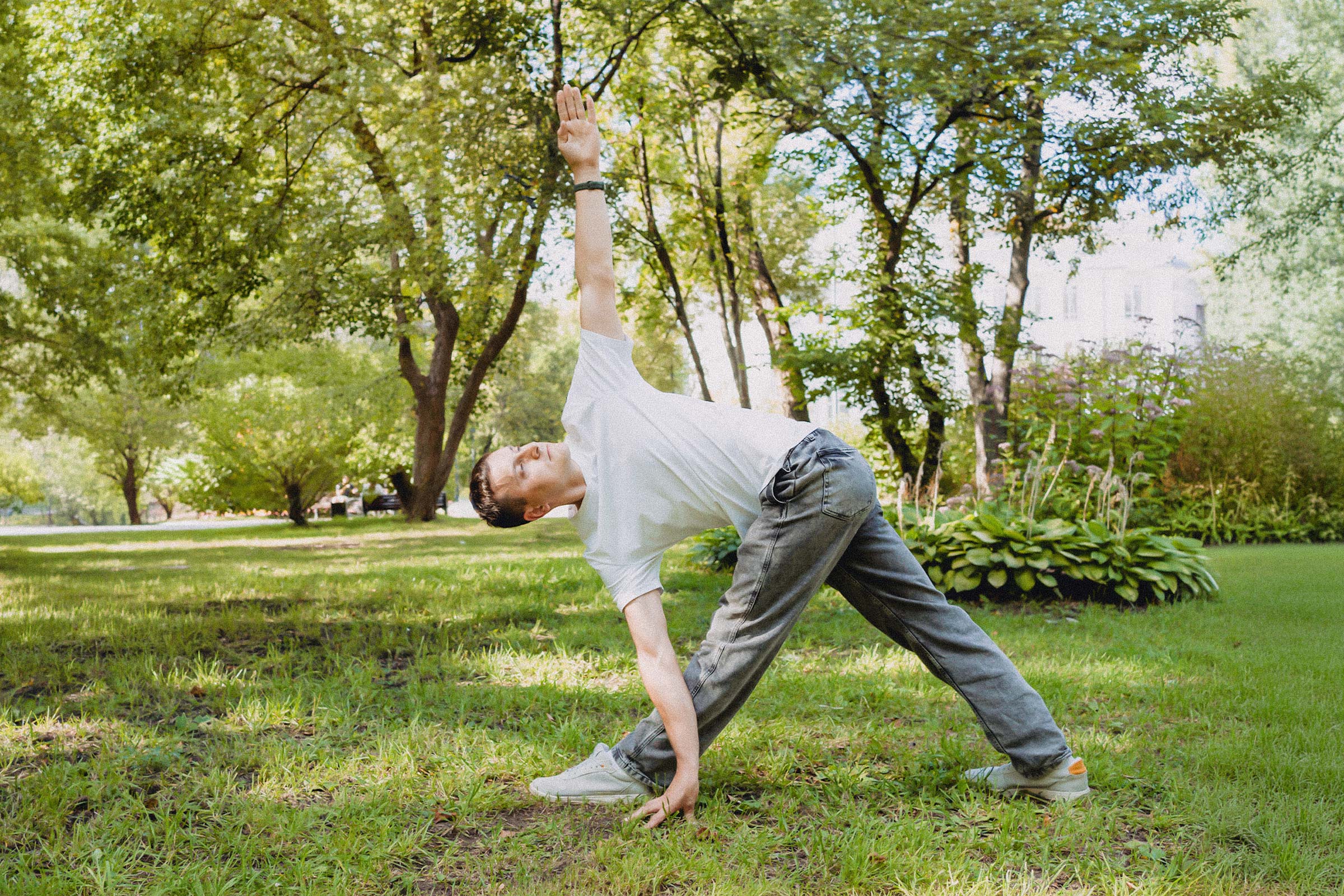
Step 1: Stand with your right foot forward and left foot back, feet wider than shoulder-width apart, pelvis and both feet facing forward.
Step 2: Lean your upper body forward and down, reaching your hands toward your right foot. Hold for three to five seconds.
Step 3: Extend your right hand outward and raise it overhead, following it with your gaze. Hold for three to five seconds, then return your right hand along the same path back to the side of your right foot.
Step 4: Repeat several times, then switch with the left foot forward and the right foot back.
Advanced Version
Narrow the distance between your feet, or place your feet front-to-back in a straight line to increase the difficulty of the movement.