
As flu season approaches, one simple ingredient can boost both your meals and your health: garlic. Long valued as a natural remedy for everything from fighting cancer to controlling blood sugar, garlic offers a practical way to add flavor to your cooking while giving your immune system that extra support.
Now is the time—plant it in late autumn, toss it into your favorite stews, and keep it on hand as a natural ally during cold-weather months.
This article will provide you with insights into different garlic varieties and which ones are best suited for your region. It also walks you through the process of growing, harvesting, and curing garlic—and how to store the bulbs properly.
Growing Garlic
Melissa Norris, host of the Pioneering Today podcast, has been gardening since childhood with her parents and has continued for most of her adult life. She preserves food through canning, fermenting, dehydrating, and freeze-drying—and cans more than 400 jars each year.
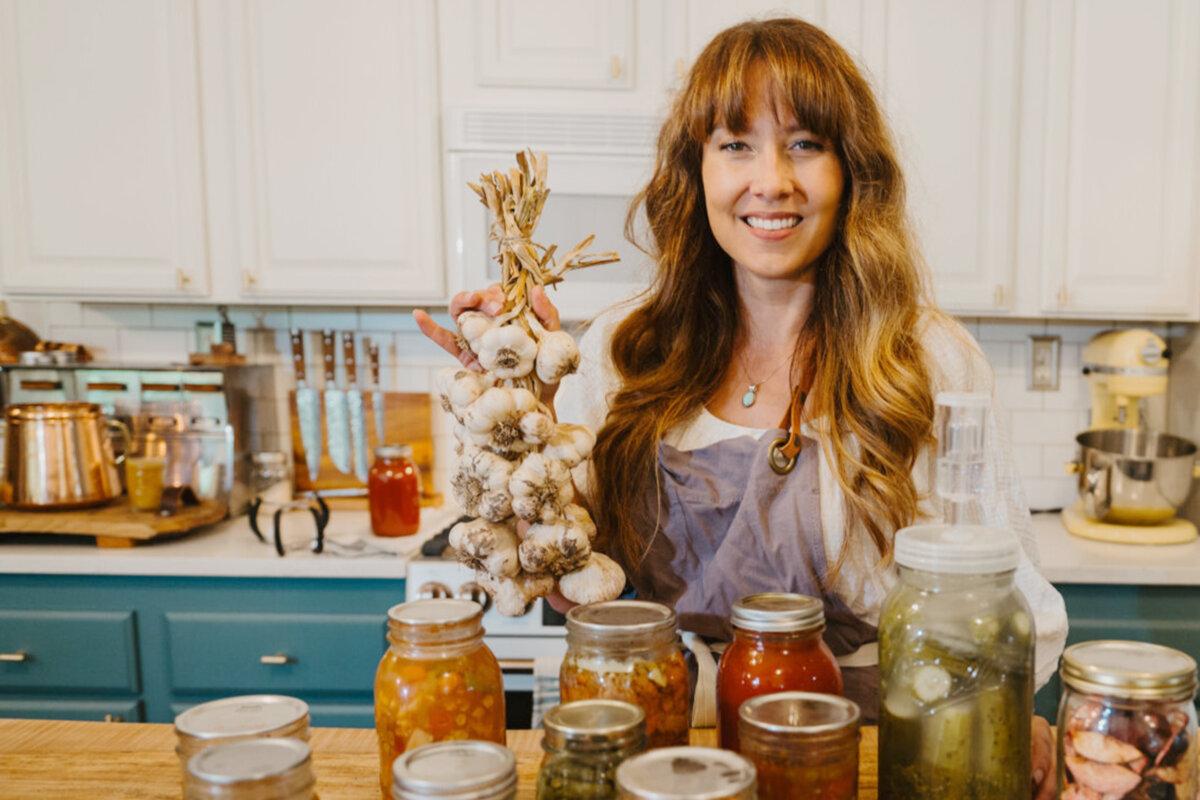
Melissa Norris uses homegrown garlic in many of her recipes. (Courtesy of Melissa Norris)
“I plant garlic in the fall, usually October here in the Pacific Northwest, after the first frost but before the ground freezes. That gives the cloves time to root in before winter,” Norris told The Epoch Times.
She encourages everyone to try growing garlic, as it’s very simple and rewarding. However, there are a couple of things to watch out for, Norris added. The biggest concern is avoiding “wet feet,” which happens when the cloves sit in water without proper drainage.
“If your soil is heavy clay, consider raising the bed or adding mulch to prevent bulbs from rotting. A good four to six inches of straw mulch also helps protect it from cold snaps,” Norris said. Well-drained, loamy soil is ideal.
A general rule of thumb is to plant garlic a few weeks after the first frost. If the temperatures are still too high, the cloves may sprout too early. However, waiting too long can be just as harmful, because the root system needs time to establish before the ground freezes. Garlic also requires a period of cold, known as vernalization, to form proper bulbs.
You can find the right planting time for your area using the frost date calculator. Add two to three weeks to determine your best planting window.
Garlic spacing is also key. Each clove needs about six-by-six inches, though many gardeners allow a bit more room and set rows six inches to 12 inches apart. This ensures that the bulbs have enough space to grow well.
Plant each clove with the pointed side up, about three to four inches deep (six inches for elephant garlic). Cover with a three- to four-inch layer of straw, which also helps suppress weeds in the spring. Then, simply let the garlic grow on its own until harvest time next summer. Garlic is a forgiving crop for beginners because it practically takes care of itself throughout the growing season.
Garlic Varieties: Softneck Versus Hardneck
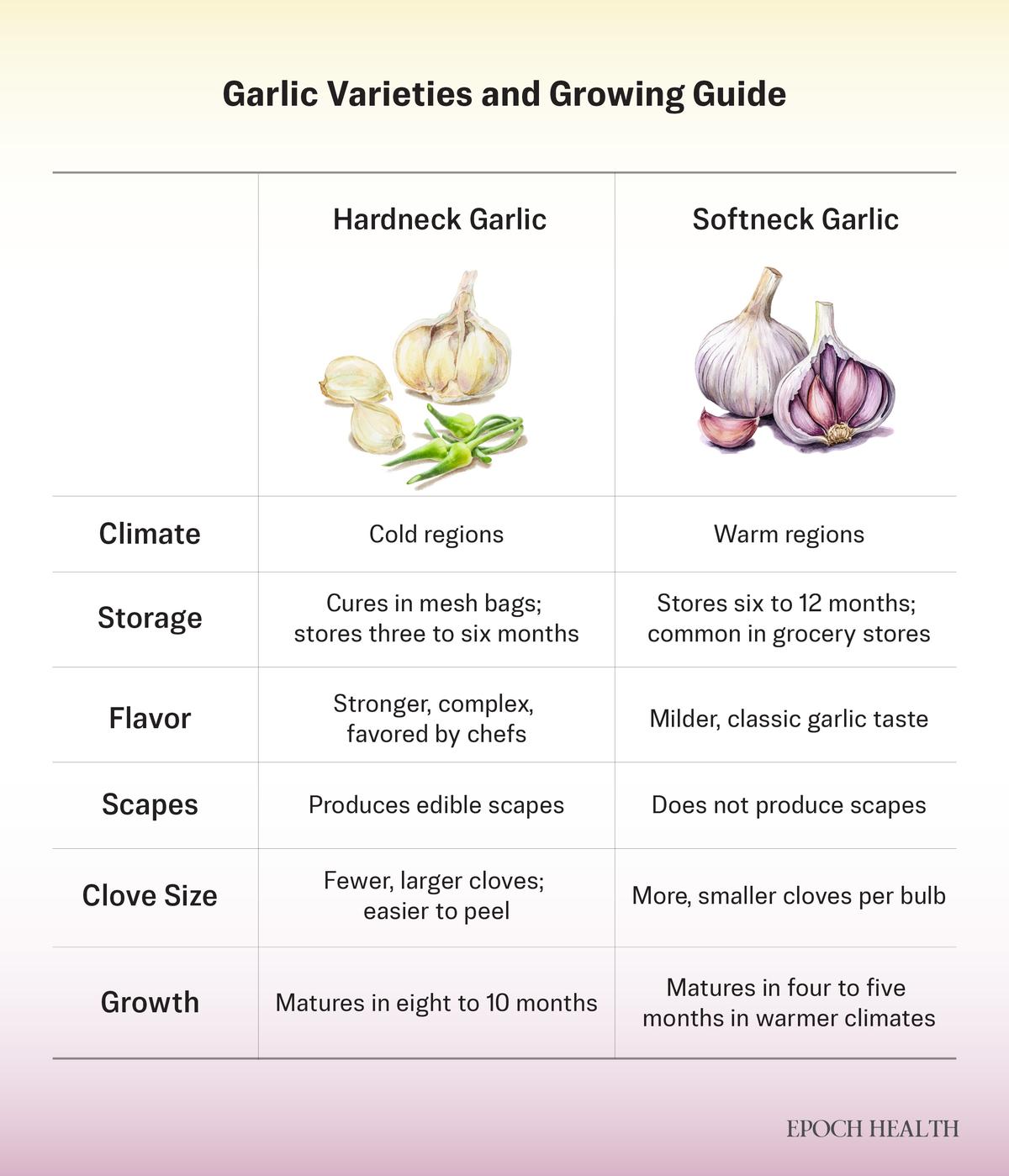
Garlic comes in two main groups: softneck and hardneck. The primary differences are in their growing conditions, structure, storage life, and flavor.
Aaron Steil, an agriculture and natural resources extension specialist at Iowa State University, has written extensively about growing garlic at home.
“The most notable difference between hardneck and softneck garlic is that hardneck garlic has a rigid central stalk in the bulb, whereas softneck does not,” Steil told The Epoch Times. “Hardneck garlic typically has fewer, but larger cloves, [which are] great for roasting. Some cooks say the cloves are easier to peel and the taste is more flavorful and complex compared to softneck types.”
Gardeners also need to be aware of climate differences when growing garlic.
“Most northern gardeners grow hardneck types and southern gardeners grow softneck,” Steil said. Hardneck garlic tolerates cold climates better, while softneck varieties often struggle to overwinter well.
One added advantage of hardneck varieties is that they produce garlic scapes—curly stalks that can be harvested and eaten. Scapes make delicious pesto or relish, and they’re equally good chopped into stir-fries or sautés.
(Illustration by The Epoch Times, Shutterstock)
Softneck garlic has its own advantages, Steil noted, especially its longer storage life. That’s why softneck garlic is most often found in grocery stores.
“From a gardening and growing standpoint, hardneck varieties are typically planted in the fall and allowed to overwinter,” he said.
Steil noted that softneck garlic can be planted in spring or fall, but it often struggles in colder climates and may not reach full maturity when planted in spring. Hardneck types, by contrast, perform better in colder regions because they need a period of winter chill to form proper bulbs—a process that doesn’t always occur in warmer areas.
Still, gardeners shouldn’t feel limited. “If you’re longing for the one you can’t have, you can still have some success with good cultivar selection,” Steil said. “Some softneck types, like ‘Polish Softneck,’ have notable winter hardiness, and some hardneck types, like ‘Georgia Crystal,’ are noted for their tolerance and good production even in the heat of the South.”
When planting garlic, it’s safest to buy seed garlic rather than using store-bought cloves. Some garlic may not be suited to your climate, and some bulbs are treated to prevent sprouting—a process that helps with storage but causes planted cloves to rot instead of grow.
Elephant Garlic
Elephant garlic is not a true garlic, but rather a member of the leek family. Also called “great-headed garlic,” it’s a favorite of many gardeners, producing segmented bulbs three to four times larger than those of traditional garlic. Like hardneck types, elephant garlic requires a cold period to grow properly.
Its taste is much milder, making it a favorite for salads, dressings, and other raw dishes. It’s also delicious roasted whole in the oven.
Harvesting, Curing, and Storing Garlic
In the Pacific Northwest, Norris typically harvests garlic in July. She notes a few simple signs to know when your garlic is ready.
“For hardneck, it is when the bottom two to three leaves have browned, but the top leaves are still green. For softneck, it is when 90 percent of the stalks are falling over,” she said.
After harvesting, the garlic bulbs need to be cured.
For hardneck varieties, this can be done by laying the bulbs on racks to air-dry or hanging them in a well-ventilated space for about three to four weeks. Using a fan can speed up the curing process to about two weeks.
Softneck varieties cure differently. “I’ll braid the garlic and hang it right in my kitchen—both practical and beautiful,” Norris said.
Someone once said that the secret ingredient in the kitchen is love. I would add that it’s also garlic. Have you ever put a pan on the stove, added olive oil and crushed garlic, and heard the “oohs and aahs” as the oil slowly warms, filling the kitchen with its wonderful aroma? My family often asks what delicious meal I’m making, when all that’s in the pan is garlic sizzling in oil.
Whether you pick up garlic at the store or grow it in your own garden, its culinary and health benefits are hard to ignore. I encourage you to give it a try—you won’t regret it.