
What Egg Carton Labels Mean
Egg labels provide key details about:
- How hens were raised: Cage systems, cage-free, free-range, or pasture-raised
- What hens ate: Organic feed, grains, or forage such as bugs
- Egg quality and size: Based on USDA grading (AA, A, B)
- Safety: Storage and transport standards to prevent foodborne illness
Some labels are regulated by the USDA and the FDA, while others come from third-party certifiers who apply their own criteria. Some claims are unregulated and used primarily as marketing terms.
USDA Oversight and Grading
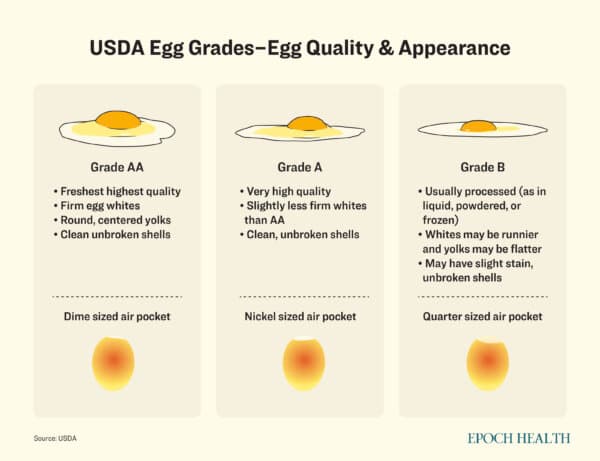
The USDA offers a voluntary grading system:
- Grade AA: Firm whites, centered yolks, and clean, unbroken shells
- Grade A: Slightly less-firm whites, and clean, unbroken shells
- Grade B: Often used for processed eggs; may have stained but intact shells
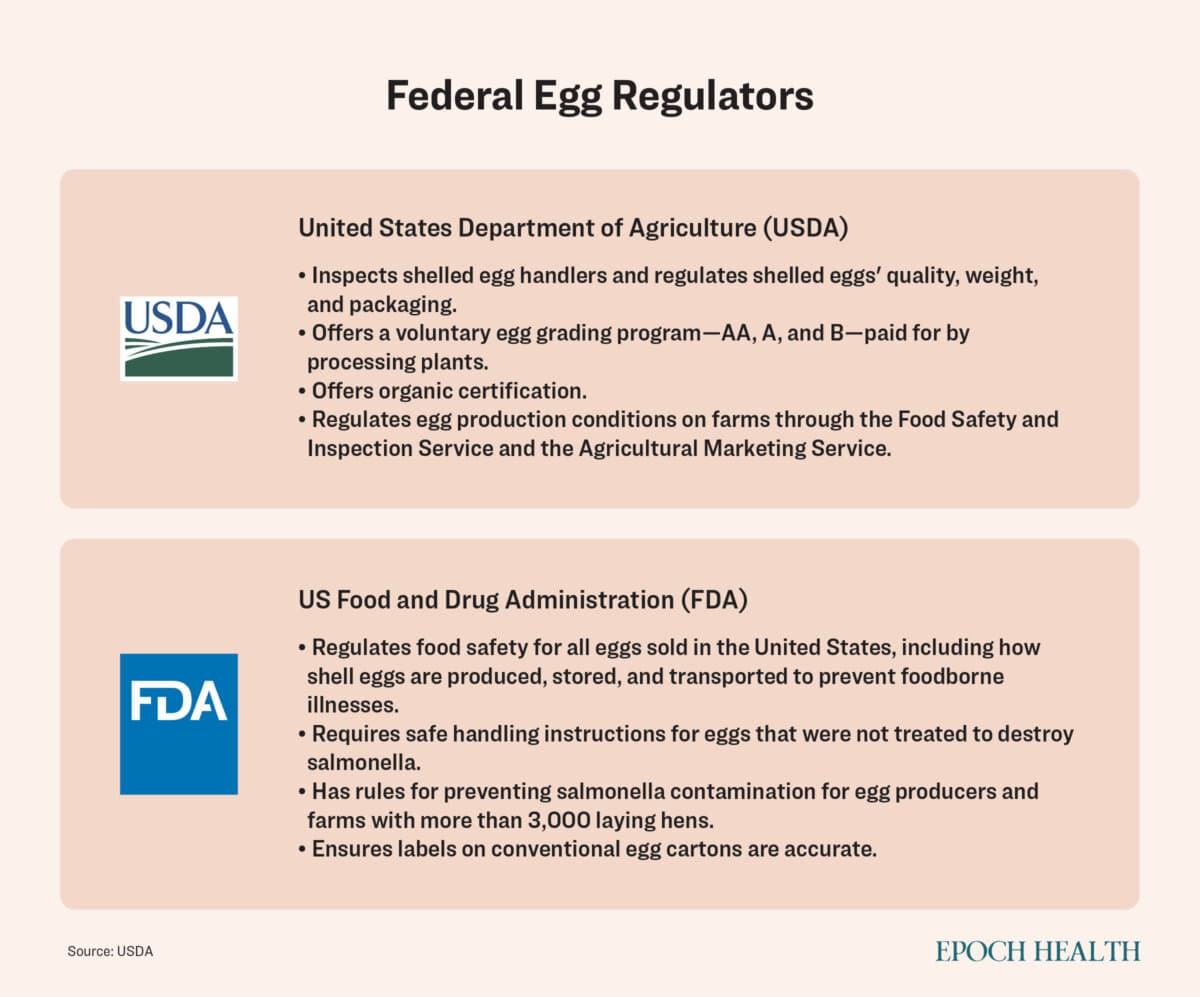
The USDA’s Agricultural Marketing Service inspects facilities and hatcheries multiple times a year. The Food Safety and Inspection Service and the FDA oversee production, storage, and transportation.
Types of Labels: What They Mean
Here’s what the most common egg labels actually mean, and how they compare in terms of farming practices, welfare standards, and oversight.
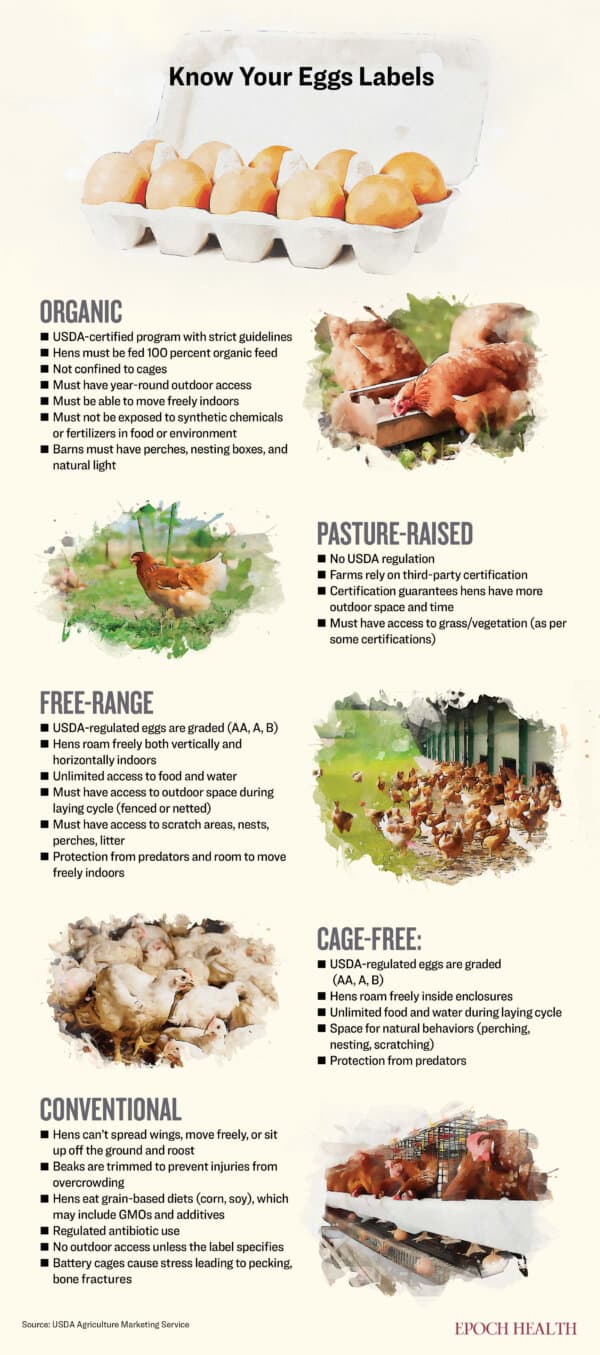
Conventional Eggs
Although practices vary, most conventional eggs come from hens raised in battery cages—small enclosures that typically hold five to 10 hens. These systems are designed to maximize production and reduce costs, but raise concerns about animal welfare.
- Restricted movement: Hens often cannot spread their wings, perch, or engage in natural behaviors
- Beak trimming: Common to prevent injuries from overcrowding
- Grain-based diets: Often include genetically modified organisms (GMOs) and synthetic additives
- Antibiotic use: May be administered preventively, although usage is regulated
- Lack of outdoor access: Hens remain indoors unless otherwise labeled
Conventional eggs are the most widely available and affordable option, but their production typically involves less stringent animal welfare and environmental standards.
Cage-Free
The USDA grants the cage-free label only to eggs that have been graded (AA, A, or B). All other cage-free claims come from third-party certifiers, who set their own criteria.
- Grade AA cage-free
- Grade A cage-free
- Grade B cage-free
USDA cage-free standards require:
- Hens are not in cages but live indoors in large barns.
- They have space to roam, access to food and water, and can exhibit limited natural behaviors.
- Typically no outdoor access unless specified.
- USDA certification applies only if the eggs are graded—otherwise, third-party verification is required.
Jimenez said that commercial farms have altered the definition of egg labels through government regulation. For example, cage-free eggs come from hens that aren’t confined to individual cages but are still housed inside large metal barns—typically about 30 feet by 400 feet—with no windows. While hens can move freely within the barn, the environment often becomes dusty, dirty, and stressful because of poor ventilation and overcrowding.
Free-Range
Like cage-free eggs, the USDA grants the free-range label only to eggs that have been USDA-graded, which can then display the official shield logo. USDA-certified free-range eggs must meet the following requirements:
- Similar to cage-free, but with the hens having added access to an outdoor area.
- Outdoor space may be fenced or netted; not all areas have grass or vegetation.
- Hens must be able to perform natural behaviors, such as foraging.
Considerations:
Pasture-Raised
The term “pasture-raised” is not regulated by the USDA, so its meaning depends on third-party certifications or individual farm practices.
- The term is not regulated by the USDA.
- Third-party certifiers typically require 108 square feet of pasture per hen and rotational grazing.
- Some farms may use this label without certification—consumers can contact farms for clarity.
Certified Organic
All eggs labeled “organic” must be certified under the USDA’s National Organic Program. These standards cover feed, housing, and animal welfare and are among the most stringent for commercial egg production.
- Hens must eat 100 percent organic feed free of GMOs, synthetic pesticides, and fertilizers.
- Hens must receive no antibiotics or hormones. (Note: Hormones are banned in all U.S. poultry.)
- Hens must have year-round outdoor access and room to engage in natural behaviors.
- Indoor spaces must include natural light, nesting boxes, and perches.
Considerations:
Labels Versus Nutrition
In addition to animal welfare concerns, many people wonder about the health benefits of the eggs they buy—and whether nutrition varies based on the label.
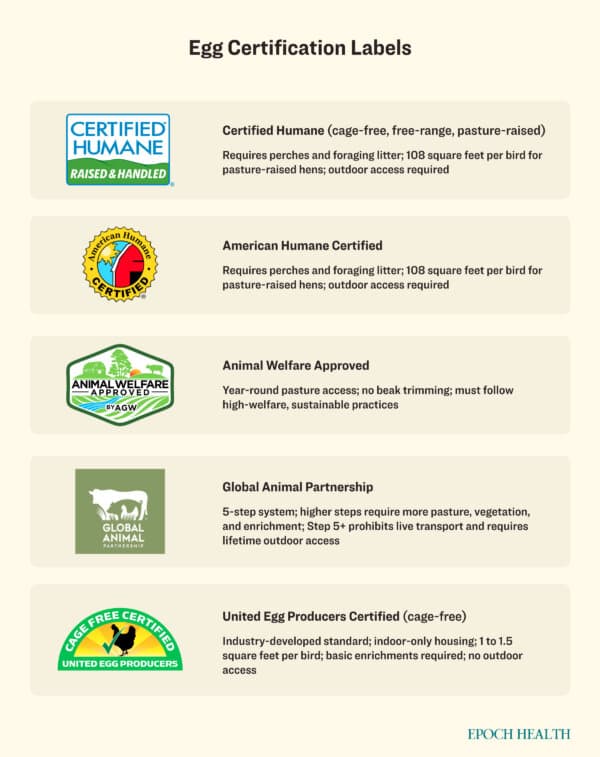
Egg Certification Labels Explained
Although third-party certification has specifics for each label, here’s a chart of the key components.
Other Labels
Hormone Free
The FDA does not permit the use of hormones—including artificial, added, or steroid hormones—in the production of chickens (or pork) in the United States. If you see a label on eggs that says “raised without hormones,” it must, by law, be followed by the statement: “Federal regulations prohibit the use of hormones.” The USDA has banned the use of all hormones in poultry since the 1950s.
All Natural/Natural
Neither the USDA nor the FDA regulates this term. However, according to the USDA website, “natural” means that nothing was added to the eggs.
Omega-3 Enriched
Omega-3 enriched eggs mean that hens were supplemented with rich sources of omega-3s—such as algae, flaxseed, or fish oils—to increase the omega-3 content of their eggs. The USDA and the FDA do not regulate the use of the term “omega-3 enriched.” However, if a label claims a specific amount of omega-3s, the producer must provide evidence to the FDA, which verifies that label claims are truthful and accurate.
Vegetarian-Fed
Vegetarian-fed means that hens were given a diet of grains and plant-based ingredients with no animal by-products. However, since chickens are naturally omnivores, bugs and worms are part of their typical diet. The term is not defined or regulated by either the USDA or the FDA.
Final Thoughts
The growing number of labels on egg cartons allows consumers to make choices based on their values and priorities. Whether you care about animal welfare, environmental impact, nutritional quality, or farming practices, you can support the kind of egg production that aligns with your preferences by choosing where to spend your money—at the grocery store or a local farm.