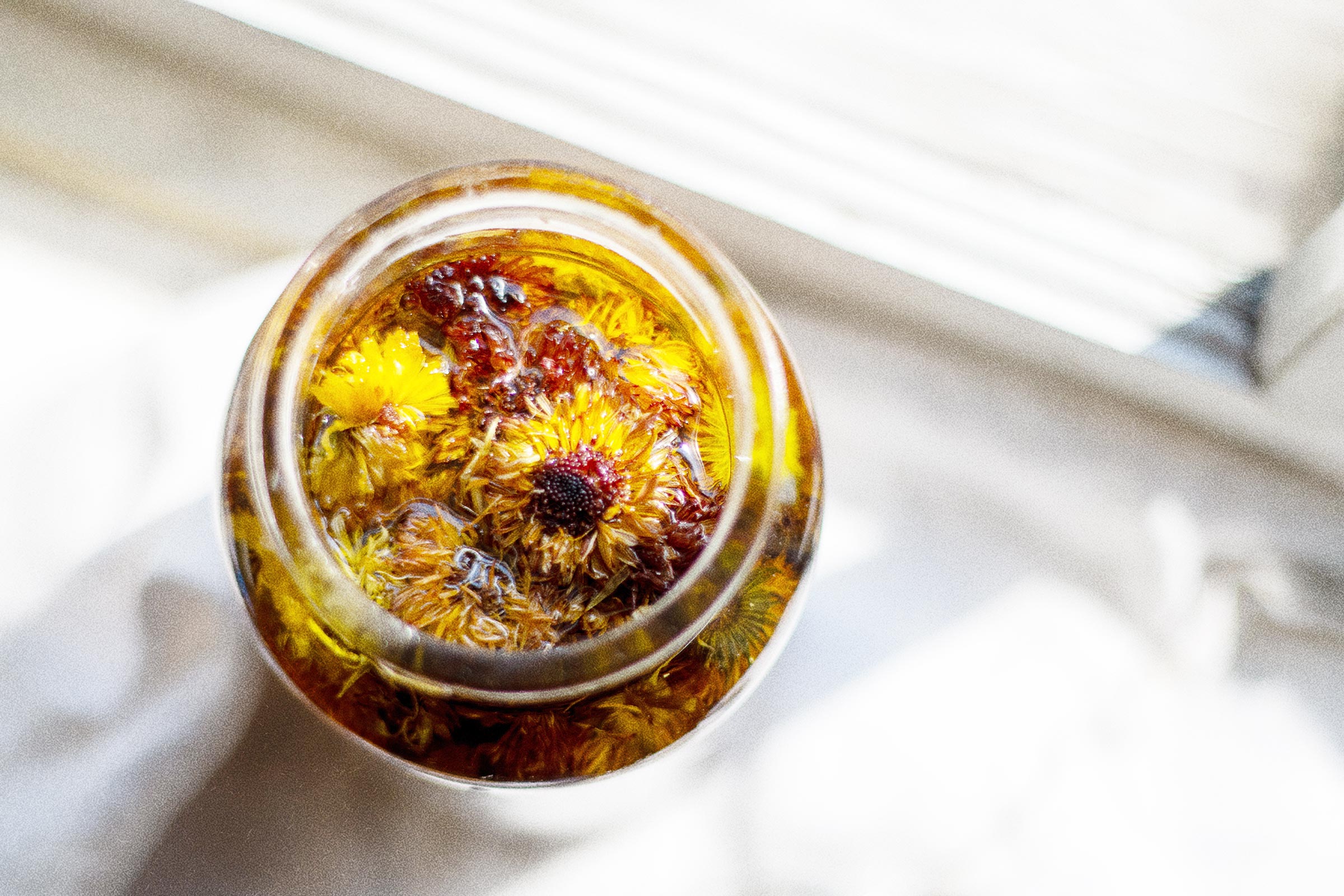
Calendula—commonly known as pot marigold—has long been a symbol of warmth, vitality, and renewal. However, its value runs far deeper than symbolism. From being used for centuries in herbal medicine to today’s clean beauty trends, this “flower of the sun” has earned a reputation as one of nature’s gentlest yet most powerful remedies for the skin, mouth, and cancer care relief.
An Ancient Remedy Backed by Modern Science
As early as ancient Roman times, the Greek physician Pedanius Dioscorides noted that calendula has cooling and astringent properties and that applying its seed pods to wounds aids healing, while internal use treats digestive tract disorders.
Hildegard von Bingen, a 12th-century mystic and herbalist, wrote in her natural history text “Physica” that calendula has detoxifying effects and can be boiled in water or infused in wine in cases of food poisoning. It is also an effective remedy for skin conditions such as scabies, with calendula ointments applied to affected areas.
Aligning closely with ancient records, modern research also confirms the lasting medicinal value of Calendula officinalis and attributes its therapeutic effects to key bioactive compounds.
Calendula contains a variety of bioactive compounds, including flavonoids, triterpenoids, glycosides, saponins, and carotenoids, which contribute to its diverse biological effects, such as anti-inflammatory, antibacterial, and wound-healing properties.
Skin Healing and Beyond
Erica Kuo, a registered herbalist, highlighted the versatile applications of calendula, emphasizing its potent healing properties for skin ailments and holistic wellness, in an interview with The Epoch Times.
Promoting Wound Healing
Kuo, the first Chinese board member of the American Herbalists Guild, said that her journey into aromatherapy and herbalism began with her discovery of calendula’s powerful skin-healing properties.
When her son first arrived in the United States, he fell off his bicycle, resulting in a coin-sized wound on his chest. After disinfecting and applying pressure to stop the bleeding, Kuo applied a calendula salve to the wound. With continuous application for several days, the wound gradually shrank, showed no signs of infection or inflammation, and left almost no scar—just a faint pink line.
Relieving Skin Allergies
After witnessing the remarkable healing effects of Calendula on her son’s wound, Kuo, who is also a clinical aromatherapist certified by the National Association for Holistic Aromatherapy, began using calendula-infused oil on her face. This homemade herbal oil helped her overcome long-standing allergies and skin sensitivity that had troubled her since her twenties.
She recalled that most commercial whitening products, acidic treatments, and sunscreens left her skin red and peeling. Some sunscreens even triggered inflammation so severe that she had to rely on steroid creams for relief.
“Since I started using herbal products, those problems no longer occur. Even when I do have an allergic reaction, the herbs help my skin recover quickly,” Kuo said.
Kuo also shared calendula’s effects on her daughter’s allergies to cats.
Sometimes, after holding our cat, her face and eyes would turn red. I had her spray calendula hydrosol, and the swelling subsided quickly,” she said.
Fading Acne Scars and Reducing Striae Gravidarum
While many turn to cosmetic treatments like skin resurfacing to fade acne scars, Kuo opted for a gentler, natural approach. She crafted a homemade serum by blending calendula-infused oil with rosehip and raspberry seed oils, a remedy she relied on for long-term skin care.
With consistent use, Kuo noticed that her skin transformed remarkably. Its clarity and glow prompt friends to assume she wore makeup.
“I’m just using natural herbal products and sunscreen,” she said.
Calendula-infused oil blended with rosehip oil is ideal for use as a pregnancy massage oil as it’s free of artificial colors, fragrances, surfactants, and emulsifiers, offering gentle and pure ingredients.
Other Skin Conditions
Kuo said that some clients and readers have reported positive results using calendula for diaper rash, diabetic foot syndrome, and eczema. Surprisingly, she discovered that calendula is also effective for treating
keloids, as evidenced by one of her clients’ experiences.
The client, prone to keloid conditions, developed raised, thickened scars even from minor injuries. Seeking to improve their appearance, she underwent cosmetic procedures, but the treatments worsened the scarring.
Once, following a burn, she applied Kuo’s recommended calendula salve to the affected area. With some salve remaining, she applied it to her existing keloid scars. To her astonishment, the raised scars visibly flattened over time.
Oral Health Benefits
Beyond its powerful ability to repair and soothe the skin, calendula’s anti-inflammatory and antibacterial properties make it highly effective for treating periodontitis and oral ulcers.
Research by Alain Touwaide, scientific director, and Emanuela Appetiti, president of the Institute for the Preservation of Medical Traditions, revealed that the Tractatus de herbis (late 13th to early 14th century) documented calendula’s use in nasal administration to relieve toothache through nasal infusion. Similarly, in the 16th century, German physician Leonhart Fuchs recorded that gargling with calendula could ease tooth pain.
A study published in Clinical Oral Investigations demonstrated that calendula extract reduces bone loss around teeth caused by periodontitis, a chronic inflammatory disease of the gums and surrounding tissues.
“Calendula officinalis possesses exceptional hemostatic properties,” Kuo explained. “For instance, spraying calendula hydrosol in the mouth can effectively treat oral ulcers or control bleeding following dental procedures.”
Relief for Cancer Treatment Side Effects
Kuo suggested that calendula can alleviate symptoms of oral and mucosal ulcers, particularly by helping cancer patients manage the side effects of treatment. For instance, head and neck cancer patients often endure severe oral mucosal damage from chemoradiotherapy, which makes swallowing and eating excruciating.
Calendula officinalis products can significantly alleviate these symptoms,” she said, “greatly enhancing patient comfort.”
One common side effect of radiotherapy in breast cancer patients is radiation dermatitis, and calendula can be beneficial for that as well. A French study published in the Journal of Clinical Oncology found that Calendula was effective in preventing grade 2 or higher acute dermatitis and suggested that it should be recommended for patients undergoing postoperative radiotherapy for breast cancer.
“I’ve also observed this among my clients—some breast cancer patients who used calendula ointment after radiotherapy not only experienced relief from dermatitis but also saw a noticeable fading of skin pigmentation,” Kuo said.
Calendula officinalis is rich in antioxidant compounds and shows potential for cancer prevention and treatment. Studies indicate that triterpenoid compounds in calendula flowers exhibit significant anti-inflammatory effects and may slow tumor growth.
How to Choose the Right Calendula Product
According to Kuo, the quality of calendula products on the market varies significantly, with notable differences in effectiveness primarily related to the product form, ingredient concentration, and storage and processing methods.
Product Types
The choice of herbal product types depends on the intended area of use and the desired effect. Calendula products come in various forms, each delivering very different results, Kuo said.
For treating scars or skin conditions that require prolonged penetration, high-concentration oil-based or ointment products are recommended. Ointments stay on the skin the longest, followed by oils. Water-based products, which evaporate quickly and are readily absorbed, are primarily used as facial toners.
She noted that when choosing calendula products for hair color care, water sprays may be ineffective and that ointments are a better choice.
Density of Ingredients
When selecting a product, pay attention to the concentration of calendula extract. Kuo emphasizes that for professional-quality infused calendula oil, the ratio of petals to oil should be at least 1:5. If the concentration is too low, such as 1:10, its healing properties are largely diminished.
Some commercially available lotions may contain only 1 to 2 percent of calendula, with the rest made up of water, surfactants, fragrance, or mineral oils.
“Due to stability concerns, most products on the market contain very low levels of actual plant ingredients,” she said.
Some products may label the concentration of calendula on the packaging. If the product doesn’t specify this, it could indicate a low concentration of the plant extract, meaning the healing benefits may be minimal.
Understanding the concentration of calendula extract is also valuable when creating your own calendula-infused products.
Preservation and Processing
The storage environment of calendula also affects product quality. , Kuo saidIn humid climates, some manufacturers irradiate or fumigate calendula petals with sulfur to prevent infestation, but this can reduce the herb’s potency or introduce harmful substances. Furthermore, exposure to direct sunlight or high-heat roasting can also degrade its healing properties.
Precautions
Beware of products on the market labeled as “calendula essential oil” or “absolute,” which often leads to consumer confusion.
Kuo clarified that the typical process for extracting essential oils involves heating, steam distillation, and separating oil from water to obtain the essential oil components. However, calendula lacks glands that produce volatile compounds, making it extremely difficult to extract essential oil through distillation. As a result, most so-called “calendula essential oils” sold on the market are CO₂ extracts.
“And the substance extracted isn’t even a liquid—it’s solid,” Kuo said.
She also emphasized that calendula CO₂ extracts (supercritical CO₂ extracts) are highly concentrated and should be used in much smaller doses than traditional essential oils. These extracts should only be used under the guidance of a professional.
“If misused or ingested, the risk is actually higher than that of regular essential oils,” she said.
Kuo strongly advises against ingesting any plant essential oils or CO₂ extracts without proper supervision, as they may burn the mucous membranes of the digestive tract.
Calendula is generally considered a safe botanical ingredient. Kuo notes that it typically does not cause noticeable side effects, though individual sensitivities should still be taken into account.
“Unless someone is allergic to plants in the Asteraceae (daisy) family, there’s usually no need for concern,” she said, adding that people who are allergic to common daisy family plants like chamomile or chrysanthemum may also experience similar reactions to calendula.
Fun Facts
- The name Calendula comes from the Latin “Kalendae,” meaning the first day of the month, reflecting the flower’s frequent bloom and symbolic renewal.
- In Greek mythology, the Calendula flower was said to be born from the unrequited love of a maiden for the sun god Apollo.
- In medieval Europe, calendula petals were used in broths and stews for their flavor and golden hue.
- Herbalist John Gerard called calendula a staple of the English kitchen garden.
Calendula is a time-honored herbal remedy bridging ancient wisdom and modern science. Like the sun it resembles, this radiant flower continues to illuminate and restore—one petal at a time.