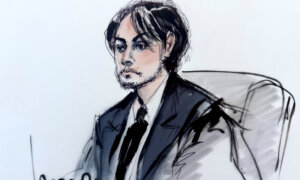

LOS ANGELES—A behavioral analyst told a federal jury on June 17 that social isolation and escalating anger helped drive a 29-year-old Uber driver to ignite a brush fire in the Santa Monica Mountains, which days later would resurface as the deadly inferno that killed 12 people and leveled more than 6,000 homes in the wealthy coastal enclave of the Pacific Palisades.
Kevin Kelm, a retired supervisory special agent with the U.S. Bureau of Alcohol, Tobacco, Firearms and Explosives who specializes in behavioral analysis and criminal profiling related to arson, alleges that Jonathan Rinderknecht was motivated by an “expressive,” or emotionally driven, and opportunistic desire for revenge on society at large.
“In my opinion, the defendant exhibited behavior consistent with [a] ‘revenge’ or ‘societal motivated revenge’ fire,” Kelm said of Rinderknecht’s behavior before, during, and after the fire.
The defendant faces three counts of federal arson related to property damage sustained in the Jan. 7, 2025, Palisades Fire, which investigators say was a continuation of the Lachman Fire, a smaller blaze they allege Rinderknecht ignited in the early hours of Jan. 1, 2025.
Defense attorneys argue that the state has not presented reliable evidence that Rinderknecht is responsible for either fire and that he reported the Lachman Fire in good faith when he encountered it on a solo hike just after midnight on New Year’s Eve.
The state argues that Rinderknecht’s deteriorating mental state and escalating fixation on themes such as wealth disparity, “climate change,” and vigilantism in the months leading up to the fire reveal his motive.
Arsonists motivated by societal revenge, Kelm said, referring to an arson motive typology used by the FBI, typically have many things going wrong in their lives and fixate on problems, which are exacerbated by an accumulation of stressors—including interpersonal relations and social isolation.
“These pressures continue to build and build,” Kelm said, and the act of setting a fire “provides some emotional relief and diversion from the problems.”
Analysis of Rinderknecht’s behavior in the months leading up to the fire, including in fraught interpersonal relationships and in thousands of increasingly frustrated interactions with the artificial intelligence chatbot ChatGPT, is evidence of such escalation, Kelm said.
“It goes to the inability to deal with a stressor. And it was focused on a large stressor for the defendant, which has to do with societal issues, one being wealth inequality and large corporations that were distressing to [him],” said the analyst, who previously worked on cases related to both the Oklahoma City Bombing of 1996 and the 9/11 terrorist attack on the Pentagon.
Digital records uncovered in the investigation reveal that Rinderknecht was at least fixated on a tableau pitting the world’s rich and powerful against the rest of society and the environment, and related feelings of loneliness and helplessness. Uber passengers who rode with him around the time of the fire testified about vitriolic, threatening rants and erratic behavior.
Steve Haney, his attorney, has argued that none of this makes him an arsonist.
Cross-examining Kelm on June 17, Haney suggested that many people are upset about large corporations, politics, the wealth disparity, or “climate change.”
“Much of what you’ve testified and observed is pretty normal American thinking right now, isn’t it?” Haney asked.
“I didn’t cherry-pick,” Kelm said. “You’re correct. Each one of these things applies to large parts of the population. But not when it’s in your everyday life and occurs over and over and in all these domains. ... It becomes controlling, and the behavior is a response to that.”
Societal revenge arsonists, according to the FBI typology, do not plan.
“It’s extremely impulsive,“ Kelm said. ”And in this case, the defendant put himself at the location. He stopped taking work calls, he went to this isolated location he had familiarity with.”
He also said that almost all arsonists choose locations that are in their environment or “comfort zone.”
The witness said investigators’ conclusion that Rinderknecht started the fire with a lighter, as opposed to accelerants or other ignition methods, was consistent with expressive arson.
While Rinderknecht’s attorneys point out he called 911 repeatedly to report the fire, investigators allege that the calls were part of a staging he carried out to appear cooperative and deflect suspicion, which Kelm said was common in arson cases.
Authorities also suspect the defendant attempted to cover his tracks by making a screen video of a 911 call and by asking ChatGPT whether one could be blamed for a fire started with a discarded cigarette.
The defendant’s “methodical stroll” down the hill as he made 911 calls, Kelm said, “is just totally inconsistent with someone who discovers a fire.”
The ChatGPT query, Kelm said, was “unnecessary behavior” by Rinderknecht.
“It’s excessive, and very inconsistent with what I’d expect an average individual to do when trying to report a fire and get out of harm’s way,” Kelm said.
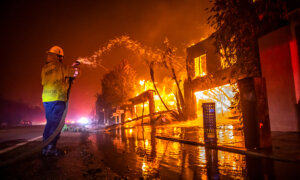
Firefighters work to extinguish the Palisades Fire burning near Los Angeles, Calif., on Jan. 8, 2025. (John Fredricks/The Epoch Times)
After leaving the scene, Rinderknecht returned and took videos of the fire and first responders; Kelm suggested this could indicate the fire was a source of excitement—another motive typology.
But the emotional release that an expressive arsonist may feel after lighting a fire, Kelm said, can be short-lived.
“I think once some of the initial excitement wears off, the daily routine hasn’t changed,“ he said. ”It’s back to being an Uber driver, to not making enough money: listening to partygoers sitting in your back seat having a great time while your life hasn’t changed at all.”
Kelm described the defendant’s behavior, both before and after the fire, as typical of a “a grievance collector—things go wrong, and he’s not the cause; it’s always someone else’s fault.”
Considered as a whole, the profiler said, the behavior took on increased significance, as the pieces fit together like a “jigsaw puzzle.”
“What I’m looking for is to see this pattern emerge over time in all of the domains ... it tells me what the whole picture is,” Kelm said.
Haney asked whether anger-motivated arsonists want to destroy things.
“No, not necessarily,“ Kelm said. ”The act of actually setting the fire is the objective. Oftentimes, the consequences are very surprising to the individual and result in a panic response, because what happens wasn’t what was expected.”
Haney asked whether Kelm had ever, in a half-century of experience, seen a revenge arsonist call 911 17 times, as his client had.
“It’s pretty unusual,” Kelm said. “That caught my attention.”