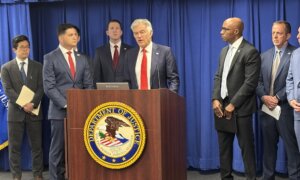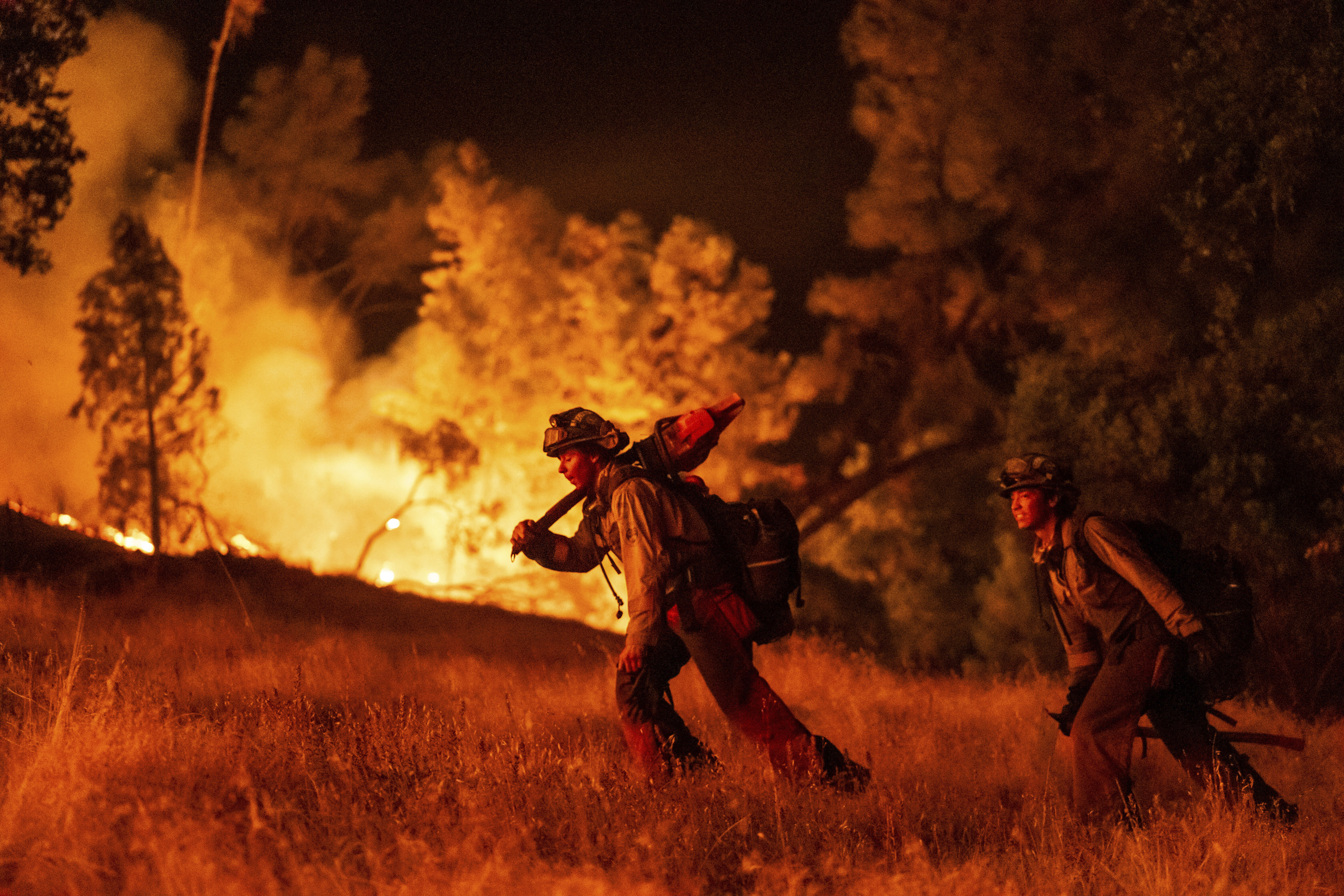

The Department of Justice (DOJ) and PacifiCorp have arrived at an agreement under which the utility company will pay $575 million to settle claims for damages caused by six wildfires in Oregon and California, the department said in a Feb. 20 statement.
“The settlement resolves the United States’ claims that PacifiCorp’s electrical lines negligently started all six fires. The settlement monies will help repay the United States for the substantial costs it incurred fighting the fires, which is critical because the U.S. Forest Service now spends more than half of its budget on wildfire suppression annually,” the DOJ stated.
“Settlement funds will also be distributed to the Forest Service and Bureau of Land Management to restore some of the 290,000 acres of public land that were burned.”
Two of the wildfires occurred in California. The first was the Slater fire that began on Sept. 8, 2020, and burned 157,229 acres of federal land. The second one, the McKinney fire, began on July 29, 2022, and burned 39,000 acres of federal land.
The four Oregon fires are from September 2020—the 242 fire that burned 8,916 acres of federal land; the Archie Creek fire that set ablaze 67,000 acres of federal land, the Echo Mountain Complex fire that scorched roughly 2,500 acres, including federal land, and the South Obenchain fire that burned down 14,780 acres of federal land.
The DOJ clarified that the claims resolved by the settlement remain only allegations, with PacifiCorp continuing to deny liability for the wildfires.
Principal Deputy Assistant Attorney General Adam Gustafson from the DOJ’s Environment and Natural Resources Division said that the settlement “ensures fair compensation to the American taxpayer for fire-related damages.”
“This agreement strikes a balance by addressing the government’s significant fire-suppression costs and loss of natural resources without preventing PacifiCorp from offering electricity at fair prices,” Gustafson said.
In a Feb. 20 statement, Oregon-based PacifiCorp said the $575 million settlement resolves all known federal government damage claims related to the 2020 Labor Day and 2022 McKinney wildfires.
The company stated that it continues to invest in wildfire prevention and mitigation measures while remaining dedicated to collaborating with regulators and customers to create long-term solutions to address the threat of wildfires.
“This settlement is another significant milestone demonstrating our ongoing commitment to resolve all reasonable claims related to the devastating fires that affected Oregon and California,” said Ryan Flynn, president of Pacific Power, a unit of PacifiCorp.
“Setting aside claims arising from the Beachie Creek/Santiam Canyon fire, we have now settled nearly 90 percent of known claims for a total of more than $2.2 billion, providing certainty for customers and progress toward a financially healthy utility.”
Federal agencies spend billions of dollars annually fighting wildfires, according to data from the National Interagency Fire Center.
In 2023, agencies spent a total of more than $3.16 billion in federal firefighting costs, up from $1.74 billion 10 years earlier in 2013. The 10-year average annual cost was calculated to be $2.52 billion.
This week, California state Sen. Sasha Renée Pérez introduced the Insurance Coverage for Fire-Safe Homes Act, SB 1076, which requires insurance companies to write and renew policies for fire-safe homes, according to a Feb. 18 statement from the lawmaker’s office.
The bill comes amid concerns among wildfire survivors that their rebuilt homes may not receive insurance coverage even after meeting the highest wildfire safety standards, according to the statement.
Under the bill, insurance companies must offer insurance to homes that meet the hardening and defensible space requirements as established by the state insurance commissioner.
“To help fire survivors return home, we need assurance that newly built, wildfire resilient homes will receive insurance coverage. Homeowners who meet or exceed safety standards should not be met with coverage denials,” Pérez said.
“I’ve spoken with Eaton Fire survivors whose newly built homes will meet the highest levels of protection against wildfires but still fear they won’t be able to purchase insurance. Being denied coverage after meeting safety standards sends the wrong message and is akin to being penalized for doing the right thing.”