LOS ANGELES—Amid ongoing legal and social media disputes with President Donald Trump over his administration’s crackdown on crime and illegal immigration, California Gov. Gavin Newsom has announced he would escalate operations to combat criminal activities and homelessness in the state’s biggest urban centers, in an apparent attempt to stave off more federal intervention.
Since taking federal control of policing in Washington earlier this month, Trump has repeatedly proposed expanding National Guard deployment to combat what he said is a crime emergency in Democrat-run cities across the country.
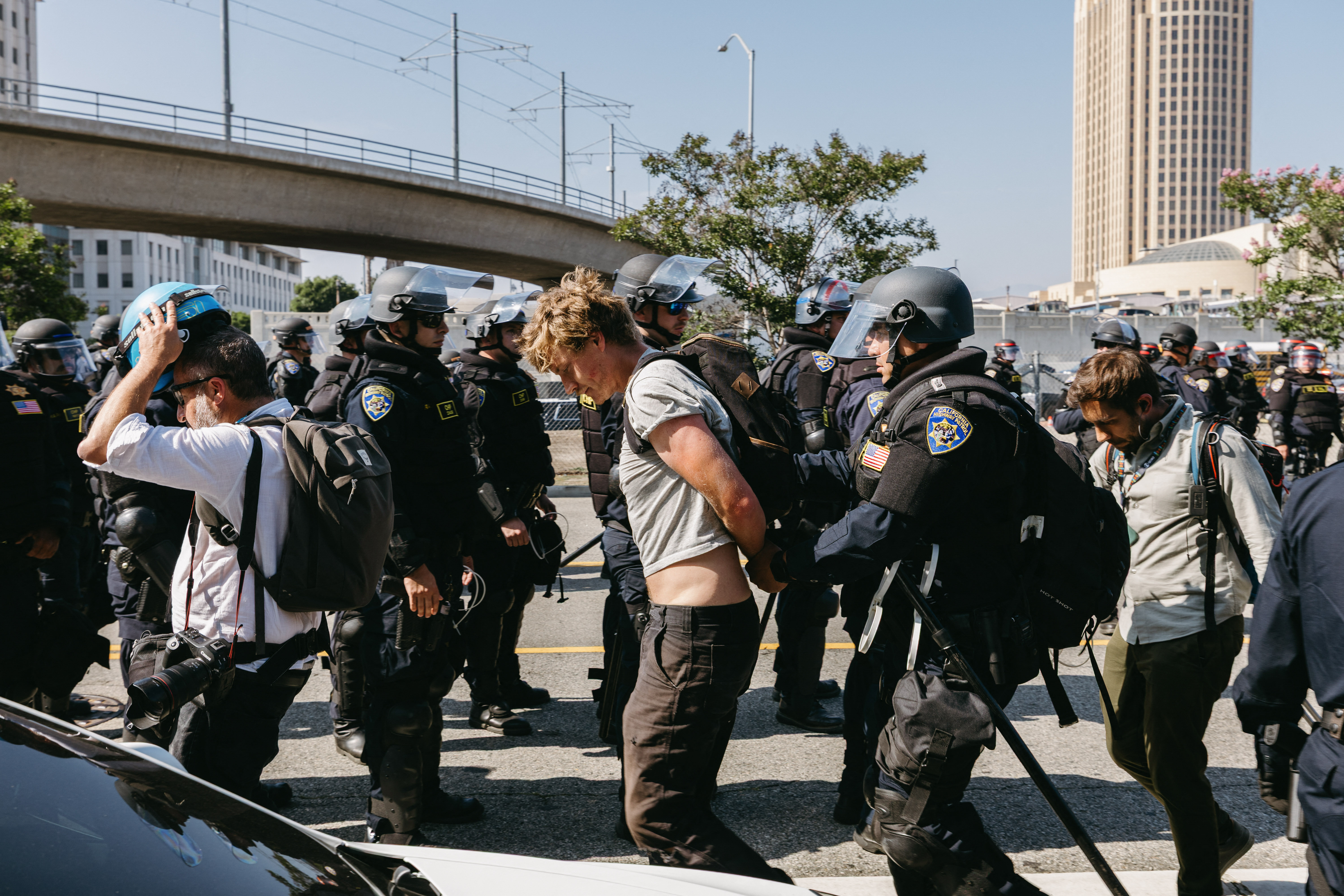
The governor’s office announced on Aug. 28 that it would deploy new California Highway Patrol “crime suppression” teams to work with local law enforcement in major cities—including Los Angeles, San Diego, the Inland Empire, Central Valley, and San Francisco Bay Area.
“We’re going to be expanding this operation, building on the success that has included over 9,000 arrests statewide,” the governor said in a press conference, referring to previous deployments to San Bernardino, Oakland, and Bakersfield.
“And we’re going to expand this in a collaborative that continues to include the cities and counties, our partners in sheriff’s offices and local law enforcement agencies.”
Los Angeles Mayor Karen Bass in a statement on Aug. 28 thanked the governor for being a “collaborative partner” and said she looks forward to “working with CHP to identify the best use” of the additional resources.
Some law enforcement leaders said the effort has not been collaborative.
Asked whether his office was consulted, Riverside Sheriff Chad Bianco told The Epoch Times: “Never. There is absolutely zero communication with the governor’s office and the sheriff’s offices who actually do this across the state.”
Bianco, who in February declared his candidacy for governor, called the move “pure political theater,” a tough-on-crime act allowing Newsom to portray himself as a centrist leader and allay continuing concerns over crime and public safety in the state.
In a poll of Americans by Axios published on Aug. 28, 81 percent of respondents said they see crime as a “major problem” in large cities, and 53 percent approve of Trump’s approach to tackling it.
Bianco said the CHP can do “absolutely nothing” to increase public safety unless it involves interventions made while driving on the county’s roadways.
“The Highway Patrol [officers] are not crime fighters,” Bianco said. “The Highway Patrol [officers] are not crime solvers. I love the Highway Patrol. They have a very important role in public safety, and we have a fantastic working relationship with all of our CHP officers and administrators.”
CHP officers are not equipped to help unless they are assigned to a police department or a sheriff’s department task force, the sheriff added.
“If you get involved in a shooting, you don’t call the Highway Patrol. ... You call the sheriff or you call the police. The Highway Patrol has no mechanism to enforce or to impose themselves in public safety unless it’s just massive vehicle stops and hoping that we get a collateral damage with warrants or drugs in the car.”
Critics also took aim at the governor’s broader history on public safety, noting that he opposed and has since refused to fund Proposition 36, a citizen ballot measure calling for stricter penalties for certain theft and drug crimes, and requiring treatment for repeat criminal addicts. The measure was approved by 68 percent of voters in November 2024.
“It’s a good thing that Gov. Newsom believes that crime in most of California’s major cities requires immediate action,” Yolo County District Attorney Jeff Reisig said in a statement, calling enhanced CHP focus in those areas a good thing.
“Unfortunately, the governor’s vocal opposition to Proposition 36 last year, and his refusal to properly fund it this year, even after nearly 70 percent of California voters passed it, means that the best tools in a decade to address rampant drug use, crime, homelessness and decay in our cities will not be put to wide use.”
“Frankly,” he added, “his goals and messaging on crime are confusing.”
Newsom, who has emerged as one of the most high-profile critics of Trump in a crowded field of Democratic detractors, is widely considered a strong contender for the presidential ticket in 2028.
An Aug. 29 poll by Emerson College shows Newsom surging ahead of other prospective Democrats. His support increased to 25 percent from 12 percent in June.
Meanwhile, 19 Democratic governors across the country this week issued a statement criticizing Trump’s “chaotic federal interference” in each state’s National Guard.
“Instead of actually addressing crime,” they wrote, “President Trump cut federal funding for law enforcement that states rely on and continues to politicize our military by trying to undermine the executive authority of governors as commanders in chief of their state’s National Guard.”
Two weeks after Trump declared a “crime emergency” and deployed National Guard troops in the District of Columbia, his office issued an executive order supporting and formalizing broader federal involvement in domestic law enforcement.
The Aug. 25 order directs the secretary of defense to immediately begin ensuring that each state’s National Guard and Air National Guard are ready to assist federal, state, and local law enforcement in quelling civil disturbances “and ensuring the public safety and order whenever the circumstances necessitate, as appropriate under law”—with a standing National Guard available for rapid nationwide deployment.
In seeking to expand National Guard deployment across the country, Trump has repeatedly taken aim at Democratic strongholds.
“We have other cities that are also very bad,” Trump said in an Aug. 11 press conference. “You look at Chicago, how bad it is. You look at L.A., how bad it is. ... New York has a problem. And then you have of course Baltimore and Oakland, we don’t even mention that anymore, they’re so far gone.”
Newsom credited “thoughtful investments” in public safety for ongoing declines in crime rates across the state, including in Oakland and San Francisco, where violent crime has dropped by 30 percent and 22 percent, respectively, so far this year. Citing combined data from the multiple law enforcement agencies representing Los Angeles County, he pointed to an 11 percent decline.
In a television appearance on Fox News KTVU on Aug. 28, Oakland Mayor Barbara Lee suggested that public safety assistance from the federal government would be better spent on strategy, workforce training, youth programs, health care, and housing.
“We don’t need federal intervention or military occupation,” she said, alleging that the deployment of National Guard troops is an effort to provoke chaos “so they can come in and militarize and occupy Oakland.”
“We’re not going to allow that,” she said.
The governor’s statement points to a nationwide survey from the Major Cities Chiefs Association showing a 20 percent drop in homicides and a 19 percent decrease in robberies among California’s reporting agencies so far this year.
Although the report shows that crime has generally decreased in Oakland, San Jose, and San Francisco, it also shows robberies up in Fresno, aggressive assaults increasing in Long Beach, San Diego, and Los Angeles County, and homicides increasing in Sacramento. San Diego and L.A. County also reported increased rapes.
According to the latest reporting from the FBI, violent crime decreased by 4.5 percent and property crime by 8.1 percent nationwide in 2024.
Meanwhile, other critics said statistics don’t accurately reflect the challenges of public safety in California.
“Gov. Newsom says crime is down because the state counted arrests, not because families actually feel safer,” said Alex Villanueva, a former Los Angeles County sheriff who is running again for the post.
“Ask anyone walking through San Francisco, Oakland, or Los Angeles if they think the streets are more secure. Real public safety ... comes from supporting the deputies and officers who put their lives on the line, and holding repeat offenders accountable instead of letting them walk right back out the door.”
In his seven years as governor, Villanueva said, Newsom has never sat down with all 58 sheriffs in California.
“If you don’t listen to the men and women on the front lines, you can’t solve the crisis,” Villanueva said. “Californians deserve leadership that fixes problems here at home, not spin for a national campaign.”
Bianco said underreporting has compromised the accuracy of crime statistics.
“Nothing is being reported anymore,” he said. “We know for a fact that people do not report crime because they know nothing is a crime—our state Legislature has reduced the penalties ... over the last 12 years.”
A day after he announced the CHP surge, Newsom said in a statement that he would convene a new task force to “prioritize and dismantle” homeless encampments on state rights-of-way in California’s 10 largest cities.
After a Supreme Court decision gave governments a green light to enforce local camping bans, the governor in 2024 directed state agencies and departments to crack down on homeless encampments and signed an executive order that “encouraged” local governments to emulate state policy.
Despite such measures, the response to homelessness in the state remains a patchwork effort, varying by municipality.
Meanwhile, a 2024 state audit found that California had not accounted for more than $24 billion in homeless spending.
Major cities and counties across the state, including San Diego and Los Angeles, saw homelessness decrease in 2024, while California hit a record high last year, with 187,094 homeless people, the most of any state.