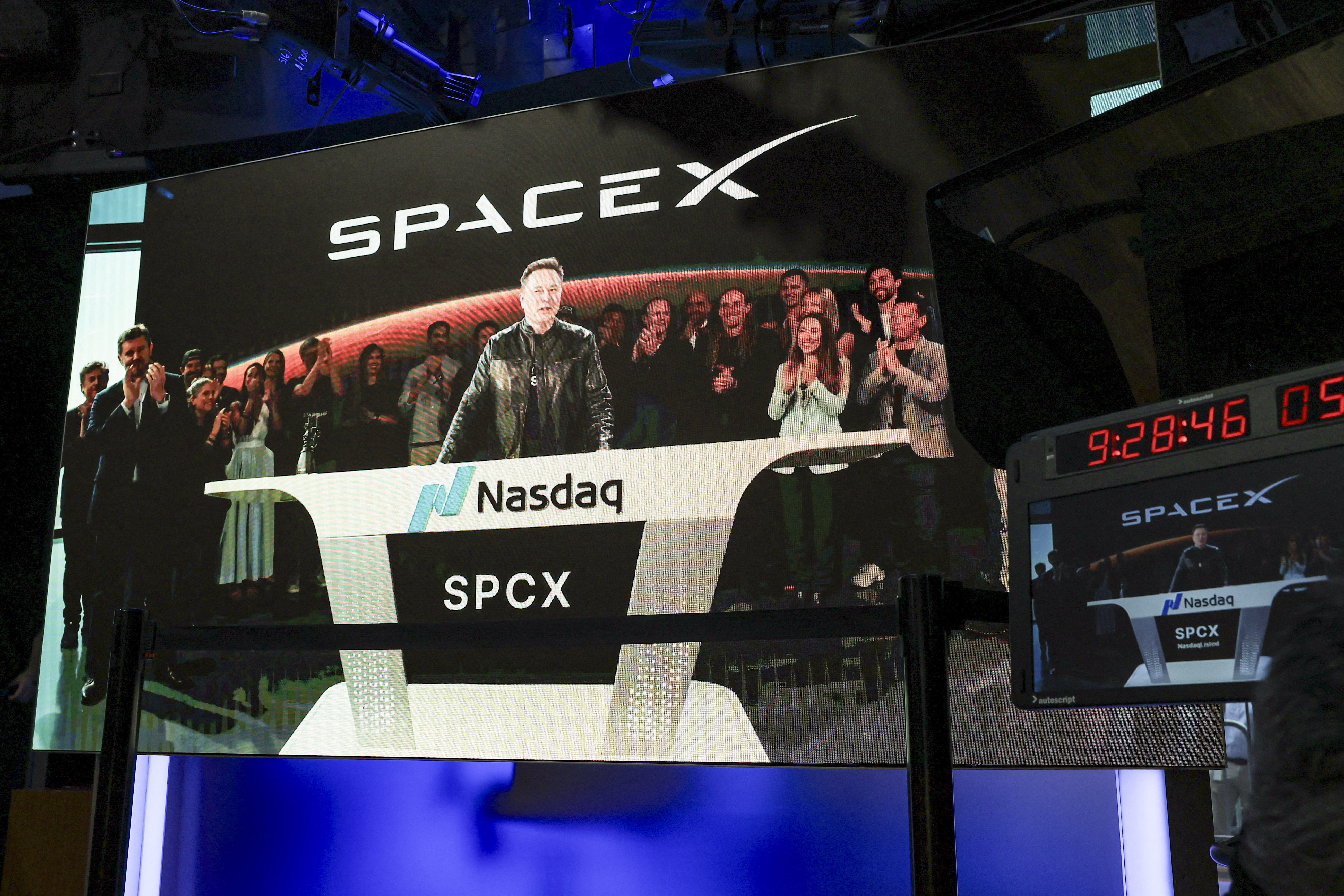

Shares of SpaceX, the rocket-to-artificial intelligence (AI) company, shaved off some of their initial public offering (IPO) gains to kick off the trading week.
The stock declined by nearly 12 percent to about $162 on June 22, poised to register its third consecutive session loss. The company has now fallen by close to 20 percent from its post-IPO high of about $202.
SpaceX has become one of the world’s most valuable companies since its blockbuster listing on June 12, with its market cap vaulting above $2 trillion. It topped Broadcom, Meta Platforms, Microsoft, and Tesla Motors, and briefly surpassed Amazon.
Under the Nasdaq ticker of SPCX, shares opened at $150, more than 11 percent above their IPO price of $135.
Despite market analysts viewing SpaceX as a growth stock with enormous upside potential, some traders could be taking profits, said Giuseppe Sette, president and co-founder of investment research firm Reflexivity.
“The market is extremely rich—not necessarily in terms of valuations, but certainly in terms of P&L,” Sette said in a note emailed to The Epoch Times.
“Some people in SpaceX are sitting on fairly significant profits from large stakes, which could prompt short-term profit-taking.”
Wall Street analysts have issued 14 ratings as of June 22, according to MarketBeat. Nine maintain at least a “Buy” rating, three have a “Hold,” and two have a “Sell.”
Bond Sale
This comes as the company confirmed an inaugural bond sale.
In a June 22 filing with the Securities and Exchange Commission (SEC), SpaceX disclosed a senior unsecured note offering.
It is unclear how much the company plans to raise. SpaceX has been clear that it will use cash windfalls to fund its aggressive AI initiatives, including the construction of data centers in space.
SpaceX said in a regulatory filing last week that it will purchase AI coding agent startup Cursor for $60 billion.
The regulatory filing also disclosed a cash stockpile of nearly $101 billion.
Paul Meeks, head of technology research at Freedom Capital Markets, believes that SpaceX is “woefully behind” in AI.
“Even after this IPO, they’re better funded and otherwise better equipped to lead,” Meeks told The Epoch Times in a note.
While SpaceX leaders say they are not focused on near-term quarterly earnings, investors might want to see some progress.
“Maybe it’ll take a few quarterly reports that are ‘all hat, no cattle’ before investors turn on [Elon] Musk. Or maybe Musk can perpetuate the myth, which may be his greatest skill,” Meeks said.

Scores of AI hyperscalers—Alphabet, Amazon, and Oracle, for example—have been selling bonds to fund their ballooning capital expenditures. It is estimated that these tech companies could collectively spend $1 trillion on building AI infrastructure.
Chipmaker Nvidia recently sold bonds for the first time since 2021, raising about $25 billion from capital markets.
Unlocking Shares
Markets will also be focused on upcoming lockup-period expiration dates. These are the dates when insiders can begin selling.
The first wave is scheduled for Aug. 11, when 20 percent of the float is unlocked. This is also a key date because SpaceX will publish its first earnings release.
Another 35 percent of the float will be released between Aug. 21 and Oct. 25. Twenty-eight percent will be unlocked on Nov. 9, and the remaining 37 percent will be released on Dec. 9.
Musk’s stake, meanwhile, will be unlocked on June 13, 2027, one year after the initial public offering.
“As for insider lock-ups, they too have different rules and staggered periods from which they can sell shares. Usually, insiders cannot sell shares until 180 days of trading,” Jay Woods, chief market strategist at Freedom Capital Woods, said in an emailed note to The Epoch Times.
“In the case of SPCX, the rules have been altered.”
Standard IPOs typically consist of a single 180-day cliff rather than a tiered, multi-window share sale mechanism.
The upcoming unlock tranches could create significant selling pressure, as so many insider shares will be freed up simultaneously. At the same time, once the additional supply is absorbed by investors, the stock’s day-to-day volatility could slow.