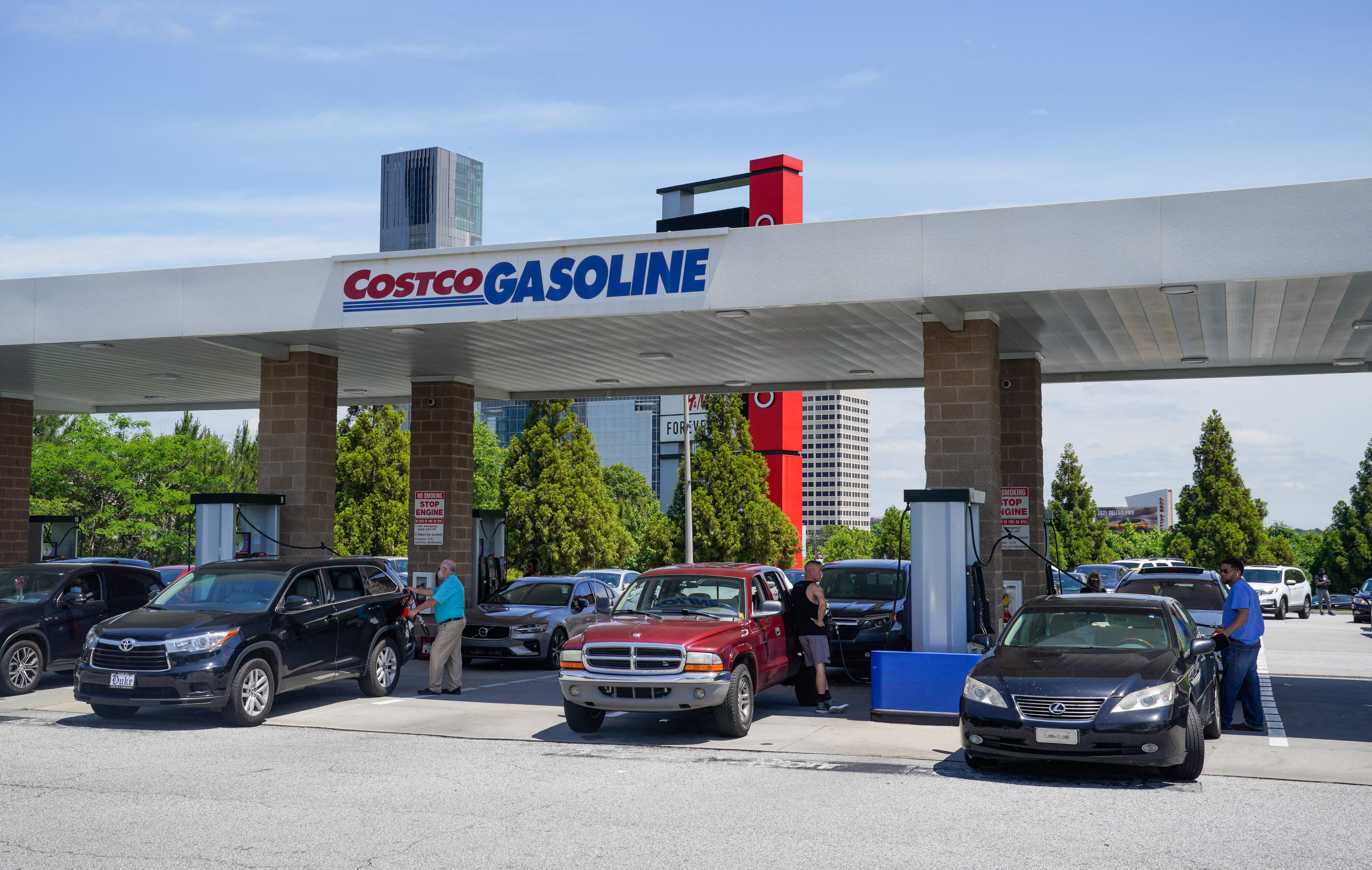
Drivers with a Costco Wholesale membership living in Mission Viejo, California, may soon no longer need to wait in long lines at gas stations attached to warehouse stores to access discounted fuel. Instead, they will be able to fill up at the company’s upcoming mega standalone gas station.
Costco is planning a fueling facility with 20 dispensers (equivalent to about 40 fueling positions) at a 3.28-acre site formerly occupied by Bed Bath & Beyond, according to a City of Mission Viejo greenhouse gas analysis for the project.
The facility is expected to open in June, making it the company’s first of its kind. The Epoch Times has reached out to the city for confirmation.
Meanwhile, according to a recent update on Olauniu, a large redevelopment project in Kapalama Kai, Honolulu, Hawaii, Costco is also building a standalone gas station within the project, scheduled for completion in 2027.
A Shift in Strategy
The standalone gas stations represent a notable departure from the company’s longstanding practice of locating gas stations at its warehouse stores, a model that has historically helped drive foot traffic into its retail locations.
Discount fuel prices, along with Costco’s well-known $1.50 hot dog and soda combo and $4.99 rotisserie chicken, have long been central to the company’s brand identity. These offerings reinforce its membership model while encouraging repeat visits to stores.
While a standalone gas station may not directly increase visits to warehouse locations, analysts say it could expand Costco’s broader ecosystem by allowing members to access benefits more frequently, making the $65 annual membership more valuable.
“This is Costco decoupling fuel from the warehouse visit. Until now, every Costco petrol station has been bolted onto a warehouse car park. The standalone model lets them put fuel in locations where they don’t have (or can’t fit) a full warehouse, extending the reach of their membership value proposition without the real estate overhead of a 150,000 square foot box,” Chris Coussons, founder of Visionary Marketing, told The Epoch Times.
The move aligns with Costco’s broader strategy of strengthening its membership-driven business model, which accounts for most of its profits, underscoring the importance of retaining and expanding its membership base.
Costco’s success stems from its ability to build a “closed ecosystem” where low prices and high perceived value drive recurring membership renewals. Rather than relying on high margins from product sales, the company focuses on volume and loyalty, using selectively discounted merchandise to fuel interest in its brand.
Greater Convenience
The company’s move comes as California continues to face the highest gasoline prices in the United States, despite being a major oil-producing state. A combination of regulatory policies, taxes, and environmental standards has driven up fuel costs, prompting consumers to seek lower-priced alternatives.
As the war in Iran continues, California’s average gasoline price is approaching $6 per gallon, according to the American Automobile Association.
As a result, demand for discounted gasoline remains strong, making the standalone stations an appealing option for bargain-hunting drivers.
“Costco’s fuel is typically 10–30 cents per gallon cheaper than competitors. Pricing is one of the strongest drivers of membership renewals,” Coussons said.
“By placing standalone stations in high-traffic areas away from warehouses, they’re making that pricing advantage more accessible to more members, more often—which strengthens the core membership flywheel without needing to sell a single rotisserie chicken.”
Greg Zakowicz, an e-commerce and retail advisor at Omnisend, said fuel discounts are a key benefit for many members and that a centralized fueling location could improve convenience.
“Looking at a map, the location is nearly central to three Costco stores,” he told The Epoch Times.
“Opening a central fuel location gives members the convenience of filling up at times when they don’t have plans to visit the store. This option allows members to receive more benefits than they previously did.”
Hawaii has the second-highest gasoline prices in the nation, averaging $5.41 per gallon, according to the American Automobile Association.
More Customer ‘Touchpoints’
The strategy also reflects a broader shift in retail toward increasing customer “touchpoints,” a critical factor in modern retail economics. By offering services that customers use frequently—such as gasoline—companies can increase engagement and reinforce brand loyalty without relying solely on traditional in-store transactions.
Patrizia Porrini, professor of management at Long Island University, said the timing is favorable for launching a large-scale discount gas station in South Orange County, where driving is common, and fuel costs are a major concern for households. Mission Viejo is about 50 miles south of downtown Los Angeles.
In the current economic environment, consumers are paying closer attention to fuel expenses as broader costs remain elevated amid inflationary pressures.
“This reinforces a virtuous cycle of sustainable competitive advantage: Members are drawn by gas discounts or the warehouse experience and symbiotically benefit from that $65 membership, while Costco benefits most of all. It generated $5.3 billion from yearly membership fees in fiscal 2025 alone, up 10 percent from the prior year!” Porrini told The Epoch Times.
Mark Tremblay, an assistant professor of economics at the University of Nevada–Las Vegas, said the company’s expansion in fuel aligns with its broader strategy of offering services that members value, noting that much of Costco’s profit comes from memberships rather than product sales.
“I suspect that the development of a standalone gas station is in response to a growing customer demand for their gas at traditional Costcos, which has been evident for many years due to the long lines,” he said.
At the same time, the standalone model may allow Costco to expand into areas where building a full warehouse is not feasible due to space constraints or local regulations. This flexibility could enable the company to deepen its market presence without the capital-intensive requirements of constructing large retail stores.
Intensifying Competition
Zakowicz added that the move may also reflect intensifying competition in the retail membership space, particularly as companies seek to differentiate their value propositions.
“Without the attachment to stores, Costco competes for those ecommerce memberships with other value-minded stores such as Walmart. Opening a stand-alone gas station may be a move to reinforce the value of maintaining a Costco membership versus switching to Walmart+,” he said.
Costco’s competitive advantage lies in its disciplined strategy of limiting product markups while maximizing perceived value, a model that is difficult for competitors to replicate without sacrificing profitability. By extending that model into fuel retailing, the company may be reinforcing a key pillar of its long-term strategy.
As Costco continues to experiment with new formats, the Mission Viejo project may serve as a test case for future expansion. If successful, the standalone gas station model could become an additional tool for the company to attract and retain members in an increasingly competitive retail environment.
“It’s a smart early-mover move, applying its proven warehouse strategy to fuel in a way that’s not easily replicated by other gas chains. A true win-win: growing the ecosystem, more memberships, deeper discount purchasing, and changing the refuel landscape,” Porrini added.