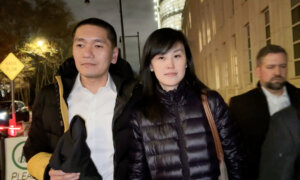

A Chinese researcher accused of smuggling biological materials into a U.S. university lab has pleaded no contest to four federal charges.
Han Chengxuan, a doctoral candidate from the Chinese city of Wuhan who sent into the United States multiple packages containing concealed biological materials, pleaded no contest to three smuggling charges and to lying to U.S. customs officials, the U.S. attorney for the Eastern District of Michigan announced.
Han is studying at the College of Life Science and Technology in the Huazhong University of Science and Technology in Wuhan and has co-authored two articles relating to the use of roundworms, known scientifically as C. elegans. She told federal agents that she arrived at the Detroit Metropolitan Airport on a J-1 visa in June, intending to start a one-year research project at a University of Michigan lab.
Han estimates that she has sent into the United States between five and 10 packages, with several lost on the way, according to the federal complaint.
U.S. customs intercepted four shipments between September 2024 and March 2025, addressed to individuals associated with a University of Michigan laboratory with content varying from plasmids—DNA fragments often used to induce the genetic modification of organisms—and petri dishes for growing earthworms, according to the court filing.
She is the third Chinese researcher facing charges over smuggling materials for biological research. The other two, the Justice Department alleged, attempted to smuggle in a crop-killing fungus for research use at the University of Michigan.
Prosecutors alleged that Han made repeated efforts to mask her actions both while shipping the goods and while speaking with interrogators.
During an interview with customs agents upon arrival, she initially denied knowledge of sending any items to one recipient until officers brought up specific packages, according to the complaint.
A transcript of the conversation showed that Han described the petri dishes as a water solution containing sodium oxide and sugar, saying, “These ingredients exist in fruit jelly.”
One of the shipments was a book with an envelope concealed inside that contained suspected biological materials, the prosecutors said. When confronted, Han initially said she designed a picture game and wanted to send it to the lab associate “to give him a surprise,” according to the court documents.
Han omitted from her initial statement mention of the plasmids in the envelope, which she only acknowledged upon close questioning, the prosecutors said.
She told the agents that the recipient and she were classmates studying the same major and that she believed that “he will understand my design.”
Han deleted content on her electronic devices three days before arriving in the United States, saying that she wanted to “start fresh,” the federal complaint states.
According to the interview transcripts, Han said that the chat history “takes memory space” and that she cleans messages regularly.
“The University of Michigan invited this Chinese national into our state to be a visiting scholar, where it was going to give her more than $41,000 in a year to do her worm research at the Life Sciences Institute. Something is wrong in Ann Arbor,” Interim U.S. Attorney for the Eastern District of Michigan Jerome Gorgon said.
Han’s sentencing is set for Sept. 10. If a conviction is entered, she faces up to 10 years in prison for smuggling goods into the United States and another five years for making false statements.