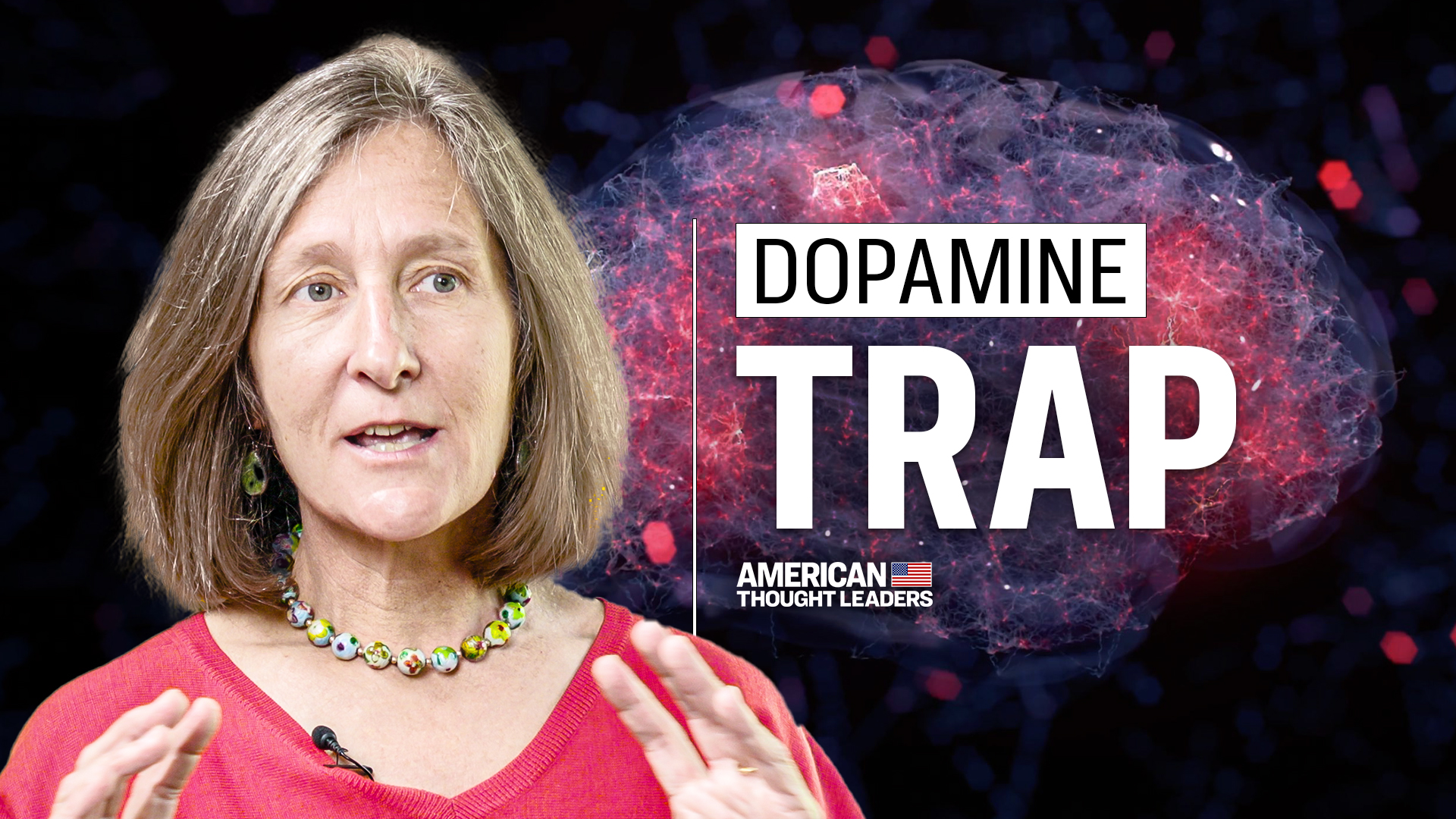

[RUSH TRANSCRIPT BELOW] “We’re living in this strange day and age when we’ve essentially bio-hacked all of the things that we do and really come to organize our lives around our little rewards, right? So, we wake up in the morning, we reach for our phones, we have our cup of coffee, we have our favorite muffin.”
Dr. Anna Lembke is a psychiatrist, professor, and medical director of addiction medicine at Stanford University. She’s the author of “Dopamine Nation: Finding Balance in the Age of Indulgence.”
“This is, of course, the great paradox, that although we want to avoid pain, our efforts to avoid pain actually lead to more pain,” she says.
How have technology and modern living led to mass overconsumption in America?
Views expressed in this video are opinions of the host and the guest, and do not necessarily reflect the views of The Epoch Times.
RUSH TRANSCRIPT
Jan Jekielek:
Anna Lembke, it’s such a pleasure to have you on American Thought Leaders.
Dr. Anna Lembke:
Thank you for having me. I’m excited to be here.
Mr. Jekielek:
I’m going to read something that I think might sound controversial. One of the biggest risk factors for getting addicted to any drug is easy access to that drug. In a world where harm reduction policies for drug abuse are the norm, this seems like a very controversial thing to say.
Dr. Lembke:
It is surprisingly controversial in this day and age, and yet it’s very evidence-based. For example, if you look at opioids, it’s very clear that if you have a region in which opioids are readily available, either because of porous borders and being imported illegally or through doctors prolifically prescribing them to patients in pain, as we had here in the first decade of this century, what you see very quickly thereafter is rising rates of addictive use and overdose deaths. Likewise, when the supply retracts because doctors start prescribing less or because borders are shored up, addictive use and related deaths and other harms go down.
This is really true for almost any substance and behavior. I wouldn’t even say almost; this is true for all substances and all addictive behaviors. When you have easy, ready access to any drug or behavior, you’re more likely to engage in that behavior, your brain is more likely to be changed from that frequent engagement, and you’re more likely to trip over into addictive, maladaptive use.
Mr. Jekielek:
Your book, Dopamine Nation, made me aware of how many things that you don’t think of as drugs, because of the nature of our technology and society, and our attitudes in general, have effectively become like drugs.
Dr. Lembke:
Right. This is what I call the drugification of modern life. Almost everything that we eat, that we engage in, including traditional drugs like cocaine, heroin, nicotine, and alcohol, has all become more accessible, more potent, more novel, and more bountiful, and those factors make them, in essence, more addictive. Even healthy behaviors—things like playing games, connecting with other human beings, or exercising—have become drugified through the application of technology, again made more accessible, more potent, more novel, and more bountiful. So we’re living in this strange day and age when we’ve essentially biohacked all of the things that we do and really come to organize our lives around our little rewards.
We wake up in the morning, we reach for our phones, we have our cup of coffee, we have our favorite muffin, we drive to work, we listen to whatever we want to listen to. Throughout our day, we work and then take a series of breaks; we scroll on our phones. At the end of the day, we look forward to going home and eating some kind of delectable food, binging on Netflix, eating cupcakes, smoking pot, or drinking. I just think intoxicants have been around since the beginning of human time, but the extent to which they are readily accessible at the touch of our fingertips, the extent to which they’re incredibly potent, easy to obtain, cheap, and really free—when you look at digital media—all this means that we’re sort of constantly bombarding our brains with these small and large rewards.
Mr. Jekielek:
This is just a normal part of our reality now, and it’s acceptable. It’s morally acceptable in our society to create technologies to basically manipulate or addict people as part of what we do—through things put into food. Another example is how marijuana has changed into something completely different today than it was even 20 years ago, just because of the potency and the impact. People experience psychotic breaks from it.
Dr. Lembke:
Right. I shop, therefore I am. We’ve really reached this kind of tipping point where, in a successful capitalist system—not to denigrate capitalism; it’s a fine system in many ways—but in any successful capitalist system, we would all be the ultimate addicts. So we have really organized modern life around consumption, and optimizing our consumption. At the same time, many of us living in wealthy nations have our basic survival needs met. We’ve got machines doing our work, so we have more leisure time than ever before in the history of humanity. We have access to more luxury goods and more disposable income.
All of that combined means that we’re living in the kind of perfect storm for all of us to become addicted. More and more, those of us who thought we would be immune to this problem are actually experiencing the addiction pattern in our own lives, whether it’s being addicted to our phones and digital media or to our drugified food supply with the addition of salt, fat, sugars, and flavorants, which lights up the same reward pathway as drugs and alcohol.
I think it’s fair to say that many, many modern people are struggling with some form of compulsive overconsumption. We can really look to people with severe addiction in recovery as modern-day prophets for the rest of us because they’ve had to figure out how to manage their compulsive behaviors as a matter of life or death. For those of us with more minor addictions, it may not be life or death, but it certainly affects our quality of life.
Looking to the recovery world, how people get into recovery and how they think about their consumptive behaviors—plus we now have surgical interventions to help us manage our appetites, right? People are, for the first time in human history, getting their intestines rerouted so that they don’t eat so much food. We’ve got medications that we’ve invented that we take for appetite control of all sorts. This means that the boundary of the problem of addiction is now extending much further and including many more of us as we’ve changed our ecosystem—the world we live in—through science, technology, and progress to make the world more addictogenic and drugified, making us all more vulnerable to this problem.
Mr. Jekielek:
It’s a combination of consumption almost as a virtue, but also pain avoidance as a top goal. You make the very strong case that this is a really bad idea.
Dr. Lembke:
First, we have to begin with empathy for ourselves because we evolved over millions of years to reflexively approach pleasure and avoid pain, right? It’s so deeply hardwired; it’s conserved over millions of years of evolution across species. We pull our hands away from a hot stove, and we approach mother’s milk. If that weren’t there, we wouldn’t be here either. The problem is that through human action, we’ve now created an environment where we no longer really have to work very hard to get those rewards that we need to survive. We’re largely insulated from painful experiences, right?
Our lives are very, very comfortable. We can micro-adjust the temperature in any given room to suit our comfort levels, right? So we’ve really eliminated hardship. We’ve exponentially increased pleasures, and this kind of ecosystem is not well suited to our ancient reward pathways, which were really evolved for a world of scarcity and ever-present danger. So it’s this mismatch that we’re grappling with now.
Mr. Jekielek:
You document how pain is actually a really important part of being able to experience pleasure.
Dr. Lembke:
Yes, so we have an innate tendency to want to avoid pain. On the other hand, pain avoidance and the pursuit of pleasure lead to more pain. This is, of course, the great paradox. Although we want to avoid pain, our efforts to avoid pain actually lead to more pain. If you look at every major philosophy or religion in the world, they essentially come down to similar messages that we have to face struggles, that suffering is a part of life, and that suffering gives us really valuable information that helps us make our lives better. But this kind of ancient wisdom has largely been forgotten.
We have lots of narratives that tell us the opposite—that if we’re uncomfortable in any way, there must be something wrong with our lives or wrong with our brains, or we need to go get treatment or go on an antidepressant. We are led to believe that we should be experiencing this kind of constant euphoria; otherwise, we’re doing something wrong. I think this is really a misleading narrative because it’s also contrary to our biology.
Our biology essentially says that no matter what we pursue pleasure-wise and no matter how much we avoid pain, our brains will recalibrate or neuroadapt to a new hedonic or joy set point, such that we'll constantly need more pleasure over time to get the same effect, and more minor injuries will, in turn, be painful. What philosophy and religion have been trying to teach us for millennia, I think neuroscience is now corroborating.
Mr. Jekielek:
Something that is a massively underreported issue in our society, is the ubiquitous on-demand availability of hardcore pornography. Tell me why that is problematic.
Dr. Lembke:
It’s a problem on so many levels. First of all, pornography is highly addictive. What happens when people initially view these images and typically masturbate to them is that, over time, they‘ll need more potent images, perhaps more deviant images, and they’ll find themselves escalating to engaging with images that are outside their values, maybe even illegal, right? But they need that higher potency over time to get the same effect. When they try to stop, they really can’t. So this is the addiction cycle.
Addiction is broadly defined as the continued compulsive use of a substance or behavior despite harm to oneself and/or others. You might ask, “What harm is there in pornography?” But you’re potentially harming the people whose images are being used. Certainly, we see that people are harming, in many instances, their own relationships because they spend more and more time engaging with these images.
Obviously, when children engage with these images, they are trying to process a video or photograph that they can’t possibly contextualize. If that becomes their definition of what sex should look like, you’ve got young people going out into the world with a very distorted sense of the meaning and purpose of sexual encounters. So on many levels, it’s very dangerous and destructive.
A lot of people ask, “Can you really get addicted to pornography?” I can tell you, if you could be a fly on the wall in my clinical setting, you would see people who come in having lost everything because they can’t stop watching pornography, even when they want to. They’ve lost their jobs, their families, and they’ve ended up in jails and prisons because they’ve broken the law in pursuit of more deviant forms of pornography.
In many instances, at heart, these are wonderful human beings. They’re good people, but their reward pathways have essentially been hijacked by this repetitive behavior of engaging with these images, engaging in sex with these images, or, in many instances now, with real people on the other end. It’s not just still images. It’s videos, live chat, and live streams. It’s very, very destructive and devastating for folks.
Mr. Jekielek:
It’s this weird subculture that I learned about from your book. But the flip side is that one character, Jacob, that we revisit constantly throughout, so far seems to have had a happy ending.
Dr. Lembke:
Yes, Jacob was a patient of mine. He came to see me for a very serious sex addiction involving initially pornography but eventually escalating to live chats and eventually him building his own masturbation machine that he let people in live chat rooms control, which meant that he was really putting his life at risk. He had escalated so far in this addiction that, even though he knew it was life-threatening, he still couldn’t stop, even after repeatedly trying to stop many times over.
It’s an extreme example, but I think we can learn a lot by looking at these extreme cases, especially when folks with this kind of extreme addiction can get into recovery. They can stop that behavior, get their lives back, their jobs back, their joy back. I think it becomes a model for the rest of us with our minor addictions, which may not meet that level of danger or impairment, but are on that same spectrum.
Mr. Jekielek:
Many of us have this issue with smartphones and maybe food. I certainly do. Your book made me reflect on the fact that I think I am significantly affected in at least two areas. But here’s the thing, right? Using the smartphone, and I guess I’m kind of asking you to do a little therapy on camera here, but the thing with the phone is that there’s a lot of really important stuff coming through there, legitimately. I have to deal with it, and in some cases, it’s incredibly important. So I feel I need to have it by me, and then I’m responding to things. You find yourself deviating into really interesting stuff on the X platform, which is genuinely fascinating, but probably not the highest priority at this moment, right?
But in some cases, it is, because I’m a news guy and I need to know what’s going on. Upon reflection, I can see I’m picking the things that are easy instead of the more challenging ones. For example, I have this huge resistance to communicating when there’s a significant chance of not getting the response back that I want. Okay, so that’s just a lifelong issue. But I think it fits into this because you end up picking the things that are quick and manageable. But then again, that’s also reasonable, because I can knock these things off my to-do list. I would expect there’s more than one person like me out there. What does someone like me do? In the end, it’s all of us. How do you deal with that?
Dr. Lembke:
Yes, right. It’s so embedded in so much of our lives and has become necessary to function in the modern world. We look at Jacob and his masturbation machine, and that seems so wildly extreme. We use not just tools, but a kind of auto-stimulation to meet our intellectual needs, emotional needs, sexual needs, and physical needs. In that process, many things are happening that are not good. One of which is that, in turning to our phones to meet these fundamental needs, we’re no longer turning to each other.
We see this in every aspect of life. Just walk around any neighborhood in the evenings when people used to roam, go for walks, go to the park, or stop by to see a neighbor. The streets are empty now. We have to really stop and look at this and say, “Okay, where are all the people?” They’re inside in their separate rooms auto-stimulating on their smartphones.
Mr. Jekielek:
There was an incredible art project where someone created a scene of people doing what you’re talking about, but in public. You can isolate yourself unbelievably, even among a whole group of people. The artist took photos of people engaging with their phones, but then erased the phones from the artwork. It was shocking. The point of the painting is that nobody was looking at anybody else. Nobody was interacting with anyone else. You get the sense that these people are completely isolated from each other, because, in fact, that’s the case.
Dr. Lembke:
Right. You also see this in families with young children. We, as a society, need to be very alarmed about this. You see young children standing next to a parental figure on their phone, the child tugging at the parent’s clothing, unable to get their attention. That is no different than having a parent who is intoxicated and checked out on alcohol or any other drug. We are not present for others when we are entranced by our phones. This will have devastating generational repercussions for all of us. We really need to pay attention to this. This is such an important topic.
The other thing I would say, in addition to how it’s adulterating our ability to connect with each other because we’re just connecting with the device, is that it’s also impairing our ability to create new things. Now, I know a lot of creation is happening online—creation and creativity—and that’s great. But I can tell you that the numbers show it is a small minority of people who are creating the metaverse content. The vast majority of us are just consuming this content. In this constant mode of reactive consumption, two things are happening.
Number one, we are not creating; we’re consuming. And number two, we’re not allowing our brains time to rest, recover, consolidate, and process this incredible flow of information. That’s stressful and that’s exhausting. People wonder why, with all this leisure time and freedom and options and material goods, are people so stressed out? It doesn’t make sense, right? People are more stressed out than maybe during famine or war.
It’s because we’re constantly overstimulating ourselves. We’re not letting our brains rest in between. The other thing that’s happening, as you alluded to, is that these devices are now procrastination generators. There are a lot of hard and annoying things that we all have to do in our lives, from taking out the garbage to responding to annoying, unpleasant emails, to writing thank-you notes to people we have delayed writing to. You name it.
And yet, the likelihood that we will engage in those mundane but important and necessary tasks is greatly decreased if we have that device available to distract ourselves, to avoid the pain of doing that mundane task, and really to get lost. Because once we go on the device, we forget. We completely forget what we were meant to do or what else we have to do. We’re sort of lost again in this kind of transportative experience that feels really good but is probably not good for us.
Mr. Jekielek:
There’s an example of a woman you asked to step away from smoking marijuana, because you figured out that a month is the right amount of time to give someone the opportunity to reflect on what life would be like without that substance.
Dr. Lembke:
That’s a great way to phrase it, by the way. I love that you phrased it that way because a lot of people don’t appreciate that I’m not saying taking a dopamine fast for a month will cure your addiction. I’m not saying that, but you’re right. It’s the amount of time on average it takes for people to sort of have that “aha” moment and say, “Wait a minute,” then look back at their using self, and say, “I don’t really want to continue to live like that.”
Mr. Jekielek:
Please explain to us how dopamine fits into this whole picture, because it’s the centerpiece.
Dr. Lembke:
Yes. Dopamine is a neurotransmitter. It’s a chemical that we make in our brain. Neurotransmitters allow for fine-tuned control of the electrical circuits that make us who we are. Dopamine is essential for the experience of pleasure, reward, and motivation. It’s not the only neurotransmitter involved in that process, but it’s the final common pathway for all reinforcing substances and behaviors. So neuroscientists have come to use it as a kind of common currency for measuring the addictive potential of a variety of different substances and behaviors.
For example, experiments in rats that measure dopamine levels at baseline and then see how much dopamine increases in response to certain substances or behaviors find that food, or chocolate in particular, increases dopamine firing by 55 percent above baseline. Sex is about 100 percent, nicotine about 150 percent, all the way up to cocaine and amphetamines at 1,000 percent above baseline. Indeed, that tracks with animal behavior. If you put a rat in a cage with a lever to press for cocaine, that rat will press that lever until exhaustion or death.
Now, human beings aren’t rats, so it’s not that what happens to rats in a cage will happen to every single human. There’s also the important concept of inter-individual variability and drug of choice. What releases a lot of dopamine in your brain might not release a lot of dopamine in my brain and vice versa. But in general, the concept holds true that intoxicants or things that are highly reinforcing, including behaviors, tend to release dopamine in those nucleus accumbens brain reward circuitry structures. The more dopamine released, and the faster dopamine is released, the more likely we are to want to engage in that substance or behavior again and again.
One important misconception here is that it’s not that dopamine is bad or that we’re addicted to dopamine per se. It’s that dopamine is a chemical signal, and we’re always releasing dopamine in the reward pathway at a kind of baseline tonic level. It’s the fluctuations in dopamine above and below that baseline that then motivate certain types of repetitive behaviors, especially to take action to get our drug of choice.
Mr. Jekielek:
What is the relationship between pain and dopamine?
Dr. Lembke:
We know that pain and pleasure are co-located in the brain. In the simplest explanation, they work like opposite sides of a balance. When we do something pleasurable, that releases dopamine, and our balance or teeter-totter tilts to the side of pleasure. The first and most important rule governing this balance is that it wants to remain level, or what neuroscientists call homeostasis, such that we will work very hard—our brains will work very hard—to restore homeostasis after any deviation from neutrality. The way our brains do that is by tilting an equal and opposite amount to whatever the initial stimulus is. If we do something pleasurable that releases dopamine, our brain responds by down-regulating dopamine transmission, for example, by reducing postsynaptic dopamine receptors, so that we get back to not just baseline firing of dopamine but actually below baseline.
I often talk about that as these neuro-adaptation gremlins hopping on the pain side of the balance to bring it level again. But they like it there, so they don’t get up as soon as we’re level. They stay on until we’re tilted an equal and opposite amount to the side of pain. It’s that come down, that hangover, that moment of craving which drives us to reach for more of whatever that substance is.
In a world of plenty where we’re surrounded by as much of whatever we like at the touch of our fingertips, it’s very hard to resist the urge not to reach for more. The problem is that with repeated exposure, we essentially end up in a chronic dopamine deficit state. You might imagine that as these gremlins camped out on the pain side of the balance. We’ve essentially changed our hedonic or joy set point.
Now, we’ve entered an addicted brain where we need more of the drug in more potent forms, not to get high, but just to level the balance and feel normal. When we’re not using, we’re walking around with the balance tilted to the side of pain, experiencing the universal symptoms of withdrawal from any addictive substance or behavior, which are anxiety, irritability, insomnia, depression, and craving. This is why people find it so difficult to stop compulsive overconsumption once they’ve entered that dopamine deficit state.
Because the fastest way to get out of that state and restore homeostasis is to reach for more of our drug, we get into this very deceptive loop where more of our drug feels good, not just because it’s dopamine-releasing, but because now we’re trying to get out of pain, right? When we’re not using, we’re in more pain. So we can get into this very confusing, tail-chasing situation where we don’t recognize the ways in which the substance is actually contributing to pain. Because in the short term, it’s alleviating pain.
Mr. Jekielek:
This is such a critical explanation. How many people functioning in this kind of environment with phones and computers are not experiencing this reality? It’s almost everybody at some level, unless they have some very unusual non-addictive personality or balance of neurotransmitters.
Dr. Lembke:
Yes, I think anybody who can manage their consumption of their smartphone or other digital media with ease is either a very rare subset of individuals for whom this medium is not particularly potent and compelling. Since the medium is invented by our own brains, there aren’t going to be very many people like that because it’s so cognitively and emotionally engaging.
Mr. Jekielek:
They are making it intentionally addictive from what we know.
Dr. Lembke:
Exactly. It was invented to be enchanting, and they’ve more than succeeded in that. So I think you’re looking at the vast majority of the population struggling with compulsive overuse of smartphones and digital media and trying to figure out how to limit use. And yet, we can—and we must—with intention do that, both through our individual efforts to manage our consumption and through top-down policies. Holding the companies that make addictive digital media accountable for the harms and getting schools to rethink how they’ve integrated technology because it’s gone far too far. Now, you can’t participate in the average American public high school without a QR code function.
Mr. Jekielek:
Except for the ones where Jonathan Haidt’s work has actually taken hold and they’ve removed them entirely, which is really impressive and represents huge changes.
Dr. Lembke:
Yes. Jonathan Haidt’s work is amazing, but he didn’t invent banning smartphones. There were schools early on, mostly private schools, starting with a few on the East Coast, but also in other parts of the world, that saw early on—our kids are not connecting with each other. They’re not paying attention to learning. They’re not flourishing because of these devices. They banned the devices and saw huge improvements in social, emotional, and cognitive well-being.
Now, formalizing studies of this is very difficult because it’s a lot of apples and oranges. You’re comparing one school that banned smartphones with another that didn’t. Did the first school really ban them, or did they just say, “Hey, don’t use them?” So there’s a lot of confusing data out there, and when you tease it apart, you realize the methodology is flawed. But what we see just experientially and phenomenologically, when schools ban smartphones, kids do better.
Jonathan Haidt has been instrumental in spearheading that work, advocating for getting smartphones out of schools, K-12, or at least through middle school, bell to bell. It can’t just be per class because then kids, in between classes and at lunchtime, aren’t interacting. It’s really got to be a top-down policy, which also greatly reduces FOMO, or fear of missing out, one of the main reasons that kids, particularly teens who are so socially sensitive, feel they can’t get off their phones even if they want to because they’re so worried they'll miss out on something important.
Mr. Jekielek:
Is it reasonable to approach this in a meaningful way without changing our societal idea that pain is terrible, and we should do everything to prevent people from having it? What do you think?
Dr. Lembke:
Yes, we definitely need a cultural shift on this point. Interestingly, we have a kind of very exercise-sports-oriented, extreme fitness culture. Getting back to this pleasure-pain balance, it turns out that if we intentionally press on the pain side to do things that are hard, those gremlins will actually hop on the pleasure side, and we can get our dopamine indirectly by paying for it upfront. That’s called hormesis. Hormesis is a Greek term that means to set in motion.
Essentially, when we do hard things and experience mild to moderate pain, our body senses injury and then starts to upregulate feel-good neurotransmitters—not just dopamine, but also serotonin, norepinephrine, our endogenous opioids, and our endogenous cannabinoids. The problem is that we can also take that to an extreme, which is not good. We can actually get addicted to pain. For example, why do people cut themselves when they’re in psychological distress? Because it releases endogenous opioids and dopamine, and that temporarily feels good.
The problem is it’s incredibly temporary, and with repeated cuts, it tends to stop working. Then, of course, you’ve cut yourself, which is terrible. Or why do people engage in extreme exercise, often combined with calorie restriction? Because it feels good, it releases dopamine, but then people can get into that same addictive cycle. My point is that we live in this world of extremes. We have this work-hard, play-hard mentality. We’re either extreme on the work and pain side, or we’re extreme on the pleasure side—or both, right? We’re doing both. And that, by the way, is stressful for our brains too because any deviation from homeostasis is biological stress.
Now, we need a certain degree of biological stress to thrive. We are human; we’re not meant to just have a flat line. That’s just not how we’re built. We’re strivers, we’re seekers; we’re meant to have these fluctuations. But the constant sort of work-hard, play-hard fluctuations that we manipulate, aided and abetted by the latest technology, are really stressful for our brains. The idea is to come back to a more subtle in-between fluctuation between pleasure and pain.
Indulging in intoxicants infrequently and in moderation is probably okay. Doing difficult things is actually something that we need to do more of because we have such a hyper-convenient, comfortable environment. I even prescribe things like exercise and ice-cold water baths to help people reset reward pathways. But we don’t want to take that to an extreme either, right?
I think what our culture needs is more recognition that life is hard, that everybody suffers, that we all experience anxiety, insomnia, intermittent depression, and that mental illness is real. The brain, like any other organ, can become diseased. Those individuals with extreme mental health issues do indeed need, in my opinion, treatment and help. But beyond that extreme gradation, there’s a lot of natural suffering. If we come together and recognize that we’re not alone in our suffering, and come up with healthy and adaptive ways to combat it, that is much better for us all.
Mr. Jekielek:
I took an antidepressant for a fairly brief time. I remember how it basically just dulled everything, and I’ve learned since that is the common reaction. But you asked if that’s what we actually want? A lot of people are asking this question, especially those who are on cocktails of various psychoactive drugs, and have found that it’s often the side effects of those drugs that are causing the problems at some point, not the original disease that they were first medicated for.
Dr. Lembke:
I always like to enter this topic by saying that I’m very grateful for antidepressants and other evidence-based psychiatric medications because, in some instances, they can be lifesaving. So I’m glad to have them, and I want people to have access to them. But it is also true that I think we’ve overmedicated and overprescribed in this country, especially in the last 30 to 40 years, where patients are coming in with really normal grief reactions and normal stress reactions—exactly what you would expect for major life losses and other stressful events. Instead of normalizing that and helping people process those experiences and making room, frankly, just for people to be unhappy, we’re trying to medicate that away.
As you noted, there are always side effects, and this kind of frontal lobe syndrome, or passivity, or dampening down of intense emotional experiences can happen with antidepressants, mood stabilizers, and antipsychotics. Again, these are good tools to have. They can be very helpful for persons with severe mental illness, and we should be using them, but we don’t want to overuse them.
Mr. Jekielek:
There’s also a tendency to not fully disclose the possible harms associated with these medications or the possible effects, even in some cases. For instance, there’s often sexual dysfunction associated with these drugs that, in a smaller subset of people, can become almost permanent. Typically, people don’t know that this is a possibility, and that might change their decision on whether to take a drug or not.
Dr. Lembke:
Yes. Telling people about all the risks, benefits, and alternatives is what we call informed consent, and every patient deserves informed consent. This means you don’t have to read all 500 possible side effects, but you should certainly be informed about the top five or so most common side effects so they can decide for themselves whether or not it’s worth the risk. Interestingly, for hospitalized patients, at least in California, we have informed consent laws. We actually have to get their written informed consent before we can initiate a psychotropic medication. That’s not generally true on the outpatient side. It’s expected that we will give them informed consent, but you’re right, it doesn’t always happen.
Mr. Jekielek:
In the book, you mention a film called Serenity. It’s one of my favorite films. Occasionally, I revisit it, and it’s a very interesting situation. Tell me why you like this film.
Dr. Lembke:
To me, it wonderfully encapsulates why we need dopamine. To be human is to strive, to look for what’s on the next horizon, to have joy or pleasure that’s fleeting and then dissipates, and then to need the next best thing. In Serenity, they discover this pill. I hope I’m remembering this right; I haven’t watched it multiple times, but they discover this pill that will basically take away desire. They experiment on a whole population on a planet, and the heroes arrive there not knowing what has happened.
They find all these people dead slumped at their computers; dead, sitting on couches; dead, at a park. They’re like, “What happened? They have all the food they need, they have all the water, they have clean air. Why are they dead?” They’re dead because this pill, or whatever it was, engineered them to not want anything, which I thought was a great metaphor for the bind that it is to be human, where we are these sort of malcontents—it’s just baked into our DNA and we can’t do otherwise.
Mr. Jekielek:
Let me tell you what I noticed in the film, which was something quite different and why I love it. I remember movie plots unbelievably well, and I wish I remembered most things as well as I remember movie plots. Actually, they put gas into the atmosphere of this planet. These people were fighting each other, and they wanted to prevent that from happening. So they put in this gas that did what you said—it basically made people not want to do those things anymore. But it ended up making them not want to do anything at all.
Someone thought to themselves, “Hey, it’s a good idea to put this gas in.” They made a decision for everybody else, just thinking that it was okay to do that for an entire planet. Of course, you could apply this idea elsewhere. It resembles a totalitarian viewpoint. There are some people who want to design the perfect society and think, “How can we do that? Let’s experiment.” But this experimentation often leads to huge problems and ethical disasters.
Dr. Lembke:
Yes, that’s right. And that’s not so far afield from what’s actually happening in the world. For example, if you look at rates of psychiatric medication prescriptions, people living in poverty are more likely to be prescribed psychiatric medications than those not living in poverty. If you look at opioid prescribing for pain, poor people are more likely to receive an opioid prescription than those who are not poor. What’s going on there?
You can begin to think about the way we prescribe these feel-good pills as a means to make people content with untenable circumstances so that they won’t rise up and fight against them. You know, Karl Marx said that religion is the opiate of the masses, but maybe now opiates are the opiates of the masses. We are giving people pills and saying, “Be okay with your life and be passive,” and that’s really concerning.
Mr. Jekielek:
I’m reminded of the example of the girl who had been constantly smoking marijuana and then had a month off, realizing, “Wait a second, I probably don’t need this anymore.” Part of the reason she was doing it is that she didn’t really want to deal with herself, her own thoughts, and the anxiety she experienced when she had to confront herself. This addiction to smartphones and the things that are just a normal part of our lives can very much serve as a way to avoid that.
Dr. Lembke:
Yes, it’s absolutely an anxiety avoidance technique. We work with a lot of teens who, when they decide they want to try giving up their smartphones and social media for a month, the first thing they notice is this roar of anxious thoughts and feelings in the early part. But as time goes on, they find that gradually their minds quiet down, and eventually they reach a place where they feel much less anxious than they have in a really long time.
The other thing they'll mention is how, in social situations, when there’s a moment of awkwardness and they’re not sure what to say, everybody just pulls out their phones now. And that’s not just teens; it’s adults too. So what are we doing there? Instead of reinvesting and reengaging with each other, we’re pulling away and disappearing during those tough times.
Mr. Jekielek:
You have a whole chapter dedicated to this idea of radical honesty. You have some very amusing examples, including from your own life with your kids and your chocolate sweet tooth—like eating your kid’s chocolate and then lying about it, and eventually deciding to come clean. It’s a touching little anecdote, actually.
Dr. Lembke:
There’s a moral argument to be made for radical honesty, but there’s also a neurobiological argument to be made for it. To define radical honesty, it means telling the truth about all things large and small in almost all circumstances. Might there be some rare circumstance where a lie would be better than the truth? Yes, I believe there would be, but very, very rarely. We often rationalize why we need to lie when we really shouldn’t.
I first learned about radical honesty as a pathway to recovery from addiction in my patients in sustained recovery, who would tell me that essentially they couldn’t lie about anything; otherwise, they were very prone to relapse. What was really interesting to me about that was that it wasn’t just that they couldn’t lie about their drug use—they also couldn’t lie about what they had for breakfast, why they were late for a meeting, or what they were doing on Saturday night. Any little lie became a kind of domino effect leading to larger lies and then relapse into using. I found that really fascinating, and it launched my research into what might be going on there.
I think radical honesty works at many different levels to help people with appetitive control and to avoid using drugs and engaging in the harmful compulsive overconsumption we’ve been discussing. One way I think it works is by strengthening our prefrontal cortex. The prefrontal cortex is that large gray matter area right behind our foreheads, which is so important for delayed gratification and appreciating future consequences, as well as autobiographical narrative.It turns out we’re all natural liars; the average adult tells one to two small lies per day.
So in order to be radically honest, we have to intentionally monitor ourselves to avoid reflexively lying, which is our natural default. In doing that, we’re probably activating that prefrontal cortex. The prefrontal cortex is a key part of the reward pathway, acting like the brakes on appetite. This allows us greater inhibitory control over these appetites. I discuss some interesting neuroscientific experiments in the book that elucidate the role of the prefrontal cortex. So it strengthens the brakes.
The other thing it does in a very interesting way is increase our awareness of what we’re actually doing. Unless we put into words and tell others, or write down, or coherently use language to narrate our experience, we’re not fully aware of what we’re doing. This happens all the time in addiction—you hear about denial and people living a double life, not even really knowing that they’re using. But when you have to tell another human, “Oh, I did this and I ate that and I watched this and I smoked that,” it becomes real to us in a way that it’s not when it’s just pinging around in the dark recesses of our brains.
The reason that’s important is because the stories we tell about our lives are not just a way to organize the past; they actually become a way to organize our future. We’re essentially creating these verbal roadmaps, and if we’re telling the truth in our lives, we have more access to better information to make decisions going forward. So this awareness piece is really key.
The third thing is that radical honesty promotes intimacy. We’re always talking about how human attachment is the opposite of addiction, and in order to get out of addiction, we have to reconnect with other humans. But how do we do that? Radical honesty is a wonderful starting place because we can wake up on any given morning and say, “You know what? Today I’m going to tell the truth; I’m not going to lie about anything.”
What happens when we tell others truthfully about what’s going on in our lives? We have this morbid fear that they‘ll run away screaming, but in fact, the opposite happens—they come closer to us. They see in us their own flawed humanity, and they want to help us. Radical honesty has this wonderful paradoxical effect of making humans connect with each other, even though we’re so afraid to tell the truth because we’re certain we’ll be rejected when we do. And yet, that’s not what happens most of the time.
Mr. Jekielek:
I’m going to read a line from your book. First, radical honesty promotes awareness of our actions. Second, it fosters intimate human connections. Third, it leads to a truthful autobiography, which holds us accountable, not just to our present but also to our future selves. Further, telling the truth is contagious and might even prevent the development of future addiction. What about that part?
Dr. Lembke:
Yes, that’s really interesting. If you talk to people with severe addiction, almost universally, they grew up in families where there was a lot of lying. Now, there’s often also a lot of addiction in caregivers, but even when there’s no addiction in caregivers, there’s hypocrisy and lying. What happens when people around us lie is that we feel we can’t rely on them or on the future, forcing us into survival mode to take care of ourselves. Once we’re in survival mode, we’re not thinking six years ahead; we’re thinking about the next six hours and getting what we need to survive because nobody else is going to take care of us.
This is wonderfully illustrated in the famous Stanford marshmallow experiment. This is a variation on the original experiment that not many people have heard about. In the original experiment, a child, four or five years old, is placed in a room with nothing but a table, a chair, a plate, and a marshmallow. The researcher in the white lab coat says, “I’m going to go away. If you haven’t eaten the marshmallow when I come back in 15 minutes, you'll get a second marshmallow.” They then measured which kids could wait and which could not.
It turned out that the older the child was, the more likely they were to be able to wait. However, even within a given age bracket, some kids could wait longer, and some could not. They then tracked these children over time and found that those who could wait or delay gratification were more likely to achieve positive life outcomes. Clearly, it is a strength to be able to do that; it demonstrates the exertion of willpower in that moment.
The variation on this experiment that relates to the idea of radical honesty involved giving the child a little bell to ring next to the marshmallow. The researcher said, “I’m going to go away. When I come back in 15 minutes, if you haven’t eaten the marshmallow, I‘ll give you another one. But if at any point during those 15 minutes you feel like you want me to come back, just ring the bell, and I’ll return.”
The children were divided into two groups. In one group, when the children rang the bell, the researcher returned as promised. In the other group, when the children rang the bell, no one appeared. As you can probably guess, in the group where the children were deceived, they were much more likely to eat their marshmallow before the 15 minutes were up. Once they realized that the researcher might not return, they thought, “I probably won’t get that second marshmallow, I’m going to eat mine.” This serves as a microcosm of the impact of a lying family or culture on people’s ability to maintain healthy appetitive control and delay gratification.
Interestingly, in times of extreme scarcity, you often hear about people performing amazing acts of generosity, even when they themselves are hungry or facing imminent threat. Often, spirituality and religion allow people to do this because they have faith in something outside of themselves—a system of caring and love that helps them be generous instead of succumbing to survival mode, even in dire straits.
Mr. Jekielek:
I’ve studied crimes against humanity and communist systems. One insight I’ve gained from speaking with people who have come out of these societies is that lying becomes essential for survival. It becomes a central part of your existence. Most people learn to lie in a way that others can’t easily detect. In societies where lying isn’t necessary for basic survival, it’s apparently easier to recognize. People explain that if you don’t lie, you could be dead very quickly. Political correctness, which arises from that system—lying to help people not feel bad—ends up leading in the same direction.
Dr. Lembke:
This is a very important point. Although I believe that radical honesty is a better way to live our lives in theory, in practice, it is very hard to achieve, and probably impossible in a collective system that punishes truth-tellers. If you are in a system built on lies, it is true that you can’t be honest without being an incredibly exceptional and brave person because the system doesn’t tolerate truth-telling.
When we look at the United States, our media coverage in many instances, and the fake memes and videos that can be generated, it is a scary time because people no longer know what to trust or believe. This, I think, encourages a survival mode mindset, making people more likely to struggle with addictive behaviors because they don’t feel they can trust the system they live in. You can lose your job or be shunned for disagreeing with dominant narratives, and this is happening in the United States.
Mr. Jekielek:
A friend of mine recently said, “We’re experiencing polarization and accelerating polarization in our society, and there doesn’t seem to be a way out.” I often reference the work of Andre Mir, a scholar at the Manhattan Institute, who says that today’s media is inherently geared toward polarization. Understanding the realities surrounding dopamine and how everything is wired around it—including for most of us, as we discussed earlier, suffering from some form of addiction—how much do you think that plays a role in this polarized reality?
Dr. Lembke:
It plays a huge role. One thing to keep in mind about addiction is that it is the opposite of attachment. Attachment is the opposite of addiction. You can have a wonderful social network, friends, and beloved family, but if you become addicted, you will distance yourself from them. Conversely, if you lack enriched attachments in your life, you are more likely to become addicted in the first place. This relates to digital media and polarization because more people than ever in human history are living alone—not just feeling lonely, but physically alone, which is not our natural state. We are meant to exist within social tribes. Now we are forced to connect with others through an addictive medium.
The nature of any addictive medium is that over time, we will develop tolerance and require more extreme forms to achieve the same effect. The algorithms know this and push us toward more extreme content. When we see others online experiencing emotions simultaneously with us, it reinforces our feelings. From an evolutionary perspective, that’s how we bond—through shared outrage, sadness, or happiness.
So people living alone are turning to this addictive medium to find others, getting sucked into it, which drives them toward more polarized displays. They experience the illusion of connection through shared outrage and animosity. I remember about 10 years ago when people began posting videos of themselves watching others’ videos. We were not just watching content; we were watching other people react to content. Do you remember that moment?
Mr. Jekielek:
Now that you mention it, I vaguely remember that.
Dr. Lembke:
To me, it was a turning point. It indicated that we are trying to connect with other humans online through shared emotional experiences. We are looking for that connection and doing it through our reactions. Whether watching a news outlet or something else, when you see someone reacting to something in the same way you do, it’s very reinforcing. That releases dopamine in the reward pathway. People then crave more of that, seeking human connection through this medium instead of making actual connections in real life.
Mr. Jekielek:
Given everything we’ve just discussed, it does not paint a positive picture for the future if the trend continues. The trend is continuing because of addiction pathways, not because people are choosing it voluntarily, as I think your argument suggests.
Dr. Lembke:
I do think addiction is the modern plague, but I think we will figure it out. It will probably take hundreds to thousands of years, but I am optimistic because we are beginning to see change. I and others have advocated for getting smartphones out of primary schools for 15 years, and it’s finally happening. There is a growing movement recognizing that this isn’t good for kids.
I see teenagers who self-opt out of addictive social media because they realize it doesn’t make them feel good; it makes them feel more lonely. I see all kinds of sports and entertainment venues that are saying, “Hey, check your phone at the door.” If you’re going to come to this event, we want you to be fully present. So I am optimistic. If you think about how new this technology is, we’re already talking about the dark side, and that’s good.
Mr. Jekielek:
What if you’re someone who is addicted to their phone at some level, but also uses it in a very valuable and meaningful way daily? The second piece is food. What can one actually do? Because you have to eat, and you have to use your device. What do you do?
Dr. Lembke:
I like to start by framing the positive. The fact that you like to eat means that you like to live. You’re embracing life when you want to eat and when you enjoy food. The fact that you’re on your phone a lot means that you want to know what’s going on—you’re engaged in life, okay? So that’s the first thing.
The second thing is just recognizing that both food and these devices are forms of drugs, right? With food, the addition of salt, fat, sugar, and flavorants means that when we eat, we’re not just getting the calories we need, which would allow us to stop naturally when we’ve had enough. We’re also getting hits of dopamine that are rewarding and make us want to keep doing it, right?
When you think about the world we evolved in, we had to walk tens of kilometers every day just to find a tiny bit of food, right? That’s not the world we live in now. So it’s a very challenging world, and naturally, we want more once we begin. The same thing applies to digital media. So I think once we recognize that, we can begin to think about how we can engage in self-binding strategies.
Mr. Jekielek:
Can you define that term, self-binding strategy?
Dr. Lembke:
Willpower can only go so far. When we wake up, we have more willpower than we do at the end of the day. It’s not an infinite resource. If we rely on willpower alone in our drugified, dopamine-overloaded world, we’re never going to make it. So we have to put both literal and metacognitive barriers between ourselves and our drug of choice so that we can press the pause button between desire and consumption. That can take many forms. It can be actual space barriers, like getting the potato chips, cookies, cakes, and empty carbohydrates out of the house, right? Or the alcohol or the pot or whatever it is.
With our devices, it’s things like using time as a self-binding strategy and saying, “I’m not going to even touch a screen or my device until I’ve finished my healthy morning routine. I’m going to get a regular alarm clock; I’m not going to use my phone. I’m going to make sure I exercise, make my bed, eat, brush my teeth, and only then am I going to sit down in a consolidated space, not while I’m moving around, doing other things, but really then focusing on my digital device and what I need to do. Maybe I’m going to make a list of what I’m going to do before I get on because I know once I get on, it can be very easy to forget what I meant to do here,” because anyone can be distracted by this incredibly reinforcing rabbit hole.
Then we can think about potency. How can one make food or the devices less potent? Generally speaking, broccoli is not something most people overindulge in, right? Because it just doesn’t have that same kind of kabang in our brains. So focusing on healthy foods that are made in a tasty way, but not the kind of ultra-processed foods that really are drugs.
The same thing with devices, like trying to circumscribe the time that we’re using, making it, you know, the classical things, like making the phone grayscale so it’s not as potent for our brains. Turning off notifications is absolutely key because every time we get that ping or that vibration, it distracts us from what we’re doing over here. It pulls us back in there and probably releases dopamine in the reward pathway. So it’s itself rewarding, and it compels us to check. I really recommend powering the phone down and off when we’re not using it.
In the world of diabetes, type 2 diabetes is caused by a poor diet and lack of exercise in vulnerable folks. But when you talk to diabetes specialists, they mention one of the major ills of modernity is what they call chronic sedentary feeding. It’s the way in which we snack all day long. For example, intermittent fasting or using time as a self-binding strategy can help people who are trying to moderate their consumption of foods. It’s not just the type of food but also the times that we eat and the amount of bowel rest we give ourselves in between.
The kind of chronic sedentary feeding that we think about with food is very applicable to digital media. It’s not just the total amount of time, but actually the frequency—the constant pulses throughout the day. I check the first thing in the morning. I check ten minutes later. I go and do something else, and then I check again.
So thinking about really consolidating the time and having a specific time when we sit down and focus on the digital media and what we need to do, and then powering it down and getting off of it, putting it in our bag, powering down. I really recommend doing as much as possible on a laptop or a desktop, including texting, rather than on the phone, because again, it’s got a place that it lives—a room, a desk, a space. It’s not this on-the-go device, which is what makes smartphones so insidiously addictive.
Mr. Jekielek:
That’s actually one of my strategies, to do more from the computer than from the phone whenever possible.
Dr. Lembke:
The other thing, especially with digital media and social media, is to realize that what we’re really wanting when we’re engaging in that kind of mindless scrolling is human connection. If in those moments we can recognize that, put the phone away, and actually go find a person and, you know, if appropriate, hold their hand or talk, because then we’re getting the real deal.
Mr. Jekielek:
Fascinating. With the issue of shame, we’re not supposed to feel that with our current overall worldview. Shame can be very destructive, but you actually make the case that it could be very valuable. Please explain that for us.
Dr. Lembke:
Shame is this really interesting double-edged sword in that it’s very true that intense shame can perpetuate addictive behaviors. But on the other hand, shame is our most pro-social emotion because it’s that gut punch of dread when we know we’ve done something wrong and we’re worried that we’re going to be shunned or kicked out of the tribe, right? But if we didn’t experience any shame in reaction to certain types of behaviors, why would we bother to want to make it different? So I think it’s really important for us to let ourselves acknowledge and experience shame and to be thoughtful about the source of our shame.
Then, importantly, we should try to make amends around that behavior. It’s kind of a three-step process: acknowledging the shame of something we regret and feel shame about, committing to not doing that thing again, and then going to the people we have harmed and making amends. This is where I think Alcoholics Anonymous and other 12-step groups have really learned how to leverage pro-social shame and mitigate malignant or toxic shame. Many people who get into recovery through AA will say that the most important aspect was the de-shaming aspect.
They went and sat in a circle and realized, “I’m not the only one. That person over there describing their life is describing my life.” They felt a sense of not having to drown in their own self-loathing around all of the behaviors adjacent to their addiction. But on the other hand, the 12 steps are really all about owning my own character defects, taking a careful moral inventory of where I’ve wronged others, and going to make amends to those individuals. So this really provides a kind of pro-social shame pathway for people to change their behavior and, importantly, to get closer to other people.
Mr. Jekielek:
It seems like we have to really enshrine agency.
Dr. Lembke:
Yes, I agree. It’s fascinating that when people come into the office, the way they tell their autobiographical narrative reflects their level of psychological health. What I mean by that is when people tell the story of their life in a way that makes them the perpetual victim of other people’s actions, I know those are folks who are not well and often deepen their addictions. When people get into recovery, one of the very first things that change is the way that they look at their own responsibility, culpability, and agency in terms of their lives—past, present, and future. We have a culture today where we essentially reward victimhood, and we don’t celebrate agency.
But again, getting back to Alcoholics Anonymous and other 12-step groups, their motto on the back of their pamphlet is, quote, three letters, three words: I am responsible. So it’s this fascinating paradox between the spiritual transformation or recognition of the locus of control being outside of myself, my life, and the impact on other people’s lives and the whole world. Because really, how does change happen? It’s those small decisions and actions that we make in our everyday lives.
Mr. Jekielek:
You end your book with something very valuable. It’s one page of, “Lessons of the balance,” as you call them. First of all, why is it the balance, and not a balance?
Dr. Lembke:
Because I use this extended metaphor of the pleasure-pain balance, so I’m referencing back to that. I’m showing how some of these neuroscientific discoveries can inform the choices that we make in our lives.
Mr. Jekielek:
It’s a great list. Here is one example, “Relentless pursuit of pleasure leads to pain, and avoidance of pain leads to pain.” What a great and valuable reminder.
Dr. Lembke:
Yes. We all need the reminder because, again, we reflexively approach pleasure and avoid pain. It’s what keeps us alive. It’s a cognitive lift to actually avoid pleasure and approach pain, and yet to be happy and to flourish—especially in this time in human history—we actually have to do that. We have to eschew pleasure and seek out things that are hard.
Mr. Jekielek:
I’m going to add another, “Abstinence resets the brain’s reward pathway.”
Dr. Lembke:
Yes, people often think, “Can’t I just reduce?” Really, it looks like that’s harder to do than if you just abstain for a period of time, let your reward pathways reset, and gain insight into that consumptive behavior. It also gives us the ability to take joy in other, more modest rewards, which we lose when we’re chasing these highly potent reinforcers.
Mr. Jekielek:
Your number nine out of ten here is, “Pro-social shame affirms that we belong to the human tribe.” You talk about, “club goods,” about how in a group we help keep each other in check.
Dr. Lembke:
Yes. Club goods is from behavioral economics, and it basically speaks to what are the intangible goods that we get from coming together in communities. Like, why do people gather outside of the exchange of material goods? What are these intangible club goods, and how do we measure them? Because they’re intangible, they’re very difficult to measure, but part of the way that you can measure it is through sacrifice, right? How much time and energy are people devoting to these club goods, and how willing are they to invest in this club and not another club? So there’s an enormous amount of sacrifice that goes into making that experience worth the bother.
Club goods in behavioral economics also talks about free riders, which is a little bit like freeloaders—people who try to get the positives of that group without contributing to the group. This is interesting; behavioral economics is a way to try to get at some of these interesting behaviors from the perspective of these mathematical models. And shame is really important to club goods because every club has norms—kind of rules around what is and is not appropriate behavior. On the margins, we can all agree on what those should be.
For example, I think we could all agree that killing other human beings is not good. I’m just going to use that as an example because we can mostly all agree that that’s not good. If you do break that rule and kill another human being, you should be shamed for that, right? You should experience shame. In some sense, the community should shame you for that, but also, importantly, provide a path for making amends, however that may look in a given social group.
Mr. Jekielek:
There was one scenario where a young woman ended up with a very big eating addiction. She grew up in a very militant evangelical family, and then later she drifts away from the church and finds her own way. It made me think about my mom, and I’m unbelievably grateful for her church community. For example, during the pandemic in Toronto, which was one of those places with complete lockdown—this community was basically a central part of her life.
She didn’t lose any community; whether it was on the phone, or people were coming over to deliver groceries. She will often talk to me about the types of things they think about and talk about, which are very different from a lot of society today. So these are club goods, right? What do they think about? The essential part is praying. My mother, a very deeply believing Catholic, prays multiple rosaries a day. She prays for all sorts of victimized people in the world, some specific people that the church has decided to dedicate time for.
Dr. Lembke:
That’s a great example of club goods—like prayer, the amount of time you’re spending praying for other people. Those are club goods.
Mr. Jekielek:
Anna, this has been a wonderful conversation.. A final thought as we finish up?
Dr. Lembke:
Thank you for your close read of my book. It’s such a joy to be interviewed by somebody who hasn’t just read the book, but has read the book in its entirety, carefully and thoughtfully. I really enjoyed the conversation.
Mr. Jekielek:
Dr. Anna Lembke, it’s such a pleasure to have you on the show.
Dr. Lembke:
Thank you. It has been a pleasure for me too.
This interview has been partially edited for clarity and brevity.