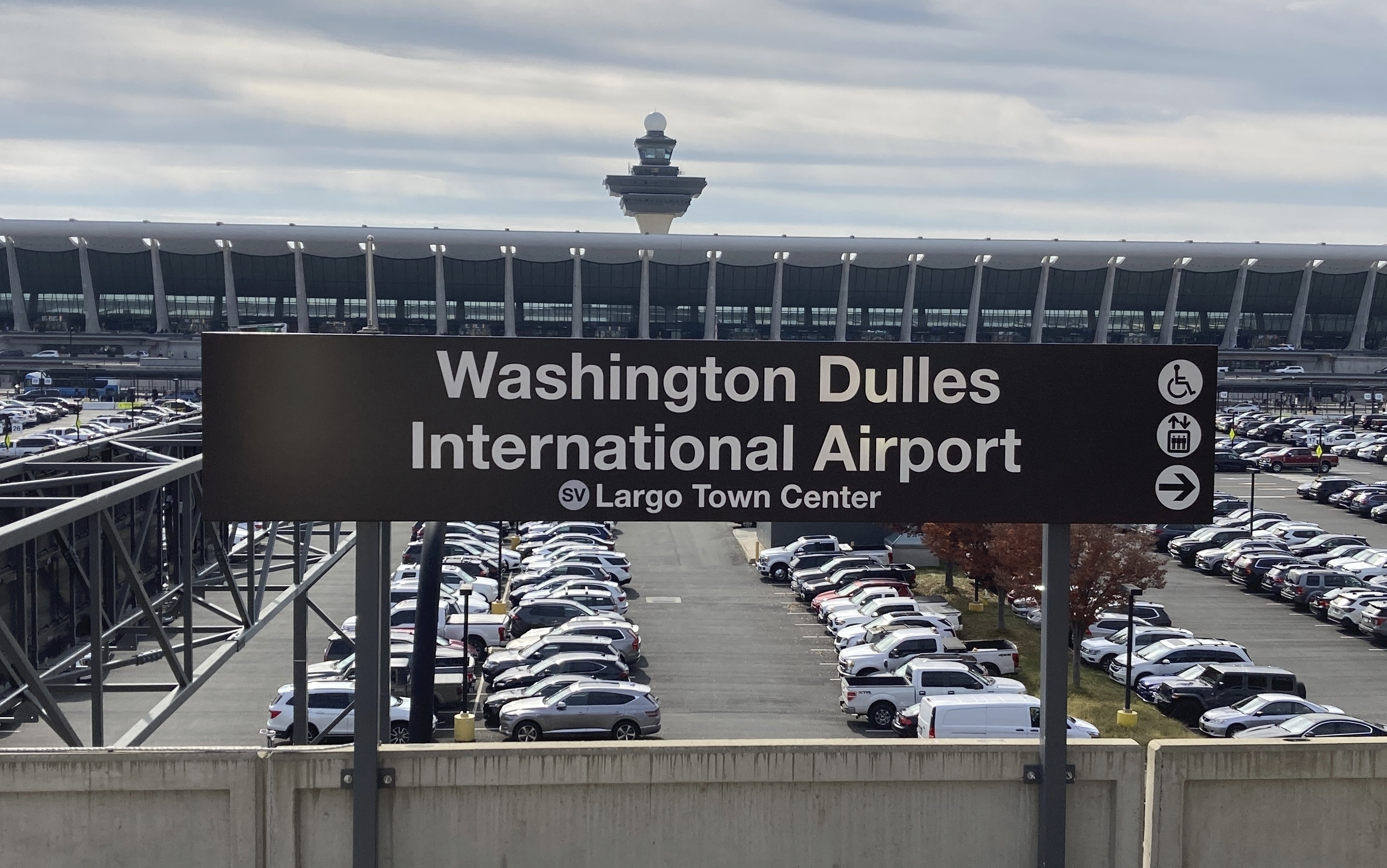

Commissioned and built in the years immediately after World War II, Washington Dulles International Airport in Virginia is a critical transportation artery in the Washington metropolitan area. It was the first airport designed for commercial jets and one of the busiest airspaces in the world.
Dulles served 29 million passengers between October 2024 and October 2025, according to the most recent annual data available from the Metropolitan Washington Airports Authority.
Alongside the federal government’s plan to overhaul America’s air traffic control infrastructure by the end of President Donald Trump’s second term, the Department of Transportation is eyeing Dulles for a widespread revitalization project, inviting proposals from the private sector to “construct completely new terminals and concourses.”
“Tourists, world leaders, and CEOs from around the world should not be forced to travel through an inefficient airport when they visit D.C.,” Transportation Secretary Sean Duffy said in a December 2025 statement. “[Dulles] needs a complete refresh to assume its proper role as the premier international gateway into the capital of the greatest country in the world.”
The airport’s “mobile lounges”—also known as “people movers,” which transport passengers from the airport’s terminal to specific concourses and, at times, directly to planes themselves—and the hub’s critical role in the expansion of the U.S. capital make Dulles a key part of American aviation history.
Although the airport is a breeze for pilots, the passenger experience leaves much to be desired more than 60 years after Dulles first opened to the public, according to some former pilots.
“They have long concrete runways and the instrument landing system—as far as takeoff and landing—as an aviator, it gets an A-plus,“ Richard Levy—safety expert, former pilot, and 40-plus-year veteran of the aviation industry—told The Epoch Times. ”For the passengers, I wouldn’t give it that kind of a grade at all with the outdated facilities.”
He said that when the upgrades are complete, “it’s going to be one heck of a place.”
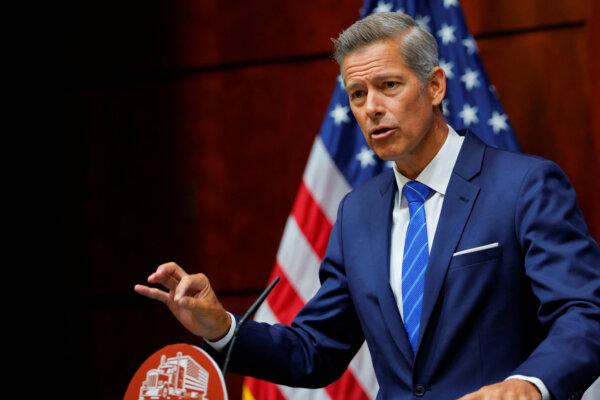
Transportation Secretary Sean Duffy makes an announcement during a news conference at the Department of Transportation in Washington, on Aug. 26, 2025. (REUTERS/Brian Snyder)
Here is what we know about the federal government’s plan to revitalize and upgrade one of the key lifelines in American airspace.
International Hub
The Transportation Department said it is pursuing the revitalization project because of Dulles’s “dated facilities,” lack of sufficient gates at the main terminal, creeping jet fuel fumes throughout the concourses, and the “inefficient system of people movers that deliver passengers as much as a half mile away from their gates.”
But how did one of the nation’s most important airports, once described as a “symbol of America’s stature and progress into the jet age,” reach this state?
The story begins with the role intended for the airport when the federal government first planned it.
Dulles was designed to support Ronald Reagan Washington National Airport (DCA), which sits close to the U.S. Capitol but is much smaller than Dulles. It is primarily considered a single-runway airport, as two of its three runways are notably shorter than its main runway, Runway 01/19, which is also the busiest runway in the nation, according to Simple Flying.
This severely limits the number of non-domestic flights DCA can handle, making Dulles the main international air travel hub for the Washington metropolitan area. Dulles also has four active runways and more than 100 gates across its five concourses, allowing for a larger volume of flights compared with DCA. The airports are located 26 miles apart.
Dulles was built as an international hub with large runways, according to Shawn Pruchnicki, a safety expert, former pilot, and aviation professor at The Ohio State University.
“Now you could have long—nine- or 10-thousand-foot—runways for really big airplanes,” he told The Epoch Times.
Combining the two airports would be convenient but difficult because of dense development in the Washington metropolitan area, Margaret Wallace, a former military air traffic controller and an assistant professor of aviation management at Florida Institute of Technology, told The Epoch Times.
“It would be nice if they could consolidate [both airports] into one, but it would have to look like Atlanta at that point, and I don’t know where that land would come from,” Wallace said.
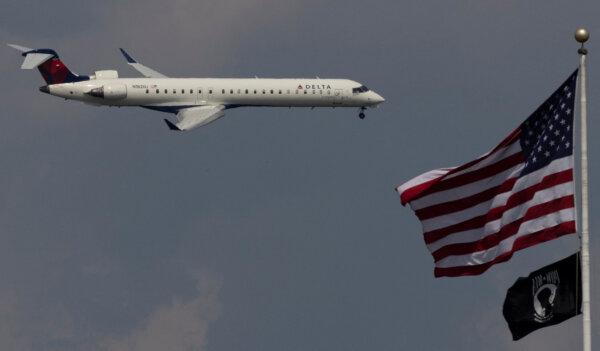
A Delta Air Lines commercial aircraft flies over Washington as it approaches Washington Dulles International Airport, as seen from Washington, on Aug. 5, 2024. (Umit Bektas/Reuters)
People Movers
One unique feature of Dulles, which is partly to blame for its recent infamy, is its people movers: 54-by-16-foot vehicles that were originally deployed to carry more than 100 passengers from the main terminal to aircraft parked on a jet ramp roughly half a mile away.
The people movers transport passengers every five minutes from the terminal to Concourse D, which is not directly connected to the terminal via the airport’s underground AeroTrain, as Dulles’s other concourses are.
Before the AeroTrain was completed and opened in 2010, the people movers were critical for travel from the terminal to all of Dulles’s concourses and directly to some planes on the jet ramp.
“I’ve had to take a [people mover] to an airplane once,“ Wallace said. ”I was like, ‘Wow, this is old school.'”
In the Transportation Department’s proposal announcement for the Dulles upgrade project, the agency noted that a people mover crashed in early November 2025, sending 18 passengers to the hospital with non-life-threatening injuries.
Duffy also commented on the accident during the president’s Cabinet meeting early last month when he first announced why the Trump administration wants to upgrade Dulles.
Main Terminal
Despite the federal government’s criticisms of Dulles’s shortcomings, Trump, during his December 2025 Cabinet meeting, lauded the airport’s main terminal, designed by world-renowned architect Eero Saarinen.
“[Dulles has] a beautiful terminal,“ Trump said. ”Saarinen was the architect, one of the greatest architects in the world at the time. We’re going to make Dulles airport, serving Washington, Virginia, Maryland, etc., we’re going to make that into something really spectacular.”
The terminal has two main levels; the upper level contains ticketing and security, while the lower level houses arrivals, baggage claim, and access to parking and ground transportation.
The historic building underwent an expansion in 1996 that extended the terminal to the length intended in Saarinen’s original design. Nine years later, the interior ticketing and baggage claim level was renovated and upgraded.
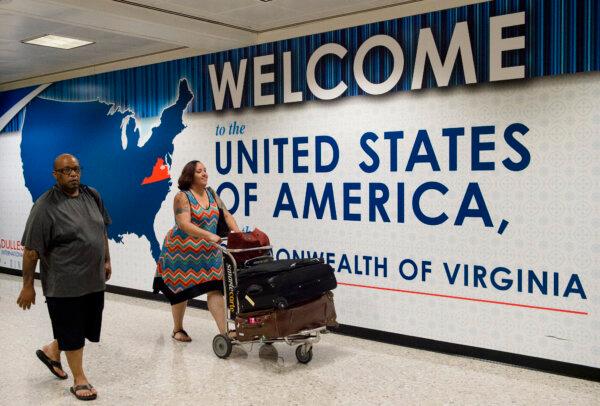
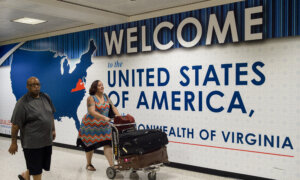
International travelers leave the Customs and Immigration area of Washington Dulles International Airport in Dulles, Va., on June 29, 2017. (Paul J. Richards/AFP/Getty Images)
Expected Upgrades
In addition to the modernization efforts done on the main terminal, the Dulles Development Program features several upgrades pursued between 2000 and 2011, as well as a few planned for the future that may be included in the Trump administration’s revitalization project.
One of the airport’s biggest improvements was the 2010 AeroTrain, which reduced the need for people movers to transport passengers from the terminal to the airport’s various concourses.
Between 2000 and 2011, Dulles also received two new parking garages, Z gates to replace its old T gates, expansions of Concourse B and the International Arrivals Building, a rehabilitation of the C and D concourse structure, and a brand-new fourth runway.
Even before the Trump administration announced its revitalization project, Dulles had two key upgrades planned for the future.
Critically, the airport will receive a long, fifth runway, allowing for increased flight capacity.
“The fifth runway will be an east-west runway approximately 10,500 feet long and 150 feet wide,” the Metropolitan Washington Airports Authority states on its website. “It will be parallel to existing runway 12-30 near the south side of the Airport. Construction dates for the fifth runway will be set in the future.”
There are also plans to replace the building, built as a temporary structure, that houses the airport’s C and D concourses. The new concourse will be near the base of Dulles’s Airport Traffic Control Tower, and plans call for a “three-level structure with 44 airline gates and amenities similar to Concourse B.”
The Transportation Department is inviting proposals on building entire “new terminals and concourses,” according to the agency’s statement.
Possible Space Constraints
When construction began on Dulles Airport in 1958, the site was adjacent to open farmland with plenty of space.
Much of that area has now been converted for other purposes, but a large portion of undeveloped land can still be seen on Google Maps to the south of Runway 12-30, which is the planned location of the future fifth runway.
Although a few access roads exist on the west side of the airport’s fourth runway, 1L-19R, there also appears to be some undeveloped land.
However, there may be other space limitations on future construction projects, Greg Reigel, an aviation lawyer and private pilot, told The Epoch Times.
“You have to start from sort of the runways and the taxiways and the safety zones that surround them,” he said. “From there, then you can see where you may or may not be able to build to make sure that you’re not encroaching on those safety areas.”
Because the property is leased from the Department of Transportation, the federal government has the power of eminent domain if the revitalization project requires additional land, Reigel said.
“So, to the extent that they want to expand and take additional property, they certainly have the authority to do that, provided they pay reasonable compensation,” he said.
Private landowners could bring legal obstacles to the project if they argue that the government’s compensation is not sufficient, Reigel said.
Dulles has another space-related limitation: It is close to restricted airspace, according to Shem Malmquist, a 40-year veteran of the aviation industry who has worked as a commercial pilot, professor, and safety consultant.
“The airport is trying to fit in between airspace,” he told The Epoch Times, noting that additional military air traffic makes it a “real challenge” for airport planners.
“It’s now as close as it can get to the capital without encroaching on restricted airspace or prohibited airspace, and it doesn’t have a lot of room around it, because everything around it is so developed.”
“It was also an old airport, so it was built, and then traffic grew up with it in existence, and they just keep on trying to fit more into the little, tiny space,” Malmquist said. “So, definitely things can be done to improve it and just make it more user-friendly for passengers, as well as hopefully eliminate some of those people movers ... [which] add complexity and risk to the situation.”