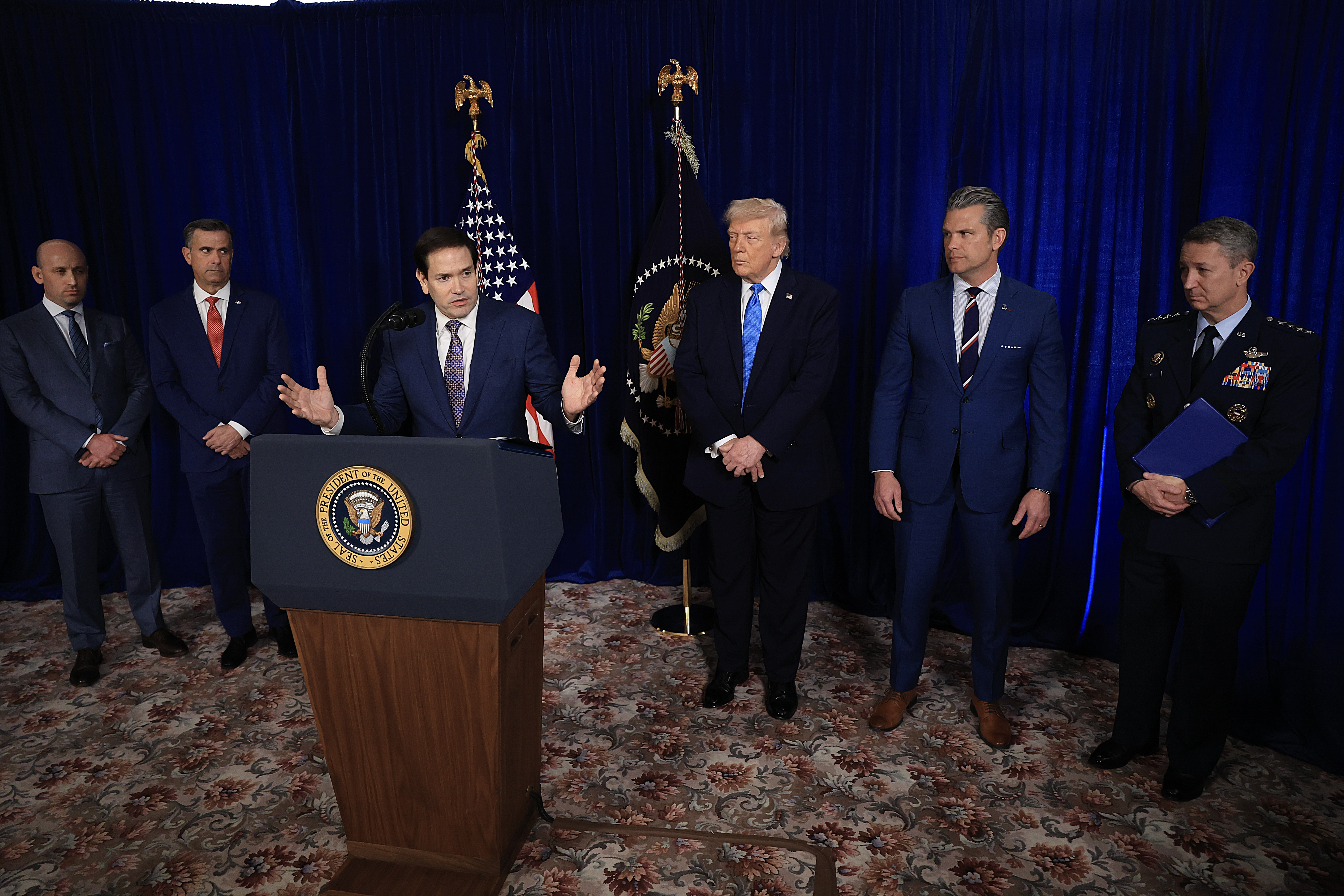
U.S. Secretary of State Marco Rubio said on Jan. 4 that the Pentagon will maintain its military blockade around Venezuela to apply leverage to the country’s socialist regime—which is now being run by Delcy Rodríguez, who served as vice president and oil minister under Venezuelan leader Nicolás Maduro following his capture by U.S. forces.
Rubio told CBS News’ “Face the Nation with Margaret Brennan” on Sunday that the United States is keeping an oil “quarantine” or blockade in place around Venezuela’s coasts, pointing to the export as being a key source of revenue for the regime.
“There’s a quarantine right now in which sanctioned oil shipments, there’s a boat, and that boat is under US sanctions. We go get a court order, we will seize it,” Rubio said. “That remains in place, and that’s a tremendous amount of leverage that will continue to be in place until we see changes that not just further the national interest of the United States, which is number one, but also that lead to a better future for the people of Venezuela.”
Rubio said that’s what U.S. President Donald Trump was referring to when he said on Saturday that the United States will not rule out further military options, including “boots on the ground,” until the Venezuelan regime meets Washington’s demands.
The U.S. secretary of state did not elaborate on Trump’s comments on Saturday about the United States running Venezuela in the interim, but said the Pentagon will continue with its military quarantine and naval and “force posture” in the Caribbean moving forward.
Trump said the United States would work with Rodríguez and the interim regime. Trump said she spoke to Rubio on the phone, adding that Rodríguez told him, “We’ll do whatever you need.”
“I think she was quite gracious,” Trump said. “We can’t take a chance that somebody else takes over Venezuela that doesn’t have the good of the Venezuelan people in mind.”
When CBS News asked Rubio about the phone call, he did not reveal what the two discussed, but said the United States’ interests regarding Venezuela and the nation’s impacts on America’s national security “have not changed.”
“We want drug trafficking to stop. We want no more gang members to come our way. We don’t want to see the Iranian and, by the way, Cuban presence in the past,” Rubio said, adding that Venezuela’s oil interests need to benefit its people instead of “pirates and adversaries of the United States.”
“We want to see all of that happen. We insist on seeing that happen,” he said.
On Saturday, shortly before being ordered by the nation’s high court to assume control as interim president of Venezuela, Rodríguez strongly condemned the United States for arresting Maduro and his wife and suggested those remaining in power are united behind their detained leader.
“There is only one president in this country, and his name is Nicolás Maduro,” Rodríguez said in televised remarks.
Other Forms of Leverage
In addition to the ongoing U.S. military “quarantine” around Venezuela, Rubio said the United States has “multiple levers of leverage to ensure that our interests are protected.”
“But we are going to judge moving forward,” the U.S. secretary of state said. “We’re going to judge everything by what they do, and we’re going to see what they do.”
Rubio did not rule out an eventual transition to democracy, emphasizing that he views opposition candidate Edmundo González as the true winner of Venezuela’s 2024 election. But he said it’s unrealistic to expect an immediate election following years of rule under Maduro, who assumed power after the death of his predecessor and mentor, Hugo Chávez. U.S. officials blamed Chávez for eroding democracy in Venezuela after he rose to power in the late 1990s.
“They’ve had this system of Chavismo in place for 15 or 16 years, and everyone’s asking, why 24 hours after Nicolás Maduro was arrested, there isn’t an election scheduled for tomorrow?” Rubio told CBS. “That’s absurd.”
The Associated Press contributed to this report.