
Americans and Canadians from the Great Lakes across Niagara Falls to Cape Cod spotted two meteors blazing through the Earth’s atmosphere within two days of each other, according to NASA.
One was spotted streaking across the skies of New England just after 2 p.m. ET on May 30, and the other was seen over the Great Lakes and the American Midwest just after 10:40 p.m. ET on June 1.
The space agency was able to confirm on June 1 that a large meteor came blazing through the atmosphere at supersonic speeds and exploded over New England at 2:06 p.m. ET on May 30.
The meteor was roughly 5 feet in diameter and had a mass of 5.6 metric tons. It entered the Earth’s atmosphere traveling 42,000 mph, and streaked across the skies of New England in a southeasterly direction for 26 miles before breaking up into fragments 31 miles above Massachusetts’s Cape Cod Bay.
The American Meteor Society received more than 85 witness reports of the event spanning from north of Montreal and the Toronto suburbs down to Maryland and Delaware, across New York State, and up the coastline to Rhode Island and Maine.
NASA deemed it a “fireball” event, adding that it was also reported by the National Oceanic and Atmospheric Administration’s GOES-19 weather satellite, with a report of a loud noise. NASA later revealed that the noise was a sonic boom released when the meteor broke apart in an explosion equivalent to about 230 tons of TNT.
The term “fireball” is the space agency’s official term for a shooting star. It designates an event where a space rock enters the Earth’s atmosphere, catches fire, and becomes brighter than the planet Venus appears in the night sky.
A fireball is triggered by a meteor, which is NASA’s designation for any piece of natural space debris that enters the atmosphere. Whether that debris is labeled a meteoroid or an asteroid is determined by size. Anything more than a meter in diameter is an asteroid, and anything smaller is a meteoroid.
In this case, it was an asteroid that entered the Earth’s atmosphere on May 30.
Three days after the New England event, NASA officially recognized eyewitness reports of another fireball on June 1.
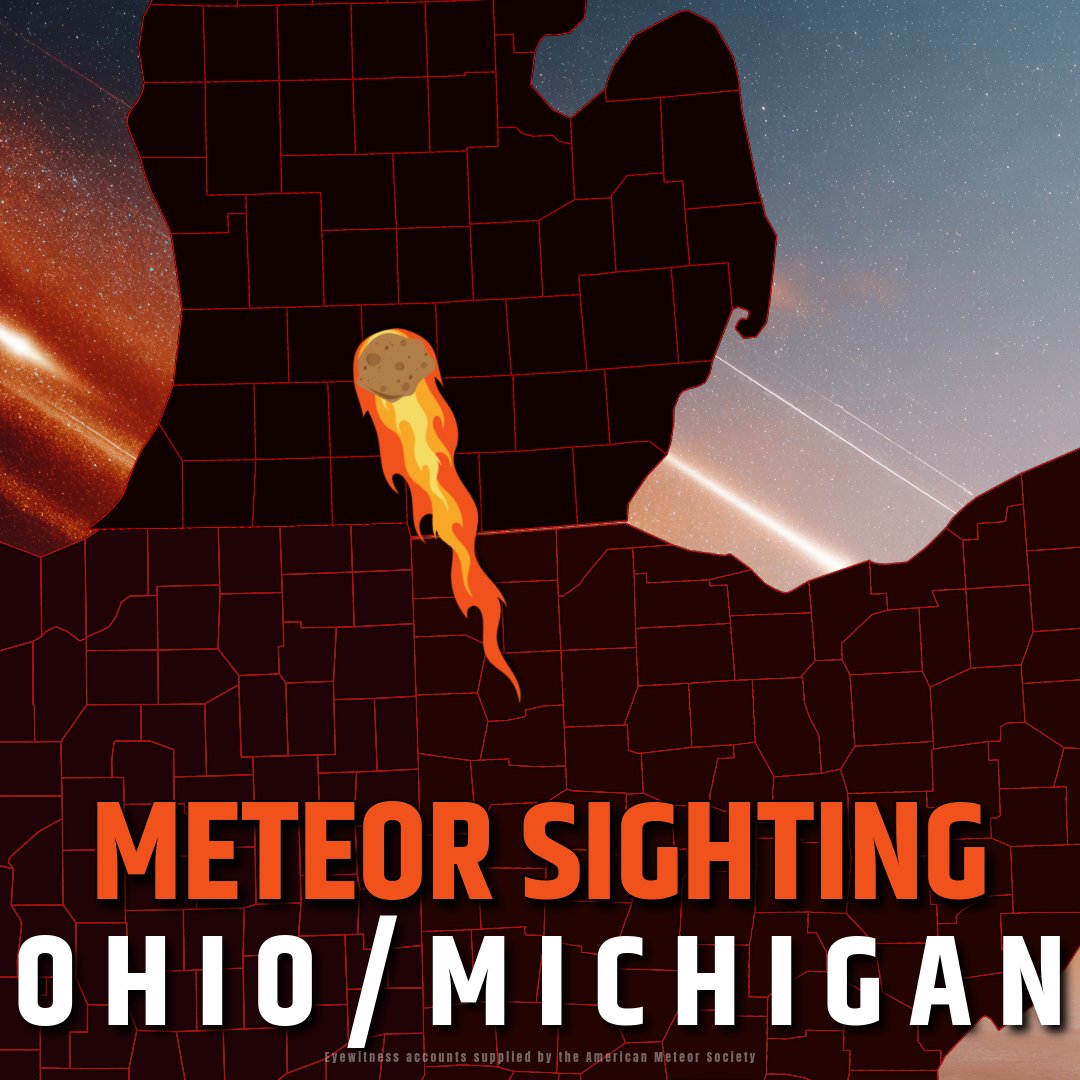
“Eyewitnesses in Ohio and Michigan reported a bright meteor on Monday, June 1, at 10:41 p.m. EDT,” the space agency said on X. ”The data puts first detection of the fireball above the Ohio area near Lima. The meteor moved north-northwest at approximately 49,900 mph before disintegrating above the area just west of Lansing, Michigan.”
According to the American Meteor Society, more than 210 eyewitness reports were submitted from Wisconsin, Illinois, Michigan, Ohio, Western Pennsylvania, Western New York State, Ontario, Canada, and even one report as far south as Kentucky. Of those reports, 95 reported fragmentation.
This makes 37 total fireball events reported in the United States by at least 50 witnesses so far this year, and one of three reported in May, according to the American Meteor Society.
“Meteors are actually quite common,” NASA said on a webpage dedicated to explaining meteors. “They occur all the time, and fireballs can be seen on any given night. But they often occur over the ocean or unpopulated areas with no witnesses, or during the daytime, making them difficult to spot.
“Viewers who catch a clear view of one in the dark skies above are treated to a spectacular sky show—but one that is hardly rare.”