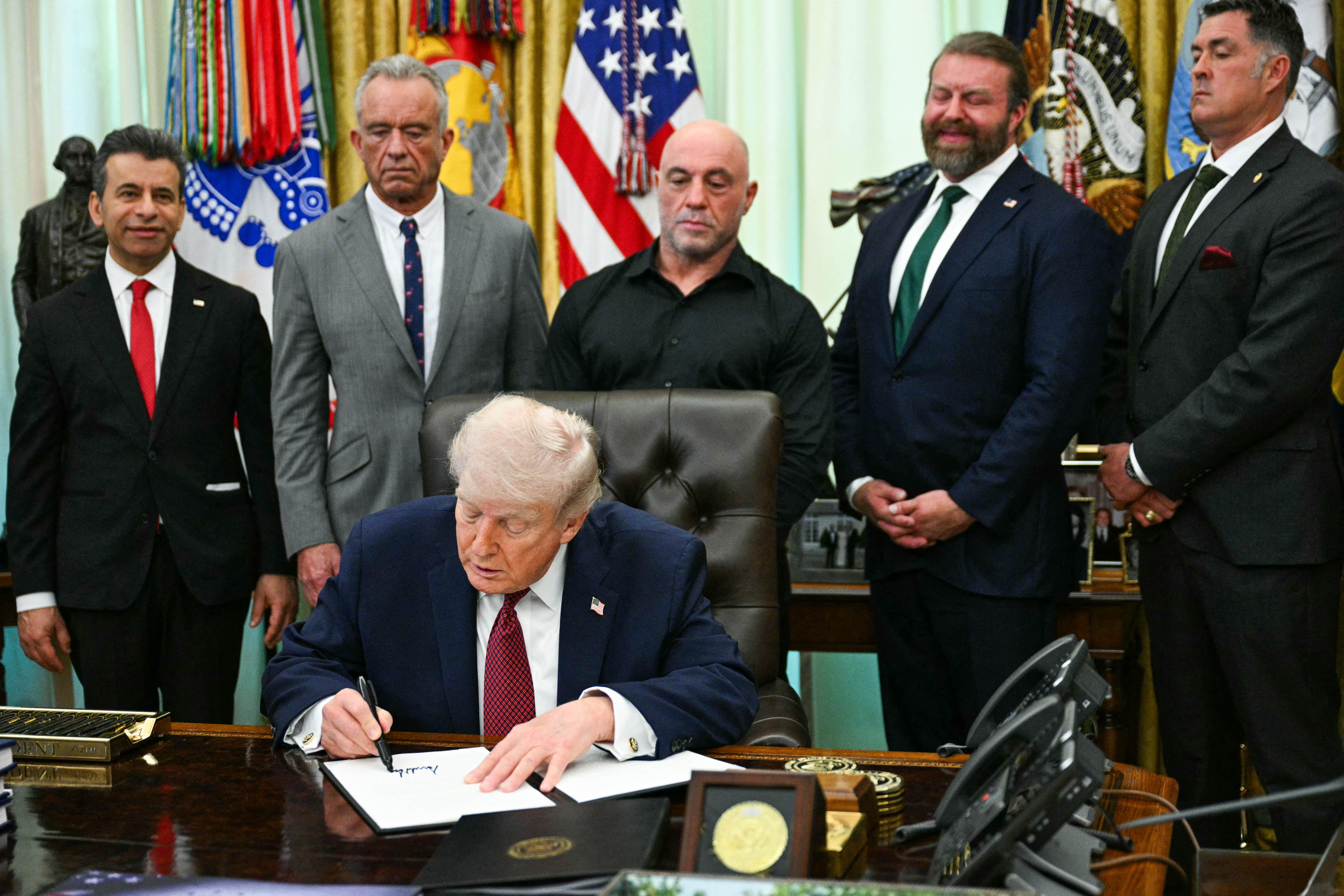

President Donald Trump signed an executive order on April 18 to expand access to psychedelic drugs as treatments for Americans with mental health disorders.
The order directed federal agencies to accelerate the process of research and approval for psychedelics, including ibogaine, a plant-derived compound currently classified as a Schedule I substance.
The order, which podcaster Joe Rogan said was issued in response to information he sent Trump, touched on a longstanding debate over mental health and psychedelics.
Here’s what Trump’s order did and how it was received by professionals.
Expanding Access
Despite decades of research, these types of drugs have yet to be approved for medical use by the federal government. Under the Controlled Substances Act, psychedelic drugs like ibogaine are still heavily regulated as Schedule I substances.
The Drug Enforcement Agency (DEA) defines Schedule I drugs as substances that “have no currently accepted medical use in the United States, a lack of accepted safety for use under medical supervision, and a high potential for abuse.”
However, the White House has painted these drugs as potential breakthroughs for mental health treatment. The administration noted that more than 14 million American adults have been diagnosed with a serious mental illness, and around 8 million are on prescription medication for these conditions.
“Psychedelic drugs, including ibogaine compounds, show potential in clinical studies to address serious mental illnesses for patients whose conditions persist after completing standard therapy,” the executive order reads.
Ibogaine, for example, has shown potential in clinical studies to improve symptoms related to depression and anxiety. It was also found to improve the function among veterans with traumatic brain injuries, according to a 2024 study by Stanford Medicine researchers.
Trump’s order directed the attorney general to review products with Schedule I substances if they had reached Phase 3, or large-scale, clinical trials. The president directed that review “so that rescheduling, if appropriate … may proceed as quickly as practicable for such specific products that are ultimately approved” by the Food and Drug Administration (FDA).
Other aspects of Trump’s order leveraged the Right to Try Act, which allows patients to access experimental drugs if they have already tried all approved treatment options.
The Right to Try Act has rarely been used for psychedelic drugs, due to many falling under the Schedule I classification. Such a classification requires additional approval from the DEA, in addition to the Right To Try’s dispensations.
Trump directed the FDA and the DEA to “facilitate and establish a pathway for eligible patients to access psychedelic drugs, including ibogaine compounds, under the Right to Try Act.”
Faster Research
The president also ordered federal agencies to speed up the development and review of potentially useful psychedelic drugs that could have applications in the treatment of serious mental health conditions.
“Despite massive Federal investment into researching potential advancements in mental health care and treatment, our medical research system has yet to produce approved therapies that promote enduring improvements in the mental health condition of these most complex patients,” Trump’s order reads.
Among other things, the Health and Human Services Department was required to allocate $50 million to support state governments that have enacted or are developing programs to advance these drugs.
Included in the order was an instruction for the FDA to prioritize some of the treatments that have already received the designation of “breakthrough therapy” and award them the Commissioner’s National Priority Vouchers.
The voucher program provides an “ultra-accelerated, 30- to 60-day review” of therapies. The “breakthrough therapy” designation is an FDA classification granted to drugs still in the experimental phase, but that show in early clinical data the potential for substantial improvement over existing treatments for life-threatening conditions.
According to the Addiction Center, ibogaine could have benefits for the treatment of depression, PTSD, and addiction given its impact on multiple receptors in the brain. However, the group also noted that some researchers have expressed concern that the very same multi-receptor interaction could contribute to increased risk of side effects or drug interactions.
The evidence on its use appears to be mixed. A literature review from 2021 found that studies pointed to ibogaine helping with trauma-related psychological symptoms and helped with substance withdrawal. However, it also said the drug posed significant safety risks, noting neurotoxic and cardiotoxic effects.
The American Psychiatric Association said in 2022 that there was “inadequate scientific evidence” to support the use of the drug. The group warned that its use could “outpace evidence-based research and regulatory approval.”
Debate Over Psychedelics
Psychedelics have long been controversial but have also received enthusiastic support from people like Rogan, who attended the signing of Trump’s order.
The Foundation for Drug Policy Solutions cited the lack of research while criticizing the order. “Because of this order, more Americans will die from these harmful drugs,” the organization said in a statement posted to social media on April 18.
The group is led by CEO Kevin Sabet, who served as a drug policy advisor under former Presidents Barack Obama and George W. Bush. In the statement, he said the “evidence for the supposed therapeutic benefits of these drugs is beyond weak.”
Health Secretary Robert F. Kennedy Jr. supported the move, saying on April 18 that Trump was removing “the legal impediments that blocked American researchers, scientists, physicians, and clinicians from properly studying these medicines.”
Tony Lyons, the president of the MAHA Action group, told The Epoch Times in an emailed statement that, the order “finally gives people a whole new class of options. … For too long, Americans suffering from mental illness have been prescribed yet another pharmaceutical product.”
The Multidisciplinary Association for Psychedelic Studies, a nonprofit research organization, spoke out in support of the order, saying that the federal action “signals growing recognition of psychedelic therapies’ potential to address urgent mental health challenges, including PTSD, depression, and substance use disorders.”
It added that “prohibition increases risks and limits oversight, underscoring the need for a public health-first approach grounded in evidence, equitable access, and responsible regulation.”
Jacki Thrapp contributed to this report.