All true readers know the delights and adventure of the clue-based treasure hunt. A friend recommends an unfamiliar book, or we come across mention of a title or author in some online article, and off we go.
Sometimes these events happily collide. An article featuring a 21st-century dad vigorously defending Eleanor Porter’s “Pollyanna” for its goodness and optimism led me to read the book—and to come down squarely on the father’s side. Later, a friend who loves children’s classics practically ordered me to read Lucy Maud Montgomery’s “Anne of Green Gables,” which I began reluctantly and finished with high enthusiasm, if for no other reason than the beauty of the prose. “Anne of Avonlea” is now on my reading list.
Montgomery’s 1908 story of the irrepressible Anne Shirley and Porter’s 1913 tale of the upbeat Pollyanna Whittier stayed with me. If we keep in mind that these novels were written for adults as well as adolescents, together they reflect an age of sunshine, confidence, and hope in the future—before the storms of the 20th century cast dark shadows over that good cheer.
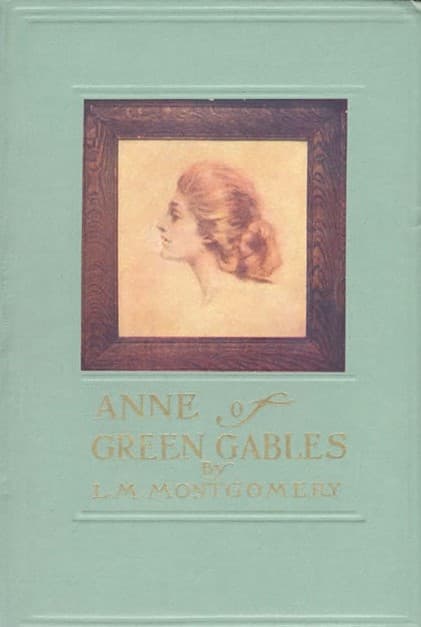
Cover of the first edition of Lucy Maud Montgomery's "Anne of Green Gables," 1908. (Public Domain)
Recently, thinking of Anne and Pollyanna, and of Montgomery and Porter, I wondered what other writers of their time offered as a similar take on life. Those online searches, one clue leading to another, brought me to a woman about whom little is known but whose zest for life, literature, and learning still burns like a flame.
Meet Mary Elizabeth Burt (1850–1918).
The Teacher, Fine Writing, and Patriotism
Details about this writer, teacher, and editor are scant. The entry in “Woman’s Who’s Who, 1914–1915,” which Burt likely composed herself, lists the schools she attended and where she taught, the books and articles she wrote or edited, and a few causes that engaged her, including equal pay for primary school educators and women’s suffrage.
If this inventory were the only information available, we might know next to nothing about Burt—her thoughts or impact on the America of her time. Fortunately, in two anthologies she edited, “Poems Every Child Should Know” and “Prose That Every Child Should Know,” Burt reveals something of herself.
In “Prose,” Burt immediately puts several questions to the reader, beginning with this one: “Is ‘Prose Every Child Should Know’ a collection of hit-or-miss selections scrabbled together, guess-work fashion, just to sell?” After answering no to this question and others, she writes:
“This volume is a growth. It is the growth of a life-time, based on happy hours in School and Sunday school, Study-hours with great teachers, Debating Clubs, Teachers’ meetings, and conferences with unworldly women and great men. It is the crystallization of childhood’s intense emotions when the big boys and girls, their faces aglow, spouted declamations; the recollections of Fourth of July celebrations when General Boyd made speeches and some loyal citizen read the Declaration of Independence, solemnly publishing and declaring anew that ‘these united colonies are, and of right ought to be, free and independent.’”
Here is an educator who clearly enjoyed teaching, admired good writing, and loved her country. Several times in the introduction and in her comments throughout the book, Burt reinforces these impressions.

Poetry is food for the soul, and early exposure to it can give children a greater capacity for spirituality. (Alla Bielikova/Getty Images)
Poetry and the Imagination of Children
In the Preface to her 1904 “Poems Every Child Should Know,” Burt also begins with a question. This one brings a chuckle: “Is this another collection of stupid poems that children cannot use?” Here is a woman with a sharp sense of humor. Again, of course, she answers in the negative.
Here, too, is a teacher at work. She advocates, for instance, that schools have poetry hours and recommends memorization, but she also recognizes that longer poems may be too much for many children. Have children memorize some portion of a poem, she tells parents and teachers, or assign different parts to different students and have them recite together. The value lies in the poetry itself.
“They should store up an untold wealth of heroic sentiment; they should acquire the habit of carrying a literary quality in their conversation; they should carry a heart full of the fresh and delightful associations and memories, connected with poetry hours to brighten mature years. They should develop their memories while they have memories to develop.”
And here again is the patriot. In writing of the value of memorization, Burt tells readers: “There is a duty, even there; for every American citizen ought to know the great national songs that keep alive the spirit of patriotism. Children should build for their future—and get, while they are children, what only the fresh imagination of the child can assimilate.”
Intelligence and Good Taste
Burt’s choice of poems and prose pieces in these anthologies reveal an educated woman who knew her classics—nursery rhymes, fairy tales, American history, Greek philosophy, and more.
“Poems” offers a number of standard pieces, from Eugene Field’s “Wynken, Blynken, and Nod” to Tennyson’s “Charge of the Light Brigade.” What makes this collection stand out today are the less familiar poems, such as Charles Kingsley’s “A Farewell”:
My fairest child, I have no song to give you;
No lark could pipe to skies so dull and grey;
Yet, ere we part, one lesson I can leave you
For every day.
Be good, sweet maid, and let who will be clever;
Do noble things, not dream them, all day long:
And so make life, death, and that vast for-ever
One grand, sweet song.
Burt’s “Prose” offers even more unfamiliar inclusions. Among these is a paragraph from Founding Father John Adams in which he uses the making of salt by the Jersey shore to impart a lesson about the value of the very young and the very old. In a speech before Congress, Abraham Lincoln humorously tells of spending his time in the Black Hawk War fighting mosquitoes. Burt arranges the material by reading difficulty and comprehension, producing an anthology that appeals to students from kindergarten through college.
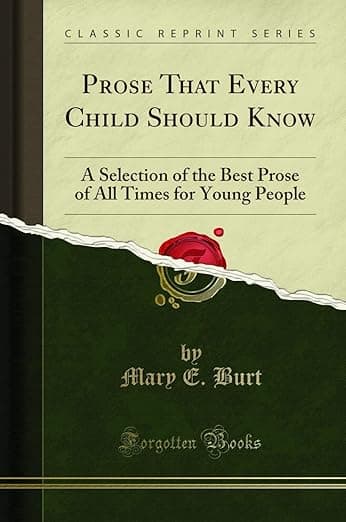
Mary E. Burt's anthology reflects a lifetime of reading, teaching, and patriotism—offering young readers a guided path into literature and character. (Forgotten Books)
In compiling “Prose,” Burt follows a sturdy American tradition dating back to Caleb Bingham’s “The Columbian Orator,” a 1797 compendium of poetry, articles, and passages from books, speeches, and plays. Designed to teach oratory, this masterpiece influenced many Americans down through the 19th century. Later editors, such as the anthology edited by William Bennett, “The Book of Virtues” and its offshoots, continued that tradition.
At one point, Burt speaks impersonally but with obvious pride in her own work as an editor. She compliments Nathaniel Hawthorne’s editing of myths and poet Sidney Lanier’s Arthurian tales, and then adds:
“After these earnest souls let the editor approach his work ‘with bent head and beseeching hands,’ for he stands on holy ground. For there is more religion in editing one good book that shall carry forth and hand down the torch of life, than in writing a dozen of indifferent merit.”
Many passages in “Prose” are preceded by Burt’s remarks. From these comments, we learn more about her life and her beliefs, and some excellent history. This example accompanies Count de Mirabeau’s “Eulogium on Franklin”:
“Franklin lived on yellow corn-meal pudding when it was necessary and dined with kings when the call came. If you want to see his grave, you can hang with a crowd of his admirers on a fence around the square in which he is buried in Philadelphia. You will always find a crowd there. And yet we call him dead.”
The Books Are Yours for the Taking
This same tribute to Franklin might well apply to all the writers collected in Burt’s anthologies. Their words still speak to us, some from as far away as ancient Jerusalem and Athens, others from Burt’s own era.
But these voices are heard only if there are ears to listen. In her Introduction, Burt writes: “‘Prose Every Child Should Know’ is a reading book for home culture. And it is a collection of recitations for school-use.”
Here Burt correctly implies that education and the home remain the principal means by which culture passes from one generation to the next. Both books are available in print and online. If you’d like to add to your “home culture”—what a beautiful duet those two words sing!—take a look at Burt’s books and see what you think.
What arts and culture topics would you like us to cover? Please email ideas or feedback to features@epochtimes.nyc.