What does it take to transition a teenager into manhood?
Since the turn of the century, a small army of authors, commentators, ministers, and psychologists has run through millions of words trying to answer that question. They recognize that today’s teens are facing impediments to manhood—the absence of fathers in many families, for example, or the prevalence of pornography and addictive video games—that previous generations rarely, if ever, encountered.
Recently, the 36-year-old headmaster of a boarding school for boys added a richer philosophical perspective to this discussion.
“The whole point of that period between childhood and manhood is to transition from a point where you are receiving everything to a point where you are giving everything,” Ben Strong told The Epoch Times. “We live in a world marked by unhappy men who don’t know what it means to be a man because they’ve never experienced doing, giving, and sacrificing.”
Strong then shared some practical ideas on how this trend might be reversed.
True Manhood Means Self-Sacrifice
Strong, who founded
Saint Andrew’s Academy in Kentucky just three years ago, gained this insight from an unexpected source.
“We had some monks visit the school, and we were discussing this idea of what it means to be a man,“ Strong said. ”One of the ways it was defined by the monks is that a child fully receives everything. He receives his food, his lodging, his knowledge, his care and support from another. A man can be defined almost completely by the fact that he lives for others. He lives in a sacrificial mode.”
The association of manhood with sacrifice is nothing new. Down through the ages, cultures around the world expected fathers and husbands to act as protectors and providers for their families. Both roles often meant sacrificing their own desires and needs—and sometimes their lives—not only for the good of their wives and children but for others as well.
And plenty of men do the same today. They are loving husbands and fathers; they care for their aging parents; they work hard for a living and contribute to society. Strong himself is one of them. A father of three with a fourth child on the way, he serves his school and his family.
Yet the insights about a missing link between boyhood and manhood seem profound. Rather than being taught a spirit of sacrifice, far too many adolescents and teens grow up believing that it’s better to receive than to give.
“We live in a consumerist society,” Strong said. “We buy everything. We push a button, and we have food. We want entertainment, we push a button. All those opportunities to experience the joy that comes from effort and sacrifice are undermined by this consumerist mentality. The message a boy hears is to buy things, and you’ll be happy.”
A Vision
Founder as well as headmaster of St. Andrew’s, Strong hopes to have a hand in restoring the sacrificial meaning of manhood. The school follows a classical curriculum, emphasizes sports and manual arts, and offers extracurricular activities such as singing and juggling.
Strong’s high-minded plans for the academy can inspire parents everywhere, whatever schools their sons attend.
“Plato says that the whole object of education is to teach men to love what is lovable, what is beautiful,“ Strong said. ”I think those two things are the values you would want instilled in boys: That they love what’s true, what’s good, and what’s beautiful, and they’re willing to sacrifice for those things.”
At the same time, Saint Andrew’s owes a debt of gratitude to a humanities curriculum at the University of Kansas, the Integrated Humanities Project (IHP). Founded in 1970 and lasting only a decade, IHP nonetheless continues to influence some Catholic schools and educators today. Particularly influential in this program was John Senior, author of “The Restoration of Christian Culture.” Senior also wrote a book list for the young, “The Thousand Good Books,” which can be found online and comes highly recommended by Strong.
IHP’s motto, “Nascantur in admiratione,” or “Let them be born in wonder,” is one of Strong’s guiding lights in his philosophy of education.
“I think a young man experiences delight in knowing what a human being is meant to know. There’s a joy and a satisfaction that comes from fulfilling your nature,” he said. “That kind of poetic approach that’s very experiential, when you’re engaging in the world and the people around you, really results in a desire to know more.”
Putting Vision Into Action
Strong’s work as a teacher and headmaster, his broad reading about boys and education, and his own experience make him a storehouse of information regarding practical ways parents can help their sons transition into manhood.
“One of the most effective tools, especially for the very young, is to engage them in the real world,” Strong said.
Reading books to the young, introducing them to nature—whether it be a woodland or the backyard—and simply spending time engaging with them are vital to their development of wonder and learning.
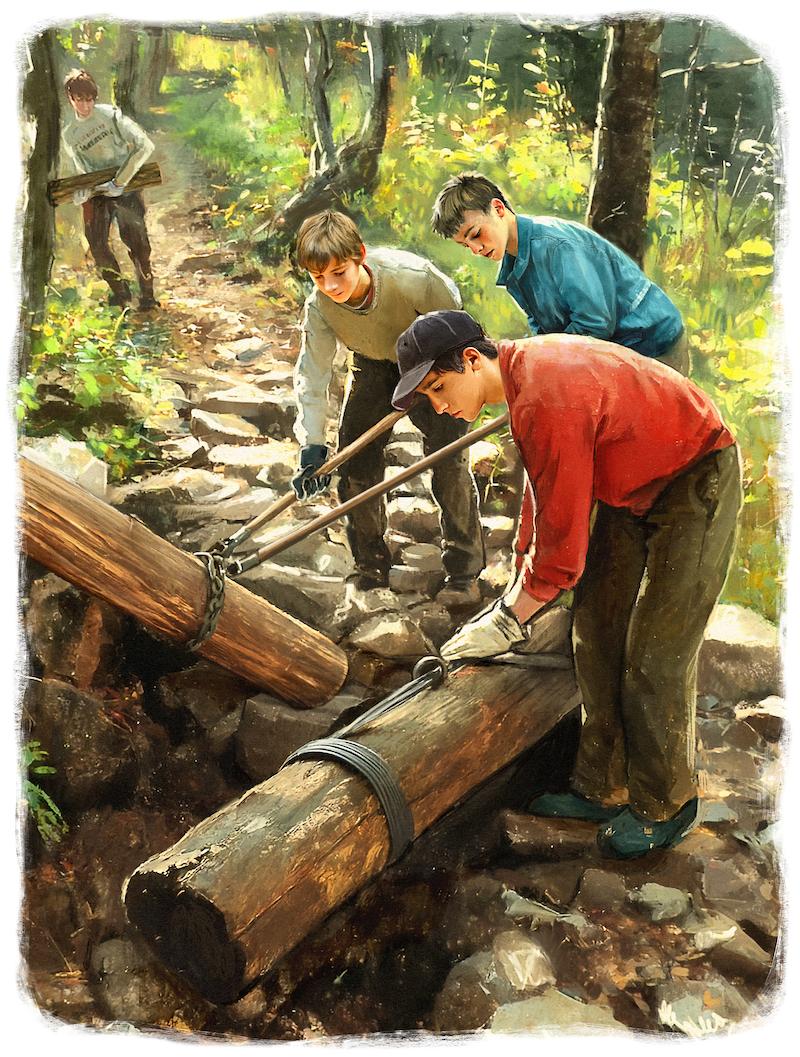
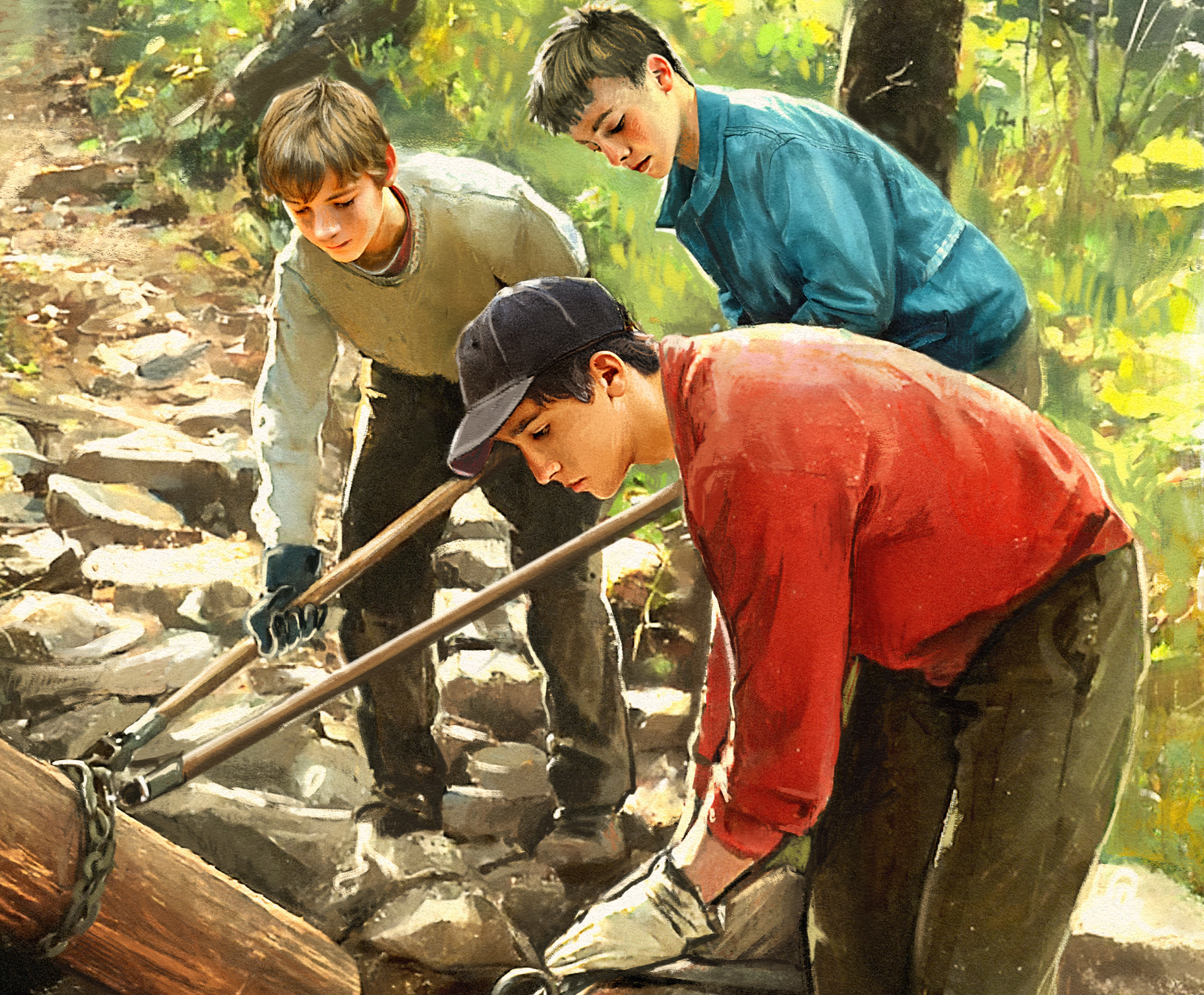
Manual labor, especially when done in community, helps boys transition from passivity to participation and generous self-sacrifice. (Biba Kayewich)
Put Away the Screens
The boys attending Saint Andrew’s have no access to cell phones, laptops, or tablets. For calls home or in cases of emergency, they use the school’s phones. In this way, they focus their attention on activities and building friendships rather than using their time looking at screens.
“Cutting the cord on electronics is huge,” Strong said. “From an early age, you’re overstimulated, and you don’t develop the habit of looking outward in an active way. Our children are trained to be passive from the moment they enter the world, and I think that’s crippling to them.”
For years, authors and researchers like Jonathan Haidt have warned of the detrimental emotional and mental effects of screens on the well-being of children and teens. Strong highly recommends that parents either dispense with them entirely or keep close watch on how much time their children spend on screens and what they are watching.
Becoming a Giver
Strong also stresses the importance of giving children responsibility from an early age.
“You know, helping set the table, picking up their toys,” he said. “Slowly, they’ll realize there’s a joy that comes with doing something and not just receiving something.”
Parents, mentors, and researchers have long known that the small tasks given to children, increased in time and labor as they grow older, make them feel more a part of a family and teach the value of work and giving.
The Three-Step Transformation
Perhaps most important of all are the later teen years, when the journey to manhood begins in earnest. Here, Strong referenced Jason M. Craig’s book “
Leaving Boyhood Behind,” which explains this transition as a three-step process of separation, initiation, and incorporation. College and the world of work are typical places where this transformation can occur. Strong offered the military as another institution in which young men bid farewell to their old life, endure boot camp, and become full-fledged members of a team.
“At some point, there has to be a necessary separation, or a removal from that world of receiving into one of giving and sacrifice,” Strong said. “And the most important phase is incorporation, where now you’ve left the world of a boy and been initiated into the world of man. You’ve done the difficult things that you’ve seen the men doing and experienced the joy that comes from sacrificing, from working, and you’re now visibly part of this group of men.”
To these attributes of manhood—a sense of wonder, an appreciation of beauty, a grasp of goodness and truth, and the willingness to give ourselves to what we treasure—Strong adds the capstone of religious faith.
“If you’re not looking to the source of life, love, and joy, you’re setting yourself up for failure. All of these things are the fruit of grace,” he said.
In short, as Strong himself said, “you love wholeheartedly what’s good, and you sacrifice for that which you love.”