
Commentary
Prices for medical insurance in the United States keep rising at twice the rate of inflation. It’s putting unbearable strains on families, individuals, and businesses.
The same is forecasted to happen next year and the next. Those who can are leaving the system altogether and just going without. Others are finding alternatives in crowd-sourcing services. Businesses are freezing employee levels at 49 to avoid crossing the threshold that requires them to provide insurance to employees.
As all Americans know, having medical insurance doesn’t mean that your bills are paid. It means that you have access, like a membership card. You still have to pay for services and products all the way up to your deductible. After that, the insurer can deny your claim and you have to pay in any case.
There is no rewards system, cash back, or annual yield. It’s pure expense with possibly zero benefit.
Everyone knows that this is madness. You can’t have useless medical insurance that costs more than a mortgage, but that’s what is happening to families of four to six. They are paying $4,000 and higher per month, but they are often afraid to go without. This is unsustainable. Everyone agrees. But there is no pressing political movement to do anything about it.
Let’s examine a detailed report from KFF Health News on this. It reveals the following.
The average annual premium for employer-sponsored family coverage reached $28,303 in 2026 (up by 5 percent). Workers themselves paid $7,471 on average (up by 9 percent from the previous year). That’s roughly the cost of a new car every year. Workers’ share rose much faster than wages or inflation. Small-firm workers paid even more, about $9,687 toward family coverage. That is hurting job growth and hiring.
If these people could be given the right to take the salary instead of the supposed benefit, millions of people would do that. That is mostly not permitted. Both employees and employers are forced to fork over. And that’s the best case because it comes through the employer. The exchanges are far worse.
U.S. health spending hit nearly $5.3 trillion in 2024, more than $15,400 per person.
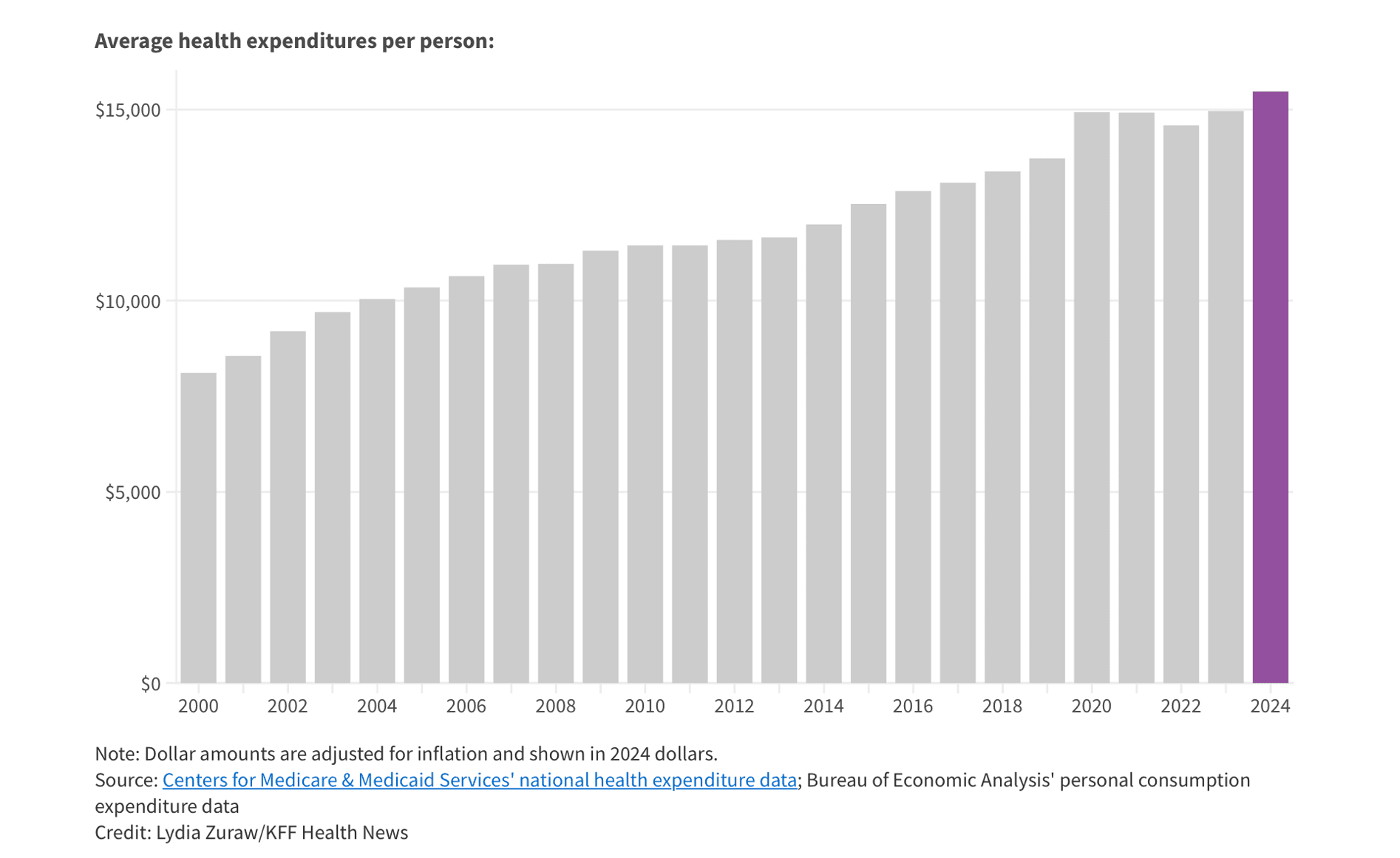
It is projected to reach 20 percent of gross domestic product by 2032 (from just under 19 percent today). Spending has grown far faster than the overall economy in recent decades.
This is not growth, much less prosperity; it’s evidence of spreading waves of ill health.
Then there’s Affordable Care Act (ACA) marketplace shock. An estimated 4.8 million people were expected to go uninsured in 2026 after enhanced ACA subsidies expired. Marketplace premiums had already jumped sharply (by 26 percent); insurers in multiple states later sought median hikes of about 14 percent to 15 percent for subsequent years amid enrollment drops. Some people saw monthly premiums jump from a few hundred dollars to $2,000.
The reports offer some vivid anecdotes.
A Kentucky skate shop owner switched from a gold ACA plan ($750 deductible) to a bronze plan with the same monthly premium but an $8,450 deductible—roughly one-quarter of his $33,000 annual income.
A Tennessee couple saw ACA premiums leap to $2,500 per month from $250 after subsidies expired; one later qualified for Medicare at far lower cost while the other sought employer coverage.
A South Carolina family’s bronze plan would have cost $1,400 per month with a deductible of more than $10,000; they dropped most coverage and insured only their child.
An uninsured Florida travel nurse faced a $93,000 hospital bill after a stroke (later reduced to about $50,000). Stress over bills contributed to a second stroke.
There are multiple stories of people delaying surgery, rationing or stopping medications (including glucagon-like peptide-1s and cancer-related drugs), raiding retirement/savings accounts, selling homes, filing bankruptcy, or living with untreated conditions (e.g., incontinence because a colostomy was unaffordable).
What is the state of public opinion on all this? People are rightly very angry, and scared.
Healthcare costs are tied with gasoline as Americans’ top economic worry (about 26 percent “very worried,” with overall worry about 60 percent). They outrank food, utilities, and housing for many. Health costs are a top midterm election issue.
Roughly 28 percent of adults skipped or postponed needed care in the past year because of cost (higher among the uninsured, younger adults, and lower-income groups). About 43 percent reported not taking medication as prescribed because of cost (not filling prescriptions, splitting pills, or substituting over-the-counter drugs).
Nearly half of working-age adults are under-insured by some measures (uninsured, coverage gaps, or underinsured with high costs relative to income). High-deductible plans and cost-shifting are pushing people with chronic conditions (diabetes, multiple sclerosis, cancer, arthritis, etc.) to skip care.
Employer plans cover 150 million people; 44 percent of large employers raised worker contributions in response to rising premiums. Glucagon-like peptide-1 weight-loss drugs had a “significant” effect on drug costs for 29 percent of companies.
The policy backdrop includes the end of enhanced ACA subsidies, effects of the One Big Beautiful Bill Act, and ongoing debates over essential benefits, catastrophic coverage, and hospital prices.
The Trump administration was right to end the subsidies and Congress was right to go along. Why should taxpayers be on the hook to pay for a broken system? The trouble is that the Republicans did not push a dramatic reform in its place. The people are left holding the bag.
This is a massive failure on the part of the party that controlled both houses and the presidency.
What should they have done? We need the following reforms, hardcore, and now, lest we drift toward a full nationalization and socialism.
Access to unlimited health savings accounts needs to be universalized for all adults, not just those with existing coverage from employers or the exchanges.
The mandate on businesses needs its floor raised from 50 employees to 500 or eliminated altogether.
Insurers need to be able to offer purely catastrophic care (no wellness checkups) with high deductibles. Those are currently not available, which is ridiculous.
Premiums should be permitted to adjust downward for individual health risk, same as car, home, or life insurance. Public subsidies, carefully monitored, can be made available for high-risk populations with incentives to get healthy when possible.
The very definition of what constitutes medical care needs to be broadened to include a huge range of providers, thus breaking up the allopathic cartel.
These are all commonsense reforms. They could dramatically reduce the amount individuals and families pay starting today. Why are they not being pursued? Because special interests do not want reform. They are making too much money as it is. Sadly, that is where we are.