
Commentary
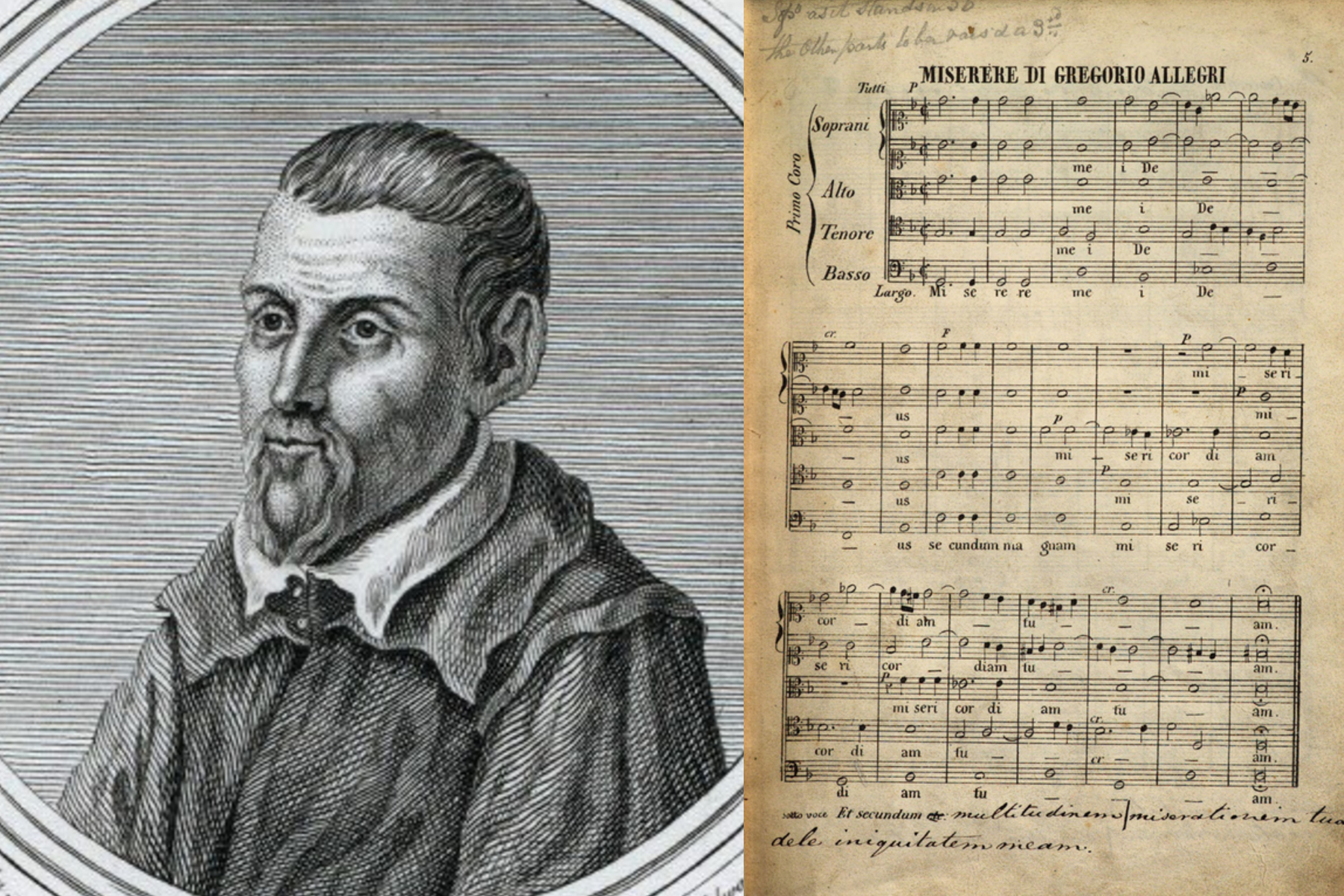
When I first encountered music of the Renaissance, one piece stood out to me for its soaring and eternal beauty which I found unfathomable. The piece was called “Miserere mei” and the composer was Gregorio Allegri who lived from 1582 to 1652, hence a life in composition overlapping with much more famous people like Claudio Monteverdi. This is pretty much the only composition for which he is known.
It is a haunting polyphonic setting of the text “Have mercy on me, O God,” that is at once simple—what’s called falsobordone, or harmonized chant, not as complex as others of the 1630s were composing—but also with this mysterious eternal reach. It features a soaring high C in the soprano part that sounds like a cry of pain, a plea for mercy, or an angel granting grace; it’s not clear which. Regardless, one cannot stop listening.
Then you encounter the urban legend, partly true and partly not, and here is where the action and insight arrive. First the quasi-apocryphal legend.
The piece was composed for Pope Urban VIII. He was impressed. It was performed annually during the Lenten Tenebrae services at the Sistine Chapel. It was so beautiful that people would come from all over Europe just to hear it.
The Pope was very anxious to keep the manuscripts in the private possession of the Vatican. Thus did he issue an order of excommunication to anyone who would sneak it out.
Intriguing! But it gets crazier. Fast forward a century and a half later. As a young man, Wolfgang Mozart visited the Vatican during Holy Week in the year 1770. He was 14 years old. He listened intently and then left. When he had access to paper, he wrote out the whole piece from memory and spread it around, first to his father back home and then to everyone else.
The Pope was initially furious that the great secret had been revealed. But then in thinking it over, he decided to forgive the sin because such extraordinary art really should belong to the entire world. It’s Mozart’s version, the legend says, that you hear today.
What is true and not true? It’s true that Allegri composed a Miserere. It’s true that it was and still is beloved. It’s true that the Papacy was possessive of it. It’s true that Mozart went to Rome at 14 and copied down the piece from memory.
Here is where matters get complicated. The version you hear today bears only vague resemblance to what Allegri composed. It certainly lacks the high C and the structure and even text of the Psalms are different. The original likely relied on improvised ornaments, so any reconstruction involves interpretation. Performed as written, it’s slightly boring.
How do we know that Mozart did transcribe it from memory? It all traces to a letter his father Leopold wrote, which is the main source of the legend as it developed.
“You have often heard of the famous Miserere in Rome,” the letter to his wife says, “which is so greatly prized that the performers in the chapel are forbidden on pain of excommunication to take away a single part of it, to copy it or to give it to anyone. But we have it already. Wolfgang has written it down. … Wolfgang is splendid.”
There it is! The trouble here is that no one has ever found any order of excommunication related to the piece in the edicts of Urban VIII or any later popes. In other words, it’s very possible and likely that Leopold was exaggerating and creating drama around his son’s talents, as dads are wont to do.
The other problem is that it is unlikely that Mozart was the first to reveal this piece. Copies of the written music circulated in Rome. By the mid-18th century the piece had already been performed in London, some 30 years before Mozart was in Rome. Very interesting!
But actually, it gets stranger still. As it turns out, the version you hear today—my own choir under my direction performed this once in Holy Week—is neither Allegri’s nor Mozart’s version. We do not have Mozart’s version at all but we do have Charles Burney’s 1771 publication, probably a version of Mozart’s. Burney’s version is relatively plain and lacks the famous ornaments.
As it turns out, its most signature sound of the wildly dramatic high C was a later addition by the English choral school of performance. That’s the one we have. It has this perfection about it, and, if you have an ear for these things, it does in fact sound suspiciously like 19th century origin, almost like a Romantic recreation of a late medieval piece. That is because that is what it is!
Does this take away any of the magic? Well, in the world of musical composition, we like hunting for singular geniuses. We talk about Bach, Mozart, and Beethoven as if they were touched by the gods to give us revelation. We celebrate them as mighty heroes. That’s all fine but this valorization of the single genius creator obscures a grittier reality.
In the real world, art and music take a more iterative path. Think about the song “I Will Always Love You” made famous by Whitney Houston, who in turn became legendary for that performance. I had not known until recently that it was actually composed by Dolly Parton. When you hear her version, it’s nice but nothing compared with what Houston and her arrangement did to it.
I feel that way about much of Bob Dylan’s music. It’s much more impressive in later versions. With much of this popular music, it really does take a village to make most masterpieces. We need covers of the original in order for the art to find its destiny.
Or consider Barry Manilow’s “Could It Be Magic” which is built directly on Chopin’s Prelude in C minor. And there is “All by Myself” by Eric Carmen, which is really the second movement (Adagio sostenuto) of Rachmaninoff’s Piano Concerto No. 2 in C minor. These are both wonderful examples of the sheer adaptability of a great idea in art.
And this is just in the few decades of our time! Imagine if we were talking about four centuries! How many iterations, covers, mutations, and versions will there be of truly great music? Plenty.
Which finally raises the profound question. Who precisely is responsible for the version of the Miserere we hear today and the one I conducted? The answer is William Smith Rockstro, an English musicologist of the Victorian period. His edition came out in 1880 and changed performance throughout the world. Of course it is still attributed to Gregorio Allegri but actually there were many composers and performers who made it what it is.
So listeners who detect in this piece just a hint of Victorian-era Romanticism are wholly correct. It is indeed a recreation, an idealization, of the original from hundreds of years earlier. In the same period, musicologists were doing the same to Gregorian chant itself, a subject for another time.
Yes there are geniuses, singular figures who leave us perfection. But the dominant pattern looks more like evolution than creation, the sharing of ideas across communities and cultures and over periods of time stretching back centuries. I find that charming and almost as magical as the legend.