

NR | 1h 42m | Documentary | 2026
Cement and concrete are not the same material. The former serves as an ingredient of the latter when combined with water, sand, and gravel. Viewers will definitely learn the difference if they watch John Wilson’s new documentary, “The History of Concrete.”
But that might be the only practical fact they learn from it. Wilson uses concrete as a launching pad for his musings on modern life. He discusses the state of his home city (New York City) and his career doldrums. He covers numerous other tangential topics that come to mind throughout his free-associational, tongue-in-cheek documentary.
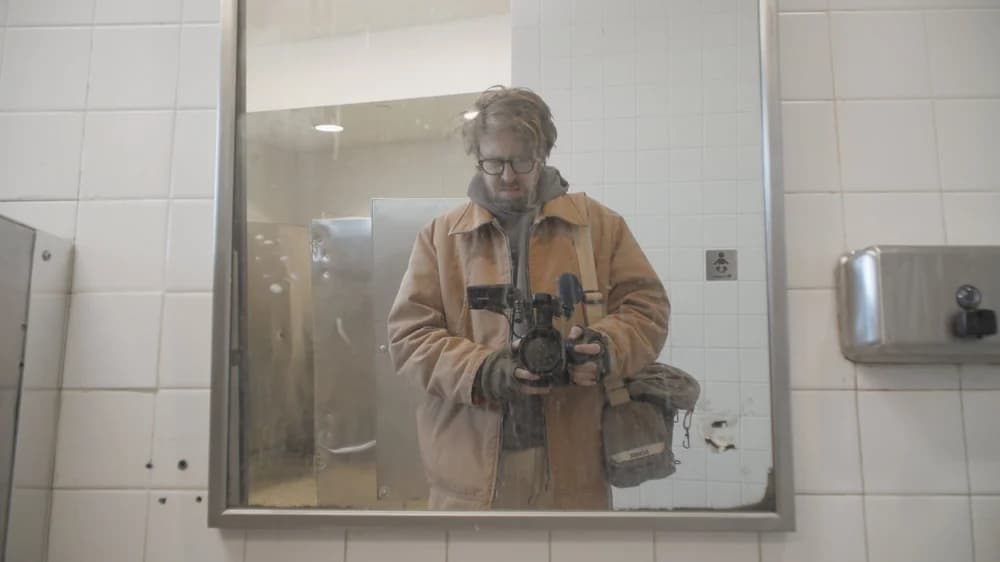
John Wilson, in "The History of Concrete." (Magnolia Pictures)
Wilson thought he would achieve fame and fortune through his HBO series, “How To With John Wilson,” until it was canceled after the third season. Now his residual checks are dwindling, along with his agent’s interest in his proposed next project.
Nobody really shares his fascination with concrete. Of course, Wilson isn’t even that captivated by it either, per se. For the filmmaker, its omnipresence makes it a metaphor.
Frankly, the resulting film is more like a piece of performance art than a documentary. The big question driving “The History of Concrete” is whether or not Wilson successfully manages to complete a film about such a prosaic-sounding subject. (Obviously, he did, or this review would not exist.)
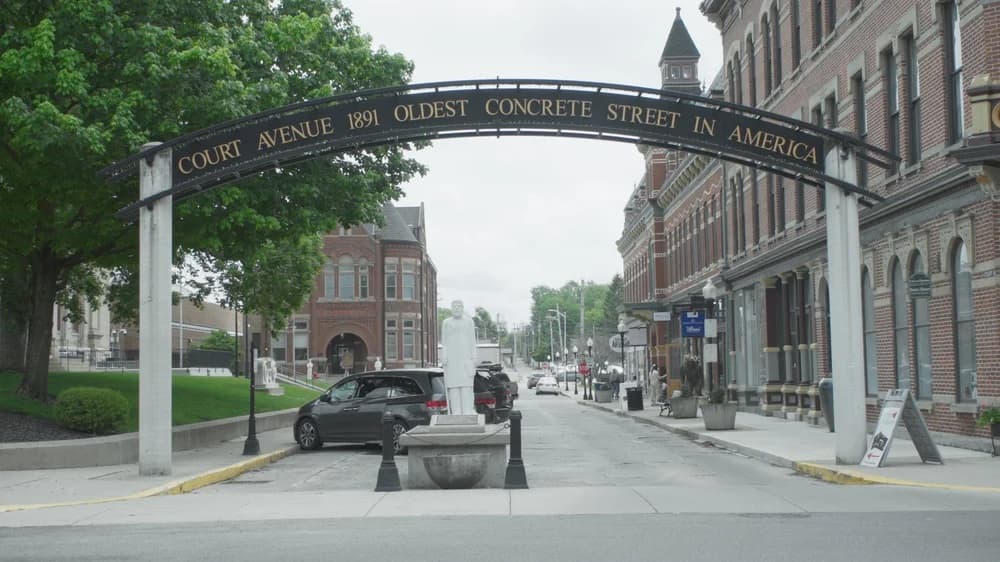
A scene in the documentary "A History of Concrete." (Magnolia Pictures)
Events and Byways
Along the way, he attends a seminar on screenwriting for Hallmark Channel original movies, expenses a trip to Rome (for the crumbling concrete landmarks), and attends a banquet in honor of Kim Kardashian. He also observes the “Sri Chinmoy Self-Transcendence 3,100 Mile Race,” a yearly 52-day event run over the same half-mile loop of concrete sidewalk.
For Wilson, one thing always leads to another, so when he meets a sales associate at a concrete industry convention who acts on the side, he naturally visits the set of the concrete-slinging actor’s latest short film.
To be fair, Wilson’s deliberately free-wheeling approach also sometimes tackles issues of urban development. In particular, he examines the decrepit-looking condition of New York City’s concrete-based infrastructure; this is exemplified by the visibly cracking triple-cantilevered section of the Brooklyn-Queens expressway, or BQE.
Wilson also discusses the environmental impact of coastal sand depletion to meet the world’s ravenous demand for concrete. Yet, instead of predictably scolding the United States, Mette Bendixon, his expert on the subject, trenchantly observes: “China used as much concrete, which is a proxy for sand, between 2011 and 2014 (just three years), as the entire United States did over the last century.” That certainly puts global demand in perspective.
While Wilson’s tangents usually result in a more whimsical tone, his chance encounter with Jack Macco, a hardcore metal bandleader, blossoms into a surprisingly endearing friendship. Both have their eccentricities, but they can forge mutual human connections. Macco’s scenes, which dominate the final third of the picture, have little to do with concrete, but they help define Wilson’s journey pursuing the project.
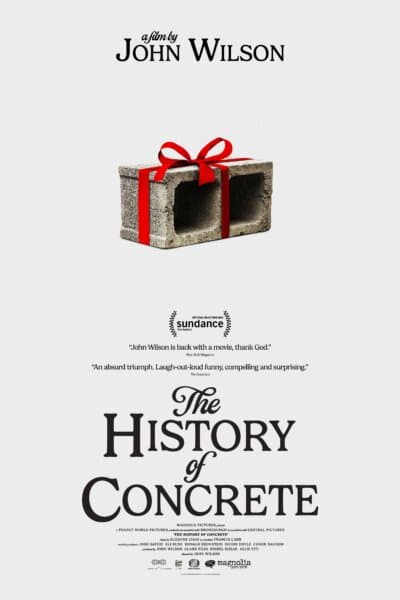
Poster for the documentary "The History of Concrete." (Magnolia Pictures)
Acquired Taste
For fans of Wilson’s HBO series, his discursiveness is the whole attraction, so it really isn’t fair to criticize him for doing what he is known for doing. However, his idiosyncratic style will inevitably alienate many accidental viewers. Wilson is very different from Mike Rowe. He never gets his hands dirty, but he will bear his soul.
Wilson is surely an acquired taste. Even his style of narration in the second person (instead of “I went here,” the filmmaker tells the audience “you go here”) will be off-putting to some. However, for those who acclimate to Wilson’s quirks, they become part of his oddball appeal.
Ironically, Wilson might just convince New Yorkers they should probably take a good, hard look at the concrete around them. According to Wilson, white concrete cracks more easily than other colors, but architects and their corporate clients often believe the former looks classier, so you will find a lot of it in Midtown skyscrapers.
As a nebbish on-camera presence, Wilson is a bit like a Michael Moore without the ideological baggage; Wilson largely eschews politics throughout “The History of Concrete.”
On the other hand, he also lacks Moore’s locked-in focus. To some, this is charming, and to others, it will be maddening. Most people should already have a good idea which way they lean.
For the open-minded and undecided, Wilson makes some interesting points. But he also surrounds them with a good deal of navel-gazing. Given its inconsistencies, even those intrigued should probably wait until “The History of Concrete” releases on affordable streaming platforms.
“The History of Concrete” releases in theaters Sept. 18.
‘The History of Concrete’
Director: John Wilson
Documentary
Not Rated
Running Time: 1 hour, 42 minutes
Release Date: Sept. 18, 2026
Rated: 3 stars out of 5
What arts and culture topics would you like us to cover? Please email ideas or feedback to features@epochtimes.nyc