
NR | 1h 47m | Documentary | 2026
When “The Satanic Verses” was published, Iran’s Ayatollah Khomeini leveled a fatwa (death sentence) against British author Salman Rushdie. In the years that followed, Rushdie fiercely advocated for freedom of expression—and bears the scars to prove it.
Viewers can see them for themselves. Rushdie’s wife, Rachel Eliza Griffiths (credited as executive producer and cinematographer), shot footage as he recovered from the notorious 2022 attempt on his life.
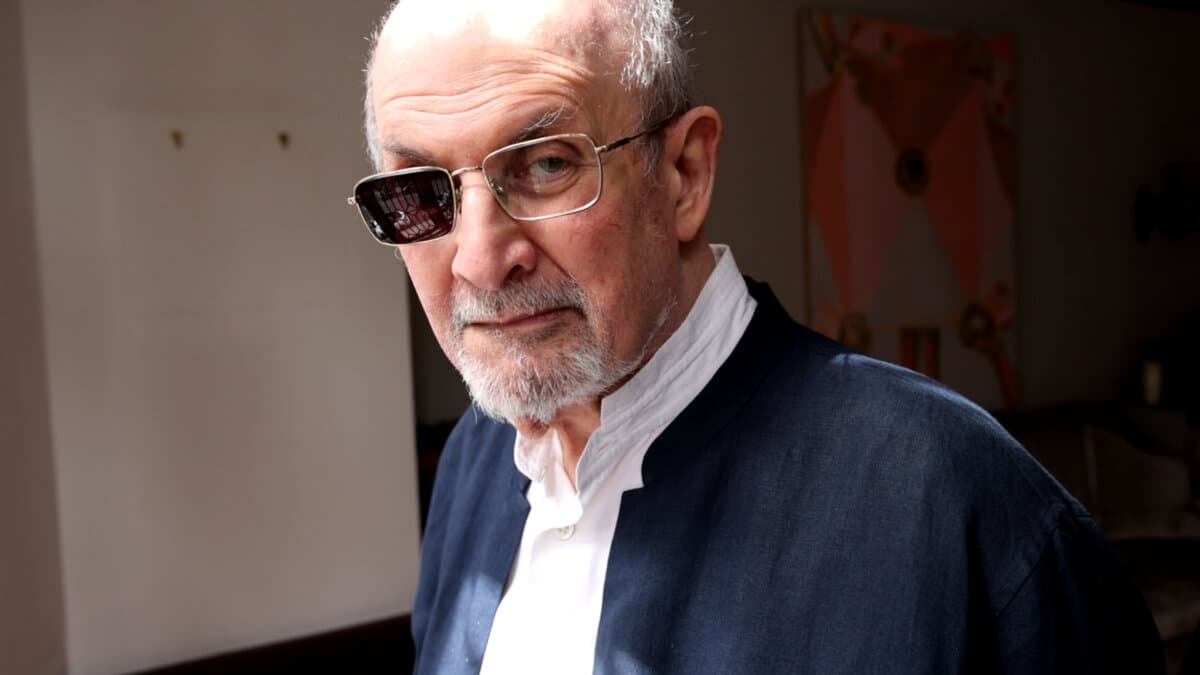
Author Salman Rushdie, in the documentary "Knife: The Attempted Murder of Salman Rushdie." (Jigsaw Productions)
It is uncomfortable to watch, but their video record was duly incorporated into Alex Gibney’s “Knife: The Attempted Murder of Salman Rushdie.”
Based on Rushdie’s similarly titled memoir, Gibney’s film offers in-depth coverage of the assassination attempt at the Chautauqua Institution in New York. The filmmaker also provides valuable context regarding the firestorm that erupted around the publication of “The Satanic Verses,” which fundamentalist Muslims denounced as blasphemous. A parade of media figures scoffed that his offending novel, “The Satanic Verses,” was “impenetrable” and that few people “got past page 15.”
Distraction?
As Rushdie himself notes, the fatwa closely followed the conclusion of Iran’s disastrous war with Iraq, which produced considerable misery and discontent among average Iranians. For the regime, it was a suspiciously convenient distraction.
Gibney and his subject thoroughly dispel lurid myths regarding the novel that have long been accepted as truths. Rushdie’s explanation of the title is also quite eye-opening. It is directly taken from the Quran, referencing passages explaining how Satan fooled Mohammed into adding false, evil text into the Muslim holy book, which the Prophet later expunged.
This is literally an Islamic doctrine, but it ironically invites skepticism of the Quran. Perhaps that explains some of the unhinged vitriol that was directed at Rushdie.
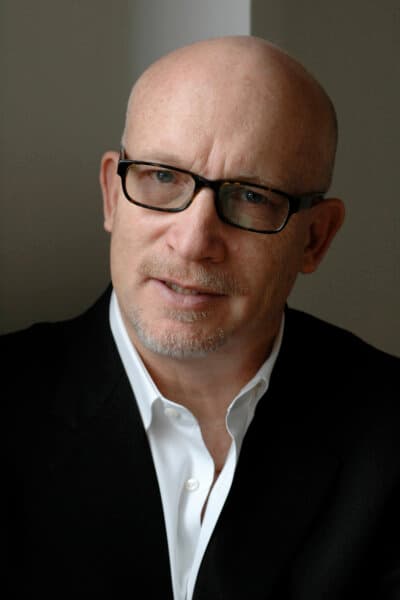
Alex Gibney, director of "Knife: The Attempted Assassination of Salman Rushdie." (Jigsaw Productions)
Chillingly, Rushdie and Gibney remind viewers that the knighted novelist was not the only victim of terrorist censorship. The novel’s Japanese translator was murdered, and the Italian translator barely survived a vicious attack. Yet despite the continuing threats, Rushdie eventually decided to resume a less sequestered life and to more effectively serve as a spokesman for the cause of artistic freedom.
Attack
Rushdie’s luck ran out in 2022. A so-called lone wolf, but clearly inspired by the Islamist regime in Iran, attacked Rushdie during a Chautauqua symposium.
It is one thing to read about the author’s injuries. It is another to closely inspect the stitches holding together Rushdie’s neck and the grotesque damage done to his right eye. Rushdie and Griffiths force viewers to do exactly that. They display his shocking lacerations and gashes, not in hopes of generating sympathy, but to expose the nature of his assailant and why documenting these grave wounds was necessary.
Perhaps the most remarkable aspect of Gibney’s documentary is the sense of humor that Rushdie maintains throughout, even during the darkest nadir of his recovery. When writing about the experience, Rushdie rather slyly abbreviated “assassin” to its first three letters when referring to his would-be murderer, whom he preferred not to mention by name.
Personal Portrait
In fact, “Knife” delivers an unusually personal portrait of the private Rushdie. He consistently displays a dryly mordant sense of humor. But the loving and supportive relationship he shares with Griffiths is what really motivates the writer during his long, challenging recuperation.
Gibney serves as the director of record, but aside from archival news broadcast footage, all the material was shaped entirely by the experiences and perspectives of Rushdie and Griffiths. It really should be considered their film because without their efforts, it would not exist.
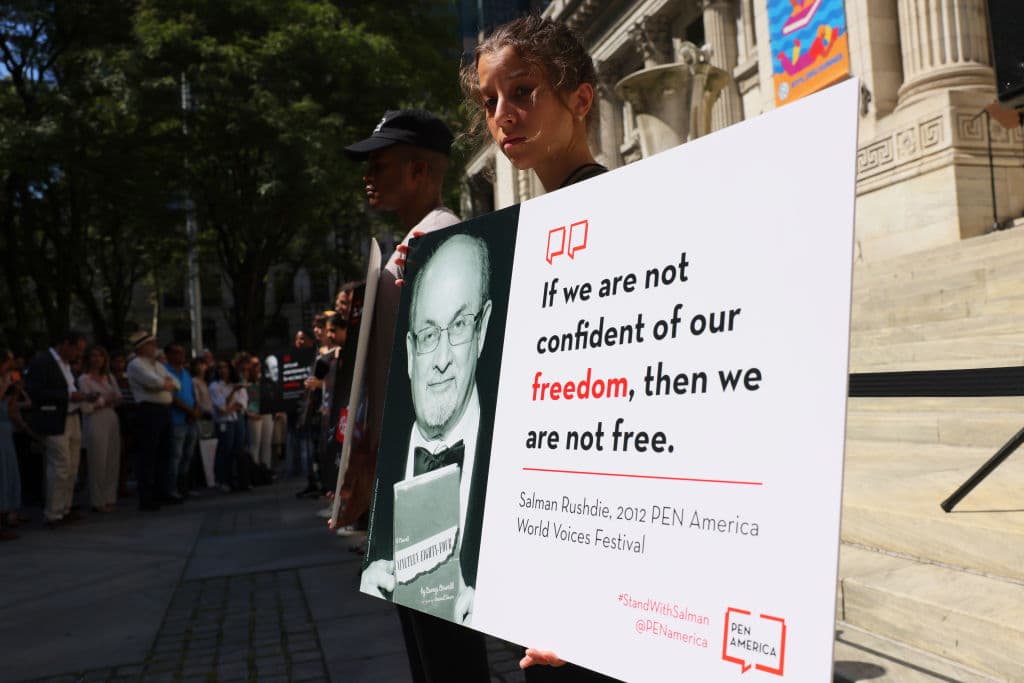
People hold signs at the steps of the New York Public Library to show support for Salman Rushdie on Aug. 19, 2022, a week after he was attacked. (Michael M. Santiago/Getty Images)
Consequently, “Knife” maintains an acutely intimate tone. Yet the documentary holds critical, arguably even dire, national and international policy implications. This is regarding extremists who believe they have a right to hold veto power over democracies’ rights of self-expression.
Ultimately, “Knife” is an extraordinarily valuable cinematic document. The attack was successfully prosecuted as an act of terrorism. Bad-faith critics hoping to deny or minimize the realities of the attack on Rushdie must ignore the evidence their eyes can plainly see.
This includes the shocking video footage of the brutal stabbing as it unfolded, as well as Griffiths’s extensive documentation of Rushdie’s life-changing injuries. There is simply no debate regarding what happened and why.
The resulting film is boldly defiant, but also surprisingly touching. It holds an urgently cautionary message, but it is also deeply humanistic. Very highly recommended.
“Knife: The Attempted Murder of Salman Rushdie” releases in theaters Sept. 18.
‘Knife: The Attempted Murder of Salman Rushdie’
Director: Alex Gibney
Starring: Sir Salman Rushdie, Rachel Eliza Griffiths
MPAA Rating: Not Rated
Running Time: 1 hour, 47 minutes
Release Date: Sept. 17, 2026
Rated: 4 1/2 stars out of 5
What arts and culture topics would you like us to cover? Please email ideas or feedback to features@epochtimes.nyc.