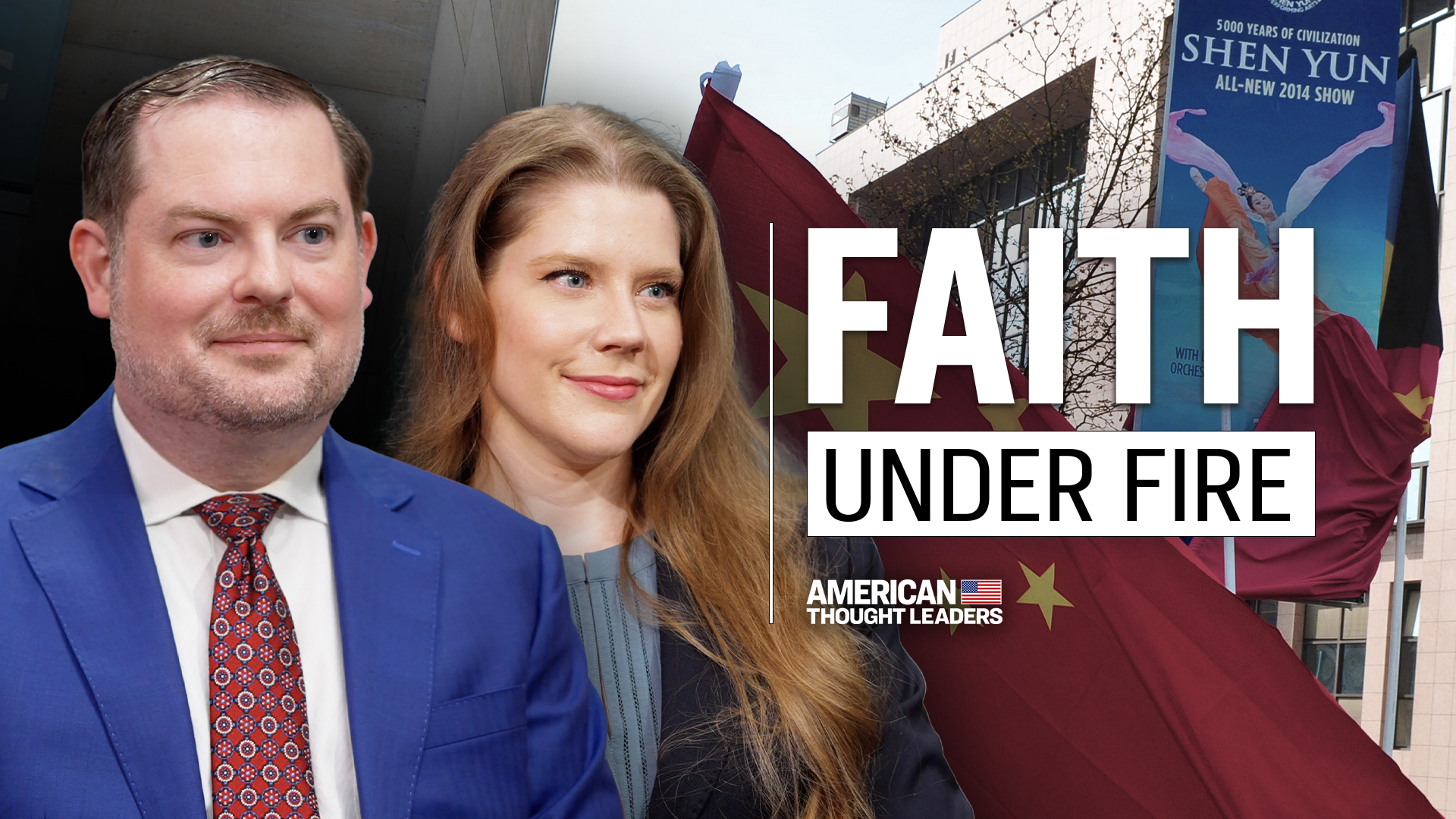

[RUSH TRANSCRIPT BELOW] For decades, we’ve been reporting on the ways the Chinese Communist Party (CCP) crushes the religious freedom of its citizens. But in recent years, the CCP has been escalating its tactics against a religious group here—on American soil.
In this episode, I sit down with religious freedom lawyers Justin Butterfield and Lea Patterson to understand what’s going on and discuss their response to a recent lawsuit against Shen Yun, the performing arts company founded by Falun Gong practitioners in New York. The case touches on vital questions about what it means to be able to practice your faith—and guide the education of your children in America.
Views expressed in this video are opinions of the host and the guests and do not necessarily reflect the views of The Epoch Times.
RUSH TRANSCRIPT
Jan Jekielek:
Justin Butterfield, Lea Patterson, it’s such a pleasure to have you on American Thought Leaders.
Lea Patterson:
It’s a pleasure to be with you.
Justin Butterfield:
Thank you for having us.
Mr. Jekielek:
I’ve come to deeply appreciate the U.S. Constitution, and it’s no surprise to me that the First Amendment of the Constitution speaks of freedom of speech and freedom of religion. Ultimately, it’s freedom of conscience. I’ve come to believe that this is the fundamental human right. I know that you share this view, but please explain it in a deeper way today.
Mr. Butterfield:
That’s exactly right. Freedom of conscience is fundamental to all other rights that we enjoy as Americans. If the government can tell you how to think, then it doesn’t matter if you have freedom of speech, what you talk about, or freedom to vote, how you vote, because all of those other freedoms are ultimately tied to the freedom to follow your conscience, to follow your religious convictions, to follow those deepest parts of yourself that tell you what’s right and wrong.
Ms. Patterson:
One of the reasons both of us wanted to be part of religious liberty litigation is because of the importance of defending that right. You can’t just leave it and expect it to still exist unless you defend it. You work to move it forward to make sure that that fundamental promise—that all of us as Americans have the right to follow God as we understand Him—exists without the fear that the government can declare you a heretic. That’s completely antithetical to what American law is. The benefits of religious liberty have resulted in a freer and better society.
Mr. Butterfield:
I was shocked when I heard that the Chinese Communist Party used the actual word “heresy” for religious groups that they disagree with, that don’t bend the knee to the Chinese Communist Party. It’s shocking when you see other governmental organizations that really are putting themselves in the place of God. They’re saying that they are the ultimate arbiter of what correct views about religion are, correct views about the ultimate things of life—the things that are foundational to everything that you are. In the United States, the government doesn’t try to put itself in that place, whereas in other countries, unfortunately, they do.
Mr. Jekielek:
I want to offer a few examples of how this Chinese Communist Party approach to dealing with heretical religions, to use the term you just offered, like Falun Gong, manifests here. A case in point is that you have people who are Chinese government agents bribing an IRS official who is actually an FBI sting operative to remove Shen Yun’s tax-exempt status, basically to cause them problems and prevent them from being able to do what they are constitutionally allowed to do. There are multiple examples of Chinese Christians, Uyghurs, and Tibetans being harassed and attacked, again by proxies of the regime, whether directly or indirectly. How does the law look at that here?
Mr. Butterfield:
It’s interesting. I worked several years ago on a matter where some Chinese Communist Party officials were visiting Houston, and there was a route they were going to travel along. Some members of the Falun Gong were going to be protesting against them on that route, and they had booked a set of rooms at a hotel. The Chinese Communist Party called the hotel and got them to kick out all the Falun Gong members, basically saying that you’re not allowed to stay here because of your religious beliefs. That’s shocking to us, and it should be shocking to us.
We have this idea that all faiths need protection under the law. I think that the Chinese Communist Party is not used to that; they’re used to saying, here are the religions that we accept, and we can do whatever we want with the religions we don’t agree with. They come to America and presume that these religions are minority religions, so nobody in the United States will have a problem with us bullying them or we’ll be able to get our way. In this situation, once we notified the hotel that there are several federal laws that you may have just violated by kicking these people out of your hotel because of their religious beliefs, the hotel reversed their decision.
That idea that all faiths in the United States are equally protected—that we don’t have favorites—is crucial. We don’t have the government saying, “You’re a good religion, you’re a religion that says nice things about the government, so we’re going to let you have peace,”or, You’re not a good religion, but you protest too much, so we’re not going to tolerate your existence.” That idea is so foreign to us.
Unfortunately, the Chinese Communist Party seems to be getting wise to the idea that we can’t just bully them directly through the law. Now we have to smear them in some way and do an end run around the religious liberty protections. But ultimately, as in the case that Lea and I have been working on recently, they just can’t escape trying to sue over everyday religious activities that are thoroughly protected in the United States.
Mr. Jekielek:
In a broad sense, how is this end run attempted?
Ms. Patterson:
There are a lot of ways. What we’re seeing in this kind of case is trying to limit the definition of what religion is and what religious exercise looks like. If you narrow it down to just certain things that look a certain way, then it makes it easier to restrict. One of the arguments we’ve been seeing, for example, is the idea of relegating Falun Gong to being a political movement, which is not at all what it is. That’s like saying that the Catholic Church isn’t religious because Pope John Paul II was instrumental in defeating communism in Poland. The Catholic Church is still just as religious, because its principles were opposed to communism.
We can’t speak to or speculate about what the individual motivations of any particular plaintiff are in bringing a lawsuit, but the effect certainly serves the purposes of religious oppression that China has been trying to accomplish. If the Chinese Communist Party is able to discredit those who want to discredit it, then it can use that to justify persecution—the terrible persecution it has committed against many religious minorities, including Falun Gong.
That’s why it’s so important to fight for religious liberty here. It’s not just that other beliefs are tolerated; it’s that it’s a fundamental part of who we are as a nation to tolerate people who are different from ourselves and to find value in that exchange. The beauty of America is learning from other people’s beliefs and building something better out of it. But if China can use essentially smear campaigns to discredit people at home, it justifies what they do.
Mr. Butterfield:
Thankfully, we are a nation of laws. When you have these attempts to intimidate Falun Gong or anybody else that China has in their targets, when you fight back and win in court and show that this was a bunch of hot air and that we can win this, then the person who’s just standing on the street corner in New York handing out flyers and someone comes along to intimidate him into stopping can think, “I can actually fight this.”
Importantly, the government officials who may not really be familiar with the bounds of religious liberty or what the Constitution actually says about this situation have probably heard about this case that’s been going on. They say, “You know what? I probably shouldn’t listen to this guy who’s telling me I need to ban them from handing out their religious literature. In fact, it’s unconstitutional, and I could get in trouble for doing that.” So it has an educational effect, not just on the people who are directly involved, but on the people who are there enforcing our rights and hopefully protecting our rights day in and day out—like local police officers and local government officials.
Mr. Jekielek:
This freedom is the deepest here in America compared to anywhere else, and all the other democracies actually have some kind of model that follows the American model.
Mr. Butterfield:
Really, no other country in the world has the same depth of protections that we have in the United States under the First Amendment. Even other Western democracies, without that explicit protection for religion, for speech, and for the ability to assemble and petition the government—without those explicit protections, over time, those concepts can fade away. The United States alone truly values those first among all sorts of civic theories.
Ms. Patterson:
The idea of religious pluralism, of not having a state-mandated faith, was revolutionary in 1789 when the Constitution was being created. Before, the idea was that a nation could only function if it had a unified religion. Seeing what America has done with this, what we have become as a result of tolerating each other’s faith and recognizing that some things are just off-limits for the government is truly wonderful.
Mr. Jekielek:
There are so many different faiths that came here, mostly variations of Christianity, but they have pretty dramatically different views on how to live that out. In some cases, the founders understood that one group would be interested in imposing its views on others, and they built the system to deal with that problem.
Mr. Butterfield:
It’s in our DNA. If you look at some of the earliest settlers, the Pilgrims, they were leaving Europe because they were rejected by the religious communities of their home countries. In England, they didn’t fit within the established Church of England’s view of what a Christian should look like. So they first went to Holland, and then to America. They brought the ideal that this should be a place where people are free to worship God according to their own conscience.
Mr. Jekielek:
The approach toward faith in communist China is basically antithetical to the approach to faith in the United States, so it’s particularly noxious when that approach is brought here.
Mr. Butterfield:
In China, you have the government, and then you have your relationship with God below that, and they expect your relationship with God to be subservient to the state. In the United States, we understand that people’s relationship with God is the most important thing in their life, and their relationship to the state is subservient to that relationship with God. The way China is trying to use laws in the U.S. to enforce their own internal law here, outside of their country, to eradicate people they’ve decided to eradicate around the world, makes me think of the Chinese government’s opening a police station in New York to enforce their local laws.
But that’s their mentality. They get to do around the world what they do internally, and that’s what they’re trying to do through this lawfare. They’re trying to target the same groups they would target in China, just here in the United States. They’re trying to impose their own concept of what is legal, what is right, what is orthodoxy. There’s no civic orthodoxy in the United States, but they’re trying to foist that idea upon us here.
Mr. Jekielek:
With the police station example, it doesn’t call itself a police station; it calls itself a community center. And then it starts exerting influence and pressure in various ways, in a kind of political correctness at first. Your point about the pushback is so important. If there’s no pushback, then it takes a little more. If there’s no pushback, it just grows.
Eventually, you get something that’s a lot closer to a police station, because people say, “It’s just the Chinese figuring out things for themselves,” or something like that. You’ve done a lot of cases related to revoking this 501(c)(3) status, non-profit status, or preventing religious groups from getting non-profit status. It’s very interesting, actually, when I think about it, that these particular Chinese agents tried to use this method, which is the exact method often used by overzealous secularists, to try to impinge on the freedom of religion of Christians, for example.
Ms. Patterson:
Yes, absolutely. One of the cases I was involved in was a Christian voter guide organization, nonpartisan, providing information on elections and how to get registered to vote. The IRS initially denied their 501(c)(3) application, saying that because they had a statement of faith based on biblical principles, it was too political because the Bible is Republican. Thankfully, the IRS reversed that decision, but that idea—that your religion can’t inform your political views—is completely wrong.
If you have the government deciding that something is too political for religion to have anything to do with, then that’s the government defining what religion is and what it can mean to someone. There are people of faith across the country, probably on both sides of the aisle, whose faith informs what they vote for and what policies matter to them. It’s crucial for the government to respect that.
Mr. Butterfield:
In the United States, after this came out, the IRS actually called the founder of the organization within, what, two weeks?
Ms. Patterson:
Two weeks.
Mr. Butterfield:
And apologized.
Ms. Patterson:
When have you heard of the IRS apologizing?
Mr. Butterfield:
I know, I know.
Mr. Jekielek:
This further dimension with the Chinese Communist Party bringing its long arm of repression to America is by finding these kinds of fellow travelers, right? They also have some kind of issue with religion, or they believe they know better about how people should think. They want to help others think the correct way. I find that a very difficult viewpoint, but there are apparently people who think this way and are happy to impose those views.
Mr. Butterfield:
We talked about the Chinese Communist Party. They are starting to get wise. They realize they can’t just directly bully people. So they’ve got to find ways to besmirch them. Here’s somebody who is a secularist or is anti-faith or dislikes this group that the Chinese Communist Party also dislikes. So they'll throw some money at them and get them to put up YouTube videos or make posts attacking this group and increase the influence of the Chinese government here.
Mr. Jekielek:
There is the Chinese United Front, which is one of the key methods of these influence operations overseas. It’s tens of billions of dollars, and there’s this huge machinery in play. For example, some hit pieces written against Shen Yun get instantly translated and then broadcast ad nauseam via these propaganda channels that the regime has in-country. But it also has a huge megaphone outside of China.
Ms. Patterson:
Absolutely. Anyone can say anything they want to. As soon as people hear all sorts of accusations—things that sound scary—you don’t know whether they’re true or not, but you’ve heard them. Unfortunately, that is an effective strategy in many cases.
Mr. Jekielek:
Let’s talk about Sun v. Shen Yun, which is the case you’re working on. You’ve just submitted this motion to dismiss. This is what brought you to my attention, and it strikes me a little bit in the vein of what you were just talking about.
Ms. Patterson:
Essentially, it’s a lawsuit filed by former Shen Yun dancers. They left Shen Yun in 2015, I believe, and they’ve brought human trafficking claims. As soon as you hear that, it sounds bad; it sounds scary. But ultimately, they don’t make out a viable legal claim at all. The school has rules that are consistent with the faith, such as limiting time on the Internet or limiting access to pornography. That was actually one of the complaints. The allegation in the complaint was that the students couldn’t freely access pornography. Well, of course, that’s just good parenting. Parents should not allow children to see that, and neither should a school that is responsible for them.
Mr. Butterfield:
The complaint makes claims like, “You gave us flip phones and not smartphones. We weren’t able to play video games.” The average person who just reads the headline, “Shen Yun sued under federal law for fighting human trafficking,” thinks, “What are they doing there?” You have to really look at the details, which are, “They limited my time on the Internet.” It’s really just absurd.
Mr. Jekielek:
Could you please walk us through some of the strongest arguments in the motion?
Ms. Patterson:
For context, at the motion to dismiss stage, when we’re writing the brief, we can’t argue about whether the allegations are true or not. That’s something that happens if a motion to dismiss fails. So we have to take the complaint as it is, does it make out a plausible violation of law? One argument is that it does not. There are a lot of reasons for that.
The kinds of things that the plaintiffs are alleging do not fall under the kind of things that the Trafficking Victims Protection Reauthorization Act [TVPRA] actually encompasses. The TVPRA requires that plaintiffs show they were threatened with serious harm in order to stay in the situation, basically. There are cases that establish that serious harm does not include religious harm. The reason for that is otherwise the TVPRA would be capable of applying to otherwise completely lawful religious activities.
So for example, if that was cognizable as a legal claim, that someone allegedly said you might go to hell for XYZ violation of doctrine, then every church… is violating that statute, right? That’s part of religious liberty—protecting the idea that you can believe your faith has eternal consequences. That’s just not the kind of conduct that the TVPRA is designed to address. So, that’s kind of part one of the argument. The things they complain about are not illegal; they’re not problematic from the standpoint of the TVPRA.
Mr. Butterfield:
Some of the plaintiffs’ allegations are that, well, we have a strict schedule. We wake up early, do our schoolwork, then practice, and then we practice our faith. We have some time set aside for spiritual development, and then we have to practice our performances more. It’s a busy, packed schedule day in and day out. But if you think about it, look at what high-level gymnasts and high-level ballet schools do. So many Olympians homeschool for a few hours every day and spend the rest of the time perfecting their performance.
Similarly, here they are committed to being high-level performers. They joined these schools and worked with Shen Yun because they wanted to be high-level dancers. They wanted to be able to perform these traditional Chinese dances at a very high professional level, and that requires dedication. They made that choice, and now they’re complaining about the dedication that getting there requires.
Ms. Patterson:
In fact, these particular plaintiffs persevered over years and multiple failed auditions because they wanted to be accepted to Feitan Academy and ultimately perform with Shen Yun so badly that they persevered in seeking this level of performance. It’s pretty much what you would expect from a high-performance ballet school.
Mr. Butterfield:
Fundamentally, the things they are complaining about and calling human trafficking are volunteering for your religious organization, attending a religious boarding school—things that happen in hundreds of thousands of religious communities all across the United States every day. I think if you told churches that having a mission trip, having the church youth group go and build a house for a poor person, might get you sued under a human trafficking statute, they would be shocked.
Mr. Jekielek:
Right, that’s a great example. That’s exactly the kind of thing that is analogous.
Mr. Butterfield:
It’s exactly the sort of thing that is being accused of. It shouldn’t be controversial. But when you stamp that label on it, suddenly it sounds much more controversial than it is, even though people volunteer at their churches all over the United States every day, and we don’t see lawsuits against them. Unfortunately, that is the sort of thing that’s a threat from this lawsuit.
Ms. Patterson:
If you look at the complaint against Shen Yun, and if you were to replace all instances of the word “Falun Gong” with “Christian” or “Catholic,” the activities they’re complaining about would be completely unremarkable. You expect a Catholic boarding school to follow Catholic doctrine and to require a code of conduct that’s consistent with that. But that’s one of the reasons why it’s so important to protect religious liberty for everyone: the burden falls hardest on religious minorities whose faith is less understood by the majority and even potentially less understood by the court. That’s why the government can’t require religion to look a certain way or to have certain principles or certain rituals, for example, because those protections are most crucial for people whose religion is less understood.
Mr. Jekielek:
A few days ago I was at Montpelier in Virginia at the home of James Madison, and saw the desk where he wrote many parts of what became the Constitution. At that moment, I recalled the paper, Federalist No. 10. I had never thought about the idea of the tyranny of the majority which is a difficult issue to deal with in democracies. You could have one group that imposes its will, and it’s the majority. It’s a democracy. Isn’t that fair? Isn’t that reasonable? Well, no. In a republican democracy, you try to prevent that from happening and give minorities their opportunity. It’s just a beautiful thing. Many of us don’t realize there isn’t a perfect solution to it, but the best trade-off is found in the U.S. Constitution.
Ms. Patterson:
The legal protections mean the most for those who don’t have the democratic wherewithal to protect themselves.
Mr. Butterfield:
You see this claim come up a lot. Should be free as long as you’re not saying anything too controversial or too harmful. But what is controversial speech? What is harmful speech? It’s the speech the majority doesn’t agree with. Those are the places where the protections for free speech are most important. It’s not about the ideas that everybody agrees with. It’s not the beliefs that everyone holds. It’s not the things that everybody does that need protection. You don’t have to worry about those. It’s the controversial ideas—those held by a few people. It’s the speech that the majority views as dangerous. Those are what need protection because those are the ones that are going to be attacked by the majority.
Ms. Patterson:
You have to ask who decides what’s harmful in terms of speech.
Mr. Jekielek:
Again, it’s not just the First Amendment. It’s speech and conscience and faith; they’re all tied so deeply together and the ability to exercise them in a public way. I’ve read both the complaint and your response to the complaint, your motion to dismiss. How is it even possible for someone to file a complaint like this?
Ms. Patterson:
You can sue anyone for anything. That doesn’t mean it has any merit. So, you know.
Mr. Jekielek:
Is this a problem?
Ms. Patterson:
Oh, yes.
Mr. Butterfield:
It is.
Mr. Jekielek:
In the legal system, is it like there no boundaries on this at all?
Ms. Patterson:
Pretty much, although there are a few limitations. The first one is, can you get a lawyer to represent you?
Mr. Butterfield:
Although even that’s not necessary.
Ms. Patterson:
It’s true.
Mr. Butterfield:
We were just talking about some people we’ve seen. One person filed a lawsuit pro se—meaning a person who was representing himself, did not have a lawyer—but sued George Washington and the Declaration of Independence.
Ms. Patterson:
And the founding fathers.
Mr. Butterfield:
And the founding fathers collectively. Yes. Now, I think anybody who reads that is going to think that’s just absurd. But, as Lea said, anybody can sue anybody for anything.
Ms. Patterson:
The court had to read it and write an opinion about why that’s a frivolous lawsuit and why it was dismissed. But that’s how the process works. So, you know, when you see that someone has sued someone, you have to ask why and if it’s valid.
Mr. Jekielek:
There is another type of lawfare that has been used against Shen Yun. There was someone who lived in China for a decade, landed in the area where Shen Yun and the dance school are located, and started launching environmental lawsuit after environmental lawsuit. After a lot of money, concern, and bad press—which was unfounded—it turns out the judge dismisses it with prejudice. So now he’s not allowed to file this anymore. But I was trying to figure out how it is that this person could do that in the first place. You’re giving me some of the answers. But if someone targets you, this is expensive. This is distracting.
Ms. Patterson:
They are. It is. And that kind of lawsuit is something we’ve seen throughout our practice against many different faiths. You see it often against Jewish synagogues, especially Orthodox synagogues that have to be within walking distance for everyone because no one can drive on the Sabbath. A lot of times, when we see cases where either an HOA [Home Owner’s Association] or the town zoning board doesn’t want to let those people into the neighborhood, they'll throw out requirements like you need this amount of parking, you need fire sprinklers, you need all of these environmental impact surveys. It eats up a lot of time, effort, and money with the ultimate purpose of that organization failing.
We see that all of the time. But there are, thankfully, federal statutes like the Religious Land Use and Institutionalized Persons Act [RLUIPA], which protects religious uses of land and provides some relief and a bit of backstopping against the power of zoning boards. And I had one case representing an Orthodox Jewish synagogue in North Dallas, and there was one neighbor who really didn’t want them in his community. He first got the HOA to go after them. HOA stands for homeowners association. Yes, he became president of his local homeowners association and used it to try to kick them out. When that failed, he then wrote a bunch of demands to the city and tried to get the city to kick them out.
I’ll never forget, we went to one of the earlier hearings, and the homeowners association brought in a witness who testified that the problem with allowing an Orthodox Jewish synagogue in the community was that one of their members was blind and would have to cross the street. He claimed it was just not right to allow people who are blind to cross the street. Additionally, there were mothers pushing their children in strollers, and he argued that shouldn’t be allowed either. These were just absurd claims. If it were any other context, nobody would give them the light of day, but they actually got an attorney to bring this claim against this Orthodox Jewish synagogue.
So, we came alongside that Orthodox Jewish synagogue and helped them, and they’re still there today. We got through all that. However, there are still many people who will try to find every little nitpicky statute, even in situations where they just don’t make sense, and use that to push people out of their community that they don’t like.
Mr. Jekielek:
We talked about the ability in the U.S. legal system to launch frivolous lawsuits. But what about lawsuits where the statute of limitations has expired?
Mr. Butterfield:
One of the interesting things about Sun v. Shen Yun is that they waited so long to bring their lawsuit. The statute of limitations is a principle by which, when you’re bringing a lawsuit under a law, there is a time limit. You have to bring the lawsuit within a certain amount of time, or we say that the statute of limitations has run. In this case, the plaintiffs in Sun v. Shen Yun waited 10 years before bringing their lawsuit.
Not only did they wait 10 years to bring these claims, but if you look at what they did in the intervening time, after performing with Shen Yun and after attending Feitian Academy, they went back and volunteered with a Shen Yun presenter. It seems like, over the past 10 years, something changed in their lives, and now they’re viewing the past through a very different filter.
Ms. Patterson:
One of the things that struck me in the complaint is that the plaintiffs talk about how they and their parents wanted to apply to Feitian Academy. They wanted to ultimately succeed in performing with Shen Yun because it was important to them as part of their faith—a crucial component, as the complaint puts it—spreading and sharing with others the message of truth, forbearance, and compassion. That’s what they aspired to do—perform as part of that important religious mission. Even after leaving, they continued to volunteer.
So I can’t say what changed, but the length of time is significant. Ultimately, none of the things they mention in their complaint happened within the past 10 years, which is the statute of limitations for the TVPRA, the federal law under which they filed their suit. That statute of limitations is already quite long.
Mr. Butterfield:
It is quite a long statute of limitations. Most laws have a much shorter statute of limitations. Even with its longer statute of limitations, they still waited.
Mr. Jekielek:
You both have your dream jobs, and you work on something you’re deeply passionate about. Lea, I’ll start with you. How did you come to this work and be so deeply involved in it emotionally and spiritually?
Ms. Patterson:
That starts in my teenage years with my own faith. I’m very grateful that my career took the path it did. I would say that’s the grace of God because it’s been wonderful to be a part of something I care about that makes a difference for my clients. My favorite cases that I’ve worked on involved retirees in senior apartment complexes who were told that in the common room—where you could have birthday parties, bingo, and book clubs—you couldn’t have a Bible study.
For many of these people, who are disabled and don’t have transportation to get to church, that Bible study on Wednesday night was all they had. Being able to come alongside those wonderful people and learn from individuals who had been faithful to their faith longer than my parents had been alive has been one of my favorite experiences. I truly want everyone to have the freedom to exercise what they believe and to share it.
Mr. Jekielek:
You’ve done this type of litigation before the Supreme Court. Tell us more about your path, because you’ve been overly humble here.
Ms. Patterson:
That’s very kind. In terms of education, I went to Texas Christian University for my undergraduate degree and then to the University of Virginia School of Law. After that, I clerked for Judge Gruender on the Eighth Circuit Court of Appeals in St. Louis before joining First Liberty Institute, a nonprofit that does religious liberty work. I spent almost seven years doing litigation there before Justin and I founded our own firm last year.
While I was at First Liberty, I had the opportunity to work on a team litigating Carson v. Makin, which was a Supreme Court victory in 2022 for school choice. I’m particularly passionate about the importance of and protecting religious education because that’s the education my parents sacrificed to give me. It helped shape who I am and provided me with the tools I needed to be successful.
The Carson case came from Maine, which is very rural, and many school districts there don’t have a population sufficient to support a high school. For decades, the state law allowed parents in districts like that without a high school to send their child to the public or private school of their choice. However, after 1980, they couldn’t send their child to a religious school. They could send a child to a secular private school, but not to a religious school. That change in policy led to, if I recall correctly, the largest Catholic school in the state transitioning to a secular school because they wouldn’t have been able to operate without the tuition funding.
Multiple cases over the years challenged that law. The law stemmed from the idea that if the government provides any support, no matter how indirect, to a religious organization, that violates the Establishment Clause. However, that is not where the law stands today. Decades of Supreme Court decisions have established that when you have a system of private choice, where a generally available benefit—something available to everyone—is provided, saying you can use this as long as you don’t do something religious with it is discriminatory.
It is ultimately hostile to people of faith to say, “We’ll support whatever you want to do as long as it doesn’t have anything to do with religion.” When everyone has the same opportunity to use the same benefit as they see fit, it’s not a decision attributable to the government at all. It’s not the government saying you have to go to Catholic school. It is empowering parents to decide what’s best for their child. That’s the principle the Supreme Court vindicated in Carson, striking down that law that had been on the books for, I believe, almost 40 years at that point.
Mr. Jekielek:
Lea, please remind us what the Establishment Clause is.
Ms. Patterson:
It is part of the First Amendment. The text of the religion clauses includes the Establishment Clause and the Free Exercise Clause. The text states that Congress shall make no law respecting an establishment of religion or prohibiting the free exercise thereof. So, the first part is the Establishment Clause.
Mr. Jekielek:
Justin, where did you find the passion that you bring to your work?
Mr. Butterfield:
Like Lea, my drive comes from my faith. I was homeschooled in high school. Texas is a very homeschool-friendly state, but I would read articles about homeschooled families in other states that were less willing to accept their parents’ religious right to direct the education of their children, treating homeschooled families like child abuse, basically. I wanted to stand up for those people who were being persecuted because they were following their conscience and their faith in how they treated their families and raised their children.
I did not immediately plan to go to law school. Being a bit of a computer nerd, I actually got a bachelor’s degree in computer and electrical engineering and decided that it was more fun as a hobby than as a career. So then I went to law school. I went to Harvard, and after graduating, I worked at a business law firm for a couple of years. But then that desire to help people stand up for their righteous conscience came back.
I also went to First Liberty Institute and spent seven years there representing people all over the country. Some of that work involved suing the Department of Health and Human Services [HHS]. If you'll recall, a few years back, they had what we called the contraceptive mandate. That was a requirement that everyone provide insurance coverage for their employees that covered all contraceptives, including those that many organizations viewed as abortifacients. Hobby Lobby was a famous case, but I represented several religious organizations that didn’t want to fund contraceptives or abortifacients.
I sued HHS a couple of times, and apparently, I did a good enough job that they then asked me to come work at HHS. At first, I was a senior advisor for HIPAA [The Health Insurance Portability and Accountability Act], and then I became senior advisor for the Conscience and Religious Freedom Division, working to ensure that HHS and their regulations don’t violate people’s conscience rights. I also worked to protect the religious beliefs and conscience rights of healthcare professionals. Many people become doctors, nurses, or pharmacists because they want to help others, and often that drive is a practical application of their religious beliefs. This is especially true in many rural communities.
Do you want to live in the city and get paid a lot, or do you want to go live in a rural community and maybe not make as much, but help people in need? Many doctors who choose that path do so because of their faith. When we started to see mandates from the government forcing them to do things that they couldn’t do in accordance with their conscience—telling them they had to refer for abortions or perform other procedures—there were federal protections in place to protect people from having to refer for abortions, perform abortions, or participate in euthanasia and other practices that people of faith vigorously object to.
What we did at HHS in the Conscience and Religious Freedom Division was create a framework for healthcare professionals to ensure that their rights were protected, allowing them to bring complaints to HHS, and providing someone to stand behind them, affirming that their rights of conscience could not be violated. This was exciting work. After my time there was done, I returned to First Liberty Institute and worked on religious liberty cases with them for a few more years.
Then Lea and I started our own firm. One of the things we noticed was that there is a lot of support for religious organizations when they face major litigation—when something dramatic happens, and they are being told to, for example, bake a cake or go to jail. However, many religious organizations were coming to us asking for day-to-day help. They wanted to know what they could do daily to protect their religious liberty and if there was someone who could assist them. Unfortunately, there was much less available for that sort of day-to-day help, so we thought that was an area where we could make a difference. We started our own firm almost a year ago.
Mr. Jekielek:
A final thought from each of you as we finish up?
Ms. Patterson:
We’re just so delighted to be with you and have the opportunity to discuss all of these topics. It’s why we do what we do: to protect religious liberty for everyone. We'll see what the court does in this particular case, and we’re excited to see what the future holds.
Mr. Butterfield:
As I said earlier, everyone needs protection. The protections in the First Amendment are only meaningful when they protect those who are less understood, who are not the majority, not the dominant group in America. Falun Gong benefits from strong religious liberty protections. If you take the claims in this complaint and substitute any other religion, everyone reading it would think, “This is just the normal things that people all across America do.”
However, the Chinese Communist Party’s ideas suggest that when the Falun Gong does it, something is wrong. We want to show that all religious groups in America need to be treated equally and that the protections our Constitution provides apply to everyone in this country, regardless of whether 90 percent or 5 percent of the population holds to your beliefs. You still have the same constitutional protection of your beliefs.
Mr. Jekielek:
Justin Butterfield and Lea Patterson, such a pleasure to have you on the show.
Ms. Patterson:
Thank you for having us.
Mr. Butterfield:
It was a pleasure to be here.