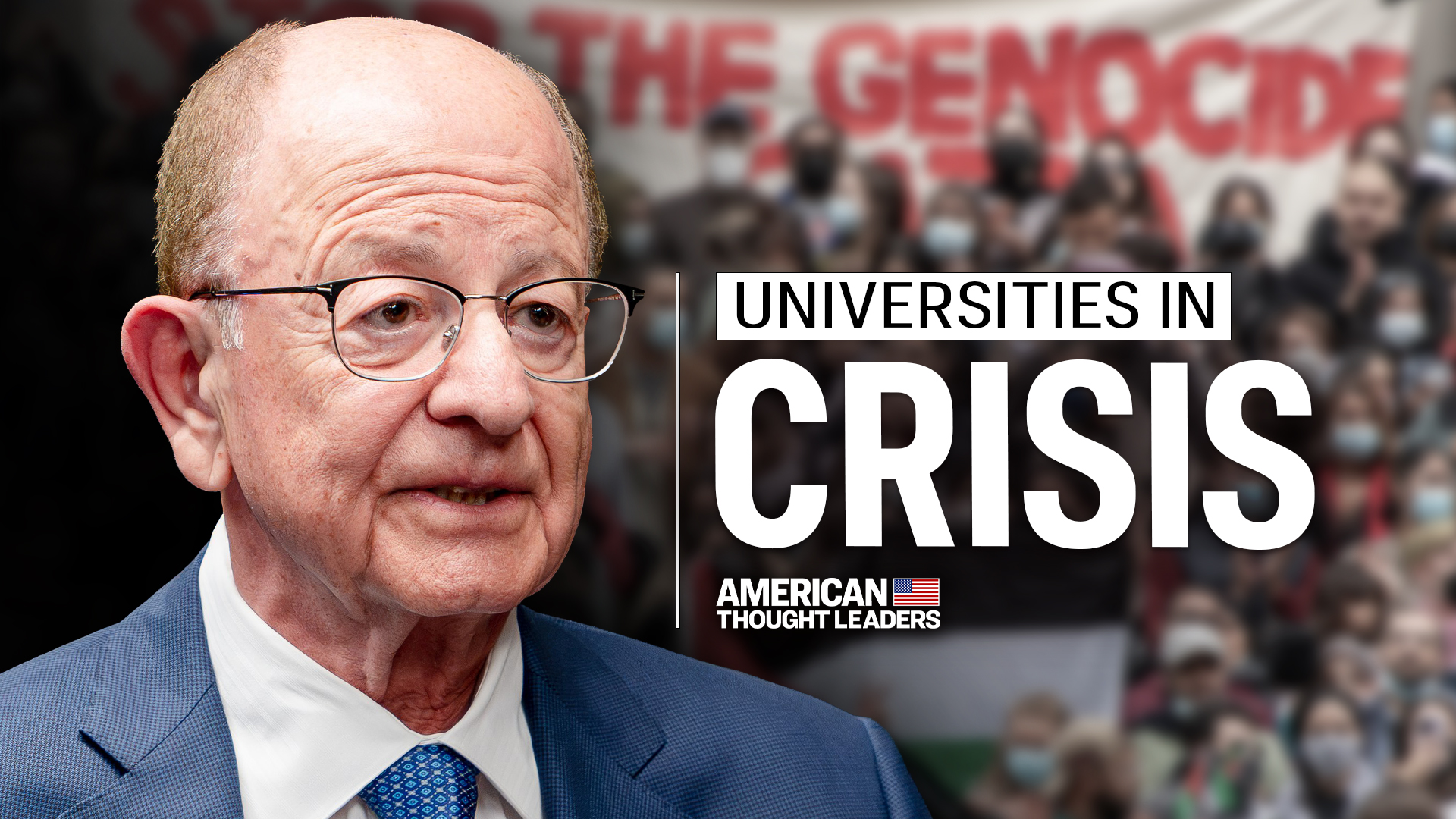

[RUSH TRANSCRIPT BELOW]Over the past three decades, American higher education has steadily drifted from its foundational mission: teaching, research, and innovation, says Max Nikias, president emeritus of the University of Southern California.
In his recent book, “American Trojan: Leadership, Resilience, and the Renewal of Higher Education,” Nikias argues that universities can be renewed not by surrendering to ideological pressures but through principled leadership.
In this episode, he answers a host of questions. How did activist faculty members and students erode freedom of speech on campuses across America? Why are the classics essential for intellectual and moral education? And as America grapples with challenges on national security and AI development, what can the ancients tell us about the path forward?
Views expressed in this video are opinions of the host and the guest, and do not necessarily reflect the views of The Epoch Times.
RUSH TRANSCRIPT
Jan Jekielek:
Max Nikias, such a pleasure to have you on American Thought Leaders.
Max Nikias:
Thank you for having me.
Mr. Jekielek:
Max, we’ve been planning this for a long time. We’re going to talk about higher education, what happened to it, and maybe how we can fix some of it. But I just didn’t fully realize that you were actually on the board of Synopsys and you’re kind of deep in this semiconductor space. And I just have to get you to tell me about how you understand this whole NVIDIA scandal that’s unfolding right now. There are so many dimensions to this, and you have so much to say. What’s going on?
Mr. Nikias:
I probably shouldn’t repeat the news that everybody reads, but there are restrictions in place by the United States government, by Congress, that nobody is allowed to sell the very advanced chips to China. And by very advanced chips, anything that is less than 14 nanometers size of transistors. We have to realize that the chip that we have in our iPhone, depending whether it’s iPhone 16 or iPhone 18, has probably 15 to 20 billion transistors. But what defines an advanced chip is the size of the transistors and is measured in nanometers, which is a billionth of a meter.
And clearly, the whole area of semiconductor chips over the past several decades has advanced dramatically through a supply chain of companies in Western democracies. But the United States pretty much has controlled more than 75 per cent of the intellectual property associated with this supply chain and the advanced chips, and that’s why it has the lever to impose those restrictions. Why?
Because the brains behind the AI revolution are the advanced semiconductor chips. Without them, we wouldn’t be here where we are talking about the AI revolution. And clearly, NVIDIA has developed the most advanced chips needed for the AI revolution. They have competitors like AMD and like Broadcom. Those are very strong competitors to NVIDIA, but they’re distant second and third right now.
Mr. Jekielek:
And so that’s a great opening to help us understand kind of the picture. But what did this NVIDIA scandal reveal? Because there are many pieces to it. There’s a Chinese intelligence angle, there’s what NVIDIA is doing in terms of what it’s selling to and where. There are these data centers that are adjacent to China that are being used. There’s a whole different range of things in this puzzle. And I think I want you to kind of put it together for me.
Mr. Nikias:
Right. Personally, I will find it very hard to believe that NVIDIA is a company that broke the law and the existing restrictions that will get them into real, real trouble. However, there are a number of data centers that have been built in Southeast Asia, in Malaysia, in Singapore, and probably some other countries. And it was perfectly legal to sell the very advanced chips to those centers. But now we begin to read reports, for example, that probably Chinese companies were behind the building of many of these data centers. So, time will show whether any law has been broken.
But it wasn’t illegal to have to provide access to this type of data center. But I believe in the next few weeks, we’re going to see an announcement that is restricting those data centers from giving access to Chinese companies, because it really defeats the purpose of not being allowed to send to sell advanced semiconductor chips to China. If they cannot get them in their own territory, clearly they can take their models, their advanced AI models, and go and train them at data centers abroad.
But now, with these new restrictions that will be imposed, then those data centers will no longer be allowed to have Chinese companies as customers. That’s a restriction, by the way, that has been discussed for several years, but was never imposed. But now I believe it will be imposed very soon.
Mr. Jekielek:
How does the, why is there this firestorm right now in your mind?
Mr. Nikias:
The firestorm, it could make a Hollywood movie, right? That there is an affair of the most talented CEO with a woman. And there are allegations that she may or may not be a Chinese spy. And what makes it even more dramatic is that the CEO of NVIDIA, Jensen Huang, has been a very strong advocate that if we don’t sell chips to China, that he was a very strong proponent of that he wanted the whole world to train their AI models, the whole ecosystem, on American semiconductor chips. And they can, if they cannot get access, then it’s like forcing them to develop their own chips.
Mr. Jekielek:
Right. That’s the Nvidia line.
Mr. Nikias:
What makes this a firestorm is that he was a very strong proponent for that kind of policy. And then on top of that, there is the affair, and there is the allegation that she may have been a Chinese spy. Nobody knows that yet. Even President Trump this morning said, may or may not.
Mr. Jekielek:
Well, let me just comment on this, okay? I generally don’t like to comment. This is your interview, but in this scenario, okay, so you could have on the one end, you can have like an MSS [Ministry of State Security] trained, something closer to the James Bond-type spy, right? But on the other hand, what you could have, and this is something that I think Desmond Shum is one of the commentators, I think is very valuable to look at in the space because he understands how the Chinese system works, corporate system, and how it interacts with the CCP [Chinese Communist Party] and so forth very well.
But basically, she could just be like an industry fixer, okay, or something like that. So if she is, of course, she has very close ties with Chinese Communist Party people to achieve that. And then on top of that, they have a national security law that says that if you are asked to work as a spy for the state security, you have to, and you can’t disclose that. So, you know, you have someone that has access to the most valuable from the Chinese perspective, perhaps the most valuable asset you can imagine, right? So there’s zero per cent chance that she isn’t working with them, in my mind. There’s no scenario where that’s even remotely possible.
Mr. Nikias:
Even if they fix it.
Mr. Jekielek:
Yes, even if she wasn’t like originally trained as this sort of thing, right?
Mr. Nikias:
And this is the argument also that when the very first restrictions were imposed on Huawei, and because the question that was asked back then by the first Trump administration in 2017, are we going to allow and build our telecommunications infrastructure on Chinese hardware from a company that we know ultimately is accountable to the Chinese Communist Party? And the answer to that was on our dead body, absolutely not. And not only and not only the United States, but we are going to ask all the European countries and all the other Western democracies not to do it.
At the beginning there was some pushback from Germany, from the United Kingdom, but eventually everybody lined up against having Chinese telecommunications hardware for their telecommunications infrastructure. It’s a security issue. It’s a NATO issue. That was the beginning. And it started with the Trump administration.
Mr. Jekielek:
So this is interesting, okay? Whatever happens now, it sounds like what you’re saying, we’re going to have more restrictions. That the effect of this whole firestorm, if you will.
Mr. Nikias:
Absolutely. I would be shocked if we don’t have more restrictions. And actually, one that is coming probably even before the end of this month, is that any data center around the world that has the very advanced chips, companies are not allowed to sell to China; those data centers cannot give access to a cloud to Chinese companies.
Mr. Jekielek:
Right. Now, at the same time, we have a situation where NVIDIA has lost, you know, its, you know, its beating heart of a leader, if you will, right, I mean, obviously foundational in its growth and success and technology and everything, and lost a, you know, some astronomical amount of market cap. That’s also true. That’s not good for the U.S., for the economy, for the for the for the whole, actually, I would say the world economy even. Both things can be true.
Mr. Nikias:
Right. But also, let’s not forget, in spite of what has happened in the last several weeks, the technology is still there. The talent is still there at Nvidia. So, I know there is a movement now to reinstate Jensen Huang, and of course, time will show whether that will happen or not. But if not, I think it is the board’s responsibility to recruit a very talented CEO to lead the company because the company has very advanced technology; they have been the leaders in this area, and it is to the best interest of everybody, of their shareholders, but also of the country, to continue innovating the same way they did before.
Mr. Jekielek:
And but, as a final thought here, you know, the idea that you will give your best technology or next to best technology to communist China to re-invent to reverse engineer at will, which of course is the thing they’re best at, right, and imagine that in this way you'll somehow restrict their ability to develop. I think that’s a kind of a crazy idea.
Mr. Nikias:
It sounds like an oxymoron.
Mr. Jekielek:
Well, it doesn’t sound like it’s, it’s just, I mean, it’s a good narrative, but it definitely is not helping U.S. or free world national security, right? So this, like, in a way, the light has been shone on this narrative as well, which I think is probably a very positive thing, right, because I’m shocked at how many people are like, this might be a good idea somehow.
Mr. Nikias:
I don’t know what you think about it, but I view that as a competition as a race. It is a race who is going to develop to be the major driver of this AI revolution. And there are also implications when it comes to national defense. And therefore, personally, I will get very nervous to have our biggest competitor, even in the area of national defense, have the most advanced chips on their military hardware. Because then they may sell their own hardware to very bad actors.
Mr. Jekielek:
They are very bad actors.
Mr. Nikias:
They already are, but they may sell it to Iran or other countries.
Mr. Jekielek:
As they have been.
Mr. Nikias:
Yes, and then it’s like shooting ourselves in the foot.
Mr. Jekielek:
Right, well, no, exactly. And just, you know, these are, you can think of—you said something really good at the beginning, right? Which is that these are the brains of the operation behind everything. So you give like the best possible brain to put into that missile, right, to the person that’s going to shoot that missile at you. That just doesn’t sound like a good idea. You know, it doesn’t, it’s not complicated.
Mr. Nikias:
And also, the AI revolution today, any way you want to look at it, and especially in terms of wealth creation, it is an American revolution. It is an American revolution. If you look at the unicorn companies, any company that is privately held today, of one billion market cap and above, the United States, in the area of AI today, has close to 850 companies. China has only half that number, and Europe is far behind.
One of these companies was public, SpaceX, and all of a sudden the market cap was $1.7 trillion. Another one will go public this week, Anthropic, from those unicorns, and the market cap is going to be anywhere between 1.5 to 2 trillion. This is the revolution that we have the opportunity as a country to double the size of our GDP [Gross Domestic Product] in the next decade.
Mr. Jekielek:
Well, you know, Max, this is the perfect segue into what we were originally going to talk about, okay, which is your love for America and what America has offered you. And frankly, you know, you yourself are a bit of a unicorn, to use that terminology, okay, a little bit.
Mr. Nikias:
I never thought of myself that way.
Mr. Jekielek:
No, but in the, I mean, you are, of course, an American dream success story, an astonishing American dream success story, and never mind that we’re going to talk about what happened to higher education because that’s where you really made your mark. But let’s, give me a little bit of your background, right? I mean, this is the American dream in action. Tell me about it.
Mr. Nikias:
I was born on the island of Cyprus, in a very small village. When I was born back in the 50s, our village didn’t have more than 1,000 people. And actually, growing up in the village, there was no electricity, no running water. But don’t get me wrong. My parents were very protective of me and my sister. It was a beautiful life for a kid growing up. I didn’t know any better.
But then when I was nine years old, my family—my father, who was a carpenter, and my mother, who was a housewife—felt very, very strongly that we had to go to the city of Famagusta, which has better middle schools and high schools. They did instill in me the importance of education. They were very, very passionate about it. My mother’s dream when I was growing up as a kid, she kept telling me that again and again. She wanted me to become a high school teacher because she considered that the most noble profession.
But unfortunately, what happened in 1974? The Turkish army invaded the island of Cyprus. And very quickly, they occupied the northern part of the island, 40 per cent of the island. And my family, and actually my wife’s family, we lost everything overnight and we became refugees. It was a totally unexpected event; it was a shocking event. And when you lose everything, all your possessions, even the photo albums that documented all your memories up to that point, then very quickly you realize that there is no going back.
The advice my father gave me at the time, and probably that was the only thing he could give me in the summer of ‘74, is that he said, you have to pursue graduate studies in America. Go to America. So the State University of New York in Buffalo offered me a full scholarship to come and pursue graduate studies in electrical engineering. And literally, that was our ticket with my wife coming to America.
We landed in Buffalo, New York, January of 1979. There was so much snow on the ground. I think my wife was in tears when we arrived. But very quickly we realized we didn’t care. We loved it because we both concentrated on our studies. I was pursuing my master’s and PhD studies, and she was doing her MBA [Master of Business Administration]. And that was the beginning for us coming to America.
Mr. Jekielek:
You, of course, built a career in electrical engineering. And I’m going to get people to read your incredible book to find out more about that. But I wanted to jump into how you got into higher education and ultimately to the top of the California education system.
Mr. Nikias:
My area of expertise, where I did my PhD, something to be said about everything is timing. But back then, my PhD thesis area was digital signal processing. So, in some ways, to put things into perspective, what AI is all about today, digital signal processing was in the early 80s. When I was finishing up my PhD. President Reagan, the defense buildup of the 1980s, that was the time when military hardware was going from analog to digital.
Actually, everything was going from analog to digital, even non-military applications. But the focus was more in the area of defense at that time, and here I was having that area of expertise. The University of Connecticut recruited me to introduce for the first time a curriculum for engineering students in this particular area and teach courses.
One of the courses I was assigned to teach was for the United States Navy at the submarine base in New London, Connecticut, where I would go to the base and teach scientists and engineers of the United States Navy these new advanced digital signal processing methods for sonar and radar and communication problems. That’s what allowed me to get my H-1B visa very quickly, because what I was going to do was of national security interest. Since then, I have to say the United States Navy has been very, very good to me because I did a lot of consulting for the Navy and then for other government agencies. So that’s how the beginning of my career was.
But speaking of my immigrant experience, I have to say that for any immigrant that comes to the United States, yes, you work very hard because you want to prove yourself. At the beginning, you are full of insecurities and you want to prove yourself, so you work very hard. But also I believe you have an obligation to express gratitude for what this country has given you. It has given me a lot of opportunities. And then you have an obligation to give back.
In my case, I feel looking back, my giving back to America was all the technical work I did, and a big part of it was classified for the Navy and other government agencies in the area of technology, but also as Dean, Provost, and President of the University of Southern California [USC], I made it possible for a lot of American kids to get the USC gift of education, underprivileged kids. And I felt that was part of my giving back to America.
Mr. Jekielek:
Because that’s what America gave to you, basically.
Mr. Nikias:
Exactly. Education is the most powerful; nobody can take it away from you. Everything else, you may lose overnight from forces that you do not control. But education will allow you to create and recreate and recreate.
Mr. Jekielek:
You know, in the book, you’re actually talking about how forces are taking our education away from us.
Mr. Nikias:
Yes, I do, unfortunately.
Mr. Jekielek:
You know, when did you first notice this happening?
Mr. Nikias:
The erosion, what I describe in the book, I use a metaphor, if you allow me to explain it. And it comes from Ernest Hemingway. In the book, The Sun Also Rises, he has one character asking the other, how did you go bankrupt? And that character replies back, two ways; gradually and then suddenly. So, I’m afraid the erosion in American higher education began more than three decades ago.
In the last five years, the last decade, but more so the last five years, we’ve been living through the sudden collapse. Universities lost sight of their core mission, which is teaching, meaning the transfer of knowledge, and research, which means the creation of new knowledge. Unfortunately, they lost sight of that core mission. The university is not a political party. The university is not a domestic or a foreign government.
So, to have groups of faculty and students demanding that the president of the university must take a stand on any political issue that arises in Washington, D.C. or around the world, it’s a recipe for disaster. And unfortunately, this is what has been going on. Cancel culture has no place on an American university campus. The freedom of speech, the freedom of expression is the most basic principle of democracy.
Then it comes to a point, yes, we’re going to allow the freedom of speech, but only speech that we like. If we don’t like it, not only are we going to cancel it, not only are we not going to allow it, not only are we going to cancel the speaker, we are also going to attack the speaker. That has no place on an American university campus.
All students, all faculty should feel free to express their own opinions, their own ideas. Yes, you can have very heated discussions, debates. It’s okay to demonstrate. There is nothing wrong with demonstrating on an American university campus. But encampments are not allowed. All demonstrations must end by 9 p.m. Anything after that is a violation of university policy. And if you don’t enforce it, you’ve lost.
Mr. Jekielek:
Can you just encapsulate in a nutshell what you think happened? Or what you saw happen?
Mr. Nikias:
Unfortunately, the reality is that a big group of faculty, primarily in the social sciences and humanities, have become self-appointed elites and political activists. They take the approach that if you don’t agree with them and their political views—not academic or scholarly views, but their political views—then you are immoral. In other words, they are self-appointed moral elites because of their political views.
And they are the ones who will attack you through social media. They will also impose restrictions when it comes to free speech or push for a cancel culture. Unfortunately, this is what has happened. And then there is the issue of whether they bring all these views into the classroom. Unfortunately, many of them do.
So that’s why I have specific recommendations in my book that the Board of Trustees of universities must step up. They have to revisit their existing policies with the president, and they also have to revisit what disciplinary actions the university can take if there is a violation of those policies. You want the university campus to be a neutral environment where all views can be expressed and debated. You want the freedom of expression.
But when you have serious violations, as we have experienced—and by the way, making the campus so unsafe for Jewish students, that’s not America, let alone it should not be an American university campus—that you have a student with a Jewish background who feels unsafe going to the classroom or walking on campus. So the Board of Trustees has to support their president and stand by the president when the president imposes disciplinary actions or is pushing to create a neutral environment for their campus. I have specific recommendations in my book about the steps a university should take.
Mr. Jekielek:
You know, one of the challenges, and I’ve talked about this again with a number of guests now from that space, is that these bureaucracies have been built into the educational system that are made up of people who are aligned with the ideologies of these activist professors.
Mr. Nikias:
Unfortunately, it is true.
Mr. Jekielek:
So, in a way, sometimes the bureaucracies, instead of helping the president, like you’re suggesting the Board of Trustees should be able to do that...
Mr. Nikias:
Oh, undermine the president. I’m not surprised with that. And not only that, they partner with media outlets outside, especially when attacking a speaker or even the university trustees or the president. Unfortunately, the best way for universities is to fix it themselves. Otherwise, you are inviting the federal government to come and regulate you, you are inviting Congress to come and regulate you, and you are inviting the courts to come and regulate you because of lawsuits filed.
And let’s face it, what happened three years ago got attention because there were congressional hearings. And then as a result of these congressional hearings, you had pretty much four presidents resign within four months. That was a shock to American higher education, and that’s why you began seeing some changes in the policies of the universities.
Mr. Jekielek:
What did you experience yourself while you were still in these roles?
Mr. Nikias:
I was tested on day one when I became president. The BDS [Boycott, Divestment, Sanctions] movement to divest from Israel came after me and the university very, very aggressively. I had a meeting with the executive committee of the Board of Trustees, and I said, we’re going to issue a statement, which, by the way, I’m going to post on my president’s website. And everybody, any media outlet, anyone who has the question, what is the university’s position,you direct that person to that statement. There I said, no, we’re not going to do it. And actually, that statement is still on my President Emeritus web page at USC, and I’m very proud of that.
And then very quickly, I announced shortly thereafter that the following year I was going to lead a delegation of trustees and deans to visit Israel and strengthen our relationship with Israeli universities, but also with Yad Vashem, the Holocaust Museum, given that our university is home to the Shoah Foundation archives, 55,000 testimonies of Holocaust survivors. It’s a two-hour testimony for each one of them, and we are the home of those testimonies. So that’s how I dealt with that. I sent a very strong signal, and they went away.
I had a second incident where I had students a few years later, for a different reason. They tricked the receptionist of the president’s suite, and they occupied my office, and they were refusing to move out unless the university was going to join a union and pay a $30,000 fee per year to that particular union. So, very quickly, I called in my vice president for student affairs.
I said, you order pizza and water for the students, and then you go and explain to them what the university policy is. If they don’t get out by 9 p.m., then I’m going to expel all of them. They are going to lose their scholarships, and they have to vacate their dormitory rooms that evening. If not, the public safety officers of the university are going to evacuate their dorm rooms. And they can file for an appeal on my decision in six months from now,” which means they lost a year. They were very defiant, but they had to show their IDs to their students.
I said, take their names. If there are no students, if anyone is not a student, we call LAPD [Los Angeles Police Department] to come and get them out. They have no business if you’re not a student in my office. And this is what did it. I said to my vice president, go back to your office with your staff and call their parents, each one of them, and explain to the parents the university policy. This is what I’m going to do tonight at 9 p.m.
And I have to tell you, the cell phones of the kids were ringing; you could hear the parents screaming at them, and then they left my office by 8 p.m. They walked out. That’s how I handled it. In other words, I imposed the university policy, and I was determined to impose it if they were not going to move out of my office by 9 p.m. No encampment or demonstration is allowed on a university campus in the unit. And if you have an encampment and you let it stay for one night, you lost.
Mr. Jekielek:
Now, that’s fascinating because I think there are probably many university administrators who could have benefited from your advice that didn’t, and maybe very quickly.
Mr. Nikias:
They lost control, unfortunately.
Mr. Jekielek:
Right, yes, right. So tell me a bit about that. You’ve thought about this.
Mr. Nikias:
Yes. Actually, I do get calls from college presidents who will seek my advice about that. And one thing I tell them is that I know you’re going to get a lot of resistance imposing the university policy, and make sure that you have the board on your side to back you up. Because once you impose the policy or you take disciplinary action, sure there may be a lawsuit, sure people may come after you through social media platforms, even media outlets may come after you for that, but make sure that at least your chairman of the board and the key members of the Board of Trustees are there with you. That’s the advice I give them. And I give them the advice to have that meeting before they even face a crisis, i.e., when there may be something that happens,
Mr. Jekielek:
And I need you guys to back me up.
Mr. Nikias:
Exactly. You need to have a dry run. The same way you do a dry run for a shooter on campus and how public safety will deal with a shooter. You need a dry run with your board. What if this happens?
Mr. Jekielek:
Fascinating. Well, I guess people can look you up on your website. You have a well-developed personal website, or read your book.
Mr. Nikias:
Absolutely.
Mr. Jekielek:
And you know, and it’s quite the book. It’s not, you know, it’s much more than a memoir. And it is engaging.
Mr. Nikias:
It is. I mean, there are three underlying themes in my book, Jan. There are three themes. One is the refugee immigrant American dream story.
Mr. Jekielek:
And that, by the way, speaks very, very closely to me.
Mr. Nikias:
And also, I think what the reader may appreciate, what comes across, is that America is opportunity, and you will not find it anywhere else in the world. That’s one of the themes.
Mr. Jekielek:
I just wanted to touch on this a little bit. You know, one of the side effects or maybe purposes of these sort of activist development professors and bureaucracies in universities has been the total, I don’t know, destruction of this idea that so many of our young people—and I feel as if I am old now, I don’t know—but so many of our young people just don’t see that. They’ve lost sight of the unique, absolutely amazing, unique in the world opportunity they have in this system that has been developed over centuries.
Mr. Nikias:
Exactly. It is astonishing. I came to this country with my wife. We had nothing attached to our names. This country welcomed us with open arms. We worked very hard, but the opportunities were there. You will not find the same opportunities in Europe. You will not find them in China, you will not find them anywhere else in the world. That’s the beauty of this country. And yes, when I see, for example, students thrashing this country, their own country, I think, you don’t know what you’re talking about.
Mr. Jekielek:
Because you don’t have the perspective. You haven’t been told, like, first of all, what it takes to have this, right? And two, just the reality that other people have to experience, right? In fact, what they’re taught in many cases is that it’s America’s fault that these other countries have to experience that.
Mr. Nikias:
Yes, which is not true. But also this erosion in American higher education, personally I trace it back to when the teaching of the Greco-Roman classics on an American university campus was pushed to the margins of the curriculum. And it was labeled oppressive, or it was labeled racist, or whatever nonsense expressions have been used. And when I became president with my provost, I went out of my way to introduce a general education course in the USC curriculum, required by all students, in the area of Greek classics.
Mr. Jekielek:
Are you sure you’re not a little bit biased here?
Mr. Nikias:
I am, yes, I am biased, but let me remind everybody, let me remind everybody that our Founding Fathers of this United States of America republic, the only education they had was in the Greco-Roman classics. They were very well aware, just read the Federalist Papers, they were very well aware of the advantages and limitations of the Athenian democracy, of the Spartan Constitution, of the Roman Republic Constitution. And that’s why they did not want to repeat the mistakes of other democracies and republics that did not survive the course of time. They gave us a constitution based on that education that has endured for 250 years.
So that’s why I was hoping that this year, when we celebrated the 250th anniversary of the Declaration of Independence, we were reminded again and again of the Greco-Roman classics, the education that our Founding Fathers had. But back at USC, when we wanted to introduce the course, I found a group of faculty pushing back. Because they felt a GE [General Education] course for all students, they were pushing for the history of Hollywood unions in the 1930s, and that was more important than Aristotle’s Nicomachean Ethics.
Mr. Jekielek:
I mean, that’s astonishing. But by the way, I think it would be, if I may, I think it would actually be helpful to know the history of those unions in Hollywood, because I think those unions had a profound, probably very negative impact on the country and the perception of America and all sorts of things.
Mr. Nikias:
That’s what I said.
Mr. Jekielek:
But they probably had a different version of that course than what I’m imagining, right?
Mr. Nikias:
But what I said, I see no problem having it as an elective. And especially for students who pursue studies in cinematic arts or in other areas. Sure, go and take it. It’s important to know the history of your industry or the unions of your industry. I didn’t see anything wrong, but not required by everybody. And especially today, when we talk about the AI revolution and safety and security issues that relate to AI, go and read book six of Aristotle’s Nicomachean Ethics. It’s all in there.
When he talks about technique without sophia is peril, technology without wisdom is peril. Technology, for what purpose? And Aristotle reminds us; any technology has to serve humanity. It’s not the other way around. So, we do need those ethics of Aristotle more so today than ever before.
Mr. Jekielek:
And just so tell me, because I actually don’t know the answer, what is the status of this course in the USC system?
Mr. Nikias:
I have to say that it’s still there, but I don’t know if they’re teaching exactly, because it’s up to the professor exactly what they want to cover. But as president, I volunteered, and I was teaching another course together with the chairman of the classics department. He was teaching Thucydides’ The Peloponnesian War, and I was covering Sophocles’ tragedies; Antigone, Oedipus the King, and Philoctetes. And it was a very popular course, so we would only let 50 students in. By the way, to this day at USC, I teach a leadership class where I base it on Xenophon’s Education of Cyrus, because I want the students not only to learn about leadership, but also to get a better appreciation of the classics through Xenophon.
Mr. Jekielek:
Sounds like a class I want to take. I’m not even kidding. Well, so I want to stress how powerful it would be for every student to have to read Aristotle’s Ethics. How valuable it would be for their just personal development and, you know, being able to look at the world with a bit of a more open mind, with some kind of grounding. So it’s just it’s amazing that you did that.
Mr. Nikias:
We do have a great need in our society today for the young people, the very young people, for guardrails, because they’re so exposed to social media platforms. And who is going to provide the guardrails, the ethics, what is right or what is wrong? And to me, there are two pillars that can provide that. One, yes, it’s Aristotle’s Nicomachean Ethics; the other pillar is faith, is religion.
And I could see that for me as a kid growing up. My Christian Orthodox religion provided me, and my parents were very religious people, they provided me guardrails to understand, even growing up as a kid, what is right or what is wrong. So we need those two pillars more so today than ever before.
Mr. Jekielek:
Okay, so I have to go there. So what does Xenophon have to say about leadership?
Mr. Nikias:
Xenophon wrote a book 2,500 years ago; he has written many books. He was a philosopher, but he was also a general who led 10,000 Greek mercenaries from Persia back to their homeland. He was elected as a leader back then to lead them back to their homeland. The very last book that he wrote before he died was Cyropaedia, The Education of Cyrus, which in many ways is Xenophon’s Prince. For anyone who is familiar with Machiavelli’s Prince, you can view this book as Xenophon’s Prince.
That’s why Machiavelli, in his Prince, lists Xenophon’s Education of Cyrus more than any other book in its references. Many consider that book today the Bible on leadership because what Xenophon describes there is the ideal leader, one who never makes a mistake in any decision. It’s the ideal leader. In chapter one, he talks about, he actually alludes that leadership may be genetic because there are certain traits in children growing up—not everybody has them—but there are certain traits that if a child has them, it opens the door for leadership. Love for humanity: you have to have an interest in other people’s problems, and you have to have an interest in helping them solve their problems. Love for humanity, love for learning. According to Xenophon, all leaders are self-educated. So as a leader, you have to be a lifelong learner.
And the third trait is the love for honor, the love for distinction, the love that anything you do, you want to excel. You want to do it well; you want to do it best. So you have to have that endurance, that drive to excel. So those are the three traits that he talks about.
And then he says, what distinguishes a leader from a follower is self-restraint. Self-restraint in the emotions of the body, but also in the pleasures of the body. Self-restraint in the emotions—one of the emotions is fear. So if you let fear overcome you, then you may not take the necessary risk as a leader. That’s one example.
But lack of self-restraint in the pleasures of the body, whether it’s sex or having an affair, can be the downfall of any leader. It’s in Xenophon. And addiction, whether it’s alcohol, drugs, or any other addiction, that can be the downfall of a leader. That’s why his prince, Cyrus, with his army, when they conquer a certain land, his lieutenants go to him and they say, Panthea, the most beautiful princess, this is the most beautiful woman we have ever seen. We want to bring her to you. She is yours, they tell their prince, Cyrus. And he refuses to see her and meet with her because he’s preparing for battle the next day. That’s the example of self-restraint Xenophon is teaching when it comes to leadership.
Those are the topics I cover in the book. And there are many other examples: how to handle negotiations, how to deal with your team and be friendly, but also to keep a little bit of distance. Because once you become a leader, and especially at the very top, everybody wants to be very nice to you. And therefore, you’ve got to exercise self-restraint. You can be friendly, but you need to be careful and keep your distance a little bit.
Mr. Jekielek:
Yes, I mean, you know, this is a lot of very what I would call old-school advice, but in the best possible way.
Mr. Nikias:
Yes, exactly. And it’s a fascinating book. I teach that in my class actually this semester at USC. And uh we talk about inspirational leadership, that’s very important as a leader. How to be inspirational to your followers. But in the end, Xenophon reminds us leadership is all about serving other people.
Mr. Jekielek:
Well, Max Nikias, it’s such a pleasure to have had you on.
Mr. Nikias:
Jan, thank you so much. It’s been a pleasure.
This interview has been partially edited for clarity and brevity.