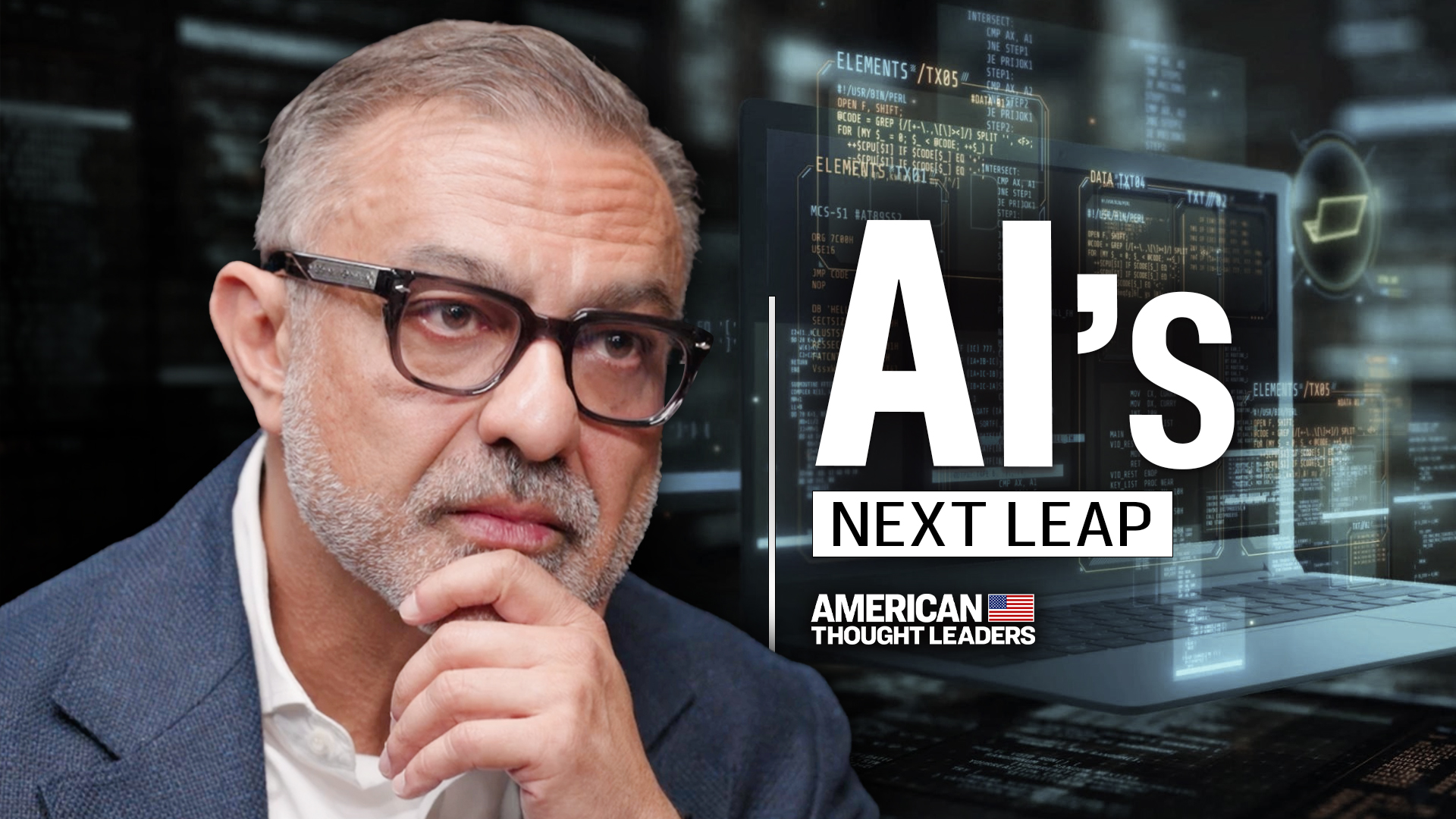

[RUSH TRANSCRIPT BELOW]Vic Gundotra, a former Google senior vice president, says that artificial intelligence is advancing along an exponential curve that few can truly comprehend. In this episode, Gundotra revealed why he is deeply optimistic about the future of AI.
“It’s terrifying and exhilarating at the same time,” Gundotra said.
Having overseen early AI breakthroughs, the development of Google+, Google I/O, and YouTube mobile, Gundotra pointed to emerging medical applications—including treatments for cancer, Parkinson’s, and heart diseases—as key reasons to allow the field to advance.
He answered a host of questions. How did Nvidia’s graphics processing units (GPUs) change the world? What are the legal guardrails that incentivize caution in big tech? And are warnings of possible AI catastrophes overblown?
Views expressed in this video are opinions of the host and the guest, and do not necessarily reflect the views of The Epoch Times.
RUSH TRANSCRIPT
Jan Jekielek:
Vic Gundotra, such a pleasure to have you on American Thought Leaders.
Vic Gundotra:
Thank you, Jan. It’s a pleasure to be here.
Mr. Jekielek:
So before the rise of NVIDIA, this is 2016, you called, well, they had started to rise, but before the big, big rise, you had called AI [Artificial Intelligence] the single greatest technological innovation of our lifetime, bigger than electricity or the steam engine. And you also described it as a double-edged sword back then. What were you thinking?
Mr. Gundotra:
It was pretty obvious to me very early on, because of my role in leading some of the AI efforts at Google in the early days, as early back as 2009. You know, the first AI product ever released, based on convolutional neural networks, was Google Translate. And that was a product that was under my team. And, you know, it wasn’t necessarily me, it was my boss, Larry Page, who was really able to see and forecast that this technology was unlike any other. I have to admit, Larry was ahead of me. You know, it took me a little while longer to understand the implications of this technology.
But certainly, as far back as 12 years ago, it became obvious to any engineer, anyone in software who had an open mind, that this technology would revolutionize humanity, that it would be something akin to fire or the invention of the wheel, that we would mark time as from the time that this technology was invented, that people’s lives, the future of humanity would change. That was very, very obvious to me. So, that’s why I made that comment, and I still believe that today.
In fact, I think recently, just in the last nine months, just in the year 2026, it’s obvious that our estimates about how AI was going to affect humanity were conservative. What we’ve seen, the acceleration just in the last 90 days, has taken most of my colleagues’ breath away. We are about to see an acceleration in the next 18 months. Some of my colleagues believe that in the next three months that is going to shock people. So, I’m more enthusiastic about AI than I’ve ever been, along with the caveat that there are also some extreme dangers I do worry about.
Mr. Jekielek:
Well, I want to talk about those and how we triage this stuff as a society, as a humanity, in the context of this exponential growth curve, if you will. A data point here, or a point in time at least, is NVIDIA today, because NVIDIA is central to this whole process that’s happening right now. And we have a company that’s lost its CEO, which, you know, arguably the beating heart of the company that saw it from its creation from the beginning. We saw a big drop in its market cap. We see maybe more scrutiny put about how many of those, you know, higher-end chips or how easy they’re going to be accessed by communist China. Can you give me a picture of what you think is actually going on here at this moment?
Mr. Gundotra:
Sure. It’s a very turbulent time, and what’s happened with Jensen Huang is heartbreaking. I sit in a very unique position. I grew up as a 21-year-old whom Bill Gates hired, and I spent 15 years working with Bill Gates. Years later, I worked with Steve Jobs on that first iPhone, where the only company he ever allowed to be on that first iPhone (remember, this is pre-App Store) was Google. I ran Google Mobile Maps Search, YouTube. Steve Jobs wanted that on that first iPhone.
I worked for Larry Page, the founder of Google. Sergey Brin and I shared an office for a brief period of time. And so my life has been blessed. I forgot to mention Eric Schmidt, who ran Google. He was my boss for a while. I’ve had an intimate association with the people who’ve led technological innovations.
Jensen Huang is on that list. He’s a founder who changed the world. These are incredibly rare people who have a gift of seeing the future and making it happen. Nvidia as a company is extraordinary, and anyone who’s watched the rise of NVIDIA knows it wasn’t an overnight story. Jensen spent over 33 years building that company, and that company became the technology, the hardware technology, which is the very heart of AI.
I’m happy to go into more details, but I’m heartbroken at the moment over the events that have occurred in the last week. Personally, I hope there’s a path for Jensen to once again regain leadership of the company he founded and the company that bears his DNA and his thought leadership.
Mr. Jekielek:
Maybe very briefly, because I’m not sure everyone fully understands the central role of NVIDIA as a company in this AI boom.
Mr. Gundotra:
Sure. I'll explain it this way. I’m 57-years-old. My generation grew up with the growth of the personal computer. We remember when people didn’t have personal computers. People younger than us don’t remember that time period, and people in their 30s have grown up with iPhones and iPads. They don’t even remember a period where technology wasn’t available in the home.
You and I probably remember when people didn’t have computers. That first wave of innovation that drove personal computers into everyone’s homes was driven by Intel and Microsoft. Bill Gates famously said that the vision for Microsoft was a computer on every desktop and in every home. My wife laughed at that.
Mr. Jekielek:
There was a computer called a PC Junior.
Mr. Gundotra:
Yes, IBM.
Mr. Jekielek:
Yes, which I had. So, that was my introductory year.
Mr. Gundotra:
Those computers were driven by an architecture, a fundamental chip, the Intel chip, that worked serially. It did one thing at a time. And it’s true that Intel developed the ability to do multiple processing at the same time. Chips like the x86 chip and the Pentium chip did give you that capability, but most people didn’t realize that software programmers were unable to take advantage of multiple threads processing at the same time.
Today, I don’t care how fast your computer is, I don’t care if you have the latest computer you bought just now, and you open up an application like Microsoft Excel or Adobe Lightroom or Spotify or YouTube, they all run on one thread, one linear process at a time. NVIDIA’s great insight was that they needed to redo the hardware so that you could in fact run across not one, not two, but hundreds of parallel execution paths.
Now, I told you that Intel was capable of that. I told you software programmers were unable to write programs because it was so complicated. There were these complicated things called deadlocks and synchronization problems that happened. As a software programmer, if you told it to do something in parallel, what happened if what you told it to do finished? And now another thread was waiting on this thread to finish. But this thread was waiting on another thread to finish. Synchronization of multiple threads, dealing with those problems, was so complex that it never took off.
NVIDIA decided to take a completely different approach and not depend on software developers to solve multi-threading. Their fundamental architecture was completely different, matrix computing, multi-threaded computing, and they decided to focus on one area that was desperate for that, and that was gaming. It turns out when you play video games, the rendering of what you’re watching, maybe you’re playing a race car, and you need to render the race car, the racetrack, the people in the stands. And they developed chips that could do just that, and it was game developers who decided to adopt Jensen’s architecture and his approach. And if you were willing to spend the money as a consumer and go to a computer store and buy a specialized chip, a GPU [graphics processing unit] chip, and you were willing to put it in your PC, you could play video games that made every other game look like a toy.
And for years, Nvidia was a gaming company. You bought their chips and made your PC better. By chance, by coincidence, it turned out that the development of AI required exactly the same kind of parallel processing as video games. And Jensen’s great insight was to make sure university professors who were working in AI would get those game GPUs. They were called graphical processing units, GPU instead of CPU. Intel sold computing, computer processing units. But he sold graphical.
Graphical was for the video games, the architecture used to render those scenes. Jensen did not know when he started NVIDIA that AI was going to be the future, but he was very quick to realize that. And he gave away those GPUs to every university. And the modern-day birth of artificial intelligence was because those Jensen Nvidia GPUs were available. And of course, today now the GPUs NVIDIA builds are a million times bigger than those graphics cards we used to buy at stores to play video games, but the architecture is the same. And that next generation of software running on GPUs is what’s changing the world.
Mr. Jekielek:
When you’re dealing with these AI models, these are not computer programs. And again, this is something maybe if you could just briefly explain to me what this is that needs this type of architecture, and so many of them, right, in many cases, running in parallel themselves.
Mr. Gundotra:
This is one of the hardest things for people to understand. Even people with a rudimentary knowledge of computer science know what programming is. They know that intelligent people write software that tells the computer step by step what to do. For example, if you were writing a computer program to make your bed, you might say something like, get the pillows off the bed, take the sheets, straighten the sheets, fold the edges, bring the pillows back, tighten the sheets, get any comforter, put it back, make sure the sheets are even.
You could go step by step. Whether it’s making a bed or a peanut butter sandwich, software in my lifetime, prior to AI, was simply a series of very cleanly organized and represented steps. AI changed all that. AI says you don’t write steps; the AI learns by itself. Now, that’s a little scary. What does it mean that AI learns by itself?
What it means is you feed it data; you feed it people making beds, a million people making beds, a video of a million people making beds, and it watches it. Now, that’s a pretty bad example because there’s not a definitive outcome. What originally happened was they would show videos of games being played. In a game, you can think of a game where you either live or die. If you make the wrong mistake in the game, you lose your character. Maybe you get three characters, and then you’re done.
Those can be run a million times over and over again. And they produce large datasets, and the computer can analyze those and see, this is a winning move, or this causes your character to die. By analyzing vast quantities of data, maybe playing that video game or making that bed a million times, AI learns exactly like children.
How does a one-year-old learn to stand up? He tries every little move until he falls, and finally, he learns how to hold his balance. AI does that on a greater scale. It tries everything. And humans help it by telling it, well, that worked. Your character didn’t die. And by itself, it begins to learn. And what it learns supersedes human intelligence.
If you remember ten years ago, Google, with DeepMind, made huge headlines because Google was able to take one of the most complex games called Go, and it was able to outperform any human. This wasn’t what you and I grew up with, with IBM beating the chess champion. That was the old architecture.
This new architecture was AI learning by itself, looking at large sets of data and doing what babies do, but on an insane scale. And building large sets of data that represented not just how to win a game, but today, ChatGPT or Claude or Google Gemini represent the sum of all human knowledge that we have in written form. It’s pretty incredible.
Mr. Jekielek:
That was fed into the system. I have to caveat that because there’s a bunch that wasn’t, right?
Mr. Gundotra:
When you say the bunch that wasn’t, what do you mean?
Mr. Jekielek:
Well, there’s just all sorts of information that wasn’t digitized.
Mr. Gundotra:
That is correct. If the information is not digitized, then it’s invisible to the computer until the robots come.
Mr. Jekielek:
Because there’s this—I’m just remembering this whole process that Anthropic was kind of getting in trouble for, chopping up these old books and feeding them into the digital, you know, processors and so forth, if you remember, right? And people are, why are they doing that? Well, because they want to have the whole sum of human knowledge, right?
Mr. Gundotra:
Well, it was amazing that the early days of AI were dependent upon the sum of human knowledge as it existed on the internet. But, for example, Tesla demonstrated that’s not true. Tesla demonstrated that they could have cars that simply recorded the world around them, information that never existed on the internet. And Tesla collected that just in the last few years.
I just went from Los Angeles to San Francisco, a six-hour drive. My wife and I talked the whole time, and we never touched the steering wheel. Instead, my wife played podcasts about improving our marriage, and oh, it was a I think somewhat of a painful but fun seven-hour drive, but we never touched the steering wheel.
In fact, the Tesla had collected video information that the world had—it was there, it wasn’t on the internet—and it collected this new information and had developed artificial intelligence that made it safer, ten times safer than a human driver. That information did not come from books; it did not come from the internet. Tesla collected that just by people who had driven the cars and what it had seen from the cameras. Pretty extraordinary.
Mr. Jekielek:
But before we go deep into the, you know, the quandaries which AI presents for us as humanity, if you will, I want to talk about NVIDIA a little more because this is kind of—I don’t know, it feels to me like a bit of a seminal moment. We have this company that’s the centerpiece of creating the infrastructure for these brains, if you will, to function at a massive scale. It’s lost its leader, maybe temporarily, we'll see.
Based on what you and many other people, from what I’m seeing, are saying, it’s lost a huge amount of market capitalization—an unfathomable amount. It’s already worth an unfathomable amount and lost an unfathomable amount. Also, there seems to be an increased interest in preventing some of this highest-end technology from ending up in the hands of communist China for its own purposes. So what does this moment mean from your perspective?
Mr. Gundotra:
So, if you don’t mind, I’m going to break your question into two different parts. First of all, let’s talk about how much NVIDIA has lost. And then, secondly, if you'll allow me, let me talk about the role that I think China plays. You know, if you just bought NVIDIA four or five years ago, it’s up several thousand percent. You could have bought NVIDIA and made a fortune if you had just bought it four or five years ago. The recent drop is about 30 per cent. So, it’s gone up several thousand percent, and it’s dropped a trivial amount.
But if you read the press, oh, the market cap has been driven down by a trillion dollars. And of course, one of the worst things you can do is to read newspapers to get real information. And anyone who can just look at NVIDIA’s chart over five years can see the drop is trivial. And so, yes, while the turbulence at NVIDIA, particularly around Jensen, is heartbreaking because it’s a personal tragedy for a man who built something so extraordinary, I think any investor in NVIDIA would still say this is the greatest investment I’ve ever made in my lifetime.
As someone who worked for Bill Gates and at 21 had a significant number of shares at Microsoft, as someone who joined Google and watched that happen, I personally have experience in seeing tremendous net growth of equities. I’m telling you, NVIDIA is one of the greatest investments of all time. I continue to believe that it’s a great investment.
Now, when it comes to China, you know, China is a very complicated topic. Jan, I’ve read and seen your book, and you, in particular, are very well-versed on some of the ugly sides of China. But in the world of AI, I would argue China has done the world a tremendous service. China has invested in AI and produced models that are just behind the best American models. When I say just behind, I mean by three months.
Imagine that your favorite manufacturer of cars, like Mercedes. Imagine Mercedes launches a brand new S-Class, and it’s the world’s best sedan. Now, I happen to believe Tesla’s the world’s best sedan, but I used to drive Mercedes, so let’s just go with that. Imagine they launch a new Mercedes in September, and three months later, in December, somebody offers a car that’s just a few months behind what they launched, only three months behind, and they give it away for free. That’s what China’s doing.
China is building open-source models that rival the best American models. They give it away for free. You can download them on your home computer, disconnect the internet, and run them locally. I know there’s fear that the Chinese government is modifying these models. They’re open source. As an engineer, you can look at them, you can test them, you can disconnect them from the internet. So they have no connection to China.
And so, I would argue that this is much like what happened with the internet. You know, when I worked at Microsoft, we sold servers. Sun Microsystems sold servers that ran what we called websites, Amazon, eBay. Then came open-source efforts like Apache, and within a short period of time, the entire internet was built on open-source web servers. To this day, you don’t have to use Microsoft software or Sun Microsystems; most people don’t even remember Sun Microsystems anymore. And you can get open-source software, and that free software changed the world.
You could be in Nigeria, you could be in India, you could be French, where there’s hardly any innovation. And you could get this open-source software, and you could run it. And China has given a gift to the world by making these open-source models available, which forces everyone to stay on this treadmill to stay ahead of those models. So I think it’s a mixed bag.
Mr. Jekielek:
They distill them, right?
Mr. Gundotra:
It’s common to say that they cheated. Distilling is when you use somebody else’s technology. It’s like cheating for a test. It’s like imagine that you don’t really know the questions for the test, but you’re able to ask questions of the professor. You’re able to ask a hundred questions and write them down. Some people claim, and there’s a certain truth to it, that Chinese models really got that good by taking the American models and asking them millions of questions and then taking those answers and training their models.
Now, whether that’s true or not, it might be true, by the way. It might have been true that China used those techniques. But you could also argue, where did our American models get their intelligence? Did they not read The New York Times? Did they not read every single thing on the internet? Did they not distill the knowledge of what was produced by other people? And so, this distillation argument is a little bit slippery. And I would argue if China all they did was distill, how come India couldn’t do it? How come China alone was able to do it?
Mr. Jekielek:
So I don’t want to dwell on this too much, but I think the idea is that China’s become expert at what you would call reverse engineering of basically theft of technology, legal transfer of technology, whatever, by whatever means, obtaining of technology that’s mainly American, but also from other places.
Mr. Gundotra:
So, Jan, I’m not going to argue with that. As a former senior vice president of Google, I have intimate knowledge of China doing exactly what you describe.
Mr. Jekielek:
Right. Well, so this strikes me that let’s just say they have some expertise in doing this kind of stuff. That’s what I’m saying.
Mr. Gundotra:
They do. Jan, you’re right. I’m just saying that this issue is a little bit nuanced.
Mr. Jekielek:
Right. And fair enough, absolutely.
Mr. Gundotra:
It’s ironic, yes. As a former senior vice president of Google, I find myself in
Mr. Jekielek:
Right.
Mr. Gundotra:
It’s not something I ever expected in my life. You know, but I’m trying to be fair. You know, what did China do that we should give them credit for? I think making open-source models available to the entire world. Not everybody can afford the top Chinese models—excuse me, the top American models in the world. This technology is going to save people’s lives.
We want AI to be as inexpensive as possible and available to people of all worlds. If you live in Nigeria, if you live in Armenia, if you live in Australia, if you live in India, we really want this technology to be pervasive. And saying that it should only exist among three American companies is not really great for the world.
Mr. Jekielek:
Well, so, this actually leads me precisely to one of the quandaries, if you will, the why I’m doing this series, which I’m so glad to have you on. I see a lot of potential problems. Let me give you three vectors, if you will. When I look at these three, I don’t see a solution. Number one is, given what you’ve explained about how AIs work, it seems to me like a terrible idea to have no guardrails whatsoever in development.
Number two, you just mentioned, you know, it doesn’t make sense to have three or however many giant companies rule the space. And of course, from the looks of it, it seems like these companies, as is often the case, are interested in creating guardrails that will be beneficial to them, which is, again, not surprising. It’s what every large company would probably try to do. And it makes much more sense to have it democratized in a way where you can have a lot of small players that can, you know, come up with brilliant things, and this is one of the great things about America.
The third part is, and we talked about China a little bit, a future where, you know, the moral core of AI comes from the Chinese Communist Party—that is a very dark future. And I do not want to see communist China winning the AI race. I don’t know how we see success in the future, and I’m also very optimistic in a lot of ways, but I can see a lot of dark paths here, and it’s unclear to me how we find the one to the light. So, wow, the quandary for the future.
Mr. Gundotra:
There are a lot of parts to your question there, and you’re actually very reasonable in those questions you ask. I don’t think the answers to your questions are obvious. The way I try to look at them is to say, do we have parallels in the past of similar things where technology was invented and there needed to be guardrails? And how did that work out? You know, when I ran YouTube Mobile in the early days, people were very concerned. You know, you may remember Google acquired a company called YouTube, and then we brought it up.
Mr. Jekielek:
I remember it very distinctly.
Mr. Gundotra:
Yes, it was quite incredible. You know, I ran the mobile version.
Mr. Jekielek:
You bought it?
Mr. Gundotra:
I was part of the team, yes. I was an executive at Google at the time. I was responsible for building the mobile version. We sat down with the founders that we had just paid significant billions to.
Mr. Jekielek:
I was just going to say, like, good move.
Mr. Gundotra:
At the time, the press report thought it was crazy. The YouTube site that we had purchased was filled with content that was illegal. People were recording NFL [National Football League] games, people were recording music, people were recording movies they were putting up online. And people thought Google buying them was the equivalent of buying a hornet’s nest of legal problems. And it was a hornet’s nest of legal problems.
At the time, the founders didn’t believe in mobile at all. And one of the founders sat down with me and said, Vic, are you crazy? Why would anyone watch YouTube on a mobile device? To download an average YouTube video would consume 30 per cent of your phone battery. And on AT&T, downloading it would cost you $900.
The founder looked at me and he said, you’re going to waste a third of your battery, spend $900 on a data bill to watch a YouTube video on a two-inch screen? I’m not developing YouTube for mobile. And Larry Page, who was the founder of Google, fortunately said, Vic, go build your own team. We built four other people, five of us. We ended up building YouTube Mobile, which then a few years later had more traffic than the desktop mobile.
But that’s not why I bring up YouTube. I bring up YouTube because it also had the issue of guardrails. Why isn’t porn on YouTube? Why isn’t it filled with horrible content of your neighbors posting salacious videos? Well, because Google was economically incentivized to build technology so that if you recorded a Monday night football game and you uploaded that to YouTube, in seconds, we could detect that it was copyrighted content and stop it. And we proved to the courts that we were doing our best to stop movies, live television, music that we didn’t have a license to. And so, those guardrails were an economic necessity for Google; otherwise, Google would be sued out of existence.
Today’s AI faces the exact same problem. If Anthropic or OpenAI or Google produces AI that breaks laws, the litigation burden is extraordinary. And somehow people seem to forget that. They somehow believe that these companies are going to build AI without any guardrails. And they don’t really think that these companies are filled with average executives like me, who have lawyers who come into the room and go, your AI is causing suicides, your AI is breaking the electrical system, your AI is causing harm in medicine.
Of course, these things happen, and executives respond, and they respond quickly. Now, those early days of YouTube were difficult. I remember that. And the same thing is going to happen here with AI. AI is going to build in those safeguards. I’m not saying those companies aren’t going to make mistakes, but they’re going to be corrected very quickly.
Mr. Jekielek:
This is a good answer, but it does make me more concerned in some ways because I know, for example, even on X and on Instagram, there’s, for example, self-harm content or pornographic content of young people uploading to shame others, and that the companies aren’t as quick as one would hope to deal with some of these very egregious violations. So anyway, I accept what you’re saying; it makes sense. But at the same time, in practical implementation, this type of thing is actually a pretty big problem. So with that caveat, yes, please. I didn’t want to just leave that without mentioning.
Mr. Gundotra:
No, I mean, we certainly sometimes forget that these technologies are basically 10 to 15 years old. They’re in their infancy. Right. You know, even Instagram, social media, it’s only a decade and a half old.
Mr. Jekielek:
Well, and then the guardrails can also be used to censor political speech.
Mr. Gundotra:
That’s exactly right.
Mr. Jekielek:
Which has happened.
Mr. Gundotra:
No, YouTube, Google was guilty of it. Google would demonetize you.
Mr. Jekielek:
My channel was demonetized in early 2021 and continues to be. Somehow it started doing well. That’s why I still use it, my YouTube channel. But Google actually collects, or YouTube, all sorts of ad revenue. And the reason I found out about this is that people were complaining to me that I’m putting too many ads on my videos. And I said, I don’t have the ability to put ads on my videos. I’m demonetized. I’ve tried to get it back. I have almost 600,000 subscribers, if possible. But for some reason, Google collects revenue off of my content. So anyway, I'll just leave it at that.
Mr. Gundotra:
I think you’re right. I was mentioning Susan, a dear friend of mine, Susan Wojcicki; she ran YouTube. After I had retired from Google, Susan picked up responsibility for YouTube, both desktop and mobile. And I retired about 14, 15 years ago. But I would often talk to Susan about why YouTube was demonetizing.
And for those of you in the audience who don’t know what demonetizing is: if you, for example, had a conservative view, if you said something outrageous, like, it’s best if a child has a mother and a father, that broke the rules of wokism. If you said something like, the COVID vaccine might not stop the spread of the disease, well, YouTube would remove your monetization. If you were someone like you, who has a large audience and monetizes that audience, that’s how you support your work. Google coming down and shutting down your monetization was a form of censorship.
Mr. Jekielek:
Yes, I mean, yes, thank you. Thank you for saying that. Yes, absolutely.
Mr. Gundotra:
It’s probably one of the darkest spots in Google’s history, was the founders allowing Google search and YouTube to be used as a form of censorship. And of course, the winds have shifted. And now we recognize the government was largely behind that. We now understand the role of Biden’s administration to come into companies like Google. I ran Google Mobile Search, I ran YouTube. I was very well aware of the pressure.
The government would come in and say, for national security, we think this is dangerous content. And then as you can imagine, as a senior vice president reporting to the CEO, what do you do? Are you going to fight against the government, or are you going to follow the rules? And so, you know, those censorship efforts are a dark spot on American politics and really a dark mark for Mark Zuckerberg as well, for Facebook, Instagram, YouTube, Google search. Those were very, very bad days.
I hope we don’t go back to those days, and I’m very proud of Elon Musk for being willing to risk his entire reputation and fight against the government and to keep X in particular open and to open source the algorithm, which no one else has done, the algorithm behind YouTube, behind Google Search, behind Instagram, behind Facebook is secret and proprietary. X is the only platform where the underlying platform algorithm for what you see in your feed is open source. And I think people don’t give Elon enough credit for fighting against governments and being very open.
Mr. Gundotra:
Yes, no, I agree. And I don’t, I didn’t mean to kind of distract us from our big picture, right? So, we have this, we don’t want wholly unrestricted development. You talked about how it’s not entirely unrestricted because of the legal liability, the legal realities. And then there’s this interest in creating regulation that is, you know, will favor people who have the ability to influence the creator, the creation of regulation.
Mr. Gundotra:
That’s exactly right.
Mr. Jekielek:
Yes. And the third part, of course, is the you know, kind of a China-focused or Chinese Communist Party-influenced AI ecosystem.
Mr. Gundotra:
Yes. In China, as I mentioned, I think it’s a very nuanced and complicated picture. They’ve given a gift to the world with their open source models. That doesn’t mean that in China those models aren’t censored, right? They run those models with different rules than the open source models they give away to the rest of the world.
I think it’s actually a brilliant strategy on their part. The Chinese are among some of the most intelligent and smart people in the world. And what they’re doing with AI is second only to the United States. It’s not Australians, it’s not the French, it’s not the Indians. No one is in this race other than China and the United States.
Mr. Jekielek:
What do you think about the right type of regulation that is needed? What are the right guardrails?
Mr. Gundotra:
Jan, you don’t ask easy questions. That is a very difficult question. What are the right guardrails? What’s the right regulation? And I think the extremes are the danger points. No regulation, AI developed solely for the benefit of economics, unrestrained by anything, is extremely dangerous. And at the same time, regulation can choke an industry.
After I retired from Google, I had the privilege of running a medical company, which brought me into contact with government agencies. In fact, I drove the first artificial intelligence-approved algorithm by the United States FDA [U. S. Food & Drug Administration]. It was one of the worst experiences of my life working with the FDA. We were the first to get it approved. But simply the application would have gone from the floor to the ceiling in paperwork, a year-and-a-half working with the FDA to prove something that it was safe.
Any normal person would have looked at it and said, of course it’s safe. It was just the detection of a particular condition called atrial fibrillation. You could hold a device that looked like a credit card. Today your iPhone, your Apple Watch has it built in. No harm could be caused, other than if it falsely claimed you had atrial fibrillation.
Mr. Jekielek:
And that is just your heart, basically, some blood being let through your heart valves, right? Really?
Mr. Gundotra:
Well, your heart typically has two kinds of problems: a plumbing problem, where there’s a blockage, and then the other type of problem is an electric problem, where the electrical currents don’t cause the contraction of the chambers of your heart to go in the right order. They misfire. Atrial fibrillation is not a plumbing problem; it’s an electrical problem.
Mr. Jekielek:
It’s the misfiring.
Mr. Gundotra:
It’s the misfiring. Okay. And so, this particular device detected that. It’s a very common problem. One out of every four Americans will get it in their lifetime. I don’t want to get into the details of that, but my point is that engaging with government regulation is unbelievable, and can be unbelievably burdensome. Just ask yourself, how did you feel the last time you went to the DMV [Dept. Of Motor Vehicles]? It was probably one of the worst days of your month. And that is the government, you know, as an example of what it’s like to work with the government.
And so, and then there’s a secondary component, which is if you’re the market leader, you want government regulation because it pulls up the ladder so your competitors can’t catch you. And secondarily, it provides you liability protection. Look at the vaccine manufacturers. The government insulated them from lawsuits. And the AI companies, the leading labs, would like nothing better than for you to believe AI is dangerous, and for you to vote for a government agency to regulate AI, because they then get liability protection, and it makes it very difficult for a small startup to compete with them.
OpenAI was only a few hundred people. Whoever believed they could compete with Google? But if you put in a government agency that says the next OpenAI has to work through huge amounts of paperwork, and have huge expenses, it makes the incumbents win. It’s not just for AI.
You can go back in history and look at every major industry, whether it be agriculture or health, and you’ve seen the playbook. There’s a great talk. The All-In Podcast has a summit where they have a single talk. I believe it was Brad Gerstner that gave the talk that walks you through the history of regulation and how it protects the leaders. And so, that does worry me.
That really worries me. I’ve got a nuanced view. I think there should be the appropriate regulation, but we should be very careful. We’re not fooled by the market leaders who prophesy great doom, a 10 per cent chance Americans are going to be wiped out by AI. At the same time, they’re making an IPO [initial public offering] next week. If they really believed it, with a 10 per cent chance it was going to cause the destruction of humanity, why would they IPO? And so any reasonable person, I think, has to slow down and say, what’s the motivation here?
Mr. Jekielek:
Is there a chance that AI wipes out humanity in your mind?
Mr. Gundotra:
I tend to be extremely skeptical. As an engineer, you know, as someone who’s helped write these early systems, I think these fears are overblown. But I’m 57 years old, Jan. I’ve seen these fears my whole life. In the 1970s, I grew up in a world where the ozone hole had been discovered, that there was global cooling. Peter Gwynne was the science editor of Newsweek in 1975. And he argued that global cooling was coming and that agriculture would never be the same for the rest of the century.
Then later I saw Y2K [Year 2000]. My friends thought, oh, even Prince wrote a song, 1999. It was part of popular culture. The world was going to end because of a computer glitch. More recently, it’s global warming. In fact, I can go back, if you let me go back just one step further. Okay. 1475. A Dominican priest wrote famously that the printing press was the whore because he believed it would lead to trashy publications that children would read. And that this technology undermined handwritten manuscripts.
By the way, there are 10 other examples like this. 1902, The New York Times argued that the automobile was going to be terrible for humanity, that we needed those horse and buggies. And so I tend to be very skeptical. If you zoom back out, just calmly step back and look at the last 200 years. The Industrial Revolution, technology, has changed humanity for the better. We have a five-day work week. Do you think people worked five days in the 1800s? Infant mortality has dropped 60-fold since the 1800s.
Now, in the 1800s in the United States, 74 per cent of all Americans worked in agriculture. Today that’s 1.5 per cent. That means three out of four of every job in America disappeared since 1800. Technology changed it. But no one sits here and says, I wish I could be in the fields. They’re happy with their modern jobs. And so, technology will be disruptive, jobs will change, but people have consistently gotten it wrong.
Mr. Jekielek:
No, and fair enough, but you explained very eloquently, I might add, very helpfully earlier, that we’re talking about a technology which learns like a baby, like a small child, that is more intelligent than we are in many respects. For example, like the Tesla driving car, that’s a much safer way to move around. Ten times safer, right? And so, you know, we’ve all seen the Terminator film.
Mr. Gundotra:
We have, it’s a very good film.
Mr. Jekielek:
Right. Extremely good film, but given what we’re creating, that actually seems like a realistic scenario.
Mr. Gundotra:
Yes
Mr. Jekielek:
Right? Yes. And that’s very different from all of these other scenarios we’ve talked about in the past. Even if people said, you know, this is, of course, these automobiles and all these technologies were groundbreaking, people couldn’t see what they would look like in the future. But that feels like an existential one.
Mr. Gundotra:
I'll tell you my theory as to why it seems so scary.
Mr. Jekielek:
But it’s possible, isn’t it? Skynet is possible, and we’re building military systems, right, that are autonomous. That’s a huge project of not just the U.S. government, China, communist China, no guardrails, wanting to win the race, accelerating competition and technology. I don’t know. I’m just throwing it out there.
Mr. Gundotra:
I'll give you my theory, and I’m not saying my theory is right. I’m an observer like everyone else. I happen to have a different seat, a different perspective. It comes down to intimacy. The more intimate we are with technology, the closer it becomes to us, the scarier it is. You know, my wife, who has fought a successful battle with breast cancer, what’s her relationship with the radiologist? The radiologist does the scan, finds the cancer, but he publishes a report that my wife can’t read. She’s not a doctor.
The report goes to her oncologist. Her oncologist reads the report, interprets it to her, and then she says from what her oncologist said, there’s a bit of distance she requires from human experts. AI changed computing. AI became the first technology that spoke the language we did. Chat GPT, you could just talk to it. You could say, here’s my oncology report, here’s my radiology report, what does this mean? And it talked to us. Our interface to a computer wasn’t a punch card, it wasn’t a computer screen, it wasn’t a mouse; it was what we learned when we were two years old: just talking.
My wife can talk to the computer when she doesn’t have to be embarrassed about asking a dumb question. And so AI has become intimate. And then when we see these scary things, this intimate thing that we’ve let into our lives, we talk to AI in a way that we never talk to anyone else. We talk to it when our spouses are not there. Could that become the Terminator? I mean, that’s what’s a little scary. And so I understand the fear, and I think we’re at the beginning of this with what just occurred in the last six weeks.
Mr. Jekielek:
But Skynet, is it possible? And please tell me if I’m wrong. I would love to believe that this is impossible, right? But we could inadvertently build a system that is highly networked, that controls the whole, you know, military situation because of this, you know, AI military race, for example, with China, which is militarizing at a rate that, you know, prior, maybe World War II was a quicker militarization in the history of the world, but it would probably be the second most aggressive militarization in the history of the world, and build something that then, you know, decides humanity is the problem. Is that impossible in your mind?
Mr. Gundotra:
It’s not impossible.
Mr. Jekielek:
Okay.
Mr. Gundotra:
You are not saying something that’s impossible. It’s unrealistic. It’s not impossible.
Mr. Jekielek:
Okay, so tell me why it’s unrealistic. I’m keen to hear that.
Mr. Gundotra:
Let me give you two examples. When we first built Google Photos, it was at a time when people were very afraid to upload their photos. In fact, Google has a Friday meeting. The whole company is invited, and it’s called an all-hands, TGIF. I remember at one of those Friday meetings, one Google employee raised his hand and everyone cheered his question.
He said, why would we Google build something that would take your photos and put them in the cloud? He said, I have naked pictures of my children in a bathtub. He was a Google employee, and he said, never want those leaving my computer to go to Google. People forget. But when I built Google Photos, we believed that moving those photos up to the cloud would provide tremendous benefits.
Today, anyone who uses Facebook or iPhoto has these memories that pop up, where instead of having your photos locked up in a shoebox, now memories from six, seven years ago pop up. As part of that project, we did face recognition. So, for example, you could search for your daughter. Just show me pictures of Samantha. And we quickly realized, my team did, that with a handful of pictures, if we could find a handful of pictures of you on the internet, we could instantly identify you.
And immediately my team realized the impact, the Skynet-like impact. What if a politician, a female politician, went into an abortion clinic and there was a video camera? We could instantly identify automatically this was a senator. What if it was a church, uh, what if it was a priest? And we had hours of meetings with legal and the founders of Google, and we decided that based on the risk that would provide that we would not launch that feature, we absolutely turned off that feature available in the API.
Now, granted, it was self-preservation. We didn’t want the liability. But people don’t realize how many, how long ago, in 2013, Google had this ability, yet it was not released because of the brand damage it could do to Google. So people forget there are guardrails in place. Our legal system, liability, the brand damage to a company. People at these companies do spend hours weighing these topics. They’re not willy-nilly building Skynet to go after you and steal your bank account information.
If this happened, the liability these companies would face would be tremendous. So that’s the first level of safeguard. But I think the root of your question is, is it possible? It is possible. We’re about to enter a period where this technology is not just smart, it’s smarter than anyone you know, and smarter than all humans on Earth.
Mr. Jekielek:
And builds the, this is the question, right? And has the ability to better itself now in ways that we can’t imagine.
Mr. Gundotra:
That’s correct. You mentioned at the beginning of our conversation the word exponential. And this technology is growing exponentially, and people toss out that word, but I find that most people don’t understand that word because in the human experience, we don’t have much experience in our life of exponential growth. A flower grows day by day. Our children grow five, six, seven, eight-years-old. The only thing we know of that’s exponential is the growth of viruses.
Viruses go from, you know, 100 people to 200 people; it doubles, and it takes the same amount of time to go from 1 billion to 2 billion. That’s exponential growth when things double every step. And our brains have a hard time understanding that. And AI is growing at that rate.
Jan, if I asked you, and I ask this when I give talks. I often ask people this; if I take 30 steps, how far is that? And people will point to the opposite side of the room and they'll go, I think that’s 30 steps. And I say, what if I took 30 steps exponentially? Every step doubles, two steps, four steps, it’s already unimaginable.
You know what I ask people, do you think it’s from here to New York? Do you think it’s from here to Tokyo? I get people raising their hands. You can Google it. 30 steps exponentially is 26.2 times around the Earth. AI compute, just compute, just I’m talking about compute, is doubling every five months. It’s hard for our brain to grasp that, that means in three years we'll have 150x compute capacity than what we do today.
That’s just compute, right? I’m not talking about the algorithms getting better, I’m not talking about the models getting better, I’m just talking about pure compute. And the cost of using a token has dropped 99.8 per cent in the last three years. If you just model what did it cost to use Chat GPT, what does it cost today per token? We’ve had a 99 per cent drop in cost, and compute is going up.
So, we are seeing exponentials along multiple dimensions, and it’s very hard for humans to realize that at the rate that these things are, hence the concern. I understand the concern. I understand the concern. It’s kind of scary. As a species, we’ve never seen anything like this.
Mr. Jekielek:
And so, you know, let’s talk about the guardrails for a moment, right? There are all these legal, let’s call them legal guardrails, liability, and so forth. Um, and actually very powerful. We’ve seen in multiple industries, this can be an extremely useful tool. And the costs, you mentioned one example, when you don’t have them, can become incredibly problematic.
But with communist China, there are actually no guardrails other than maintaining power. Unfortunately, I wish that wasn’t the case. But so, this is, that’s why I see this kind of technological arms race, if you will, that could develop. How do we create credible deterrence? I don’t know. This is what I’m thinking, right?
Mr. Gundotra:
Unfortunately, you’re right. There is an incredible arms race that’s happening. It’s a little bit complicated. You know, even if you take China out of the picture, there’s an arms race that’s driven by capitalism. You know, whether you’re Google or you’re Anthropic or you’re OpenAI or your Grok, if you’re building AI, you keep your eye on your competitor because the winner of that race is likely to be the most valuable company on Earth and in history.
Mr. Jekielek:
And most influential and wielding the greatest amount of leverage and everything else.
Mr. Gundotra:
Correct. Just think about what happened this weekend. Think about the implications, the military implications of what just happened this weekend. For the first time in history, SpaceX caught a 30-story building that was in orbit for 22 hours, that re-ignited an engine and landed itself to be reusable. That means that SpaceX can move a hundred tons of equipment to any place on Earth in 45 minutes.
What do you think that means for the military? You think having nuclear submarines matters? How many countries have nuclear submarines? Now, how many countries have the ability of Starship to move a hundred tons anywhere? And so, it’s not just AI. And of course, Starship uses AI, but technology itself is a tremendous advantage militarily and economically. And it’s happening across multiple dimensions. It’s almost hard to keep up.
Mr. Jekielek:
I was watching that too and was just stunned at the prospects. It’s a completely different thing to have a fuel tank and get caught in the, what do they call them, the chopsticks? The chopsticks, right? To have like, you know, something that can actually carry not just equipment, but people, right? And just be reused near instantly. I mean, refuel.
Mr. Gundotra:
You and I grew up in the age of the space shuttle. I remember as a young kid getting those little models that you make and painting the space shuttle. I dreamed of being on the space shuttle, but the space shuttle cost us eight hundred and forty-nine million dollars per launch. Elon is working towards a target of two million dollars per launch. That changes the whole equation.
Mr. Jekielek:
Changes the whole equation.
Mr. Gundotra:
And so we’re about to see the birth of the space economy. We think of Silicon Valley. If you say Silicon Valley, everybody knows. Oh, that’s Google, Apple, Netflix, you know, the Bay Area. There’s a new thing emerging, which is Space Alley, which is in Los Angeles, Hawthorne, Manhattan Beach. These are a hundred startups producing a completely new economy, largely which will move AI away from terrestrial data centers into space where electricity is abundant and free in 24 hours. And that’s all going to happen in the blink of an eye. Five years.
Mr. Jekielek:
So you still haven’t explained to me why you think we don’t get this, you know, singularity that Ray Kurzweil describes as self-aware, you know, self-growing, brilliant, you know, unfathomably intelligent AI that may or may not think humanity deserves just to stay around?
Mr. Gundotra:
Ray Kurzweil worked with me at Google, and he’s one of the most brilliant men I’ve ever met. And his prophecies, his projections have been more spot on than anyone else I’ve ever met. And, you know, I do think there’s a truth to what he’s saying, and there’s a certain amount of uncertainty. What happens when intelligence created by humans is a million times smarter than us? What happens when it cures wrinkles, balding, cancer, heart disease, Alzheimer’s? Do people worship it as God? What happens when it produces answers that we can’t even understand the reasoning behind? That is not something in the distant future. That’s in the near future.
I believe we’re about 12 months away from recursive, self-improving AI that starts to get to the point where humans have a hard time understanding. It’s happening now. We’ve just seen recent proofs from the most advanced models where mathematicians, after weeks, are still trying to verify that the proof works, even though we know the proof is accurate based on the lean programming language, but humans are having a hard time understanding what the AI produced. We’re on that exponential curve. And I don’t think anyone has the real answers. I certainly don’t. It’s terrifying and exhilarating at the same time.
Mr. Jekielek:
But you don’t think the thing to do is to put the brakes on, because there’s legislation.
Mr. Gundotra:
My wife’s father, my father-in-law, is the sweetest man you'll ever meet. He’s got Parkinson’s, advanced Parkinson’s, and he’s losing the ability to speak. He talks to me and I can’t understand him. And after a dozen times of saying, you know, Greg, I can’t understand you, I just play along. I go, yes, because I know he’s lonely. He can’t even talk. And you sit there and all you can do is hold his hand.
Yet, on the internet, you can go look at a Neuralink video of a man who was at the top of his field, a 50-year-old lawyer who, because of ALS [amyotrophic lateral sclerosis] lost his ability to speak. They put in a Neuralink chip, and the Neuralink chip, using AI, reads his brain signals and communicates out. You know one of the first things he said? He turned to his wife and thought the words, I love you. And she started crying. So, do I want to slow down technology?
My wife had breast cancer, my dad died of heart disease, my wife’s parents have dementia and Parkinson’s. You don’t think I want those solved? And so I think we are being somewhat afraid and greedy when these answers are at our fingertips. And I think we should go solve those things. There may be a point in the future where we decide to deal with it, but don’t forget, you can turn your iPhone off.
Yes, we can turn these things off. These are just 10 million times more powerful than your iPhone. We can shut them off. If the worst happens, the US military has jets; we can blow up the data centers. We sometimes forget that we humans are very creative. If bad things happen, and they might, we will respond. But if I can hear my father-in-law talk again, if I don’t have to have my dear family member die of cancer, if I can stop heart disease, selfishly, if I can get rid of wrinkles and gray hair, I think we should give it a shot.
Mr. Jekielek:
I want to talk, just as we finish up, about, and we could do a whole episode on this, but I know that you’re a devout Catholic, you’re serious in faith, and you have talked about the perils of people starting to deify these super intelligent models. So just a few thoughts on this, on how to triage this kind of a new moral, spiritual, religious reality that we’re entering.
Mr. Gundotra:
So, I should first of all acknowledge that I was not Catholic until the last few years. The way I lived my life, the morals that I exhibited prior to becoming Catholic, I would tell you that I believed I was God. I was a materialist; I believed in atheism, I believed in evolution, I believed that was the only answer, things that could be tested. And it was later in my life that I really had a chance—I was also retired, so I had a lot of time to think about this—that I came to the conclusion that there was too much evidence of design in the universe for me not to believe an intelligent designer created it.
Having built Google Maps and Search and YouTube and Gmail and Android, if you told me those happened by accident, I would be angry at you. I know how hard I worked and my team worked on those. And yet a single human cell exceeds everything Google has ever built. Charles Darwin didn’t know that. He thought a single cell was like jelly. Now we know the complexity.
And so, then I went on a search: if I believed there was a creator, then why would I believe the Bhagavad Gita, the Muslim books, the Christian books? How do I know which one is true? And after a long period of research, I came to the conclusion that I did, that the true God was found in Catholicism, that Jesus was resurrected, that the Bible itself could not be written by humans. It was something that was of divine origin. It changed my life.
The Bible says something very interesting in Genesis. It says God created man in his image. Well, God is the most amazing creator of all. He created the orca; he created the puppy that you stare at and love; he created the sunset that takes your breath away. If we’re created in his image, we too will build things that are awe-inspiring. And humans have done that. We are by our very nature always trying to do better. Our entire history is one of creation.
Now, sadly, some of that creation has been technology for war. But AI in many ways is the height of human creation. Unlike the Industrial Revolution, which extended our muscle, horsepower, we measured things. Today Starship has 200 million horsepower. We went from a single horsepower to 200 million, or the telescope. You know, Galileo saw the rings of Saturn. And now we’ve got the Hubble and the James Webb that see 13 billion years out. It’s mind-boggling.
But for the first time with AI, we extend the human brain. It’s incredible. And we now are entering a new phase of what God enabled us to do. I do worry that for many people, AI will become their God. They will worship the creation rather than the creator. And that is what keeps me up at night. In a world where young people have suicide as an increasing concern, where a loneliness epidemic has occurred, when marriages are falling apart, AI is not the answer. AI is not going to solve the core issues facing our culture.
And so, my belief is that the real solutions to our cultural problems are not legislation, are not politics, are not AI, but they’re a return to ancient wisdom. And that ancient wisdom happens to be found, in my view, in what my research has led me to believe in; Catholicism.
Mr. Jekielek:
Oh, that’s another hopeful note, I suppose, although a fraught one, right? Because like you’re saying, there is an unusually low level of religiosity in our society compared to the history of humanity.
Mr. Gundotra:
But the trends in the last two years are looking very positive, particularly among young people. I’m inspired when I see 20-year-olds really turning. And you have to give credit to Jordan Peterson, Bishop Barron, Father Mike Schmitz. In February, the number one app in the United States in the iOS store, the Apple store, for a period of time was Hallow. How in the world would it beat ChatGPT? Google has tried to beat ChatGPT.
Do you know the bonuses I would give to my engineers if we moved Google Maps or YouTube or search into the top position of the App Store? And yet, this Hallow app, a meditation app, went to number one. It happened to be the season of Lent, but it’s extraordinary. I think it demonstrates a real hunger on the part of young people to go search for meaning. And so, I think there are green shoots of optimism.
Mr. Jekielek:
Okay. And a final quick thought as we finish, Vic?
Mr. Gundotra:
Jan, it was a pleasure. Thank you so much. I would encourage people to say, look, if you’re anxious about AI, it’s okay. Every major technological revolution, from the printing press to the steam engine to electricity to cars, has always caused anxiety because it means dramatic change. Dramatic change means ambiguity. All of us feel anxious because of ambiguity.
But don’t be scared. Start using it yourself. Use it for daily things that you do. That’s the only way you’re going to be able to keep abreast of AI. Whether you’re a housewife, whether you’re a lawyer, whether you’re a chemist, or you’re a cardiologist, don’t be afraid. Start up AI, play with it. You’re going to find it to be one of the most extraordinary technologies humans have ever developed, and all it requires is for you to talk to it.
Mr. Jekielek:
Well, Vic Gundotra, it’s such a pleasure to have had you on.
Mr. Gundotra:
Thank you, Jan.
This interview was partially edited for clarity and brevity.