
Commentary
No matter how long you have been cooking, no matter how many meals you have prepared at home and how many recipe books you own, there is surely one dish, one food, that you have neglected. Maybe this is on purpose, maybe not. We all have a tendency to return over and over to what works. When the variety seems large enough, we stop experimenting.
There are probably some foods we skip because of some association we don’t think matches who we are. I’m not the kind of person who eats X, whatever it might be.
It suddenly struck me the other day that I had no idea what to do with a cabbage. This is the lonely hard thing in the produce section that looks a lot like lettuce but is not. Surely the same family but it is not so easily managed. You cannot just cut it up and add dressing. It has always struck me as something of a mystery vegetable, something rabbits like and lots of people grow but not much use after that.
And let’s face it. It lacks the status of the carrot or potato because it is not entirely obvious what to do with it. It is likely the least expensive thing in the entire grocery store, which is why it reads as poor rather than fancy. It’s for other people, not I. Surely no one really wants this thing else demand would raise the price beyond its rock bottom.
How can a food that is virtually free be anything that anyone would want?
Finally last week I took one home just because. There it sat in the vegetable tray for days, lonely and unloved, a picked plant with no destiny at all. It is highly likely that it could have stayed there for weeks until I finally just threw it out. But no, I decided to do something with it. I looked up the simplest approach and gave it a try.
To cut to the chase, cabbage is wildly underrated. It is a thrill to cook and better to eat. It tastes like health itself, full of flavor and loaded with character. I had absolutely no idea.
Yes, I’m suddenly aware that the cabbage has been a staple of every diet in many lands for so long as we have records. It’s peasant food, royal food, mainline food, a core vegetable of diets everywhere from time immemorial. But these days, with so many choices and so much pressure all around us to prepare meals of the sort you see on a restaurant menu, the cabbage is necessarily going to experience grave neglect.
Imagine sitting down at a restaurant and the menu features a head of boiled cabbage with sausage. You would wonder what kind of place this is. I seriously doubt it would be among the most popular items. It sounds like penance, not dinner. The words cabbage and gourmet just don’t seem to go together.
Here is what I did with mine. I pulled out a large pot for stew or pasta and filled it with water. I cut up some white onions, threw in some rosemary, added two tablespoons of salt, and started a boil. Then I threw the whole green cabbage right in there. Then I covered the pot and let it cook.
It stayed this way for probably 45 minutes or longer. I would periodically check on the thing and rotate it. It was obviously getting ever softer, turning what began with the texture of a softball into something that was starting to look like food. This is where matters became exciting because I could see the transformation before my eyes, this previous inedible green rock was becoming something meaningful.
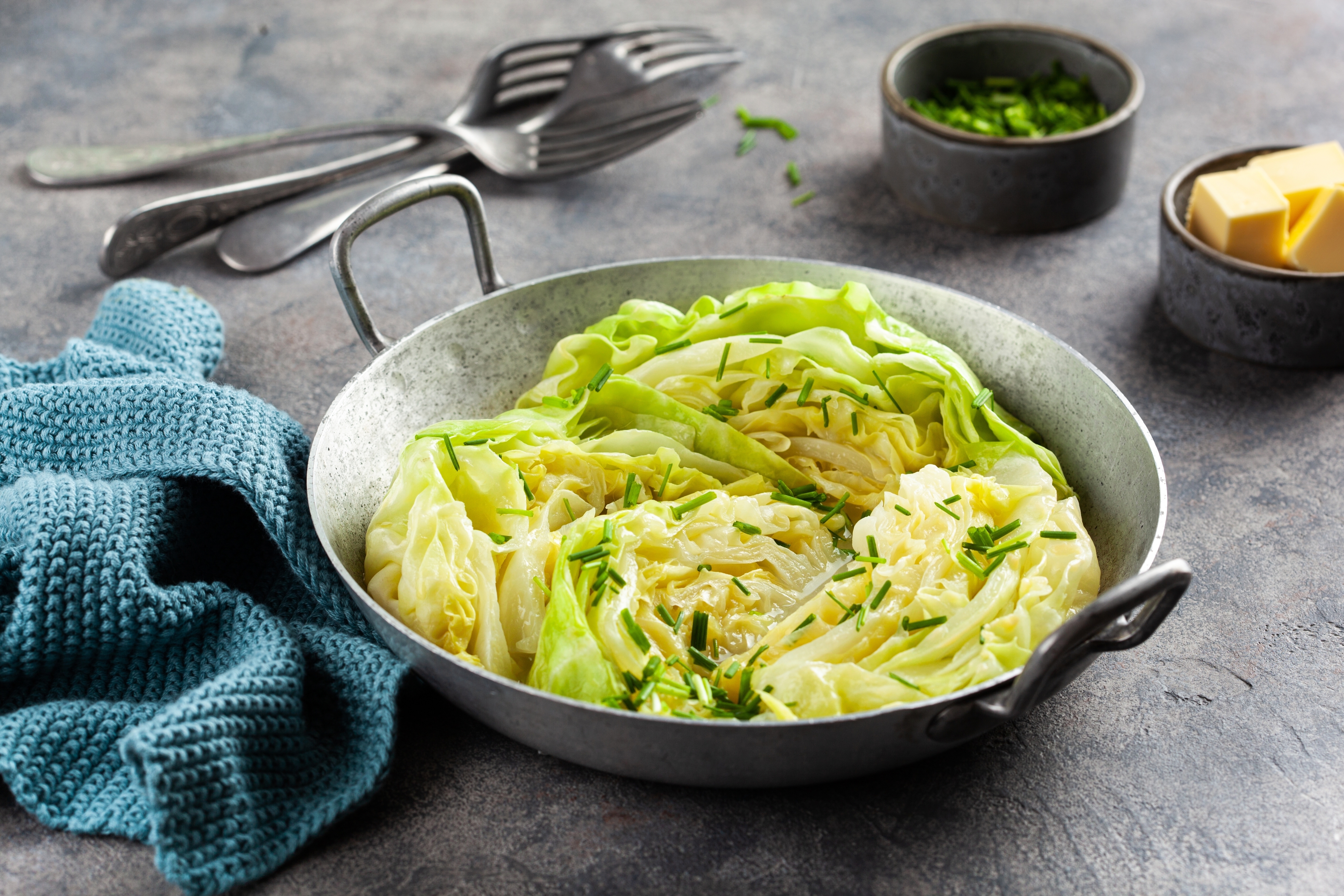
After it was clearly finished, I transferred the cabbage to a large iron skillet with a stick of butter in there, while spooning some water from the pot along with the onions and herbs.
Here is where the action began. I took my large knife and a fork and cut it in half, then half again, then half again. I kept cutting this way and that until the thing was in small pieces as the iron skillet became hotter and hotter. The butter began to sizzle up around the cooked cabbage. I threw in some lard just for the fun of it and salted it a bit more and even added a bit of vinegar because it seemed like the right thing to do.
There it cooked as I tossed and turned it for another 15 minutes until it clearly looked like real food. Then I removed one leaf and gave it a try.
Heaven! Absolutely delicious. Mostly it was just fun finally to see what this seemingly useless and inert food could become in real life.
Serving it was not an issue. I put it on plates alongside some boiled eggs and smoked salmon. That’s it. That was the whole meal. The end result was filling and satisfying and left me with the feeling that I had eaten something of enormous health benefit.
Looking back now, I can recall few foods I’ve cooked with such a sense of simple joy. It requires nothing other than water and time. That thing that I had eschewed in the store for decades—not with a great deal of consciousness but with a kind of benign neglect—has become a known friend, a thing of familiarity that I know now I can turn into a genuine meal.
Thinking more about the odd way in which this food evaded my attention for so long, I suspect that this might be the difference between choosing a food and inheriting one. Everything people cook by default is inherited—the pasta, the chicken breast, the steak, the salad. Each is something we attempt to recreate from what we’ve seen or had.
Cabbage is a food you have to decide to cook, because nobody hands it to you and nobody on a menu is selling it to you. The truth is that it is one of the most versatile vegetables on earth, and it’s been that way for thousands of years. It’s the backbone of sauerkraut, kimchi, colcannon, borscht, choucroute, okonomiyaki, and haluski.
That’s right: not a single American English word. Our word for this carries a connotation of dull: stewed cabbage. Ho hum, what is this, a famine?
Make it your mission to change this impression. A raw head is not just a crunch with a smell. Twenty minutes of fat and salt later, it’s sweet, silky, almost meaty, a genuine dish of dignity with a high calling and purpose.
Beautifully, this is something you can do yourself, an ancient tradition recreated by your own hands in your own kitchen. The pieces of this that I found by accident—the abundance of salt, the addition of fat, the dashes of vinegar—all work together to form a chemical base that makes the magic happen. You see this plain thing transform before your eyes.
My first thought: I’m going to serve this for guests. Serve any meal and put a pile of this in a sterling silver serving boil with a handle top. After the meal begins, you reach over and lift off the top and announce the contents with great elan: presenting stewed cabbage. Watch the jaws hit the table in amazement and the sheer chutzpah of serving such a thing. But then watch: every bite will be eaten and you are celebrated as the chef of the season.