Commentary
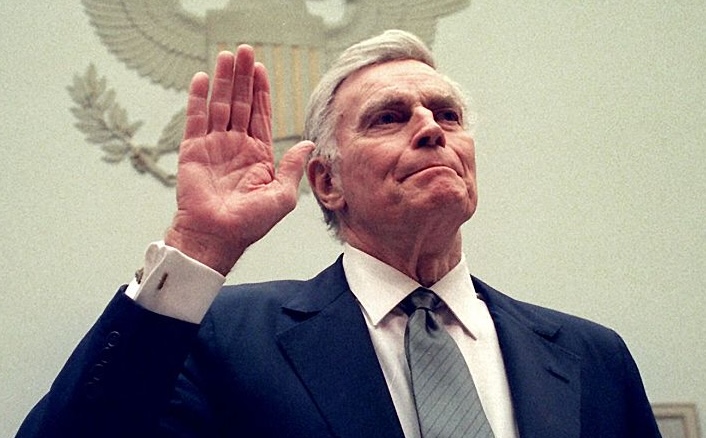
On Feb. 16, 1999, the late Charlton Heston spoke at Harvard Law School on the topic of “Winning the Culture War.” To a standing-room audience, he forthrightly and bluntly addressed the culture wars, political correctness, and the suppression of free speech in the United States.
Heston began with some humor at his own expense and the fact that he had appeared in films as prophets from the Bible like Moses, generals, three American presidents, Michelangelo—“If you‘d like me to work on this ceiling, I’ll be glad to do my best”—and other historic figures.
To that list, he added another accomplishment: his election to the presidency of the National Rifle Association (NRA).
That was 27 years ago. Today, of course, few universities would allow any representative of the NRA anywhere near campus.
Heston was angered and dismayed by the political correctness rampant across the nation. To the Harvard students and faculty, he offered several specific examples from university campuses and government. Here are two of them:
“In San Francisco, city fathers passed an ordinance protecting the rights of transvestites to cross-dress on the job, and for transsexuals to have separate toilet facilities while undergoing sex change surgery.”
“At the University of Pennsylvania, in a state where thousands died at Gettysburg opposing slavery, the president of that college officially set up segregated dormitory space for black students. Yeah, I know, that’s out of bounds now. Dr. King said ‘Negroes.’ Jimmy Baldwin and most of us on the March said ‘black.’ But it’s a no-no now.”
Here, younger readers may require a brief explanation: the March to which Heston referred took place in 1963, when Heston and 200,000 others gathered in solidarity with Martin Luther King Jr. at the Lincoln Memorial in Washington.
At that time, African-American was the acceptable term. “Black” then made a comeback, and both are interchangeable now. This wrestling match over words is yet another sign of the unpredictable winds of the culture wars and the fluid language of political correctness, which today goes under the banner of “woke.”
Heston then boldly told the students: “You are the best and the brightest. You, here in this fertile cradle of American academia, here in the castle of learning on the Charles River. You are the cream.
“But I submit that you and your counterparts across the land are the most socially conformed and politically silenced generation since Concord Bridge. And as long as you validate that and abide it, you are, by your grandfathers’ standards, cowards.”
He then asked: “But what can you do? How can anyone prevail against such pervasive social subjugation?”
Referencing King again as well as Mahatma Gandhi, Henry David Thoreau, Jesus, “and every other great man who led those in the right against those with the might,” Heston answered that question: “You simply disobey. Peaceably, yes. Respectfully, of course. Nonviolently, absolutely. But when told how to think or what to say or how to behave, we don’t. We disobey the social protocol that stifles and stigmatizes personal freedom.
“I’m asking you to disavow cultural correctness with massive disobedience of rogue authority, social directives, and onerous laws that weaken personal freedom.”
That refusal to bow to social directives, as so many Americans have done in the last decade, comes with a price, which Heston shared from his own experience. Heston said his stance against Time Warner’s promotion of obscene rap music that also promoted the killing of cops, for instance, cost him possible future film roles.
“But disobedience means you have to be willing to act, not just talk,” he said.
“So that this nation may long endure, I urge you to follow in the hallowed footsteps of the great disobediences of history that freed exiles, founded religions, defeated tyrants, and yes, in the hands of an aroused rabble in arms and a few great men, by God’s grace, built this country.”
Heston then gave the students instances of how to engage in this peaceful disobedience.
“When your university is pressured ... to lower standards until 80 percent of the students graduate with honors, choke the halls of the Board of Regents,” he said. “When someone you elected is seduced by political power and betrays you—petition them, oust them, banish them.”
Today, Americans face even greater challenges in this arena than when Heston spoke at Harvard. The lingering effects of the government’s COVID-19 lockdown, the diversity, equity, and inclusion (DEI) policies that originated in universities like Harvard and infected corporations, the partisan stances taken by some mainstream media outlets, the ongoing loss of privacy to artificial intelligence, and most of all, perhaps, the social media platforms with their mobs smearing those who offend politically correct mandates: these are just some of the ongoing trials liberty has endured.
Heston rightly urges us to resist these modern forms of tyranny by protest and disobedience. To that stance, I would add that we also need positive resistance.
We can, for example, read good books rather than spending hours on TikTok. We can seek out and spend time with flesh-and-blood friends rather than AI companions. If our public schools are failing to educate our children or are corrupting them, we can look for alternatives, such as homeschooling or enrolling in private academies.
In an age of cynicism, anxiety, and victimhood, we can raise our young people as wide-awake, level-headed optimists who embrace life as an adventure.
You can watch or read this film star’s speech by searching online for “Charlton Heston Winning the Culture War.” When you’ve finished, keep in mind, as Heston told his audience, “You have to be willing to act, not just talk.”