Hamilton is not a German name. It was by mere happenstance that Edith Hamilton was born in Germany. Her mother, Gertrude, was a New Yorker, and her father, Montgomery, a Hoosier. The two met in Germany during the Civil War, after Montgomery had served briefly in the Union Army.
In 1866, the two were wed, and, on Aug. 12, 1867, Gertrude gave birth to their first child in a town near Dresden. Edith would grow up in a happy, intellectually charged home in Fort Wayne, Indiana, but she would find her calling, similar to her birthplace, by happenstance.
The Hamilton family was wealthy, so wealthy that Montgomery practiced no profession, but rather dedicated himself to studying in his personal library. From 1867 to 1873, the Hamiltons had four children—all girls—and both Montgomery and Gertrude provided their children a classical and stringent education. The couple had a fifth child much later, a son, in 1886.
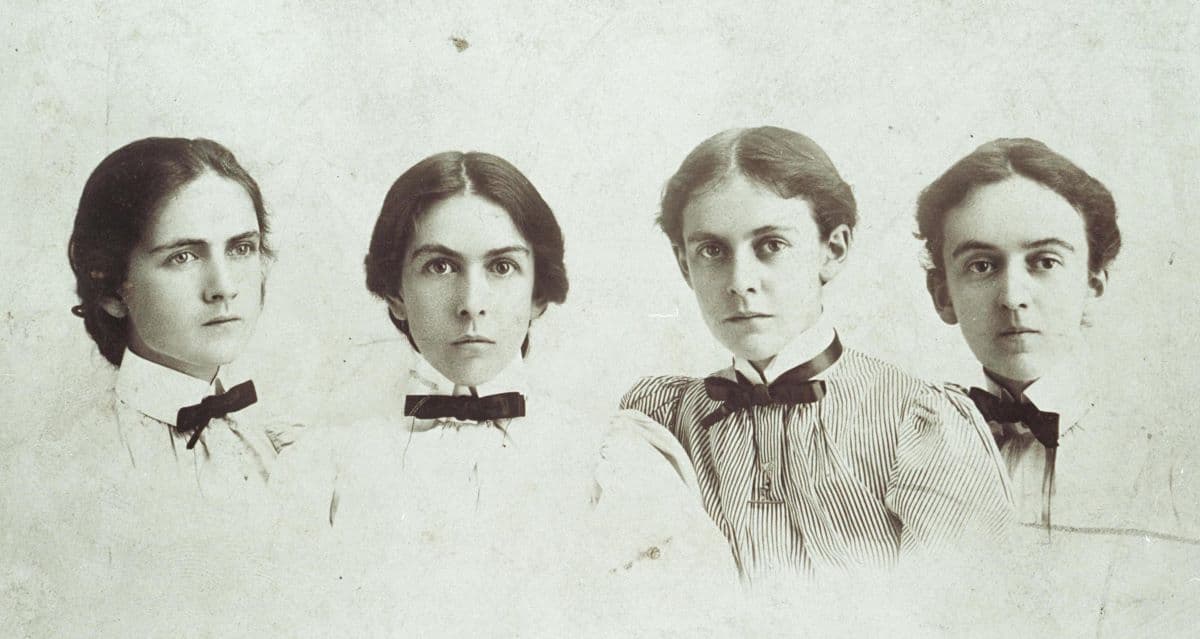
The four Hamilton sisters: Edith (far R), circa 1890-1895. (<a href="https://www.flickr.com/photos/schlesinger_library/15459280954/">C.G. Agrell</a>/<a href="https://creativecommons.org/publicdomain/zero/1.0/deed.en">CC0</a>)
By the time Edith entered a formal school at the age of 17, she had already learned Latin, Greek, French, and German. Miss Porter’s all-female school in Connecticut was considered a finishing school, established to complete a girl’s education. Edith, however, wished to continue her education and opted for college.
Becoming Headmistress
In 1890, she began her studies at the recently established Bryn Mawr College in Pennsylvania, where she earned her bachelor’s and master’s degrees in Greek and Latin. In 1895, she received the school’s Mary E. Garrett European fellowship. Through the fellowship, she, along with her younger sister Alice (who became a Harvard professor), returned to the country of her birth and continued her studies for a year in Leipzig and Munich.
When she returned to the States in 1896, she accepted a position as headmistress at the Bryn Mawr School in Baltimore. The school, established in 1885—the same year as the college, was created as a college preparatory school, specifically for girls planning to attend Bryn Mawr College.
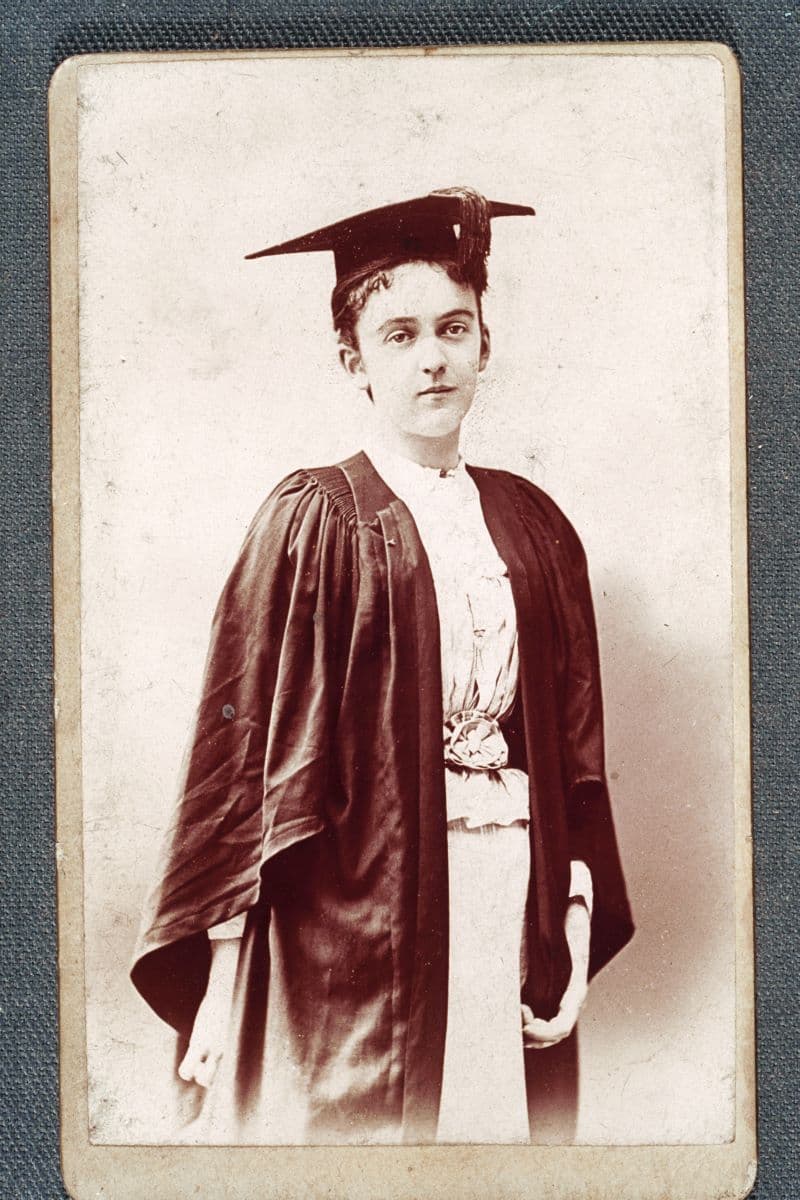
Edith Hamilton in graduation cap and gown, circa 1890s. Schlesinger Library on the History of Women in America. Harvard University. (Public Domain)
Hamilton enjoyed a 26-year career as the school’s headmistress. But she did not confine herself strictly to her scholastic surroundings. She traveled extensively around the globe and established friendships with some of the early 20th-century intellectuals, such as Elizabeth King Ellicott and Ezra Pound.
Her love of the classics was consistently instilled in her students at the preparatory school. One of her famous quotes, a loose translation from Plato’s “Republic,” was “Hard is the good.” She had learned personally during her childhood that to become successful at something, one had to apply oneself. Referencing the ancient Greek poet, Hesiod, she told her students, “Before the gates of Excellence the high gods have placed sweat, long is the road thereto and steep and rough at first, but when the height is achieved then is there ease.”
After more than a quarter of a century at Bryn Mawr School, she resigned. But it was during her retirement that her career path truly began.
Late Start on a New Career
Hamilton moved to Gramercy Park in New York City with her friend Doris Fielding Reid in 1924. The social circle of Hamilton and Reid was wide and included Rosamund Gilder and Dorothea McCollester, who were on staff at the Theatre Arts Monthly magazine. Having spent time with Hamilton, Gilder and McCollester convinced the former classics instructor to write an article for the magazine.
Just before her 60th birthday in 1927, Hamilton wrote her first article, entitled “Tragedy.” She wrote five more articles and produced a translation of Aeschylus’s “Prometheus” over approximately two years for the magazine. It was the start of a new career.
Elling Aannestad, an editor for W.W. Norton, contacted Hamilton and convinced her to write a book on the ancient Greeks. What resulted was “The Greek Way,” published in 1930, and was well-received by critics and readers. The book immediately positioned the recently retired headmistress as an authority on the classics.
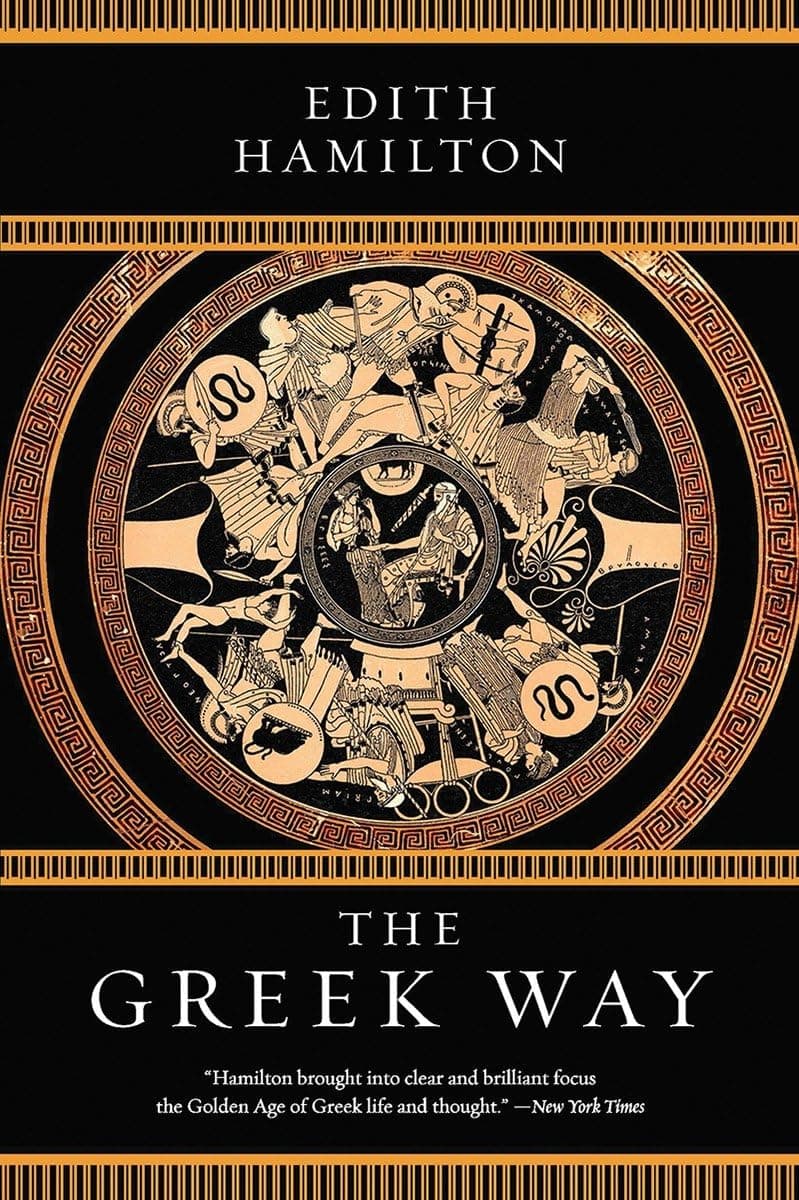
W.W. Norton & Company's 2017 edition of "The Greek Way." (W.W. Norton & Company)
Shortly after the book’s publication, she traveled to Greece and Egypt, adding to her knowledge of the ancients. She returned to America to work on her second book, “The Roman Way,” which was published in 1932.
Her work expanded from the ancient Greeks and Romans and into Christianity—she was a Presbyterian. She followed up her 1932 book with “The Prophets of Israel” in 1936, “Witness to the Truth: Christ and His Interpreters” in 1948, and “Spokesmen for God: The Great Teachers of the Old Testament” in 1949.
Ancient Greece for Modern Times
Ancient Greece, however, remained her primary subject. In 1937, she produced her translation of “Three Greek Plays: Prometheus Bound, Agamemnon, The Trojan Women,” and in her final years, she co-edited with Huntington Cairns “The Collected Dialogues of Plato.”
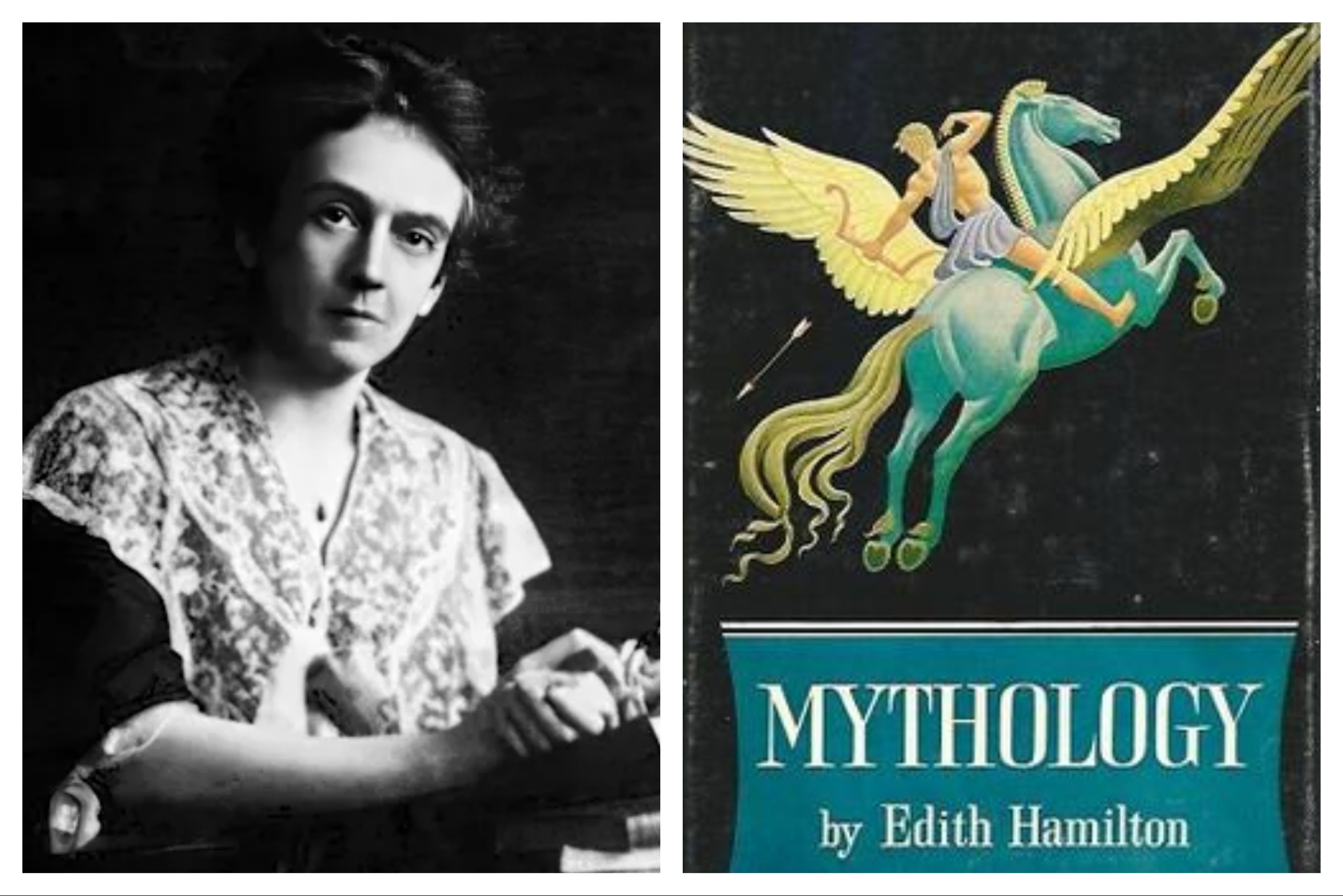
Her most famous work, “Mythology,” was published in 1942 and has since sold millions of copies. Hamilton dove into the stories of the gods and heroes of the Greeks, Romans, and the Norse, providing a detailed, yet accessible volume on these past civilizations. “Mythology” almost instantaneously became an American classic.
Hamilton built off of her fame to address the concerns she had about the modern age. She had been an advocate for numerous progressive movements during the turn of the 20th century, like women’s suffrage, though she opposed the temperance movement.
With the rise of communism and the start of the Cold War shortly after the end of World War II, Hamilton voiced her thoughts on the dangers of communist thought and how Americans should reference the ancient Greeks to direct their paths.
“Greece never lost sight of the individual, and I’m afraid we have,” she said. “That frightens me much more than the sputniks and the atomic bombs. Greeks thought each human being different and I take a lot of comfort in the fact that my fingerprints are different from anybody else’s.”
Her Greatest Achievement
To further voice her concern, she wrote “The Echo of Greece” (1957), which was a study of 4th-century B.C. Athens, the brilliant philosophers it produced, and the eventual rise of Alexander the Great. It was a warning about the past repeating itself.
The 89-year-old popular classicist had added more weight to her scholarship, and it was noticed not solely by the American public but by the Greeks, too. The year the book was published, she was invited to Athens by the Greek government, where she was treated to a performance of Aeschylus’s “Prometheus Bound” based on her 1937 translation. The performance held at the Odeon of Herodes Atticus theater, located along the south slope of the Acropolis, was followed by the announcement that she was made an honorary citizen of Athens.
“I am an Athenian citizen! I am an Athenian citizen!” she told the audience enthusiastically. “This is the proudest moment in all my life.”
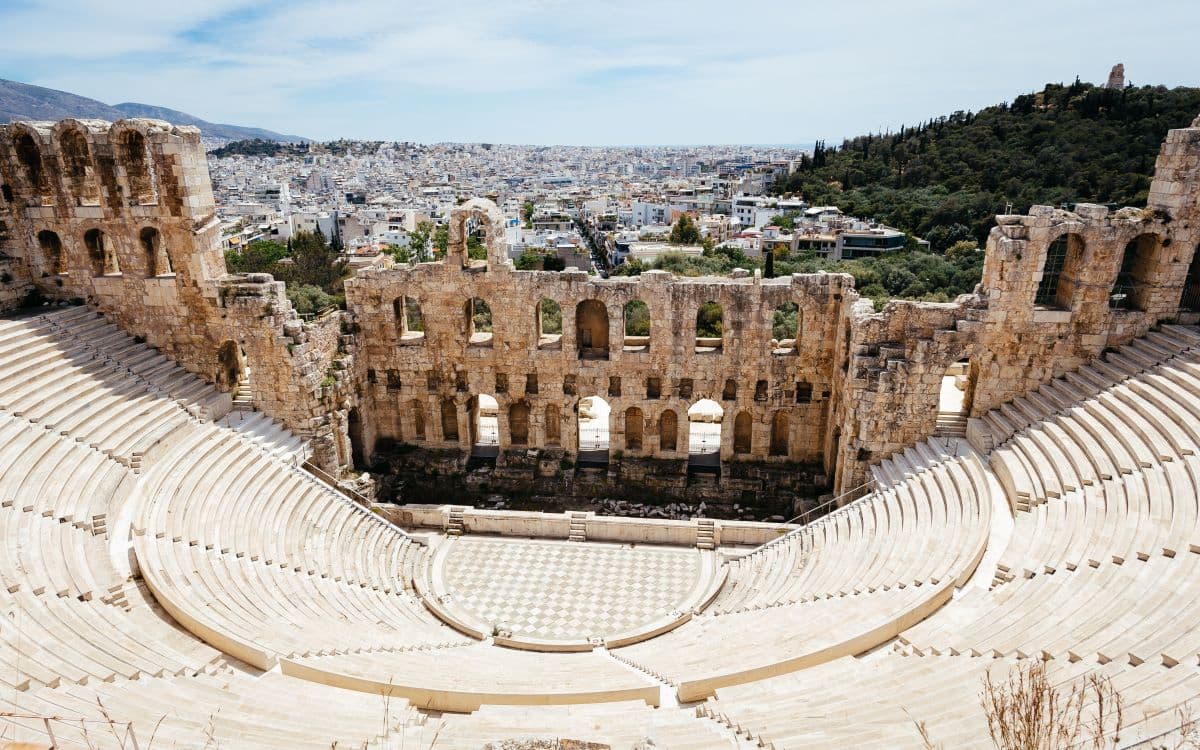
Odeon of Herodes Atticus. (<a href="https://www.flickr.com/people/50312443@N04">Robert Anders</a>/<a href="https://creativecommons.org/licenses/by/2.0/">CC BY 2.0</a>)
Additionally during her visit, she was presented with the Gold Cross of the Order of Benefaction by Greece’s King Paul. The award is given primarily to women for charitable or artistic achievement.
Hamilton, however, was not finished with her work. Her collection of Plato’s “Dialogues” was published in 1961, and she had set her mind on writing a book on Plato. The same year the “Dialogues” was published, though, she suffered a severe stroke. The doctors estimated she would never walk or talk again. She disproved them thoroughly, and after recovering from the stroke, she stated, “I think I am going to be able to finish that book on Plato.” Sadly, she died of a heart attack a week later on May 31, 1963, at the age of 95.
Even in death, she was able to give readers further insights on the importance of literature and philosophy from ancient to modern times with the 1964 publication of “The Ever-Present Past.” Along with her numerous accomplishments and published works, she was honored with honorary degrees from Goucher College, the University of Rochester, the University of Pennsylvania, and Yale University.
She was awarded the Jane Addams Medal for Distinguished Service by Rockford College (now University). In 1957, the same year she awarded her Greek citizenship, she was elected to the American Academy of Arts and Letters.
As historian Victoria Houseman wrote in her biography “American Classicist,” Hamilton was “the most prominent interpreter of the relevance of ancient Greek culture for the modern world, writing for an audience who had not studied ancient Greek but who sought knowledge of the roots of Western Civilization.”
What arts and culture topics would you like us to cover? Please email ideas or feedback to features@epochtimes.nyc.