Think of soldiers in the Civil War, and our imaginations paint a picture of men in uniforms of blue or butternut-gray marching along dusty roads shouldering a rifle and carrying a backpack or bedroll. In our mind’s eye, perhaps we see lanky men charging the enemy at places like Antietam, Fredericksburg, and Gettysburg, bayonets flashing in the sunlight.
We may think of men in camp, singing songs like “Tenting on the Old Campground,” playing cards, and writing letters home. We may think of men returning home at war’s end, in the North to the tune of “When Johnny Comes Marching Home” or in the South to the silence of a devastated land.
What we probably don’t think of are boys.
The Call of a Trumpet
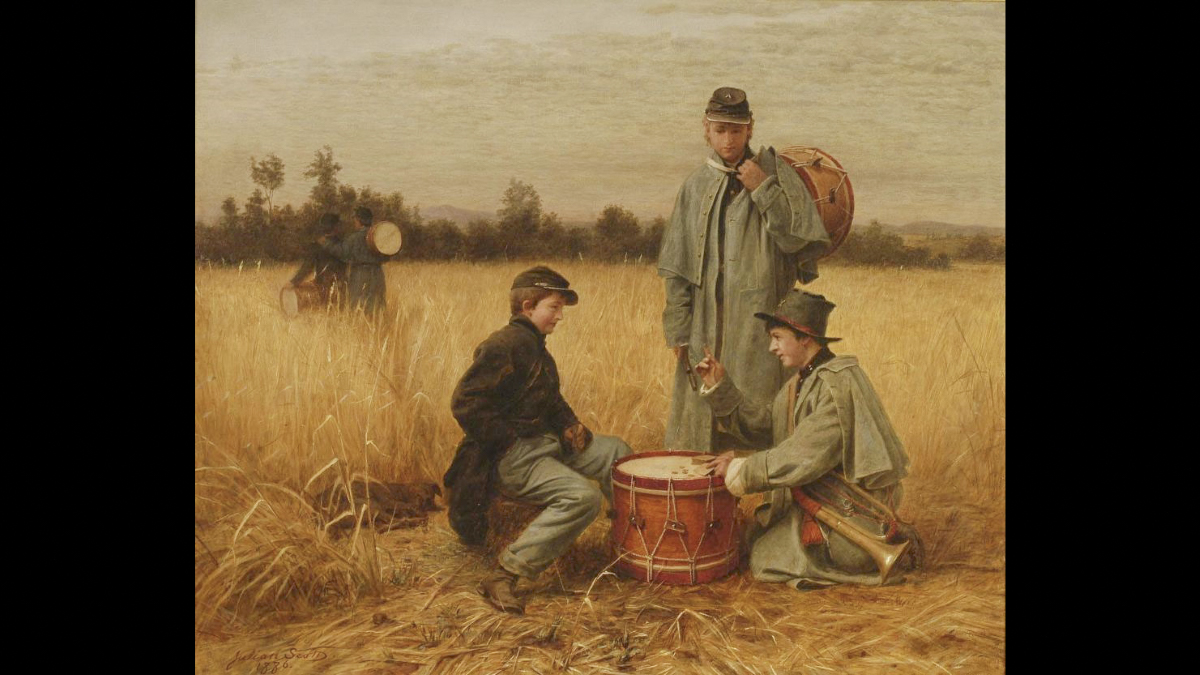
Teenagers and even younger boys in uniform were not uncommon in the first half of the 19th century. On ships, they served as cabin boys and powder monkeys; while in the armies of that day, they might become drummer boys or play instruments in regimental bands.
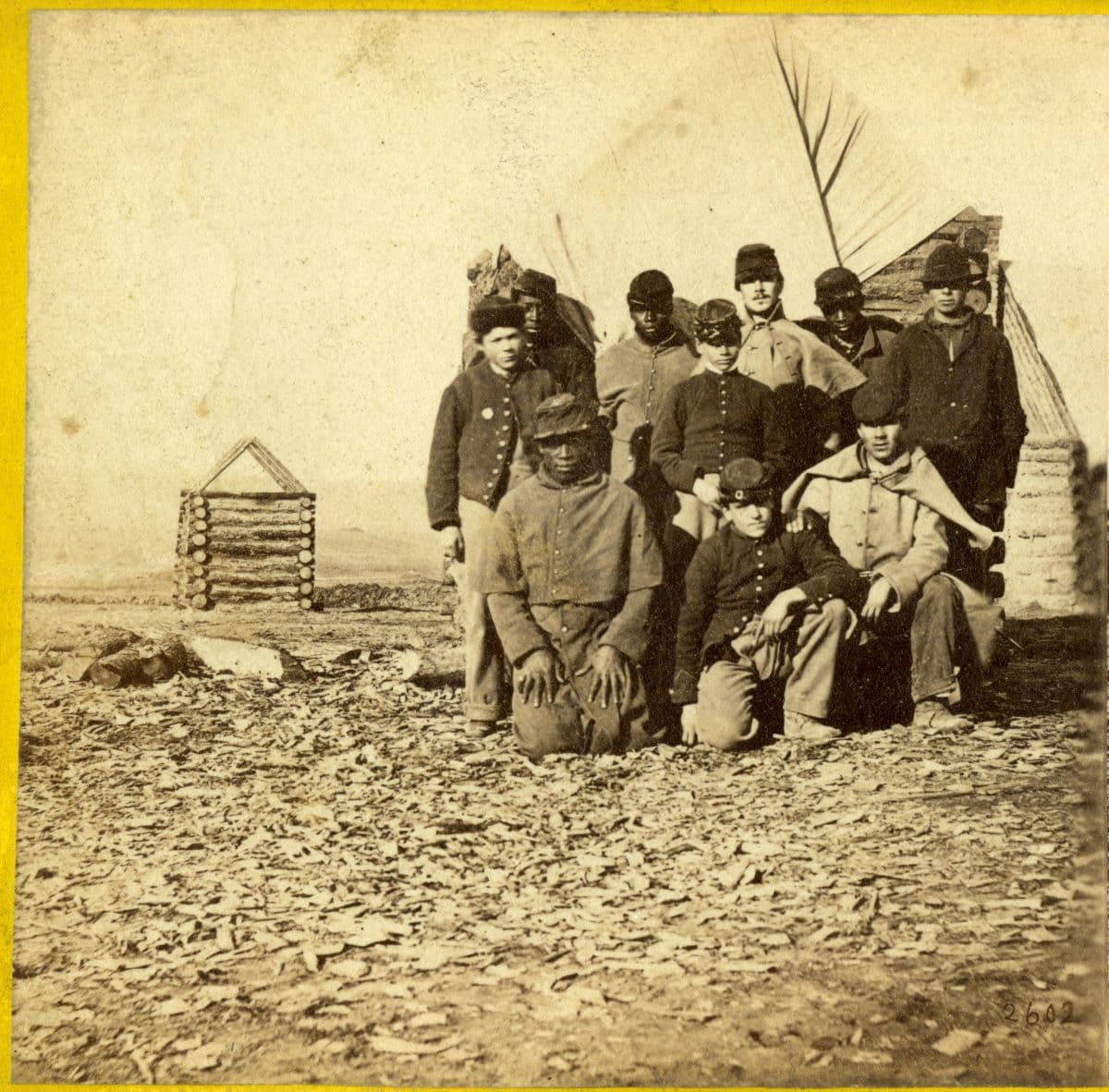
In 1863, the Union Army accepted Freedmen; seen here are black and white teenaged soldiers who volunteered to fight for the Union. (Public Domain)
But there’s a reason why some refer to the Civil War as “The Boys’ War.” Though the enlistment age on both sides was set at 18—later lowered in the South to 17—and though Abraham Lincoln, speaking of runaways seeking to join the army, declared “the United States don’t need the service of boys who disobey their parents,” large numbers of underaged adolescents put on uniforms and either served in tasks ancillary to combat or fought on battlefields. Some historians estimate that up to 200,000 Union soldiers fit into this category, with another 100,000 enlisting in the Confederate states.
Calculating these numbers is difficult for several reasons. First, many of the recruits lied about their age when enlisting. With the record-keeping of the population then at a minimum, no birth certificate was required, though recruiters might ask for a parental letter affirming a candidate’s age.
Moreover, as the casualty lists of the war grew and replacements became scarce, recruiters were less scrupulous in the ways they filled the ranks. In addition, recordkeeping at the time, especially in the South, was often haphazard, making it difficult and, in many instances, impossible for today’s researchers to match ages to the names of the enlistees.
What we do know is that the youngest of these soldiers in the Union army was 8-year-old Edward Black, a drummer for the 21st Indiana volunteers. Though discharged after being captured in battle, he reenlisted and remained in the army for the rest of the war. One of the youngest Confederate soldier for whom records exist was 11-year-old Charles C. Hay of Alabama.
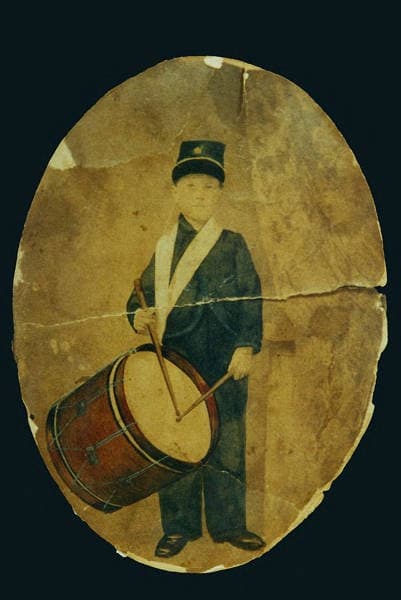
Edward Black, youngest Union soldier in the U.S. Civil War. Children's Museum of Indianapolis. (Public Domain)
Gaining Entry
Some of these adolescents entered the military alongside a relative, trusted friend, or mentor. Charles Willison, 16, joined a company of volunteers headed up by his church’s Sunday school superintendent.
Ned Hutter, also 16, replied honestly to the questions asked by the recruiter about his age and was told to go home, but his father, who stood directly behind him in the line, spoke up, “He can work as steady as any man, and he can shoot as straight as any who have been signed today.” Both Hutters joined the ranks.
Feeling the call of patriotism and often simply seeking adventure, many teens and preteens slipped away from home and family, headed for a nearby town where they were unknown, and signed their name into the list of recruits. Wisconsin’s Elisha Stockwell looked back on his enlistment at age 15 and recalled, “I told [my sister] I had to go down town. She said, ‘Hurry back, for dinner will soon be ready.’ But I didn’t get back for two years.”
Thomas Hinds, a 16-year-old Irish immigrant living with his family in Philadelphia, provides us an example of perseverance in his efforts to enlist. After he ran away and joined the army in May 1861, his father tracked him down the following day and brought him home.
Hinds ran away a second time and joined a cavalry regiment that was dispatched at once to New Jersey, but, somehow, his father again found him. He ran away a third time and returned to the cavalry regiment, and, for a third time, his father came after him, accompanied on this occasion by an official of the court and armed with a writ of habeas corpus.
At this point, the older Hinds promised his son that, despite his 50 years, he would join the army if Thomas would stay home, but, by fall, Thomas had once again slipped away. This time he succeeded in his efforts to join the war.
Here, we should keep in mind that the great majority of these boys were only a year or two below the legal age limit. Moreover, we should also note that youngsters then were generally more accustomed to work and responsibility than today.
Drums and Bugles
Those who were even younger than 16 but who legitimately joined the ranks tended to be drummer boys and buglers, which were officially noncombat positions, though that status could easily change on the battlefield. The drums and bugles sounded signals and commands to the men around them, meaning drummers and buglers were often in the thick of the fighting. Some of the boys operating in this capacity showed extraordinary courage in the face of enemy fire, earning citations for their heroism. Here are just two of them.
Those who were even younger than 16 but who legitimately joined the ranks tended to be drummer boys and buglers, which were officially noncombat positions, though that status could easily change when on the battlefield.
John Clem of Ohio, age 9, sought entrance to the 22nd Michigan, but officers refused to enlist him. Instead, they let the boy, reported to have lost his mother in a train accident, march with them as a sort of “mascot.”
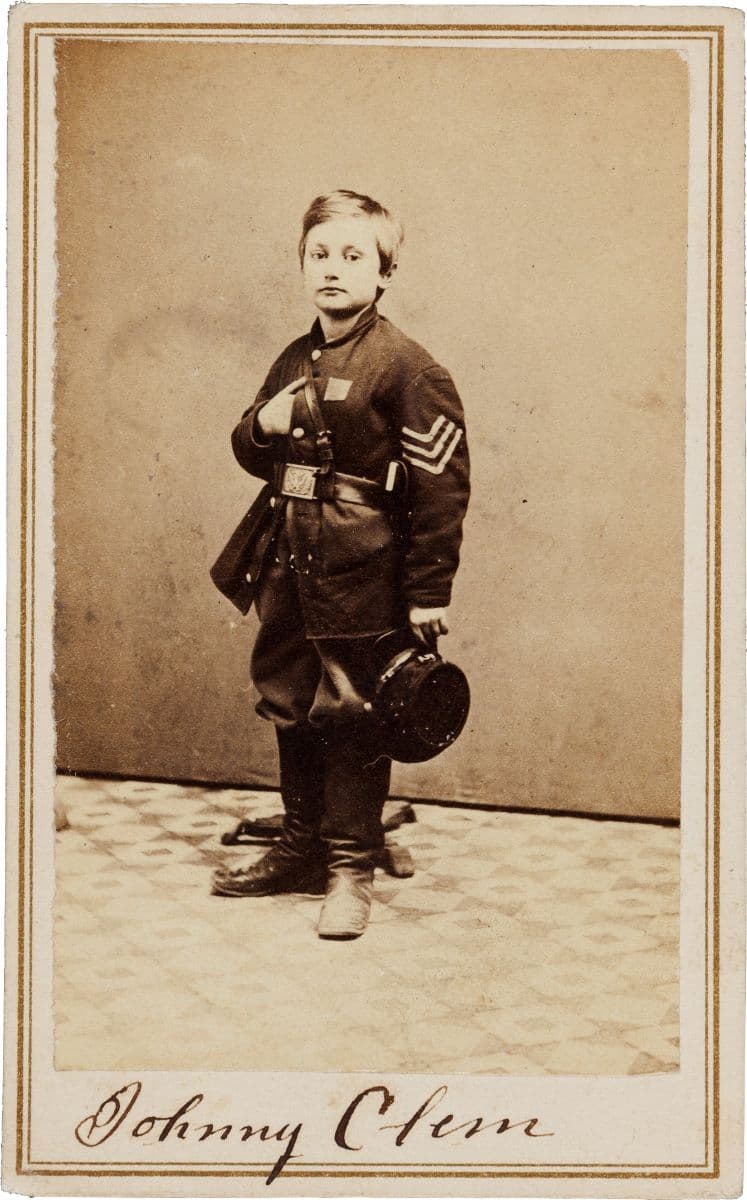
Clem during his Civil War service. (Public Domain)
Within two years, he was permitted to formally enlist as a drummer. At the Battle of Chickamauga in September 1863, when the Union lines broke, Clem is said to have faced a Confederate colonel who called him “a damned little Yankee devil” and demanded his surrender. Instead, Clem shot and wounded him with his saw-shortened musket and successfully retreated to Union lines.
Clem participated in several other battles in the war’s Western theater, and went on to serve in the army for more than 40 years, retiring at last with the rank of major general.
John Cook, also of Ohio, was 14 years old, 4-feet 9-inches tall, and already working when the war broke out. He was a bugler with the 4th U.S. Artillery during the September 1862 Battle of Antietam. During the vicious fighting, his unit’s captain was wounded by Confederate musket fire. After pulling the officer to safety behind a haystack and then riding off to deliver a message to another officer, Cook realized that many of his unit’s cannoneers were dead or wounded. Dismounting, he began loading and firing the cannons himself. Passing nearby, Gen. John Gibbon sprang from his horse, and together the 15-year-old and the general fended off the advancing Confederates.
Later, at Gettysburg, Cook again demonstrated his coolness under enemy fire as he delivered messages on the battlefield.
Nearly 32 years later, he received the Medal of Honor for his heroism at Antietam.
The Lure of Battle
In their article “
Boy Soldiers,” historians Frances Clarke and Rebecca Jo Plant look at the role of the teens and preteens who participated in the Civil War. At one point, they highlight a particularly strong magnet drawing boys to the ranks, that is, the verse, songs, and stories of the time, which often celebrated those boys of the battlefield and painted them “as heroic American patriots who inspired older men while retaining their innocence amid the slaughter.”
These depictions, they point out, occurred with far greater frequency in the North, where they were “highly romanticized, misrepresenting the realities of camp life and combat, even as it undoubtedly inspired many boys to envision themselves in the ranks.”
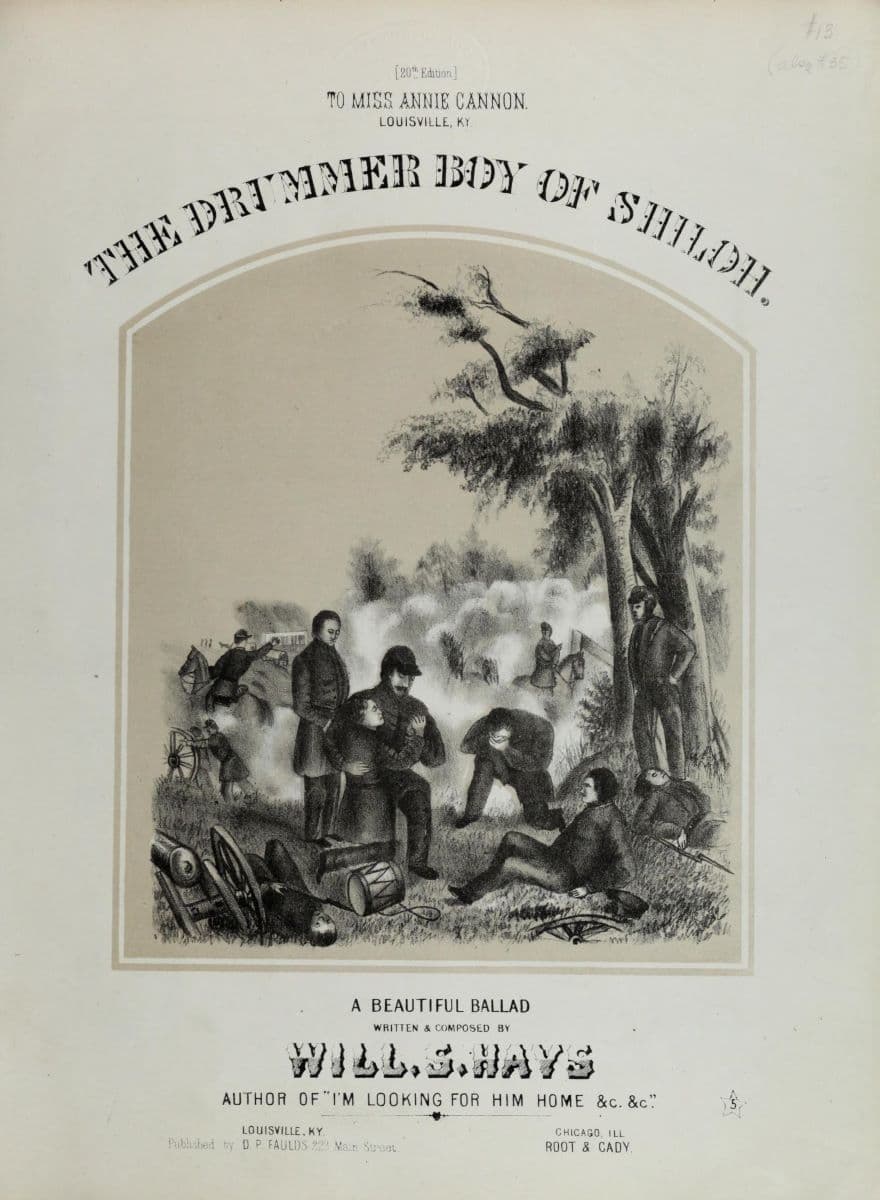
"The Drummer Boy of Shiloh," by William Shakespeare Hays. Internet Archive. (Public Domain)
Among these depictions was an 1862 poem “The Drummer Boy of Shiloh” by lyricist and poet W.S. Hays. To our modern sensibilities, this highly sentimental poem—draped as it is in youth, death, motherhood, and God—may sound foreign or even ridiculous, yet it is representative of the emotions that might have prompted a schoolboy to throw aside his books and take up a musket, or to exchange the milking stool and plow of the family farm for a drum and uniform. As a salute to him and that youthful idealism, we’ll conclude with the “The Drummer Boy of Shiloh”:
On Shiloh’s dark and bloody ground,
The dead and wounded lay;
Amongst them was a drummer boy,
Who beat the drum that day.
A wounded soldier held him up
His drum was by his side;
He clasp'd his hands, then rais’d his eyes,
And prayed before he died.
He clasp'd his hands, then rais’d his eyes,
And prayed before he died.
“Look down upon the battle field,
Oh, Thou our Heavenly Friend!
Have mercy on our sinful souls!”
The soldiers cried “Amen!”
For gathered ‘round a little group,
Each brave man knelt and cried;
They listened to the drummer boy,
Who prayed before he died,
They listened to the drummer boy,
Who prayed before he died.
“Oh, Mother,” said the dying boy,
“Look down from heaven on me,
Receive me to thy fond embrace—
Oh, take me home to thee.
I’ve loved my country as my God;
To serve them both I’ve tried,”
He smiled, shook hands—death seized the boy
Who prayed before he died.
He smiled, shook hands—death seized the boy
Who prayed before he died.
What arts and culture topics would you like us to cover? Please email ideas or feedback to features@epochtimes.nyc.