
President Donald Trump’s second term is reshaping U.S. foreign policy—this time with tariffs as the centerpiece.
No longer just an economic tool, tariffs are now the administration’s primary diplomatic lever, used to end conflicts, secure trade concessions, and pressure rivals.
Trump has touted how his tariff strategy—resulting in trade concessions from allies such as the European Union and South Korea, along with breakthroughs in conflicts—is delivering results.
His trade threats have helped end several conflicts, including the recent border skirmish between Thailand and Cambodia and the crisis between India and Pakistan.
On June 27, Trump hosted the foreign ministers of Congo and Rwanda at the White House as they signed a peace deal to end their 30-year war.
Michael Walsh of the Foreign Policy Research Institute said the administration believes that economic incentives can resolve conflicts. Trump’s approach in Africa—prioritizing trade over aid—has been more effective than strategies pursued by former administrations, he said.
Trump has also been pressuring China and India to stop purchasing sanctioned Russian oil to weaken the Kremlin and end its war in Ukraine.
In July, he targeted the BRICS alliance —led by Brazil, Russia, India, China, and South Africa—warning members against their efforts to challenge the U.S. dollar’s global dominance.
Most recently, he threatened Brazil with a 50 percent tariff, accusing the country of becoming an “international disgrace” because of the ongoing trial of former Brazilian President Jair Bolsonaro, a close Trump ally.
Trump’s tariff strategy is already showing results. In June, Canada backed off its plan to implement a 3 percent digital services tax on large tech firms after Trump halted trade talks and threatened to impose higher tariffs on Canadian imports.
Trump also introduced a 40 percent tariff on transshipments to block cheap Chinese goods from coming to the United States through other trading partners.
The U.S. government has collected more than $150 billion in tariff revenue over the past six months.
Keith Krach, former under secretary of state, said tariffs are now “the linchpin” of Trump’s economic statecraft.
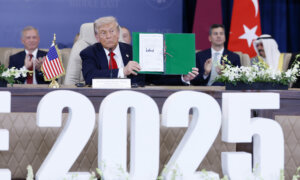
Trump struck a deal with the EU that included a 15 percent tariff on its goods, $600 billion in investments in the United States, and a commitment to purchase $750 billion in American energy over the next three years.
Japan and South Korea reached similar deals, with major investments and energy purchases committed.
The administration has already secured trade deals with eight key partners covering about 55 percent of world GDP.
Despite higher tariffs, broad retaliation from major trading partners has been avoided.
Some companies are relocating production to the United States to avoid tariffs and serve the domestic market, according to Chris Tang, a professor at the University of California–Los Angeles Anderson School of Management. However, many still depend on cheaper overseas labor for international sales, creating a split in global supply chains, he said.
Uncertainty remains about the long-term durability of these trade deals and tariffs, many of which rest on executive authority.
Analysts also question whether investment pledges will be fully delivered. For instance, some doubt the United States’ ability to sell $750 billion worth of energy products, citing export infrastructure bottlenecks.
Despite caution from business leaders about persistent high tariffs, markets have largely shrugged off concerns. The S&P 500 has rebounded more than 25 percent since early April, reflecting investor optimism about Trump’s trade diplomacy.
– Emel Akan
BOOKMARKS
NASA’s acting administrator Sean Duffy says the United States is looking to build a nuclear reactor on the moon to power a permanent base on the lunar surface. The project, called Artemis, will be implemented in stages, with a moon landing planned for mid-2027.
The U.S. economy “is on the precipice of recession,” according to an economist at credit rating agency Moody’s Analytics. “Consumer spending has flatlined, construction and manufacturing are contracting, and employment is set to fall,” Moody’s Chief Economist Mark Zandi said on X this week.
Trump plans to allow some illegal immigrant farm workers to return to the United States, but legally this time. The move is intended to avoid a manual labor shortage and prevent harm to farmers, Trump said in an interview on Tuesday.
International sanctions against Iran’s nuclear program might be less effective because of outside assistance from China. Check out Leo Timm’s latest report to find out more.
Attorney General Pam Bondi and U.S. Attorney for the Southern District of New York Jay Clayton are asking federal judges to unseal grand jury testimony related to Jeffrey Epstein and Ghislaine Maxwell. The Department of Justice is also planning to notify victims that the records are being unsealed, according to a letter written by the two officials.