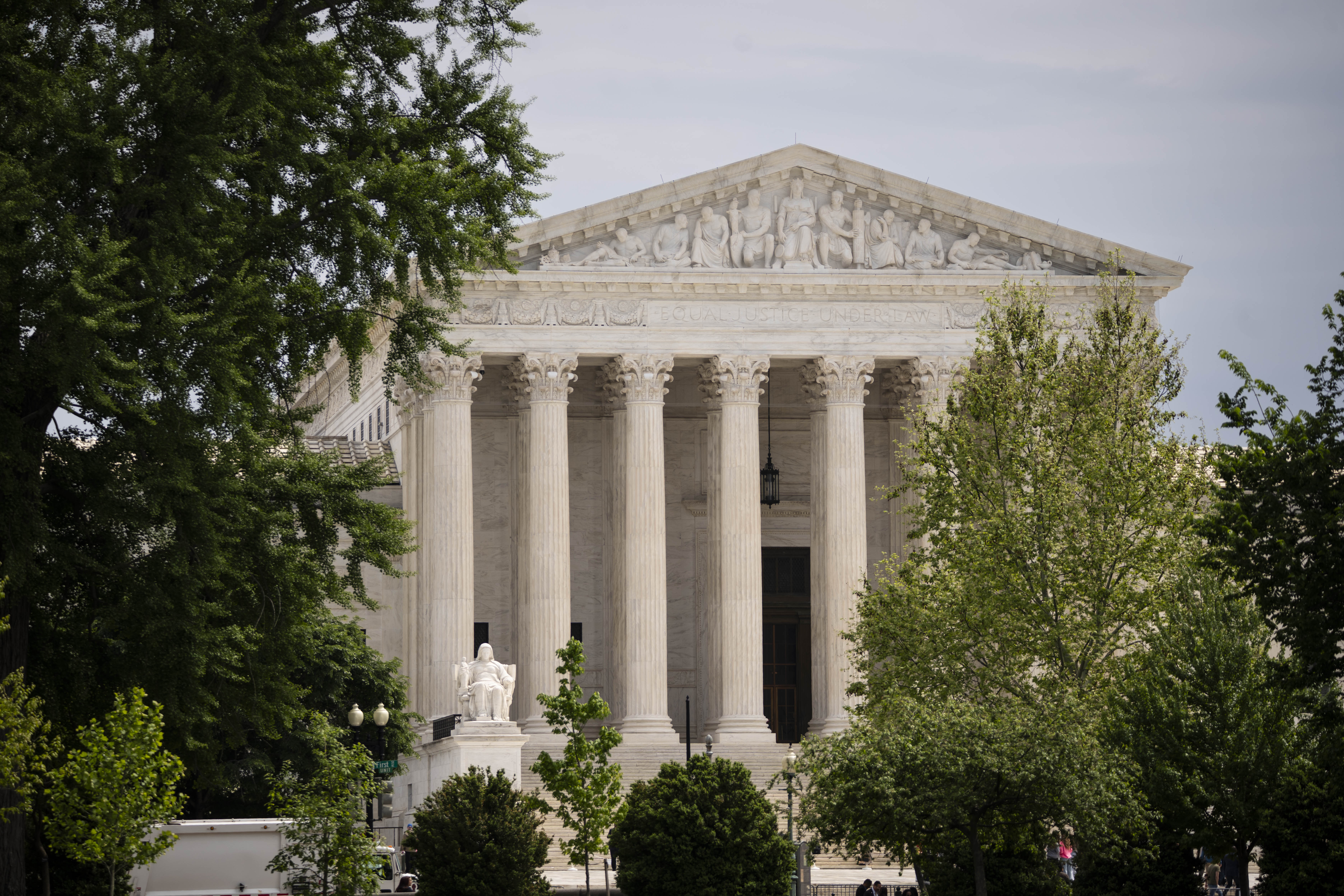

The Supreme Court will hear oral arguments on April 29 on the Trump administration’s efforts to terminate temporary protected status (TPS) for Haitian and Syrian nationals.
These cases, Mullin v. Doe and Trump v. Miot, pertain to Haiti and Syria, but the justices’ decisions will likely have implications for more than 1 million people from 17 countries currently in the United States under the TPS program.
One of the main issues surrounding the case is how far courts can go in reviewing the Trump administration’s decisions on which nationals from which countries qualify for protection.
“This is an important case that could potentially affect hundreds of thousands of people. It’s the first time the Supreme Court has agreed to hear a TPS case on the merits,” Neama Rahmani, a former federal prosecutor who worked on immigration at the Justice Department, told The Epoch Times.
Temporary Protected Status
TPS stems from the Immigration and Nationality Act of 1990, specifically via 8 U.S.C. 1254.
The act gives the secretary of homeland security the power to designate a foreign country for TPS, allowing its nationals who are already in the United States to receive temporary relief from deportation and authorizing them to work.
The act authorizes the secretary to designate countries for TPS based on three criteria: ongoing armed conflict, natural disasters, or extraordinary and temporary conditions that prevent foreign nationals from safely returning to their homeland.
Past administrations granted TPS for Syria in 2012 during a civil war and for Haiti in 2010 after an earthquake. TPS has been renewed for years since then.
Former Homeland Security Secretary Kristi Noem, invoking the authority of the Immigration Act, moved to end TPS for 13 countries, including Haiti, Syria, Venezuela, and Afghanistan.
Noem said conditions in these countries no longer warranted TPS.
“The administration is returning TPS to its original temporary intent,” Noem said when announcing the end of Afghanistan’s protected status in May 2025.
Lawsuits
The Trump administration’s efforts to end TPS for certain countries have been met with a barrage of lawsuits.
Those filed by Syrian and Haitian nationals claim that the Trump administration must still follow the processes outlined in the Administrative Procedure Act in making TPS decisions, which they claim were flawed.
The Administrative Procedure Act governs how the administration can execute federal laws through agencies.
The plaintiffs claimed that removing humanitarian protection would harm them. They also argue that President Donald Trump’s efforts to end TPS are based on racial bias.
The government responded to lawsuits by saying that courts lack the authority to review TPS policy and that it had followed all procedures in revoking TPS.
The administration said TPS was never meant to last forever. The Trump administration accused the previous administration of abusing the TPS system, allowing a flood of immigrants to stay indefinitely.
Judges Preserve TPS
In canceling TPS, the Trump administration argued that the “extraordinary and temporary” conditions no longer exist for Haiti and Syria, so nationals from those countries no longer qualify for TPS.
Lower courts agreed with the plaintiffs, blocking the government from ending TPS status for about 330,000 Haitians and 6,000 Syrians while the underlying legal challenge proceeds.
Judge Katherine Polk Failla of the U.S. District Court for the Southern District of New York blocked the termination of Syria’s TPS status on Nov. 19, 2025.
Failla noted that within months, the government ended TPS for several countries. She suggested that this demonstrated the government’s lack of careful consideration of each designation as federal law requires.
She also agreed that Homeland Security had not followed proper procedure under the Administrative Procedure Act.
This included the government’s inadequate review of current conditions in Syria, its forgoing of interagency consultation, and its allowing political considerations rather than legal ones to determine the decision.
On Feb. 2, Judge Ana Reyes of the U.S. District Court for the District of Columbia agreed with the Haitian plaintiffs that the administration’s termination decision violated federal law.
As with the Syria ruling, Reyes wrote that the department didn’t properly consult with other government agencies before issuing the termination order.
Appeals courts declined to block both judges’ decisions.
Judicial Power
One of the administration’s key arguments is that the courts lack jurisdiction over immigration matters.
According to 8 U.S.C 1254, which governs TPS under the Immigration and Nationality Act, there is no judicial review of any determination of a Homeland Security secretary “with respect to the designation, or termination or extension of a designation, of a foreign state.”
Hans von Spakovsky, senior legal fellow at Advancing American Freedom, said he agrees that the courts lack jurisdiction over TPS.
He said the lower court judges should have dismissed the cases.
“So every single one of these federal district court judges [is] violating the law, in having even considered the case,” von Spakovsky said.
Still, the Supreme Court will need to send a clear message to deter future district courts from getting involved in immigration cases, he said.
“The only way this is going to stop is if the Supreme Court not only rules in favor of the government, but puts very stern language in that order, making it clear that judges do not have any ability to entertain any lawsuits on this issue,” von Spakovsky said.
Legal observers have said that the Supreme Court has already ruled in Trump’s favor in similar cases.
For example, the high court allowed TPS to end for roughly 300,000 Venezuelans in October 2025 after a lower court’s injunction had previously blocked the termination, saying it violated the Administrative Procedure Act.
Potential Decision
Von Spakovsky said he thinks the high court is likely to side with the government’s argument that the judicial branch lacks jurisdiction over TPS.
“This should be an easy slam dunk case for the Supreme Court to decide,” he said.
James Rogers, senior legal counsel for America First Legal, said during a Federalist Society discussion on April 16 that the Supreme Court has been ruling in favor of jurisdiction-stripping statutes in immigration cases.
One example is the 2022 Patel v. Garland case, in which Pankajkumar Patel entered the country without inspection and the Department of Homeland Security charged Patel as removable. The high court found that federal courts lack jurisdiction to review facts in any judgment granting discretionary relief in immigration proceedings.
Rahmani said clarity on immigration policy was needed from the Supreme Court because the current patchwork of decisions in different states defies common sense.
“I think really, part of the blame is on the Supreme Court itself,” Rahmani said. “Because especially when it comes to immigration, you really need uniform immigration law in this country.”
Limiting TPS is part of Trump’s ongoing efforts to stop illegal immigration and deport unauthorized foreign nationals.
House Democrats recently passed a bill to extend TPS for Haitians, with support from several Republicans.
However, even if it were to pass the Senate, a Trump veto would be all but assured.
Von Spakovsky said the House legislation is irrelevant because it merely seeks to extend TPS and doesn’t change the law.