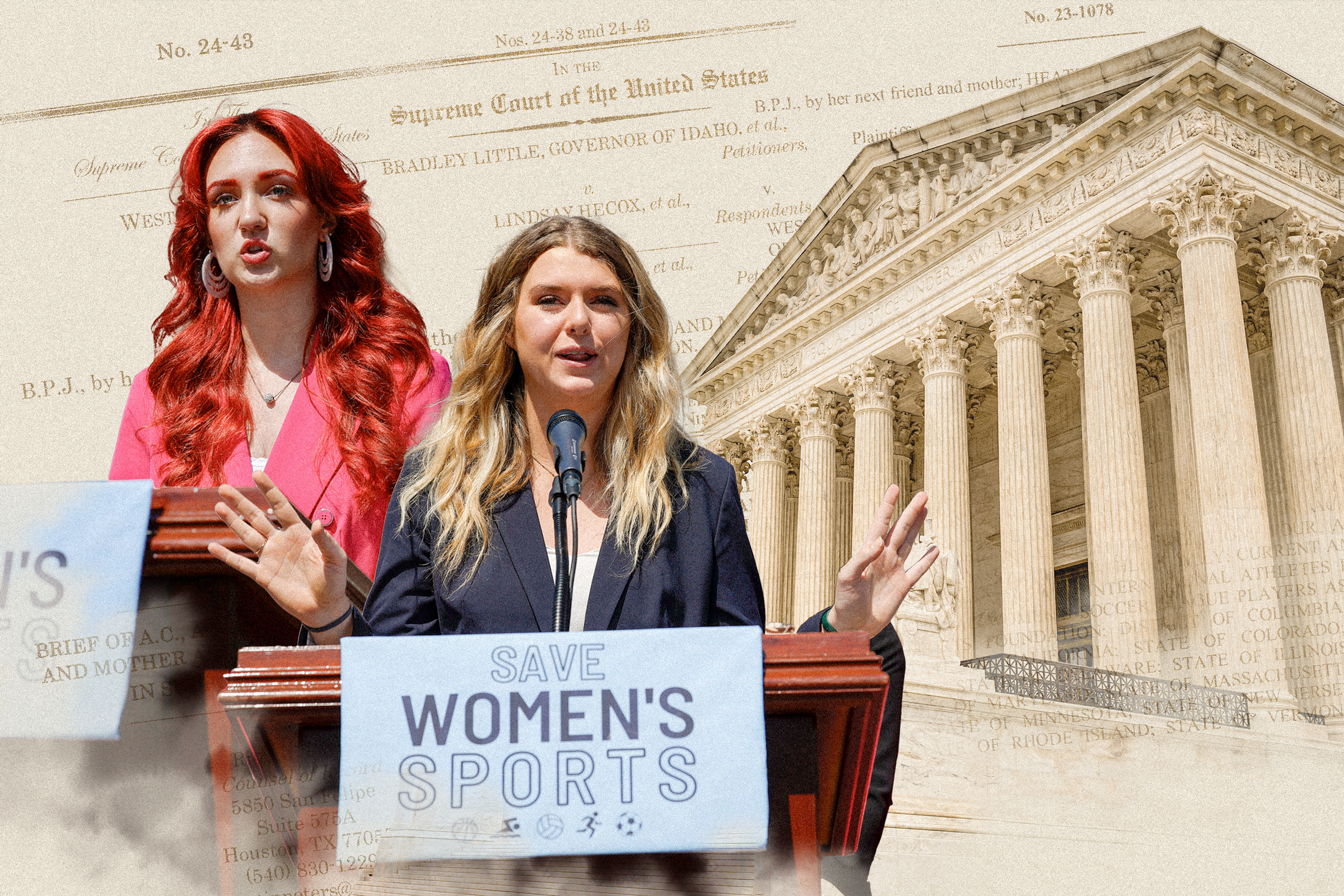


Selina Soule was a high school track and field champion in Connecticut, holding multiple state conference titles and school records.
But when male athletes who identified as transgender started competing against her, Soule said her prospects of winning diminished.
“It didn’t matter how much time I put in, in practice; how much extra effort I put in. There was nothing I could do to win the race,” Soule, who graduated from Glastonbury High School in 2020, told The Epoch Times.
Soule’s sentiments have been common in the ongoing national debate surrounding males competing in female sports.
The Supreme Court on Jan. 13 is set to weigh in on the issue by hearing cases challenging state laws barring boys from competing in girls’ sports.
In two cases to be heard back to back, the high court will examine allegations by male students who identify as transgender that West Virginia and Idaho illegally discriminated against them by banning their participation in girls’ sports.
The cases—Little v. Hecox and West Virginia v. B.P.J.—are expected to yield rulings on whether the state laws violate the Constitution and federal civil rights law.
Depending on how the justices decide, the lawsuits could make it easier for states across the country to maintain the sex-segregation some female athletes say is critical for sports.
‘Stakes Are High’
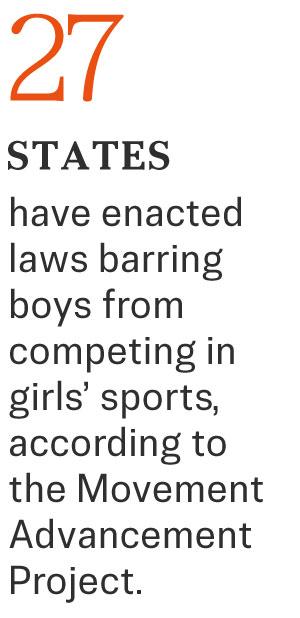
According to the left-leaning Movement Advancement Project, 27 states have enacted bans such as the ones being considered by the Supreme Court. Some states have encountered federal court blocks.
Those included Idaho and West Virginia, which federal appeals courts have ruled they acted illegally discriminatory based on sex and “transgender status.”
But female athletes say their interests are not being respected when males compete against them.
A recent study by the right-leaning Concerned Women for America showed that since the mid-1980s, women have been deprived of more than 1,900 gold medals by men competing in female categories.
An amicus brief from 102 female athletes told the court that “female athletes across the country, at all levels of sports, stand on the precipice of permanently losing their access to equal opportunity and safety in sports.”
“Based on their biological sex, they are at risk of being pushed aside in law and in life in a permanently damaging and irreversible way.”
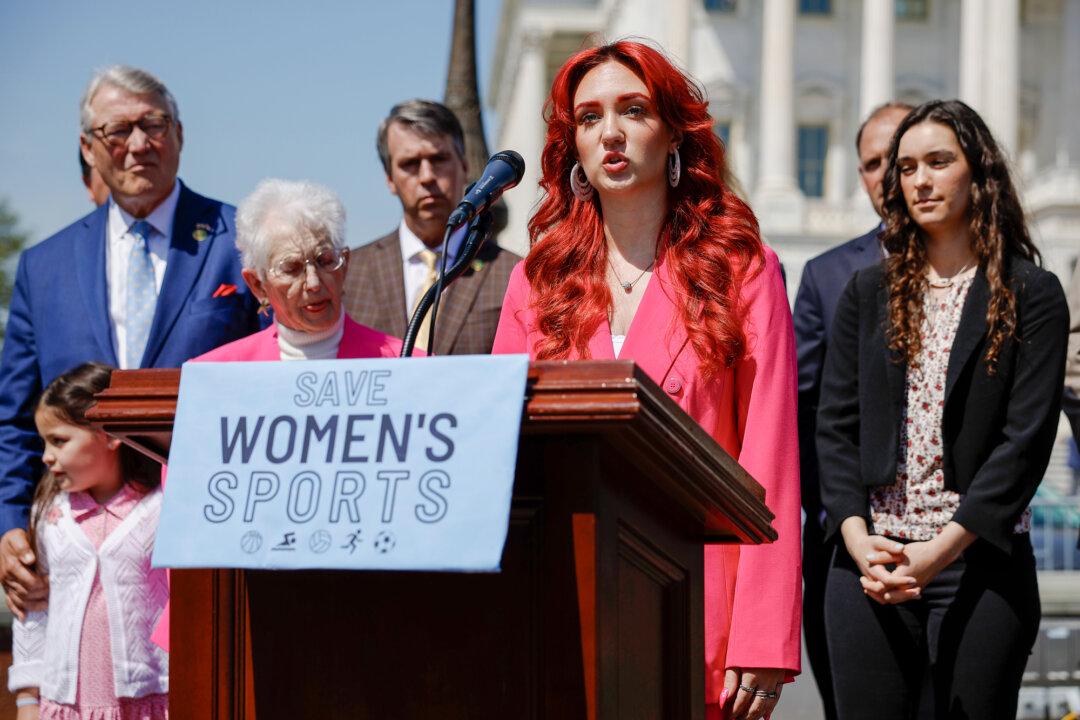
Track and field athlete Selina Soule speaks at a rally celebrating the House passage of the Protection of Women and Girls in Sports Act outside the U.S. Capitol on April 20, 2023. Soule said she had to compete against two males throughout her four years of high school in Connecticut. (Chip Somodevilla/Getty Images)
Macy Petty, a former high school volleyball player, told The Epoch Times, “We’ve come to this point that men have infiltrated women’s sports to the degree where women are walking up to the court wondering if they will actually have the privilege of only playing against women.”
Petty, who participated in countless matches across the country, graduated from Northwestern High School in South Carolina in 2020. She trained in volleyball for seven years and had competed in hundreds of matches across the country by 2018.
That year, she attended an event where college recruiters were in attendance to recruit gifted female athletes and reward them with scholarships. As she walked onto the volleyball court, she was shocked to see that she was matched with a male.

Macy Petty at Lee University in Cleveland, Tenn., on Oct. 2021. Petty trained in volleyball for seven years and had competed in hundreds of matches across the country by 2018. (Courtesy of Macy Petty)
“The only emotion that I knew was pure confusion,” Petty told The Epoch Times.
Countless others, including Alliance Defending Freedom President Kristen Waggoner, share Petty’s critical approach to male participation.
Although “compassion and respect needs to occur for all children,” Waggoner said during a Jan. 8 press briefing, the rights of young women must not be ignored in that process. The organization led by Waggoner, who played volleyball in high school, is helping Idaho and West Virginia defend their laws in court.
The justices are expected to focus on two legal provisions: the equal protection clause of the Constitution and Title IX of the Civil Rights Act. The first generally guarantees equal protection under the law, while the latter prohibits sex-based discrimination in educational institutions that receive federal funding.
“The stakes are high,” an amicus brief from athletic officials and coaches of female athletes reads. They warned that rendering the laws unconstitutional “would not only revoke the very rights and protections that specifically secure women’s access to school athletics, but would do so in order to extend those rights and protections to men.”
Allowing male participation was “blindly adhering to platitudes of equality,” they stated. Other coaches have argued that “allowing transgender women to participate in women’s sports, consistent with applicable rules, neither poses safety concerns nor gives transgender women an unfair advantage.”
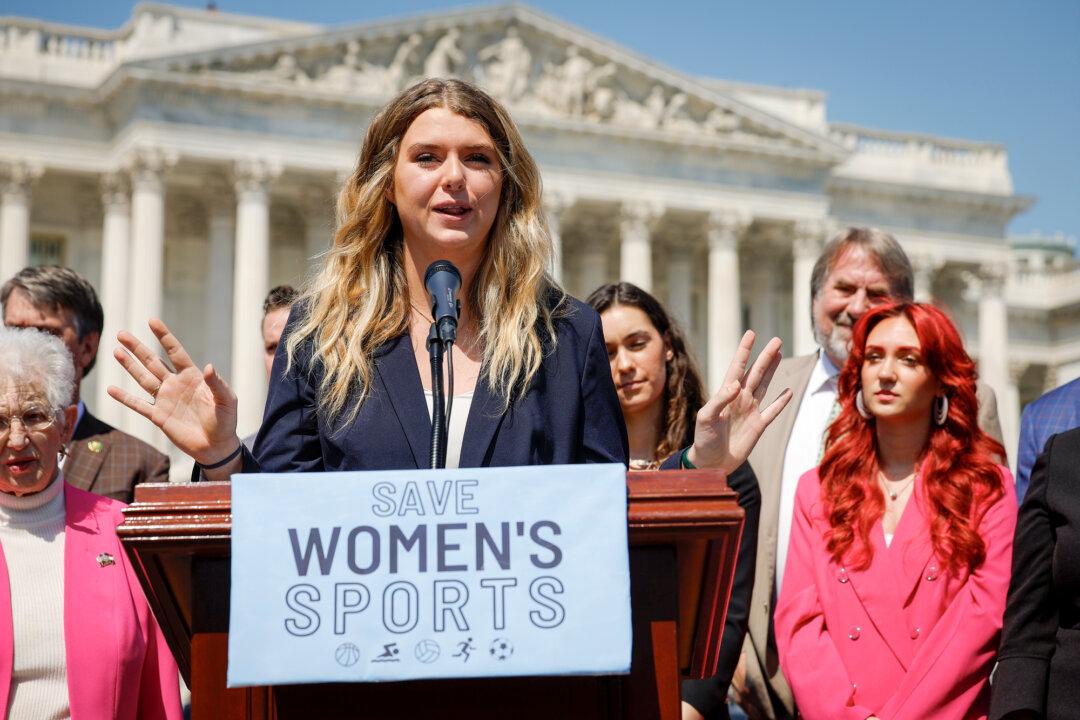
Lee University student athlete Macy Petty speaks at a rally celebrating the House passage of the Protection of Women and Girls in Sports Act outside the U.S. Capitol on April 20, 2023. At a college recruitment event, Petty was shocked when she walked onto the volleyball court and saw that she was matched with a male. (Chip Somodevilla/Getty Images)
Title IX
The West Virginia case is distinctive in that it invites the justices to rule on Title IX, in addition to the equal protection clause. Given Title IX’s history and how the Supreme Court has handled similar laws, legal experts have suggested it could bolster female athletes’ opposition towards male participation.
The U.S. Court of Appeals for the Fourth Circuit ruled in 2024 that the state’s law treated B.P.J., the plaintiff in the case who sued West Virginia as an 11-year-old, improperly on the basis of sex and therefore violated Title IX.
However, others have argued that Congress had a different intent when passing Title IX. An amicus brief from nearly 50 members of Congress argued that Title IX was passed in 1975 to prevent discrimination against women and that the first Title IX regulations adopted a binary view of sex.
“It has to do with safety and for bathrooms and locker rooms, it has to do with the anatomy that is exposed in athletics. And so that’s why sex matters; what a person thinks about their gender doesn’t matter,” Randall Wenger, chief counsel of the Independence Law Center, told The Epoch Times. “If you were looking to preserve athletic opportunities, you do need to divide it on the basis of sex.”
By contrast, a group of Title IX scholars told the court that Title IX’s language was an inconsistent “categorical ban that excludes all transgender girls from participating on girls’ sports teams.” The justices are focusing on participation in sports teams but their reasoning could extend to segregation of locker rooms and bathrooms.
In 2022, Kylee Alons, then a swimmer at North Carolina State University, became increasingly anxious at the thought that Lia Thomas, a male competing with women, would potentially knock some of her teammates out of the competition.
“It wasn’t until I was in the locker room, actually the first day, that I realized, ‘Oh, I had never even given thought to the fact that I would have to be changing with a man in my locker room,’” Alons told The Epoch Times.

Transgender swimmers Lia Thomas (2nd L) of the University of Pennsylvania and Iszac Henig (L) of Yale University pose with their medals after finishing first and second in the 100-yard freestyle at the 2022 Ivy League Women’s Swimming & Diving Championships at Harvard University in Cambridge, Mass., on Feb. 19, 2022. (Joseph Prezioso/Getty Images)
“And I think until you’re in that position, you don’t realize how uncomfortable and how violating that feels.”
Both sides of the debate have pointed to the Supreme Court’s 2020 decision in Bostock v. Clayton County, which could bear on the justices’ decision-making.
In Justice Neil Gorsuch’s majority opinion, he said that “discrimination based on homosexuality or transgender status necessarily entails discrimination based on sex.”
That case, however, focused on a different civil rights law—Title VII—and Gorsuch explicitly distanced his decision from disputes about locker rooms.
Fairness and Biology
How the justices parse questions of equality could come down to their view of evidence surrounding physiological differences, and the way hormone-altering drugs impact those.
Both the Fourth Circuit and the Ninth Circuit suggested the states’ bans were too broad because they encompassed males who hadn’t undergone the physical changes of puberty.
The Fourth Circuit specified that B.P.J., the unnamed male who sued over West Virginia’s law, didn’t undergo something called “Tanner 2 stage,” a medical designation for the beginning of puberty. “As a result, B.P.J. has never experienced elevated levels of circulating testosterone,” the court wrote.
But one of BPJ’s teammates, identified in court filings as A.C., told a different story. A.C. said that at the beginning of the school year, she and B.P.J. were evenly-matched in athletics, although she was two years older.
By the end of that year, B.P.J. was vastly outperforming her, had grown, and “developed a deeper and more masculine voice,” despite the puberty blockers. A year after that, B.P.J. was one of the school’s top competitors in discus and shot put.
A.C., who had previously quit jiu-jitsu because she no longer wanted to compete against boys, was forced down in the rankings, and became discouraged when she didn’t qualify for elite events.
During all four years of high school, track and field athlete Soule was forced to race against two young men in her home state of Connecticut. She told The Epoch Times that facing them on the weekends was “extremely mentally draining and demoralizing.”
“And each time that I competed against them, I was never close to winning, despite the fact that I was a five-time school record holder,” she said.

Former high school athlete Selina Soule, who competed within the Connecticut Interscholastic Athletic Conference, said it was “extremely mentally draining and demoralizing” to compete against males. (Alliance Defending Freedom)
Scientific Evidence
The court’s dockets for the two cases are full of amicus briefs on both sides of this issue, with the briefs from sports scientists and doctors tending to express support for the states that have banned males from women’s sports.
On the other side, a group of pediatricians noted important differences that emerge during puberty. “Males must experience endogenous puberty to acquire the significant athletic advantages that manifest during puberty and in adulthood,” one such amicus brief reads.
By contrast, Defending Education Vice President Sarah Parshall Perry told The Epoch Times, “What we have discovered—and the research in increasing measure indicating—is that these differences between natal girls and natal boys begin to express themselves at the age of 10 or 11, when there is a 20-fold surge in testosterone for biological boys.”
Amicus briefs from the group Do No Harm and sports physiologists both argue that these differences exist even before puberty. Do No Harm Medical Director Kurt Miceli told The Epoch Times that puberty blockers and hormone treatments likely don’t eliminate these differences.
“Current evidence indicates that puberty blockers and estrogen only minimally erode the physical advantages gained as one grows up, meaning some strength advantages remain even after several years of hormone interventions,” he said.