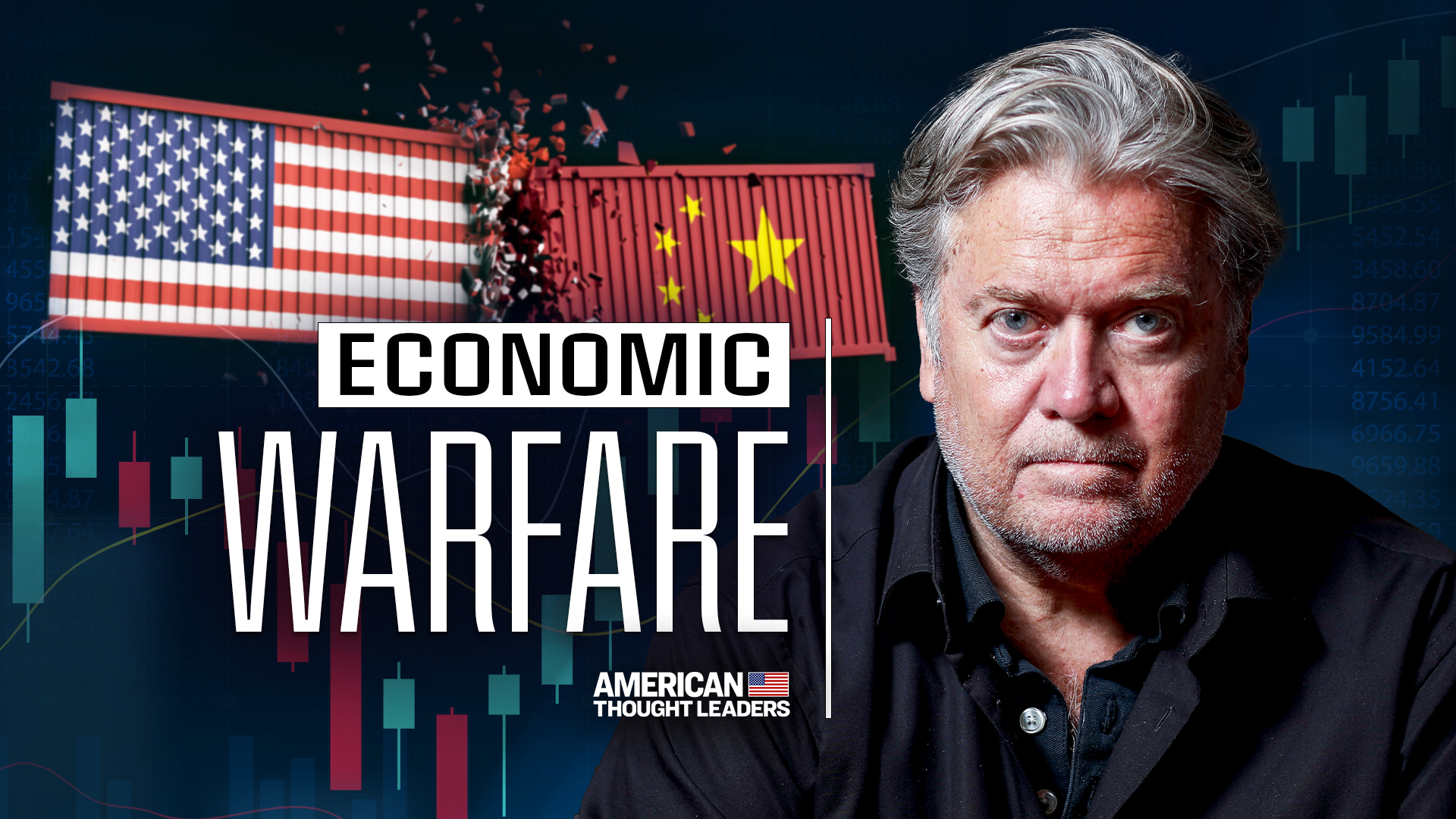

[FULL TRANSCRIPT BELOW] “Never before in history have two great trading entities ever engaged in outright economic warfare, like is being engaged today. And that’s why I say we’re living in historic times,” says Steve Bannon, former White House chief strategist during President Donald Trump’s first administration and host of the “War Room” show.
“It’s not just tariffs. They’re a tool. [Trump]’s reorganizing the world system of commerce and of trade,” Bannon says.
In this episode, we dive into the U.S.–China trade war, Trump’s tariff strategy, his first 100 days in office, and where America is headed in the weeks and months to come.
“The next 100 days is going to be three times more intense, dramatic, and meaningful than the first 100 days,” Bannon says.
Views expressed in this video are opinions of the host and the guest, and do not necessarily reflect the views of The Epoch Times.
FULL TRANSCRIPT
Jan Jekielek:
Steve Bannon, such a pleasure to have you on American Thought Leaders.
Steve Bannon:
I’m a huge fan of your show, and thank you so much for coming to the War Room.
Mr. Jekielek:
President Trump has instituted this regime of tariffs. You’ve described it as economic warfare, potentially putting Xi Jinping out of business. Please tell us what is happening.
Mr. Bannon:
What President Trump is doing is reorganizing. It’s not just about tariffs; they’re a tool. He’s reorganizing the world’s system of commerce and trade. Why is he doing this? Because for the last 40 or 50 years, the elites in the West, both in the City of London, which is their Wall Street, and our Wall Street, along with the global corporatists, have essentially worked with the Chinese Communist Party as partners to shift all high-value-added manufacturing from England and the United States to mainland China.
What hasn’t really dawned on people—because the mainstream media covers it, and the corporate media is part of this—is that you’ve had a systematic deindustrialization of the West for the last 30 to 50 years. It has been done by the leaders and elites in the West, to the detriment of working-class and middle-class people. That’s what President Trump is trying to reorganize—global trading systems around it.
Here’s where you’re finding the biggest appetite for this to happen: Japan, South Korea, Taiwan, Vietnam, the Philippines, and India. Those are the countries right now that are stacked up over at the Treasury Department, trying to finalize the architecture and the memoranda of understanding of the deals that will create this new trading relationship.
This is very different from the TPP [Trans-Pacific Partnership]. People ask, “Why did you do the TPP?” The TPP was a total disaster. President Trump is doing this because the Chinese Communist Party has engaged in an economic war against the West for 20 to 30 years. This is what unrestricted warfare is about.
As The Epoch Times has shown in every issue, the people’s war was declared by Wang Qishan and Xi against the United States in May of 2019. They did that after walking away from two years of tough negotiations between Vice Premier Liu He and Bob Lighthizer, Peter Navarro, and President Trump, showing you that they were not interested in a deal. Their only focus was a complete decoupling, except from our capital and technology.
Mr. Jekielek:
In 2018 and 2019, when that deal was being negotiated, for the first time the Chinese Communist Party actually had to do something that it didn’t want to. What do you think?
Mr. Bannon:
This is very important for the audience to understand. Let’s go back to how this all began. At Tiananmen Square, when the Goddess of Liberty went up, Deng Xiaoping and his faction said, “Okay, we’ve had enough of this. We’re going to drop the hammer.” That moment was six months before the fall of the Berlin Wall, which collapsed 50 years after the U.S. and the allies walked away from the Russian people and allowed the Bolsheviks to continue to run them. They essentially turned over the Chinese people, the laobaixing, to the communists, which was an action done by the U.S. State Department and other elites in the United States.
In the collapse over 50 years, the whole aspect was to get the Chinese Communist Party re-engaged and economically engaged. They had most-favored-nation status and were part of the World Trade Organization by both Bush and Clinton in the late ‘90s, along with the Republican Party and the Democratic Party. The political class and all of the elites joined in. They completely gamed that system.
Fast forward to 2015, with the cyber deal cut by Obama and his great pivot to Asia. It was a tough negotiation—not a bad deal, not perfect, but okay. The Chinese Communist Party does not live up to even one element of it. Shortly thereafter, they walked away from a deal they made on Hong Kong, essentially making it into a slave labor camp.
After two years of intense negotiations, the Lighthizer-Trump-Navarro deal dealt with the seven deadly sins for the first time. Then immediately, they have this meeting of One Belt, One Road in 2019, and Wang Qishan, Xi, and Putin show up. They walk through the whole network effect, how they will manufacture component parts in Europe, do final assembly in China, and source natural resources from South Asia and Sub-Saharan Africa. It’s an entire system.
They sit there and say, “If we sign this Trump deal, we are now actually coupled to the economy of the West, and the foreign devils will always have the upper hand.” They just walk away from it. Shortly thereafter, Xi declares a people’s war.
Everything the Chinese Communist Party does is very methodical. They use negotiations and diplomacy as stalling tactics or to make the foreign devils feel better, letting their media talk about these big deals, like Obama’s cyber deal, but they never intend to live up to them. Like Hong Kong, we’re never going to live up to it. As soon as we want to move, we move.
Remember, coming out of that there was the skinny deal. Two things happened: the military games in Wuhan in July and August, where all of a sudden people started getting sick with a virus. Then later, there was the skinny deal. Think about that. The skinny deal that was done in 2020 had no provisions allowed.
We have signed, negotiated, and signed major agreements with these guys over the last 25 years, including allowing them into the global trading system, the most-favored-nation status in the WTO, and they renege on everything. They have no intention of fulfilling it. That’s our cash and resources going to the Chinese Communist Party for slave labor products. They are skimming 80 percent off the top. Have the Chinese people prospered? I kind of missed seeing their prosperity.
Mr. Jekielek:
A few people prospered.
Mr. Bannon:
Yes, it was the CCP, which most people in the West still don’t understand. I told this to a very prominent person the other day. I said, “Let’s say there are 2 billion people in China, there’s only under 100,000 communists. He goes, “No, they’re all communists.” I go, “Oh, no, they’re most certainly not communists. They’re Chinese. They’re laobaixing. They happen to be living under a dictatorship.”
But there’s about 92,000, and only a couple thousand matter. It’s run by five factions who are stealing or forcing our companies to give them $600 billion in intellectual property a year. The deficit on intellectual property is about $25 trillion. These are massive debts they’ve sucked the lifeblood out of the industrial West, as they’ve industrialized themselves.
It’s not that they did it by themselves. Their partners are Wall Street, the City of London, the corporatist elite in the United Kingdom and the United States, and Silicon Valley. The pliant political classes, both the Tories and the Labour Party, allowed this to happen in the UK. Here, the Republicans and Democrats are both part of the same problem. This economic war is a deep issue. Finally, President Trump said, “I’ve had enough of getting ripped off, and we’re going to engage in this.”
Mr. Jekielek:
Part of it is because of the financialized economy.
Mr. Bannon:
Back in the ‘90s, we started to financialize the economy.
Mr. Jekielek:
Right. Whenever there is an economy where people are making money just by manipulating money, those will always be the richest people. They have access to the cheap money needed to make money. How culpable and responsible are these elites, or is it just the Chinese Communist Party with their Machiavellian schemes?
Mr. Bannon:
The Western elites, very early on, recognized this. It shouldn’t be lost on the people that at the very moment there was an open revolt against the Chinese Communist Party, people did not understand that Tiananmen is much bigger than Tiananmen Square. You had a country in a moment right around that lead-up into late May and early June that was in open revolt against a dictatorial system that had been imposed upon them in every major city.
Beijing, right there by the Forbidden City, is sacred ground for the CCP, because they are an imperial dynasty. What you could have had is the peasants overthrowing the system right there at that moment when the Goddess of Liberty went up, which was one of the strongest symbols in world history. They said, “We are united with the American Revolution. We’re united with the French Revolution. We are united in this quest for freedom, dignity, and liberty.”
At that very moment, Deng and the hardliners took over and said, “Okay, we’ve had it. This is not good. This is where the world gets a system, and they’re going to start asking questions. This is going to be put down, and we don’t care how many people we kill. In fact, we have to kill them on global TV. We’re going to kill them on global TV.”
Where was the outrage from the West? There was no outrage. In fact, it was the exact opposite. Bush 41, who had been ambassador to China and head of the CIA, what did he do? He sent General Scowcroft to Beijing for 30 days to basically tell Deng Xiaoping and these guys, “You’ve got to tone it down. Obviously, this thing’s not working.”
They said, “We'll help you figure it out, but you’ve got to clean it up, and we can’t have any more tanks.” We’ll get you into the World Trade Organization and give you the most favored nation status. We’re going to allow you to become a manufacturing power because we are going to work in conjunction and ship all the jobs over here, and we’re going to be partners.”
That’s what happened, and this occurred in broad daylight. The cynicism of it is that the global elites don’t have credulity. They had willful blindness back then. They knew exactly what was going on and they were party to it. Here’s the cruelest thing: they sold this to the American people. But the American people have always had a bond with the Chinese people dating back to the 17th and 18th centuries.
I remember as a kid in Catholic school, giving to the orphanages in China to help the young Chinese. They have always had a strong bond with the American people. As a young kid in Virginia, I always wanted to go to China from a very early age to see the mystery of China and the beauty of China and how magnificent it was.
But they took the most cynical approach to sell this to us. They said, “If we give them all this stuff economically, they will become more liberal politically.” But it was the exact opposite. It was a bald-faced lie. In fact, you could argue that 30 years after that, our elites really looked around and said, “ We kind of like their system. It is state capitalism with authoritarian control and a merger of the elite regulatory apparatus.” That’s what the United States had come to under Biden.
That’s what the Trump revolution is a rejection of. But this whole system is a sham, because it requires this wholesale mass theft that you just described. Like we’ve learned, you can’t innovate in a totalitarian system. You have to steal the innovators or you have to steal the innovation. Both sides of the equation are a sham.
Because to keep it going, all of this happens because of federal spending. We’ve shipped all the high-value-added jobs over. We only generate internally in our country about $4.5 to $5 trillion in total revenue from taxes, fees, and with the minimal tariffs we have. But we spend $6.5 to $7 trillion.
We have to finance $2 trillion a year by printing the money and being able to sell those bonds, whether to the Chinese Communist Party or Japanese insurance companies, or just buy them ourselves. If you can’t sell them, keep interest rates down, then just buy them ourselves. That part of the system is unsustainable. Their part of the system is also unsustainable. The whole thing is a total sham, not just the politics of it.
If you actually look, this goes back to the decency and the common-sense hardheadedness of laobaixing, which in Chinese means, old one hundred names. It is a term of endearment for the working-class folks—the little guys in China. China was supposed to transition because of the state-owned industries and the corruption with the CCP. Folks remember why there are so many state-owned industries—they’re skimming 20 percent off the top.
The way they finance the party and the five factions that essentially control the Chinese Communist Party are the wealthiest families on the planet. They’re far wealthier than the tech billionaires. They’re far wealthier than all the sheiks, the royal family of Saudi Arabia, or the Russian oligarchs. The Chinese Communist Party members are the richest people in the world by far. They skim through the state-owned industries. That’s how they do it.
First, they get their hands on everything. Every company has to be involved. But part of their strategy was to ensure that, hey, we can only export these goods and bury the West for a certain amount of time. At some point, we do have to transition to more of a consumer economy. Part of these exports have to be consumed by the laborers themselves.
But the common sense of laobaixing is the fact that they don’t buy it. They say, “Hang on, they don’t spend. But why don’t they spend?” There’s no social safety net, and they don’t trust the government. The government not only lies to them, it steals and suppresses them every day. In fact, and this is the tragedy of the Chinese people, they did buy into the system for one thing.
How has every working-class and middle-class family in world history gotten out of poverty? It’s to make a little money, to save a little money, and to buy a piece of real estate, to buy a farm, to buy the white picket fence. The American dream isn’t about dollars. The American dream has always been about owning a house with a white picket fence. In Europe, it’s the same way. It has always been about ownership of a real asset.
They sold that dream to the Chinese people, who bought in with their hard work, making no money, and saving on the side, not consuming. They thought, “I’m going to buy it.” And what did they do? The Chinese Communist Party, with the banks in the West, the financial services in the West, orchestrated the biggest scam in the world—the massive over construction of apartment buildings and units.
All the construction companies and everyone backed up with Chinese companies and the CCP made more money than ever. All the banks, in particular all the regional banks, are upside down. They’ve got the West in there; they’ve got the CCP in there. Guess what? The real estate assets these people bought with the little bit of money they had are now worth 50 cents on the dollar. This is the cynicism of the Chinese Communist Party.
Now, you have a system where both systems don’t work. We have to just create the money to buy this stuff. It can’t continue because we can’t continue to finance it. On the other hand, they can’t shift to a consumer economy because they’ve been screwed over by their leaders on the real estate side. The real assets are now worth 50 cents on the dollar, and they know everybody is lying to them.
There is no Social Security, no pension, and no way to sustain themselves. With the one-child policy, they don’t have eight kids anymore back in the village that can support them. They’ve got one. Normally, that one has an attitude and is in the big city somewhere, not wanting to hear from mom and dad anymore about their problems. They’re sitting there saying, “Hey, we’re going to save 50 percent of whatever we have left.”
That’s the dilemma of the world economy right now. The reason for the crisis is that the elites have been concentrating wealth. This has worked out for both sides. The elites of both countries have been gaming the system at the expense of their own workers and have made a fortune. The system works for the connected and the wealthy.
What Trump stands up for is saying, “Put America first. As a nationalist, I’m going to put America first.” This miraculously coincides with what the fixes have to be with China, where laobaixing will actually come first in deals that are made to balance this out in Trump’s perfect trade relationships.
Mr. Jekielek:
There is another dimension. A few weeks ago, Vice President Vance said that the system is actually using the hard-earned savings of the Chinese peasants.
Mr. Bannon:
I don’t like the term he used. The Chinese people are not peasants. They’re the greatest, hard working folks. I see his point, but using that terminology killed the message.
Mr. Jekielek:
But I think his point definitely holds, which is that they’re using those savings to buy U.S. sovereign debt to continue to game the system and they’re playing both sides.
Mr. Bannon:
Yes.
Mr. Jekielek:
Let’s look at the Chinese economy. We just talked about how the housing crashed. This whole infrastructure development aspect of the economy is down. There’s not much of a consumer economy. There’s the theft economy, of course. The fourth part is the exports which are in play right now with these tariffs.
Mr. Bannon:
Let’s make sure your audience understands something. When we say tariffs, as we speak today, there’s a full embargo. This is a full embargo. That’s why you see Secretary Bessent and some outreach to the CCP and they’re working on it. Right now, there is a full embargo of products coming in from China into the United States. We just had the truckers on the show the other day. There are no trucks leaving San Pedro and the Port of Los Angeles, these big West Coast ports.
We’re a developing nation to the Chinese. If you see what the trade balance is, what comes in on ships to San Pedro, Los Angeles Harbor, the Bay Area, and Washington, and what comes in on the West Coast and gets shipped east, they are consumer products, engineering products, products that have value. Yes, you have T-shirts and things like that, but you have a lot of value-added manufacturing that comes in.
If you see what goes out, it’s soybeans, sorghum, wood, wheat, some high-tech chips, and some super high-advanced chips. Mainly what goes out is natural resources, foodstuffs, things that have very little manufacturing value added, except at the super level where you have the chips and airplanes. Don’t get me wrong. We are at a super, super level, but basically we’re shipping out, because the system has been set up that we’re like an economic colony.
Mr. Jekielek:
What happens with these tariffs now? Do you agree that exports are the only part of the economy they have left?
Mr. Bannon:
But the pressure is on the Chinese people. Secretary Bessent said it yesterday. The Wall Street Journal had quite a brilliant piece this morning, a paper that does not have a lot of brilliant pieces. They actually had quite a brilliant piece about the real pressures and fissures. The BBC had a great piece the other day about the reality of Xi.
Now, here’s the dilemma. Yes, they’re already suffering, and they’re going to suffer more. But the Chinese Communist Party doesn’t care. They told Xi to get ready for it. They’re trying to go ultra-nationalist and say the foreign devils are trying to destroy us like they’ve always tried to do. They’re trying to make this an ultra-nationalist, and in some aspects, even a racist thing.
Remember, the Chinese Communist Party are not communists. They’re just a group of gangsters. They happen to be living in the imperial palace. It’s another imperial dynasty, this time run by a group of armed thugs. With the tensions around the Cuban Missile Crisis and other things like that in the 60s, we study them, we talk about them, and we make movies about them. Mao said at the time, “If they hit us with nuclear weapons, if we lose 200 or 300 million, that’s nothing. We’ll recreate that.” They didn’t care.
This is the Chinese Communist Party. The people that are in business with them will burn in the lowest pit of hell for this—very simply, it is the 450 to 500 million forced abortions. Mao Zedong said that the forced abortions have been on at least half-a-billion people, 80 percent of which were little girls. It’s the hungry ghost of forced abortions. On top of that, they admit to murdering, starving, and beating their people to death.
This is from the forced collectivization, to the Great Leap Forward, to the Cultural Revolution, to right now. This is happening to the underground evangelical Christians, the underground Catholics, and the Falun Gong. It’s any religious or spiritual sect that you have. It is happening to the Uyghurs. It doesn’t matter if you’re Muslim or if you’re a Right-wing traditional Catholic. They fear religion and spirituality among the Chinese people. Nothing else. They will quash that down, torture it, and do live organ harvesting.
It’s out in the open. These are not hidden things. You don’t have to read. You don’t have to have a security clearance to understand this. This is all known, and it’s particularly known by the people that deal in information, which is not Wall Street. The financial markets are nothing but information markets. They have perfect information. They know exactly what the Chinese Communist Party has been doing.
The Chinese Communist Party is by far, with no second, the most murderous dictatorship in the history of mankind. The Bolsheviks and the Nazis are there, but Mao and his gang killed hundreds of millions of their own countrymen. It’s not like they’ve been some invading power that has gone and killed. They have done that too in the killing fields, but they’ve principally taken it out on their own people. Why? They don’t care. They don’t care about the Chinese people. They look at the Chinese people as disposable, as a cocktail napkin.
This is why if you’re in Wall Street, in the money class, in the global corporatist class, in Silicon Valley, or in this apartheid state and you’re in business with them and made money off them, you need to have your nose rubbed in it. Because trust me, when you leave this veil of tears and stand before your maker, you’re going to be held accountable for that. You’re going to be held accountable for the enslavement, murder, and degradation of the Chinese people.
Mr. Jekielek:
Steve, there are so many things you said that I agree with. But they absolutely are communists. In every communist society, it’s the gangsters that rule. I do think it’s the ideology that’s driving it.
Mr. Bannon:
But I want to bifurcate communism between the economics of communism and the cultural milieu of communists. Clearly, they are cultural Marxists, which are atheists, and they’re thugs, which the Bolsheviks have been and every communist party has been since then. I’m just saying that economically, they are state capitalists. Because if you believed in communism, you couldn’t possibly believe in the wealth disparity between laobaixing and the five factions of the CCP.
Let me repeat this: Rubio and these guys just did the Senate thing that came out. I was very disappointed. The factions that rule Beijing and run the Chinese Communist Party, and people should know it, are at each other’s throats all the time because they are inherently evil people. They’re narcissists and nihilists that just believe in temporal power in this life.
They’re the wealthiest people on earth. They make the Saudis, UAE, Qatar, and these sheiks in the Gulf look like pikers. They own so much real estate in the West End of London. They own Midtown Manhattan. One of their big scams is to get as much cash generated out as possible and then get it out of the country.
They’re not reinvesting their own money back in these plants. They basically own a piece of the action on Western capital that’s come in. They’re gangsters, but they believe in a stark state capitalist autocracy where they’re the ones rent-seeking, taking all the value out of laobaixing.
Mr. Jekielek:
Right. The economic aspect of communism was debunked even before the Soviet Union took up the mantle of communism. Let’s discuss the external revenue service.
Mr. Bannon:
That concept was created in this very room with John Gardner, a small manufacturer from Laguna Beach, California.
Mr. Jekielek:
It’s already happening at some level, but there seems to be a pretty big cost. Many people are reporting that GDP numbers are down. But some people are saying that’s just a statistical artifact.
Mr. Bannon:
The GDP number came out the other day. If you look right below that number, it’s really 3 percent growth. There’s investment growing and that is since the Liberation Day that happened on April 22nd. We’re now only 29 days into this, so it wouldn’t have had that big an impact on the quarterly number. President Trump sees the U.S. as the premier consumer market in the world.
Before, we just let people have free access to it. In fact, it’s not just tariffs in that number; it’s also non-tariff barriers. It’s currency manipulation and counterfeiting. The Chinese Communist Party are masters of currency manipulation and counterfeiting.
Mr. Jekielek:
The highest tariffs were all on the big transshipment jobs.
Mr. Bannon:
Yes, exactly. President Trump looks at the United States as a premium market. Just like you would pay to get a skybox at a sporting event or pay for a front-row ticket for a concert, he’s saying that there’s going to be a premium to get in here. That’s why reciprocity comes into play; he takes the non-tariff barriers into account.
He’s saying, “By the way, you can get out of paying that. The way you can get out of that is if you bring your manufacturing back to the United States and create high-value-added manufacturing jobs with massive capital investment. You can avoid the tariffs. Now, if you want to continue on as before, there is going to be a tariff structure.”
Right now, even at the minimum, the average tariffs in the United States have been 2 percent. Right now, the basic lowest tariff in the Trump administration is 10 percent, which is a 500 percent increase. It’s amazing. A lot of these tariffs are going to be 20 to 25 percent, so the revenues generated from that will be pretty extraordinary.
I happen to think that most companies are going to opt into—which I think President Trump wants—investment here in the United States that returns us to a manufacturing superpower. Because of that, we get domestic tax revenues from corporations and from people making better wages, with more people making good wages.
Mr. Jekielek:
The strategy is that there is nowhere else to go. Either you do it here in the United States or you pay the tariff.
Mr. Bannon:
It’s the greatest consumer market in the world. Like President Trump says, he’s holding the cards now, but some things kind of slip out. Look, this guy’s a master negotiator geopolitically, geostrategically, and geoeconomically. I was doing a town hall last night at News Nation. The guys were screaming, “Well, when’s it going to deter them?”
I said, “Guys, this has been 50 years of rot, 50 years of selling out your country, 50 years of selling out your countrymen, and selling out the workers of the middle class of this nation.” The guy is 100 days into it, and he’s only 28 days into Liberation Day. It’s going to take a while. It’s not going to take 10 years. Directionally, I know Trump pretty well; he ain’t backing off this.
By the way, I love The Epoch Times newspaper so much. It is by far the best broadsheet in the country. I can say that because I am a newspaper consumer. I get every printed newspaper that you can get here in Washington, D.C. But you’re extraordinary—it’s an extraordinary paper. It’s put together well, the writing’s amazing, and the investigative reporting is amazing. Then with NTD, what you do on TV is also extraordinary.
For a media company that is in its early years of growth to outshine the Wall Street Journal and the New York Times, who’ve been doing this for over 100 years, that shows the number of online subscribers and total subscribers you have. I believe you’re number three behind the New York Times and the Wall Street Journal, who have also been around for over 100 years, with massive multi-billion dollar valuations.
These things trade all the way up to $40 billion and have huge, massive staffs. But they also have gone out of their way with hundreds of millions of dollars to promote their paywall behind it. If you look at Epoch Times, there is not a huge effort to do that. It’s basically that in a free market people are attracted to you because of the content. It’s just extraordinary.
Mr. Jekielek:
Just for the record, by our calculations, we are at number four.
Mr. Bannon:
Who is at number three? It’s not the Washington Post.
Mr. Jekielek:
I thought it was the Washington Post.
Mr. Bannon:
I think you guys have surpassed them and are on a growth trajectory. Plus, the reporting is just extraordinary. It’s not just the serious stories—it does what a newspaper is supposed to do. It not only informs you of domestic politics and what’s going on. It’s one of the most serious papers in the world, allowing any individual to understand the world.
That’s been the power of the New York Times for the elites, for the progressives, and of the Wall Street Journal for the business community. It gives those people insight into the entire world. The Epoch Times does that, and it’s pretty extraordinary. If you read that paper, if you go online and read it every day or read the printed edition, it’s extraordinary. If you look at what’s going on in those editions you can see what’s happening with this fight.
With President Trump, this is part of his core being. This is central to not just his political DNA; this is central to what I call his public persona DNA.
When he started doing media in the 80s and 90s, long before he was thinking of running for office, when he would do media because he was such a dominant member of the social and cultural aspect of New York City in the 80s and 90s. They would have him on and ask questions about public policies and those types of policy people.
He really came from what I call the Lou Dobbs school of trade deficits and global trade and political economy. He knew this cold. He has talked about trade and trade deficits, first with Japan and then with China, for 40 years. I tell people that if you didn’t know this was coming, don’t think he’s going to wave off.
He said last night on News Nation, and it’s the first time I’ve heard him say it, “Part of my negotiating strategy is to think things through and have the flexibility to be able to call an audible and do this.” There’s going to be flexibility and audibles called between the United States and China as this thing gets worked out.”
Many of the readers of The Epoch Times know about the New Federal State of China, the group that I represented part of. We want to take down the CCP. We want laobaixing to overthrow them. Directionally we’ll be fine, but there’s going to be some sort of accommodation at some point to work this thing out to the betterment of the United States of America.
But never before in history have two great trading entities ever engaged in outright economic warfare like it’s being engaged in today. That’s why I say we’re living in historic times. Now, I realize this is a curse for our Chinese audience, but that’s the reality of what we’re living through today.
Mr. Jekielek:
Why don’t we just stop supporting the CCP and let the Chinese people do what would happen naturally, if the CCP hadn’t come to control all aspects of the global economy?
Mr. Bannon:
I have been working on this project now for 20-some years. You can read Josh Rogin’s book, which I recommend to everybody. Josh Rogin is probably the most sourced writer in corporate media. He works for the Washington Post as a columnist. He wrote a book about Trump’s first term called “Chaos Under Heaven.” It was about the fight between Xi and Trump.
He goes through American foreign policy, national security, and economic policy. Traditionally, you’ve had hardliners against China. You’ve had realists that say, “Hey, one guy’s going to be hardline.” The other says, “We’ve got to be tough with these guys. We’ve got to be realists. They control East Asia.”
Then you’ve had the accommodationists, which in the first term included Gary Cohen, Steve Mnuchin, and the Wall Street crowd that just wants to make as much money and see China as a business partner. But for the first time in American history, you actually had a group that was probably the closest to Trump and his mindset at the time. That group was called the Super Hawks. The Super Hawks questioned the very legitimacy of the Chinese Communist Party. Remember, I virtually never say “China,” and I never say “the Chinese people.” Our issue is always with the CCP, the Chinese Communist Party
The CCP is not China or the Chinese people. But think about how that term has changed over time. So many people in this town now say, “The CCP.” Before Trump came on the scene, that term was never spoken. It was always “China” or “the Chinese” and terms like that.
Mr. Jekielek:
It was huge when Congress established The Select Committee on the CCP. That was very deliberate.
Mr. Bannon:
That was huge, and now there has been a sea change. People had been blinded by the business community and the media community. People’s natural inclination was to say, “Hey, we like the Chinese. They were our allies in World War II.” We’ve always been close to the Chinese. Sun Yat-sen,founder of the Republic of China, came over here and really set America on fire back before World War I. After the 1920s, he had a tremendous reception and sold bonds, and people wanted to support the development of a free China. The sea change during the 2015 campaign was that there had to be some sort of confrontation.
In the book, Rogin identified this new group, the Super Hawks, who didn’t believe in the legitimacy of the Chinese Communist Party. They were saying, “We should back laobaixing to overthrow the CCP,” because that would naturally happen if we cut off the CCP.. They were uber-nationalists like Stephen Miller, and also Peter Navarro, the China hawk, who has written all these great books.
Mr. Jekielek:
Peter Navarro wrote the book, “Death by China.”
Mr. Bannon:
And then there was Stephen K. Bannon, who is a very anti-CCP guy. Rogin said that this group was totally different. Trump has come through on this in his second term even more so. There are more people coming to our cause intellectually. Now, the reality is that the world’s economy hinges upon these two entities. Now, you’re still seeing, particularly the business community and the Republican Party, being very vocal about it. They say, “We’ve got ourselves into a terrible jam. We’ve become very dependent upon this.” President Trump is a master negotiator. Bessent, no friend of the CCP, is a very big anti-CCP hawk.
I think you’re going to see some amazing things. It’s already amazing. Hell, we are finally engaged in the economic war they’ve been waging against us. He called them out. We have a full embargo right now, and we have all the countries of East Asia coming to our side.
I don’t know if this is in one of my Financial Times articles. Bit it says on the cover that Beijing has warned East Asian countries, “If you sign a deal or come to terms agreed in the architecture of a deal, and anything in there makes you not part of our sphere of trade, you will pay for it. You should not sign it.” That is a threat and it’s a warning. That’s where we are today.
Mr. Jekielek:
Please tell us about the first 100 days of the Trump administration.
Mr. Bannon:
This has been four years in the making and is part of Project 2025 and the Center for Renewing America. Five or six think tanks have been working on this for four years. This is why you had the days of thunder. In just one word, the first 100 days have been a revolution. President Trump has impacted every vertical, particularly the main thing, the Chinese Communist Party, geopolitically, geostrategically, and geoeconomically. It has been magnificent.
But that’s only one of 50 major things happening right now. On the border, we were told things by Senator Lankford and Republicans. This was not Democrats trying to sell you a bill of goods. This was Republicans trying to sell you a bill of goods. They said that we had to have this huge bill, putting up tens and hundreds of billions of dollars. People forget that none of the restrictions came on until after you had 2 million illegal aliens crossing the border each year.
The bill Lankford put up, which President Trump was criticized for, called for 2 million immigrants a year coming in before penalties and sanctions and restrictions. Trump closed the border by basically doing away with the architecture of Biden’s executive orders that allowed this invasion to happen and by sending Customs and Border Protection and some troops down there. In 60 days, the border is closed. Now we’re going to build the wall and do everything we have to do. The border is closed.
Okay, so the number one thing he ran on has been done. Have we deported 10 million? No, that’s kind of step two and that’s being worked through. He’s trying to deport as many as possible. But they say, “Oh, you haven’t done deportation.” I say, “Screw you. You just gave me a solution a year ago that was going to have 2 million coming here every year before you even did anything about it.”
So I don’t want to hear your complaints, because this guy closed it in 60 days, as he said he would. People watching this show should go back and remember every lie you were told about the border. All the misinformation you were given about the border—all of it was 100 percent lies. Trump came in and did it in 60 days.
The people in South Texas, in the Rio Grande Valley, and in Southern Arizona know it’s a totally new situation. It’s not an invasion going on anymore. Do we have problems on the border? Certainly. Do we have a massive problem now in how to deport these people? Of course we do. That’s all being worked through.
The other thing is inflation. They said, “Inflation is at 2.3 percent. Interest rates are down. Everything’s down. Cheaper energy, his thing.” The two big things he said are all happening at the same time. Then there are another 50 or 100 things on top of that. There have been 137 executive orders. It’s the urgency, the rapidity, and the scale of what he’s done.
But the most important part of this breathtaking thing, is the fact that you see this guy every day. It’s the same guy. It’s Donald Trump. It’s Trump in the Oval Office where there are bilateral meetings, and they are all behind closed doors.
Remember the Iraq and Afghanistan wars in the Bush years? There would be meetings at the White House, but you never heard about anything. Today, these guys come to the White House, and Trump sets them up in front of the fireplace. The cameras come on, and he disintermediates the mainstream media. No longer do they have the microphone. He just starts talking. He goes on one of his riffs, and then he opens it up for questions.
Now, he’s opened up the press conferences to The Epoch Times and the WarRoom and to the ecosystem on the Right. You get better questions. Every day he’s showing you what government is about. It’s like FDR doing a fireside chat every day and having the whole nation engaged.
This has never been done in human history. No advanced industrial power has ever governed this purely as a populist, saying, “Come on in, ask me some questions. What do you have to say?” He doesn’t shy away from questions. It’s extraordinary in the level of energy and intensity.
It’s Trump sitting there, and he’s the same guy every day. He’s going to throw out some crazy stuff because he’s Donald Trump. Half of it is trolling people. With the other half, he’s throwing out ideas. It’s extraordinary and has never been done before, and it will never be done again. That’s why right now we are living in a completely historic moment.
Mr. Jekielek:
Let’s talk about the dismantling of USAGM [U. S. Agency for Global Media], which includes Voice of America and Radio Free Asia. People there have been furloughed. It’s unclear whether these agencies will come back.
Mr. Bannon:
I’m one of the drivers of the deconstruction of the administrative state. You’ve got this fourth branch of government that has taken over. It’s impervious to elections. Whether you’re a socialist, a progressive on the Left, or a Right-winger, this thing has to go, because it’s a permanent Praetorian guard that runs the country. There are two ways to do this.
One, Elon Musk came with DOGE that was supposed to find waste, fraud, and abuse. You have $6.5 or $7 trillion spent a year. Is a lot of this just ripped off, and is a lot of it fraud? Is much of it just waste with all these fat cats? A lot of it is just abuse. Programmatically, you’ve got all these programs like USAID and DOE.
Let’s use USAID as an example, along with USAGM and Voice of America. It’s not that these issues haven’t been addressed. Our show did live streams in the summer of 2023 for the single subject authorization bills, which our audience couldn’t get enough of. At two o'clock in the morning, Marjorie Taylor Greene, Eli Crane, Lauren Boebert, and all the MAGA congressmen were arguing at the subcommittee level on the House floor about USAID and identifying the problems with DOE. Guess what? They would be voted on in the subcommittee with majority RINO support, and then passed overwhelmingly. The programmatic side was being addressed.
DOGE went in with taking $2 trillion out in the first year, and then a trillion in subsequent years. I said, “Don’t give people false hope that you’re going to find this fraud. I’m not so sure it’s there. I’m sure there is a lot, especially at the Pentagon, which you refuse to examine. The political class here is looking for a magic wand. They don’t want to cut anything; they want to add to USAID and the Voice of America.” This is the Republicans.
The Democrats, on the other hand, want to spend every penny in the country that comes from the government. So he went in there, and it was a lot of Sturm und Drang, plus optics. Most of the cuts, aside from all the kicking up of dust about Social Security, were overshadowed by the Treasury Department’s $4.6 trillion payments going out. Nobody knows where they go.
I said, “What?” I called the Secretary of the Treasury Bessent. I said, “You’re going to have to sell $12 trillion worth of government securities this year to finance this mess. I certainly hope it’s not $40 trillion.” He said, ”That’s ridiculous. It’s nothing. These guys don’t understand how the government system works.” Here we are with DOGE and Elon is leaving. It went from $2 trillion to $1 trillion to $150 billion, but it’s almost all on the programmatic side. They did put them on the programmatic side.
Mr. Jekielek:
What do you mean by programmatic side?
Mr. Bannon:
The programmatic side is basically the programs of the State Department. The State Department is made up of hundreds of different programs that all get funding through the appropriations bill. The State Department gets its funding, but it’s programmatic. Underneath, when you look at the 10,000-page appropriations bill because it’s a law—it’s a contract. In that contract, it delineates the tens of millions of dollars going to USAID. Inside of USAID, it specifies allocations for projects in sub-Saharan Africa and Pakistan, etc. There’s not much ability to even move that money around.
This is what OMB [Office of Management and Budget] does. Upon appropriations being approved, the funds immediately go to OMB for management. I could call Russ Vought during the first term and say, “ I want to talk to you about certain programs for American Indians at the Department of the Interior.” He would say, “Give me 15 minutes; I’ll send a guy over.” They can actually talk on a weekly basis about the amount of money programmatically allocated to the whole budget—what has gone out, what has been achieved, everything like that. It’s a fairly tight management system.
Hence, Elon didn’t find a trillion dollars of fraud; he just didn’t. I realize you’ve got fanboys who want to skip around and light their hair on fire. I’m a guy who says, “Show me the money” because I’m focused on cutting the federal budget. If fraud is happening, that’s got to go, and the fraudsters must be turned over to the DOJ, prosecuted, and put in prison.
If there is waste in the Pentagon, I want to know where it is. Let’s hold those responsible accountable. If it’s fraud, the same way; if it’s abuse, the same way; if it’s programmatic—this is what needs to happen. We have to make tough decisions now.
The Pentagon has a budget of over one trillion dollars, Medicaid is about $800 billion, and the other non-discretionary spending outside of Medicaid is around $500 to $600 billion. Those are all programs. Someone here is going to have to make tough calls. There are no easy calls. All of this goes somewhere; it all has a constituency, and the media will be all over it.
But this is called the adult work of how you start to reduce federal spending. That’s still not happening. The political class were the biggest cheerleaders for Elon because they wanted him to be the fairy godmother who would come with a magic wand and find a trillion dollars of fraud. That would be the greatest solution in the world, but it’s also not going to happen.
As bad as these systems appear to be, I don’t think they’re that bad. If they are that bad, we haven’t seen it yet, because they haven’t matched up what they say—like Social Security having all these people over 100 years old. That looks like it’s in a different category; that money doesn’t go to it. That’s all some historic bookkeeping.
We haven’t seen to date where the Social Security fraud is. I’m sure there’s some. I’m sure there’s fraud at the IRS and in these places. That’s what we need to see. Programmatically, the big battles this summer will unfold. This is why we’re in the second 100 days, given the tee-up of the first. We’re now getting into the zone I call the convergence of the crises.
Converging are three verticals: number one, national security, which involves ending the kinetic part of the third world war in Ukraine on the Eurasian landmass, the Middle East, and the Red Sea, and hopefully not getting into a kinetic conflict with the People’s Liberation Army [PLA] and navy around Taiwan.
Number two is regaining our sovereignty over the 10 million illegal alien invaders, which he did, and starting the mass deportation program. It’s not just criminals; it has to be all 10 million. They have to go because they’re crushing the black and Hispanic communities at the lower skill levels. The third is the enormous existential threat of the economy and debt and everything you pay, which ties to the commercial relationships with the Chinese Communist Party.
This summer, we’re going to have a constitutional crisis regarding deportations. President Trump, in exercising his Article II powers, is saying, “Let me be blunt on the unitary theory of the executive. I’m the chief executive officer of the United States by the Constitution. That means I can fire people at these agencies or in my cabinet as I want. I can say, ‘You’re gone,’ and ‘You’re gone.’”
Number two: go back to the programs and the appropriations with OMB. In those programs, if he deems that they’re not hitting their targets or should be reappropriated, he can impound the money. He can simply choose not to spend it. That is going to face opposition; they’re fighting that. He’s involved in 50 different lawsuits about this.
His second power is as commander-in-chief of the armed forces. He has declared a national emergency at the border, a national security emergency. He can deport these people without a deportation hearing or due process because they are here illegally. They are going to go. He’s already at the Supreme Court on this, which will force a ruling maybe sometime in June. If they rule that a court has supremacy over him as commander-in-chief, I think that will be a significant issue we’ll need to sort out.
The third phase is now that Elon is gone, he has left behind issues related to fraud or abuse. But we’re still stuck with six-and-a-half or seven trillion dollars of spending. Now we need to have a budget to get serious about defense spending, Medicaid, and these other social programs. All of the cuts are going to hurt.
It just is because everyone has a constituency, whether you’re a defense contractor, part of the military, involved in Medicaid, or engaged in social programs. But while you have that gap, we can’t finance $2 trillion a year. It’s not doable. The Chinese Communist Party ends up financing part of it, which puts us more in their grip.
The third goal is obviously stopping these wars. That’s why this Russian rapprochement is crucial—to break their alliance and allegiance with the Chinese Communist Party and to separate the KGB from the Russian rapprochement. This is what Steve Witkoff has been working on. The Ukraine economic deal is essential. and peace deals, a subset of that. The situation with nuclear power in Persia, which I am adamant should not be bombed, has got to be part of this deal.
The third situation is in Gaza and the Red Sea. These things are hurtling towards a climax this summer. The next 100 days are going to be three times more intense, dramatic, and meaningful than the first 100 days. But here’s the good news. Our revolution shows us one thing: if we don’t quit, we win. The same goes for a civil war. It’s the side that doesn’t quit that eventually wins.
What I love about the tenacity, grit, and toughness of the MAGA movement is that we aren’t going to quit. We’re not quitters. We’re all in on this. If we were going to quit, you would have quit when they stole the election. You would have quit when Trump was forced back to Mar-a-Lago. You would have quit when Fox News didn’t cover him live. You would have quit back in those days of January, February, March, April, and May.
Those first four, five, or six months when he was a lion in winter down in Mar-a-Lago and all the Republican Party turned against him, all the conservative media turned against him, and all you heard about was Ron DeSantis, Nikki Haley, and all these clowns who are never going to be president of the United States. Those were the dark days.
We didn’t quit then. We rallied. We had his back. We started doing the hard work of Project 2025 and building these cadres that could come in and get these policies done so we could have this great 100 days.
The toughness and ability to be resilient is something we possess. You can see on the Left that they don’t quite have it. They’ve been too lazy, too complacent, and too whiny. They’ve abandoned the working class. That’s why I believe we’re tougher and more focused, and that’s why we’re going to win.
Mr. Jekielek:
If you had one piece of advice to give to President Trump, what would that be?
Mr. Bannon:
Triple down. Just make every day more intense than the day before. You’re on the right track. You’ve got the right policies. You’ve got the right people. Obviously, today, the National Security Advisor is going to make changes. Directionally, you’re right. You’re fighting on the side of righteousness. I think we’ve seen this. Trump is having a front-row seat to this.
The 2016 election was providential. That was the hand of God. We had a plane, we had a jet, a man, a message. We had no organization, no money. That was the American people stepping up and saying, “I want this guy. This guy’s different. I’ve heard enough of the Clintons. I’ve heard enough of the Bushes. I’ve heard enough of this crap. I want to give this guy a shot.”
The stealing of the 2020 election and the pandemic was also the hand of God. At the time, it didn’t seem that way, but if we had gone right into a second term, it would have been like trench warfare. It would have been like the Western Front in World War I or World War II, with two sides dug in, and with Trump surrounded. God’s hand worked so that we would step back and put the burden on MAGA and his followers to make sure they had his back, to do the precinct strategy, and all the things necessary to be there for him. If he commits to do it again, we would drive to victory.
But it showed us how these Democrats are not traditional Democrats. These people are neo-Marxists. They’re autocrats trying to destroy people. They’re using the pandemic to destroy people. They’re using the government to destroy people. They ran this like the Stasi in East Berlin. That was all revealed to us.
Plus, we had time to regroup. Trump had time to think. We had time to put together Project 2025 and the Center for Renewing America. We had time to think through what we had to do regarding the Chinese Communist Party and other issues. You had those four years of preparation.
I gave this interview to PBS after I left the first time. I said, “Flood the zone. Here’s our strategy—have two or three things every day so they would bite on one and we’d run with it.” Now, we’re doing a dozen to fifteen a day. What I would tell the president and his team is urgency, action, and intensity, every day. When you have an enemy on the run, you keep them on the run. Never take your foot off the pedal. Don’t let them retreat. Run the tables and let’s break this globalist imperial capital here in Washington, D.C., because victory is at hand. We just have to keep pounding down.
Mr. Jekielek:
Steve Bannon, thanks so much for being on the show.
Mr. Bannon:
Thank you. Love you guys, and please come back.
This interview has been edited for clarity and brevity.