If you or your kids or your grandkids haven’t read this fine American writer, now is the perfect time to pick up a story and turn the page.
The television series “The Ray Bradbury Theater” opens with Bradbury turning on the lights in two rooms cluttered with drawings and paintings, memorabilia running from a globe to a Tiffany lamp to a picture of Mickey Mouse, toys and gadgets, piles of papers, and hundreds of books in cases, on every tabletop, and stacked on the floor. As his friend Dana Gioia wrote, “No boy ever had a cooler clubhouse or enjoyed it more.”
Then comes Bradbury’s voiceover:
“People ask, ‘Where do you get your ideas?’ Right here. All this is mine. Martian landscape. Somewhere in this room is an African veldt. Just beyond, perhaps, is a small Illinois town where I grew up, and I’m surrounded on every side by my magician’s toyshop. I just look around, find what I need, and begin.”
From his youth, Bradbury employed that recipe for serving up his stories for readers. For decades, he wrote every day, and unlike those dreary “I bleed through my fingertips” writers, he took joy in his creations. His passions—dinosaurs, space travel, the Midwest, literature—spill out in wonderful abundance in his books. This combination of work and play resulted in an immense body of work: novels, screenplays, essays, and hundreds of short stories.
Let’s look at this master craftsman and some of the enthusiasms he brought to his typewriter.
The Man Remembered the Boy
In Bradbury’s poem “
Remembrance,” a man in his 50s revisits his childhood home, walks the fields where he once played, and stumbles upon an oak where, at the age of 12, he had hidden a note in a squirrel’s nest. He climbs the tree, discovers the note still there and intact after all these years, reads it, and begins weeping. On this scrap of paper, he had written “a message to the future, to myself.”
And fresh to the me that was large and no longer new.
What did it say that made me weep?
I remember you.
I remember you.
Likewise, Bradbury the man always remembered the boy he once was. In coming-of-age books like “Dandelion Wine” and “Something Wicked This Way Comes,” he brings that Midwestern boy to life. Other stories like “A Sound of Thunder” with its dinosaurs, pieces like “The Veldt,” the Martian tales, and even those like “There Will Come Soft Rains” with their critiques of technology and gadgets—all in one way or another flow from the imagination cultivated in his boyhood.
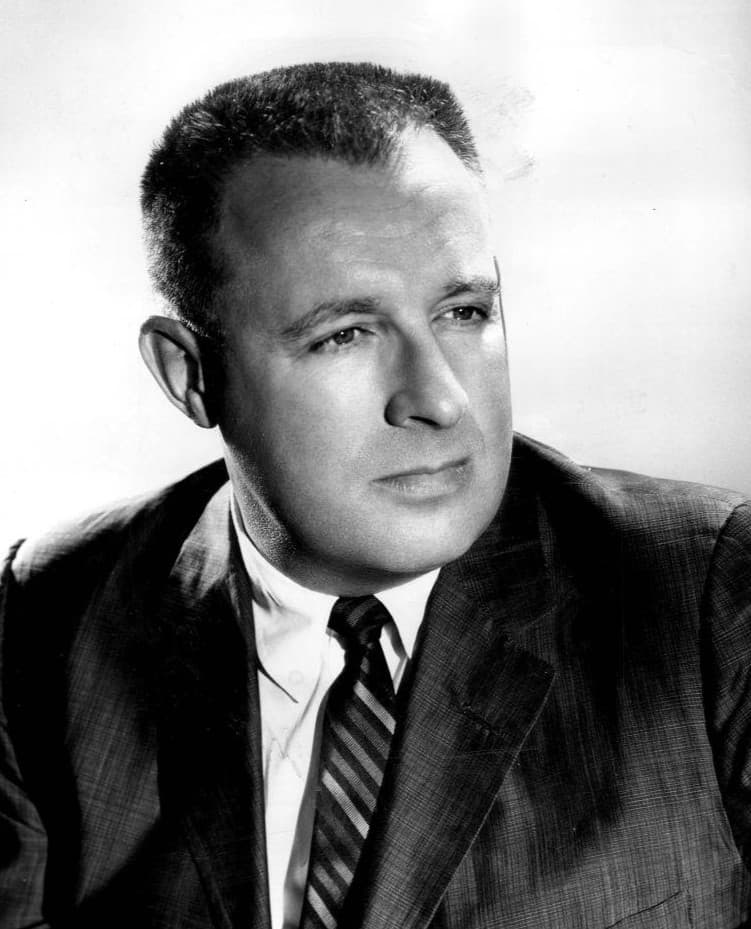
Publicity photo of Ray Bradbury from the television program "Alfred Hitchcock Presents." (Public Domain)
Bradbury was also a man of contradictions. All his life he loved toys and would ask his beloved wife, Marguerite, to give him these as gifts for Christmas so that his grandchildren remembered him as having more toys than they did. He lived in Los Angeles most of his life, yet he never learned to drive a car. He wrote of space travel but, until his early 60s, was terrified of flying. He predicted all sorts of innovations and advances in technology, from virtual reality to ear buds, yet he did his work on a typewriter, refused to own a computer, and considered the internet “a waste of time.”
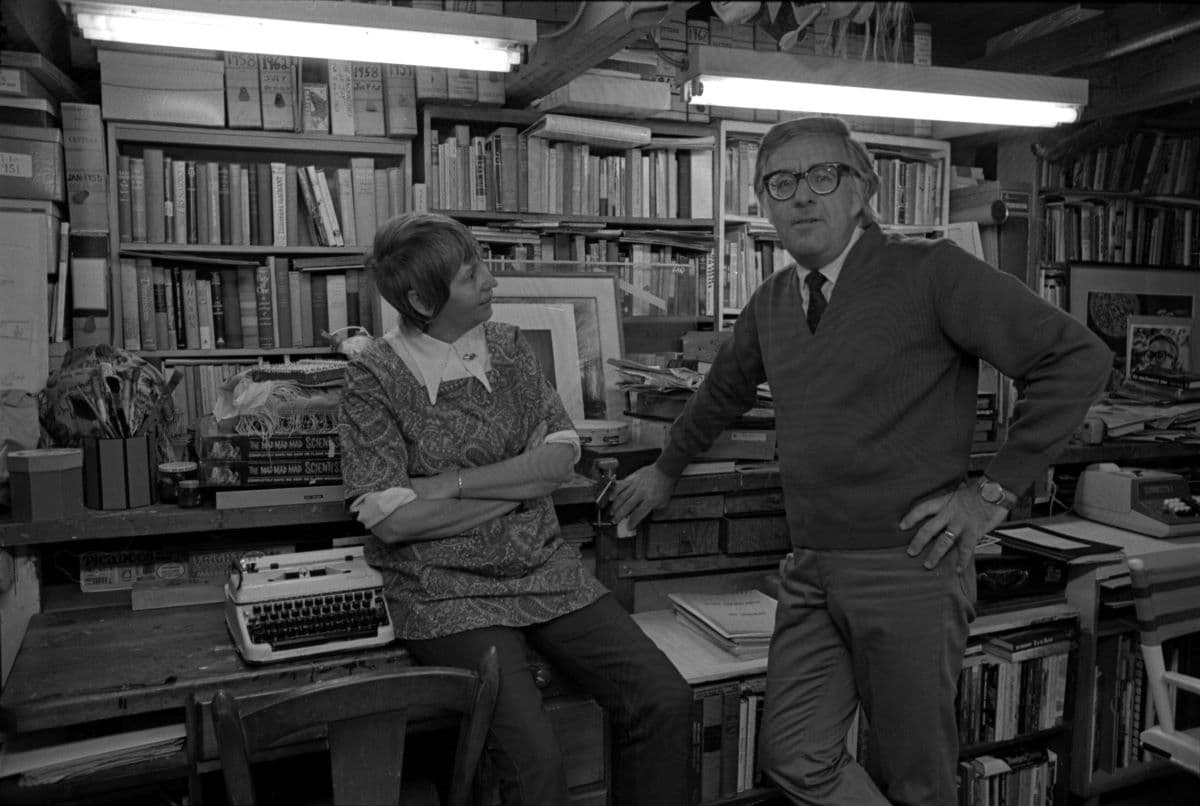
Ray and Maggie Bradbury in their Los Angeles home and Ray's office in 1970. (<a href="https://digital.library.ucla.edu/catalog/ark:/21198/zz0002vt83">Los Angeles Times</a>/<a href="https://creativecommons.org/licenses/by/4.0/">CC BY 4.0</a>)
Literature, Libraries, and Love
Of all American writers of fiction, Bradbury surely stands at the head of the class in the homage he paid to writers, books, and libraries.
In our school days, many of us read “Fahrenheit 451,” Bradbury’s dystopian novel about a future where the government has banned books and reading and where “firemen” root out and burn books when they find them. As we follow fireman Guy Montag and his increasing dissent from the system, Bradbury uses the story to promote, or at least mention, Western classics like the Bible, Plato’s “Republic,” Dante’s “Divine Comedy,” and Henry David Thoreau’s “Walden.” Through these examples, he reveals to readers the crucial importance of books and reading in our culture.
His short stories also frequently center or touch on authors and their work. In “Forever and the Earth,” for instance, he imagines bringing back by way of time travel one of his early exemplars—American writer Thomas Wolfe—to describe the cosmos. “The Kilimanjaro Device” and “The Parrot Who Met Papa” involved Ernest Hemingway, “Any Friend of Nicholas Nickleby’s Is a Friend of Mine” is about a man imitating Dickens, and the time Bradbury spent in Ireland writing the screenplay for John Huston’s film “Moby Dick” has become the stuff of literary legend.
Bradbury is well-known for praising and promoting libraries in his interviews and in some of his books. In an interview with his biographer Sam Weller for The Paris Review, Bradbury spoke, as he did frequently, on the debt he owed the public library, which became his classroom when his family lacked the money to send him to college during the Depression:
“I am a librarian. I discovered me in the library. I went to find me in the library. Before I fell in love with libraries, I was just a six-year-old boy. The library fueled all of my curiosities, from dinosaurs to ancient Egypt. When I graduated from high school in 1938, I began going to the library three nights a week. I did this every week for almost ten years and finally, in 1947, around the time I got married, I figured I was done. So I graduated from the library when I was twenty-seven. I discovered that the library is the real school.”
‘All You Umpires, Back to the Bleachers’
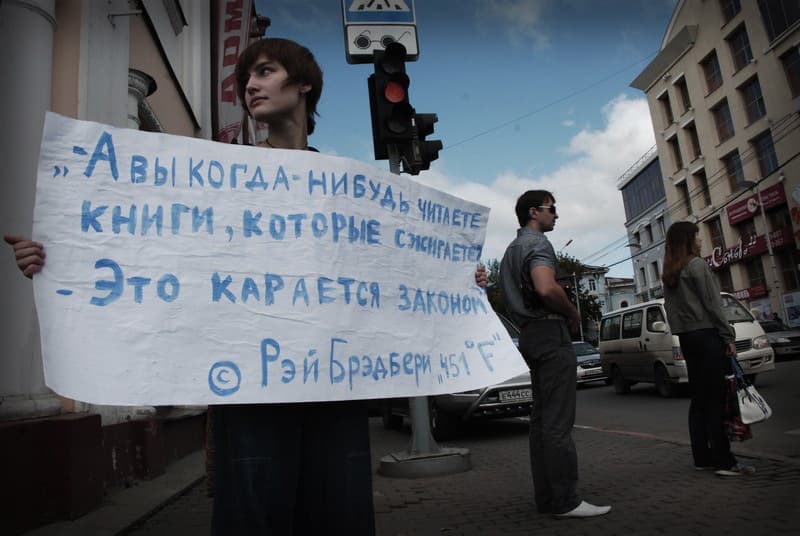
A protester from Russia showing a quote from "Fahrenheit 451": "Do you ever read any of the books you burn?—That's against the law." (<a href="https://commons.wikimedia.org/wiki/User:Gaura">Gaura</a>/<a href="https://creativecommons.org/licenses/by-sa/3.0/">CC BY-SA 3.0</a>)
“You don’t have to burn books to destroy a culture. Just get people to stop reading them.” This quote is attributed to Bradbury’s “Fahrenheit 451,” but it actually came from interviews he gave after the book’s publication. It’s perhaps his best-known quote and one in which he fiercely believed. He foresaw the dangers that screens, mass media, and a visual culture posed not just to reading but also to thinking and, consequently, to liberty.
In a Coda to “Fahrenheit 451,” which he added after a reader alerted him to cuts and changes made in the book by editors in a later edition, Bradbury wrote: “There is more than one way to burn a book. And the world is full of people running about with lit matches.” He despised the political correctness that for the last 50 years has led to the bowdlerizing of books by dead authors, like “Mary Poppins,” the “James Bond” books, and the “Nancy Drew” series. In the Coda, Bradbury pointed a damning finger at all who changed a text, who feel they have “the will, the right, the duty to douse the kerosene, light the fuse.”
At the end of his Coda, Bradbury wrote: “All you umpires, back to the bleachers. Referees, hit the showers. It’s my game. I pitch, I hit, I catch. I run the bases. At sunset I’ve won or lost. At sunrise, I’m out again, giving it the old try.”
In other words, hands off.
An American Voice
Speaking at a 1981 graduation ceremony at Harvey Mudd College in Claremont, California, Bradbury said:
“The American people are a remarkable people. I think we’re far more remarkable than we give ourselves credit for. We’ve been so busy damning ourselves for years. We’ve done it all, and yet we don’t take credit for it. Everyone in the world is dressed like us. We’re the center of the universe. If we opened the floodgates tomorrow, the whole world would pour in here. I’m always talking about invisible revolutions—the things we’ve done that we don’t take credit for.”
In his writing, we find his affection for his country especially evident in those stories he set in the Midwest of his childhood, his celebration of even mundane things like fireflies and new tennis shoes. His references to popular culture—the style and tone of his prose—all mark him as an American writer of his time.
Where Bradbury differed from some of his fellow authors is in the optimism he brought to his work, his life, and the country at large. He criticized the misuse of technology and its damaging effects on the human spirit and feared government overreach, but he also looked positively toward the future, demonstrating that optimism in his words and in his general upbeat attitude toward life.
Gratitude
In “Fahrenheit 451,” Bradbury examines the idea of legacy, of what remains of us on earth after our death:
“Everyone must leave something behind when he dies, my grandfather said. A child or a book or a painting or a house or a wall built or a pair of shoes made. Or a garden planted. Something your hand touched some way so your soul has somewhere to go when you die, and when people look at that tree or that flower you planted, you’re there.”
Ray Bradbury left us his books and, in them, his spirit.
In the last days of his life, when Bradbury was confined to a wheelchair, Weller frequently visited him. Weller recounts that Bradbury asked him to read to him. Often, Bradbury asked him to read the paragraph from “A Sound of Thunder” that describes dinosaurs. “And I would read the paragraph, and when I was done, look up at Ray. Tears would be streaming down his cheeks.
“‘I can’t believe I wrote that,’ he said. ‘I am so grateful.’”
So are we, Mr. Bradbury. So are we.
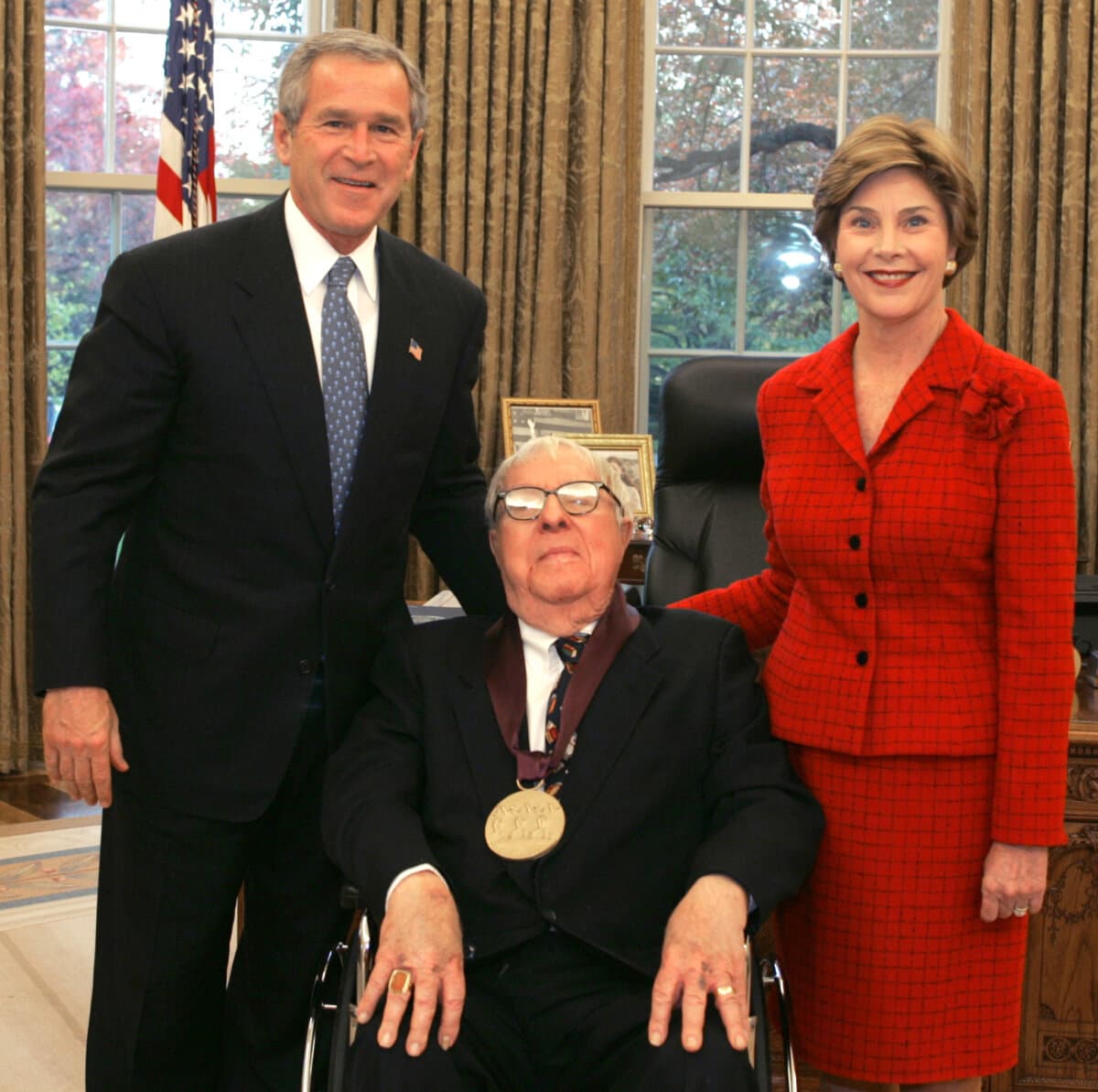
Ray Bradbury receiving the National Medal of Arts in 2004 with President George W. Bush and First Lady Laura Bush. (Public Domain)
What arts and culture topics would you like us to cover? Please email ideas or feedback to features@epochtimes.nyc.