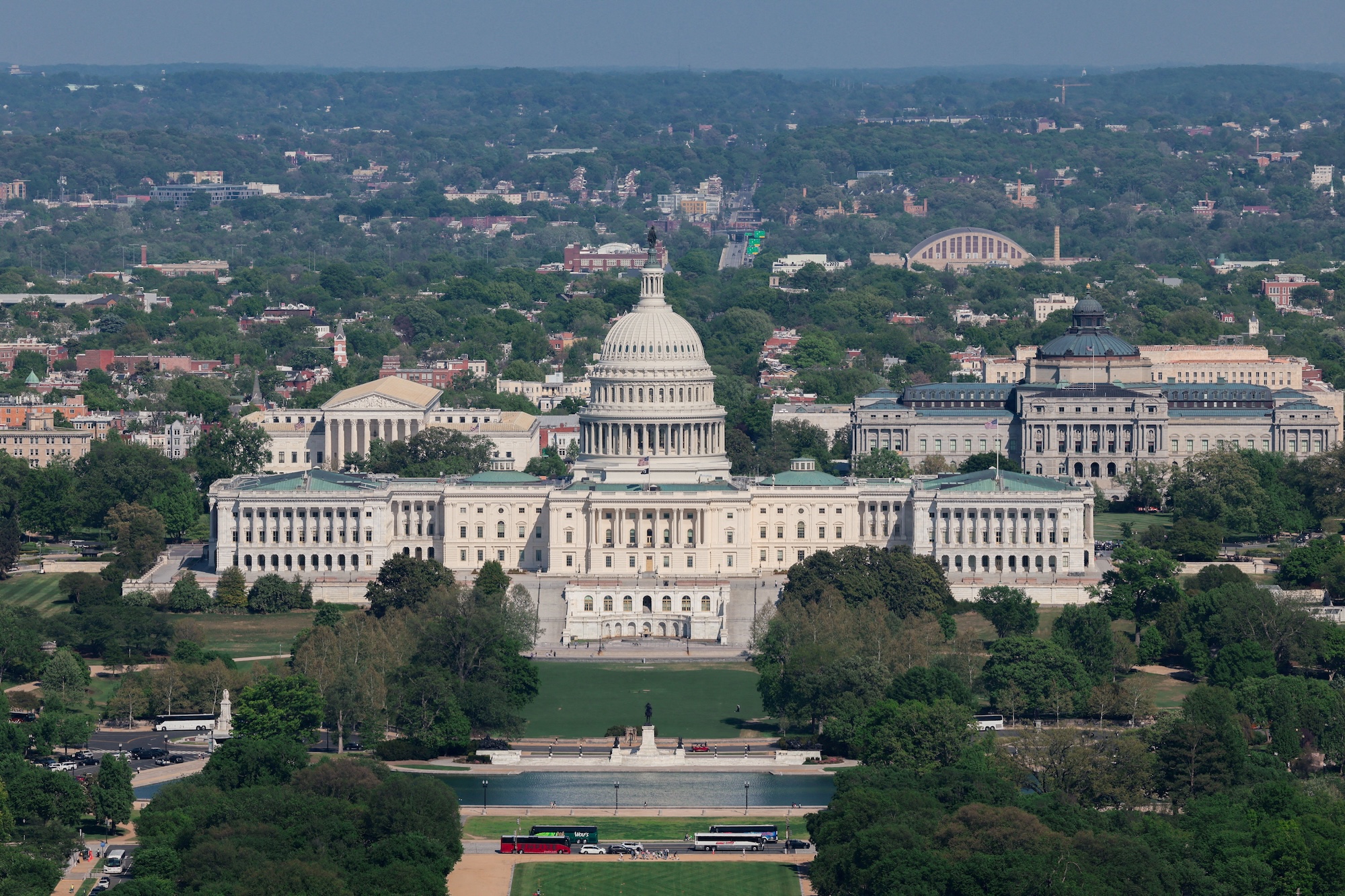

The Senate voted early this morning to advance a $70 billion funding blueprint for immigration enforcement agencies, moving Republicans a step closer to unlocking a party-line bill to fund Immigration and Customs Enforcement (ICE) and Border Patrol through the remainder of President Donald Trump’s term.
Lawmakers voted 50–48 in predawn hours to adopt the nonbinding budget resolution and send it to the House of Representatives, overcoming Democratic demands for new restrictions on enforcement operations. Sens. Rand Paul (R-Ky.) and Lisa Murkowski (R-Alaska) joined Democrats in opposing the measure.
If adopted by the House, the resolution would allow congressional committees to draft detailed legislation allocating the funds, which would require Trump’s signature to become law. The funding is expected to run through January 2029.
The vote marks a key step in Republican efforts to end a partial shutdown at the Department of Homeland Security (DHS) that began in mid-February amid a standoff over immigration enforcement funding.
Republicans are using the budget reconciliation process—which allows passage by a simple majority—to bypass the Senate’s 60-vote threshold and advance the measure without Democratic support. The blueprint triggers a process in which committees fill in spending details in subsequent legislation.
In a post on Truth Social shortly after the vote, Trump praised Senate Republicans and urged party unity.
Trump urged Republicans to “stick together and UNIFY to get this done, and to keep America safe.”
—Tom Ozimek
VIRGINIA MAPS BLOCKED
A Virginia judge ruled on Wednesday that the state’s redistricting referendum approved by voters a day earlier was invalid, nullifying the election results.
Virginia Attorney General Jay Jones said he would immediately file an appeal.
“Virginia voters have spoken, and an activist judge should not have veto power over the People’s vote,” Jones said in an X post.
Tazewell Circuit Court Judge Jack Hurley entered an injunction blocking certification of the election.
Former Virginia Attorney General Ken Cuccinelli said the legal fight was just beginning after language used in the ballot question raised a lot of interest among the opposition.
The question voters faced was: “Should the Constitution of Virginia be amended to allow the General Assembly to temporarily adopt new congressional districts to restore fairness in the upcoming elections, while ensuring Virginia’s standard redistricting process resumes for all future redistricting after the 2030 census?”
Cuccinelli expected the case to move quickly through the appeals process.
“The “yes” folks probably are going to look back at Tuesday and think that was the easy part because they have so badly violated several constitutional provisions,” Cuccinelli told The Scott Jennings Show.
The referendum faces three other legal challenges in addition to the one decided on April 22.
“Here’s my prediction, the referendum gets tossed out in May,” Cuccinelli said in an X post.
Three of the lawsuits challenge the referendum on procedural grounds, arguing the Democratic Party lawmakers didn’t follow the law regarding timing requirements and legislative steps, when passing the measure to place it on the ballot.
The fourth argument is about how the electoral districts were drawn and challenges the maps on contiguity requirements.
Tens of millions of dollars were spent to pass the redistricting referendum as Democrats across the nation continue their quest to redraw congressional seats in favor of taking back the U.S. House of Representatives.
Campaign finance reports for the referendum’s political action group, Virginians for Fair Elections, reached over $64 million by April 13, according to the Virginia State Board of Elections.
Much of the funding came from national Democratic political action organizations in the Washington, D.C. area, including congressional committees and the National Democratic Redistricting Committee, the League of Conservation Voters, Common Ground, and a $2 million donation from The Fairness Project, a labor union-backed activist organization.
House Majority Forward, a progressive Super PAC launched by Democrats, contributed $38.8 million to the redistricting effort. The organization does not have to disclose its donors.
Voters approved the new map by a razor-thin margin, making Virginia the latest state to gerrymander its congressional seats in favor of Democrats. The map is intended to give the Democratic Party 10 out of the 11 seats in the House, a drastic shift from the current map, which gives Republicans five of the districts.
Virginia is the latest blue state to march into the redistricting battleground. California also passed a referendum likely giving the Democrats in that state three to five additional seats in the upcoming general election. Utah’s new map, enacted through a court order, may add one Democratic House seat.
On the Republican side, a new congressional map in Texas is expected to give the GOP three to five new seats. Ohio and West Virginia could gain one each, while Louisiana and Missouri are awaiting court rulings to redistrict. Florida officials have not yet decided whether to redraw the state maps.
Sen. Lindsey Graham (R-S.C.) encouraged South Carolina to consider jumping into the fight.
“I would encourage South Carolina’s next Republican governor and the Republican legislature to seriously look at what our state’s response should be to Democrats in Virginia,” Graham said in an X post on April 22. “Republicans in South Carolina should consider being bold and fighting back.”
—Jill McLaughlin