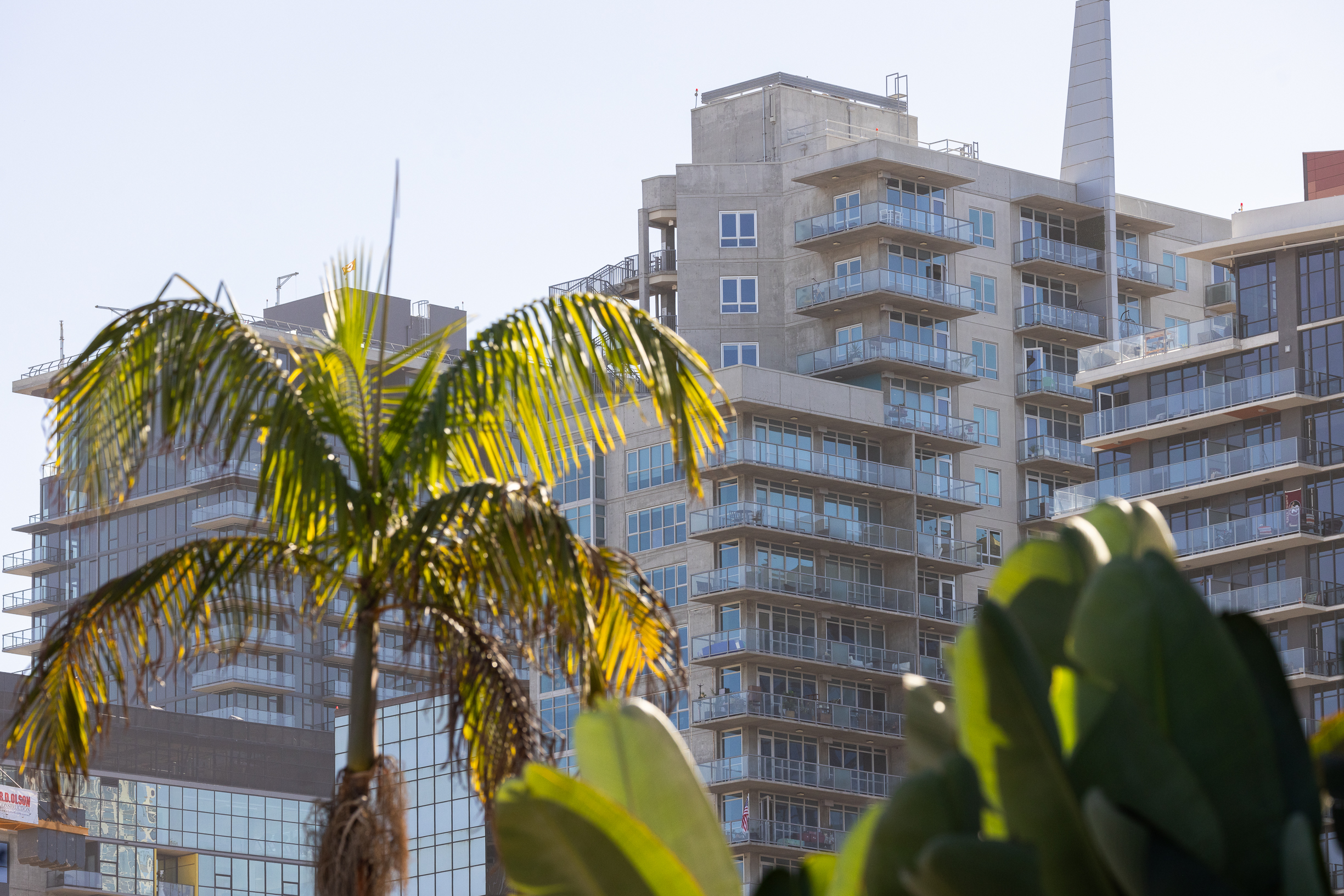

Residents of San Diego will decide on June 2 whether to approve or reject the proposed empty homes tax in a municipal special election ballot.
If passed, the tax would go into effect on Jan. 1, 2027.
The San Diego City Council voted in March to place the empty homes tax, officially called Measure A, on the June 2 ballot. The city said the tax is intended to encourage long-term leases and property sales, thereby increasing housing availability. It is also intended to raise funds for municipal services, which would be deposited into the city’s General Fund.
A March memo from the city attorney states that if passed, the bill would impose an $8,000 tax in the first year on all non-primary residences left vacant for more than 182 days, and $10,000 annually in subsequent years. Homes fitting this category owned by a corporate entity would be charged an additional $4,000 the first year and $5,000 annually in subsequent years.
The empty homes tax would be on top of real estate taxes and other homeowner expenses.
The tax would not apply to owner-occupied primary residences, long-term residential leases, and other vacant homes under certain exemptions such as military service, natural disasters, and after an owner’s death.
Concerns
Shane Harris, CEO and founder of S Harris Communications and a public advocate, who has been actively opposing the proposed legislation, called on the city government to adopt a different approach to address its fiscal challenges.
“Essentially, it is being deemed as a tax on the rich, when really the common family that may have acquired a second home, a second condo over the years, is now being affected by this,” Harris recently told Siyamak Khorrami, host of EpochTV’s “California Insider.” “It’s really an attack on home ownership.”
Harris said this legislation could affect an acquaintance who owns a home in Nevada and a condo in San Diego. Her husband recently died, but she still travels back and forth from Nevada for healthcare treatments, he said.
He said he believes that the empty homes tax would force her to sell either her primary home or the condo because the tax would be prohibitive.
According to the city attorney’s memo, some 5,140 homes in San Diego could be affected by the tax. If passed, any money collected would go into the city’s general municipal fund.
This is not a housing fund, as it can be used for whatever the city wants, Harris noted, and the amount is “not nearly enough money” to fill the hole in the budget. He said that there are no substantial data to back up the tax proposal.
Harris argued that in addition to placing financial burdens on those owning non-primary homes, the tax would also encroach on people’s privacy.
“How is the city going to check whether you are living in your home?” he said. “How is the city going to enforce that?”
“The city’s going to be spending most of the money that would come in from this for enforcement,” Harris said.
He said that it would be “a misuse of taxpayer dollars.”
The proposal would also discourage investment in non-primary homes, he said.
‘A Spending Problem’
Harris, who identifies as a Democrat, suggested that the tax is intended to address a multimillion-dollar deficit by increasing costs for homeowners, many of whom are middle-income earners.
“It’s not ... a money problem—it’s a spending problem,” Harris said. There are a lot of city departments and programs that “did not deliver,” he said.
“[If we] cut the fat, we can really strategically spend in the areas where people really care,” he said, including police, fire, and infrastructure.
In an April 15 memo, San Diego Mayor Todd Gloria released the city’s $6.4 billion budget for fiscal year 2027, citing a $118 million structural deficit.
The memo indicates several areas slated for cutbacks in 2027, including the city workforce, library and recreation center hours, capital investments, arts and cultural grants, and hiring adjustments.
Harris said he believes that the city is not going far enough to make concessions. He suggested cutting departments and programs started in recent years that “may have had sort of goodwill behind them, but did not deliver many results, such as [diversity, equity, and inclusion] programs ... launched in San Diego.”
What the government needs to realize is that the basics matter and all the extra stuff is just extra, Harris said.
“Do what families have to do every single day in this state—sit around the table and discuss where you got to make the cuts so that your wallet can work for the entire house,” he said.
Possible Legal Challenge
San Diego is not the only city considering the empty homes tax.
In 2022, San Francisco proposed a similar tax measure, called Proposition M, which sought to tax vacant apartments and other residential units between $2,500 and $20,000, depending on their square footage and how long they remained empty.
The measure was placed on the ballot and approved by voters on Nov. 8, 2022.
However, the San Francisco Superior Court struck down the tax as unconstitutional in November 2024. As a result, the city was prohibited from enforcing or administering the tax.
The court document states that Proposition M violated the takings clause of the Fifth Amendment of the U.S. Constitution, which requires the government to compensate property owners when their property is taken through government action.
The court also found that the proposal violated property owners’ “fundamental liberty interests in familial living arrangements” under the First Amended Complaint and “constitutional right to privacy under the California Constitution.”
Additionally, the court ruled that Measure M violated the Ellis Act, part of the California Government Code, which prohibits public entities from compelling property owners to rent their residential units.
Berkeley voters also approved the empty homes tax, called Measure M, in November 2022, which aims to discourage non-occupancy and speculative property investment, according to Berkeley Rent Board’s guidelines.
According to the guidelines, qualifying vacant residential units are being taxed $3,000 to $6,000 in the first calendar year and $6,000 to $12,000 in the second consecutive calendar year and each subsequent calendar year, depending on housing types.
The taxes are also facing legal challenges. The Berkeley Property Owners Association said in a November 2025 statement that it was participating in legal action against these taxes.
The group also discussed the implications of San Francisco’s legal battle over the empty homes tax for Berkeley and stated that “the legal principles at issue in San Francisco’s case will likely influence how Berkeley’s law is interpreted and enforced.”
Harris said San Diego’s empty homes tax could face litigation if passed.
“People are struggling … [and] I want to keep as much money in people’s pockets as possible,” he said. “People don’t want to pay more sales taxes. People don’t want to pay more property taxes.”
New York City and Honolulu have also proposed such tax measures.