
A group of national security policy advisers is calling for a reversal of the U.S. government’s recent decision to allow Nvidia to resume sales of an artificial intelligence (AI) chip to China.
In a July 28 letter addressed to Commerce Secretary Howard Lutnick, the group of experts and former officials urged the department to keep the export control on the H20 general processing units in place.
“The decision to ban H20 exports earlier this year was the right one,” the letter reads.
“We ask you to stand by that principle and continue blocking the sale of advanced AI chips to China as America works to maintain its technological edge.
“This is not a question of trade. It is a question of national security.”
The group warned that the H20 chip is “a potent accelerator of China’s frontier AI capabilities” and that technological development from the U.S. commercial sector will be leveraged by the Chinese Communist Party (CCP) to advance its armed forces, a strategy known as “military-civil fusion.”
“By supplying China with these chips, we are fueling the very infrastructure that will be used to modernize and expand the Chinese military,” they wrote. “The line between optimizing an online marketplace and optimizing military logistics does not exist in the Chinese system—and we should not pretend otherwise.”
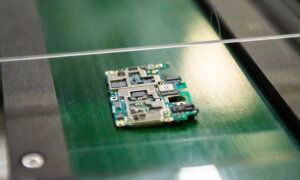
The H20 chip is specifically designed for the Chinese market, in line with the previous U.S. administration’s policy of denying the CCP’s access to high-performing AI chips. Despite having a lower core count, which results in reduced performance, the chip is still able to deliver some key AI capabilities, including in the domain of inference, the process by which a trained AI model draws conclusions from data it hasn’t encountered before.
The group said in their letter that for the inference tasks, “the H20 outperforms even the H100, an AI chip this administration has restricted access to due to its advanced capabilities.”
The Trump administration introduced new export controls that limited Nvidia’s sales of the H20 chip to China in April. According to Nvidia’s assessment, the curb could cost the company roughly $5.5 billion due to covering charges related to inventory and purchase commitments.
On July 14, Nvidia announced that it had filed applications with the U.S. government to resume the sales of its H20 chips in China and that it had been guaranteed to receive a license. Lutnick later confirmed that the resumption of H20 sales was part of a trade deal in which China would lift its ban on rare earths.
In the July 28 letter, the group expressed concerns that such a policy reversal might “embolden China to seek additional access concessions, or create similar dynamics for any one of the other 24 countries that currently require export licenses to obtain similar access to advanced H20 chips.”
The Commerce Department didn’t respond to a request for comment by publication time.
On July 30, White House national economic adviser Kevin Hassett defended the Trump administration’s decision to permit Nvidia chips to go to China, saying that it was aimed at maintaining the United States’ lead on AI.
“One of the risks that you have to take seriously is that if China’s not buying chips from us, then they’re innovating, making their own chips,” Hassett told Fox News.
“The one thing we don’t want is for them to jump ahead in the race for chips.
“You don’t want China to become the world standard for AI chips, as we have to win that horse race.
“So taking our lower-end chips and letting China have them, while our best chips are still kept for us, I think was a decision that the team made, and I think that it was a wise one.”
Andrew Thornebrooke contributed to this report.