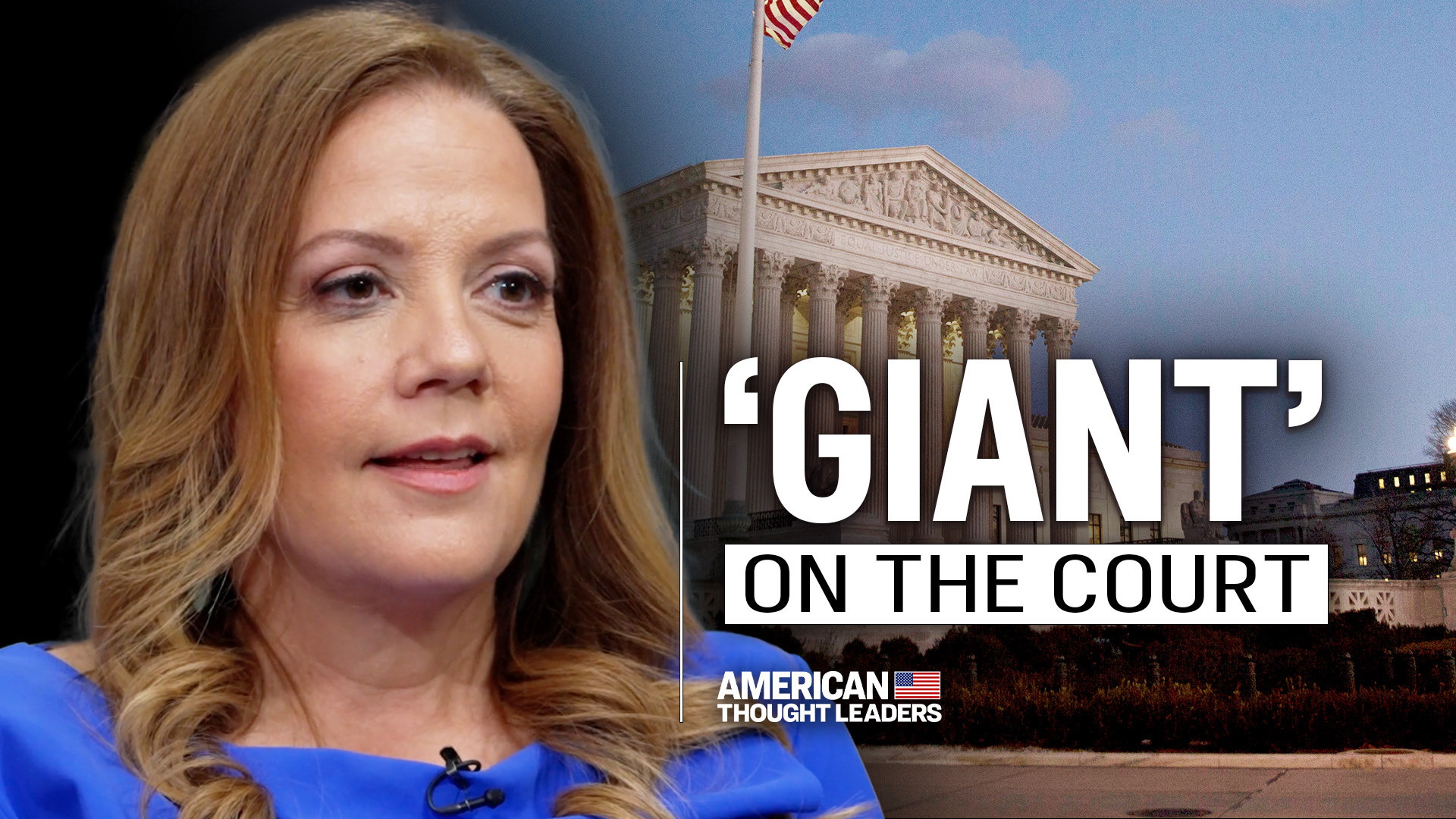

[RUSH TRANSCRIPT BELOW] Among Supreme Court justices nominated by Republican presidents in recent decades, Clarence Thomas and Antonin Scalia are cited most often by conservative commentators as influential giants on the court.
But there’s another justice who warrants equal attention, says Mollie Hemingway, editor-in-chief of The Federalist.
Justice Samuel Alito, a 20-year veteran on the court, “is behind some of the most important work that the court has done,” she says.
She recently authored the first biography on him titled “Alito: The Justice Who Reshaped the Supreme Court and Restored the Constitution.”
In particular, she details the pivotal role Alito played in undoing one of the most consequential decisions of the Supreme Court—Roe v. Wade—and returning the regulation of abortion to individual states.
For the book, Hemingway interviewed almost one hundred people who have known Alito throughout his life, including his colleagues on the court.
In our interview, she takes us behind the scenes of the Supreme Court, some of its most momentous recent decisions, and how she believes it was transformed in the last half-century by justices who had a more progressive interpretation of the law and the Constitution.
I also get her take on escalating political violence against conservative figures—from Supreme Court justices to President Donald Trump—and the recent Department of Justice 11-count indictment of the Southern Poverty Law Center.
The indictment alleges the group deceived donors and funneled money to the leaders of the very extremist groups they claimed to fight.
Views expressed in this video are opinions of the host and the guest, and do not necessarily reflect the views of The Epoch Times.
RUSH TRANSCRIPT
Jan Jekielek:
Mollie Hemingway, such a pleasure to have you on American Thought Leaders.
Mollie Hemingway:
It’s great to be here with you, Jan.
Mr. Jekielek:
So congratulations on an absolutely incredible book, Alito. I feel like I’ve learned a lot already about the Supreme Court. Before we go there, let’s talk a bit about the indictment against the Southern Poverty Law Center.
Ms. Hemingway:
Yes, I’m someone who has criticized the Southern Poverty Law Center for a very long time. This is a group that, however it got its start, and whatever good work it may have done at the beginning, in recent decades it has become this very hateful group that falsely accused its opponents, political opponents, of being bigoted and racist. They created hate maps and hate lists. Charlie Kirk was on one of their hate lists shortly before he was assassinated. They put Turning Point USA on there. The Family Research Council was on their hate map.
And someone who said he had learned about them from the Southern Poverty Law Center went to the Family Research Council and tried to commit mass murder; he was prepared, armed to the teeth. He ended up being involved. A security guard stopped him. The security guard was shot. You can still go to the Family Research Council and see where the bullet holes were in there. Yet this group was used by the media as if they had anything legitimate to say about anything at all.
So I have criticized them for a long time. This indictment stunned me about what they were actually doing. They were funding the leadership of various groups and then raising money claiming to fight those very groups whose leaders they were funding. The indictment is not for that per se, so much as that they also were involved in wire fraud and bank fraud. They set up fake companies to disguise what they were doing. And this is a very serious issue for an absolutely massive arm of the left-wing movement.
Mr. Jekielek:
The leaders are kind of the key here, right? Because these people were financing informants ostensibly, right? I mean, it is actually portrayed that way in the indictment. But tell me, okay, tell me what you’re thinking.
Ms. Hemingway:
I think that’s what the attorneys like to say. The attorneys, and they’ve got very high-powered attorneys defending them, say, oh, we’re just doing like what the FBI does. Well, that’s not true in two ways. One, you’re not allowed to do things the FBI is allowed to do, including some of their informant work.
Also, the FBI itself has a lot of problems when they get involved in informant work. Sometimes they'll say, oh, we caught this person who was about to commit a terrorist attack. And then you learn more and realize that it was the FBI informant himself or herself who was instigating the attack. So you can see why there’s a problem with informant work anyway.
But they were not paying informants. They were paying the leaders of these groups. Sometimes these groups had not a, you know, nickel to their name, and yet their leadership was being paid by the Southern Poverty Law Center. So their argument is weak, and also it has nothing to do with committing wire fraud and bank fraud, which is what the indictment is actually about.
Mr. Jekielek:
And so is there a Supreme Court dimension now transitioning into Alito here?
Ms. Hemingway:
I’m not sure, but they‘ll definitely have, I mean, they’re going to mount an absolutely massive legal defense because the Southern Poverty Law Center has a nearly billion dollar endowment. They raise over $100 million per year. So you’ll see a lot of legal battles there. Whether it reaches the Supreme Court, we'll see.
Mr. Jekielek:
The other part, you know, I’ve been thinking a lot about this dehumanizing rhetoric. You know, I was at the White House Correspondents’ Dinner, you know, I ran into Senator Deb Fischer on the ground after all this happened. And she said, you know, this is a product of the rhetoric we’ve been hearing. And I, you know, as this dehumanizing rhetoric escalates, right, and of course, you just mentioned the Southern Poverty Law Center is no stranger to, you know, pushing out this kind of thing. I’m worried about the acceleration of this in our society here and the implications.
Ms. Hemingway:
Political violence is something that happens. It’s something that can come from different groups of people. You can acknowledge that and also acknowledge that what we’re experiencing on the left with political violence is a massive crisis. It’s not just that they’re trying to kill the president and cabinet officials. They’re also going after individuals. They assassinated Charlie Kirk, the most important non-politician leader of the conservative movement.
They’re also engaged in the type of terrorism or violence that we saw as part of the BLM riots, where you had dozens of people killed. They were the most destructive riots in the country’s history. You have various anti-semitic attacks. You have just assassinations of corporate leaders. It’s a problem, not just that this is happening, but what’s happening in response to it.
You see people like The Atlantic, a publication, depicting Trump as Hitler. You see major media figures and major political leaders almost supporting and embracing this assassination prep, and then when an assassination does happen, they make light of it. It was after Trump had nearly been assassinated twice that Jimmy Kimmel is joking about Melania Trump becoming a widow, and it’s like not taken seriously at all or maybe is taken seriously but almost in an encouraging way.
Jimmy Kimmel (audio clip):
Our first lady, Melania, is here. Look at Melania, so beautiful. Mrs. Trump, you have a glow like an expectant widow.
Mr. Jekielek:
Not so long ago, people making jokes like that, I just don’t think anybody would have thought of that as okay somehow.
Ms. Hemingway:
You might remember that after President Reagan dealt with his assassination attempt at the same location as this most recent assassination attempt, Johnny Carson, who was hosting, I think, the Oscars, delayed them because it was not appropriate to have a night of celebration at a time when the president had been shot and nearly killed. And you compare that to some of the rhetoric that you’re seeing from the left after Trump was nearly killed in Butler; they developed crazy conspiracy theories about how he had done it to himself. Remember that Corey Comperatore died, and was murdered there by Trump’s attempted assassin.
And a recent poll showed that nearly half of Democrat voters are conspiracy theorists about these Trump assassinations. Even the guy who tried to kill him at the White House Correspondents’ Dinner thought the previous attempts were hoaxes. Even as he’s trying to do it himself, there are levels of delusion happening among some quarters of society that are not healthy. How do we come back from that? Well, probably through the same hard work that got us in the bad place, by the hard work of the left. They took on the education environment, destroyed critical thinking, and taught people to hate their country, to hate institutions.
Think about someone who is the age of this most recent attempted assassin. I think he was 31. So, for the last 10 years, you’ve had a completely corrupt media that has lied about everything, falsely accused Donald Trump of being a traitor who stole the 2016 election by colluding with Russia. You had all the COVID hysteria, which had so much disinformation and misinformation from the government. You’ve had all sorts of breakdowns in just dealing with reality from the media.
But prior to the last 10 years, that person who tried to kill Trump most recently was probably educated in an environment that taught him to hate his country, hate a lot of traditional values, and it’s a problem. On the media front, I do think that people continue to give corrupt media way too much power. Donald Trump did not attend what I think was a horrible dinner, the White House Correspondents’ Dinner, during his first term. The dinner was like dying on a vine.
Mr. Jekielek:
It was the first time as president that he attended.
Ms. Hemingway:
And then he grants them this wonderful gift of treating them as legitimate, even with all the lies that they’ve told and all of the water carrying they’ve done for corrupt government organizations. I mean, they just act as a filter for some of the worst bureaucrats. Oh, you said this? I'll print it with no skepticism. And they do it over and over again. What does Trump do after surviving yet another assassination attempt? He goes on, what was it, CBS?
Mr. Jekielek:
60 Minutes.
Ms. Hemingway:
60 Minutes? 60 Minutes manipulates videos. It deceptively edits videos. Why would you treat them like anything other than the completely hostile actor that they are? And until people, it’s hard to take people seriously with their complaints about the corrupt media when they’re also continuing to watch it, read it, give interviews, or in any way treat them as legitimate actors?
Mr. Jekielek:
You know, there’s a challenge here. I mean, I’m thinking about these sorts of questions a lot myself. And, you know, a number of these media, for example, The New York Times, they have this halo around them of maybe historical credibility. I don’t know exactly what it is, but, you know, it’s powerful, right? And people are aware of that. And so you kind of, I imagine, you know, people hope they can have a piece of that halo or that glow, right? I don’t know exactly, right?
Ms. Hemingway:
I don’t know. I mean, they’ve been so bad for so long. How many decades? It’s one thing, you know, the first Republican president to complain about the media was Dwight Eisenhower. By the time you get to Reagan, it’s a known fact; they’re really bad. George H.W. Bush had a bumper sticker that was his most, he loved it, that they would give out at his rallies that said, annoy the media, reelect Bush. After decades of complaining about it, but still acting like they are worthy of your time and energy and that you should care what they have to say, it’s kind of on you. And these people really do damage.
How did that half of the Democrat Party believe that these assassination attempts are hoaxes? They hear it on MSNBC and CNN from their other top officials and leaders. They were treated like they were moderates, that they were in between, that they were moderating things. And so they would be given the privilege of, for instance, moderating a debate. Okay, you can understand that in the 50s and 60s, maybe the 70s, or I guess in the 80s. It’s now 2026. You still have the Republican Party asking some of these crazy Left-wing people who are activists to moderate debates with their real Democrat opponents. It’s just absurd at some point.
Mr. Jekielek:
Okay, but we’re going to get to Alito momentarily. But I do have one more question for you because this is something that we struggle with at The Epoch Times, right? The question is simply that, you know, there’s a whole lot of people, and I think this might be a part of the answer to your question, the question you just posed. There’s a whole lot of people that listen to those media, and those people also deserve to have better information. I can’t feel good about writing off everyone just because people have chosen to believe media that engage in a lot of, you know, bad reporting. I still want to reach them, right, with good reporting.
Ms. Hemingway:
That is absolutely fair. I mean, even just to try to reach the audience of the New York Times reader, that’s a difficult audience in terms of how open-minded they are, but it’s still one worth reaching. I think that you have to have skills at the level of a Donald Trump or a Scott Bessent to go in there. If you understand that you’re not just having a debate with an opponent, but your most hostile and most rabid opponent, if you understand that they are propaganda and then you go into it, I think that’s one thing. If you’re just treating them like you still have this 1960s view of what the media are, that’s where you’re going to get in trouble.
Mr. Jekielek:
All right. Well, maybe we'll solve this problem together another day. I really want to talk about the book. Why Alito?
Ms. Hemingway:
So I'd previously co-authored a book on the Supreme Court with Carrie Severino, who’s just wonderful. And we interviewed nearly 100 people for that book. One of the things that people kept saying that stuck with me, including some of Alito’s colleagues on the court, was that it was really weird that nobody talks about Alito, given what a giant he is on the court. So we have tons of books about literally every other justice, including the ones that got there like yesterday.
But we don’t have anything on Alito. He’s been there 20 years and is behind some of the most important work that the court has done. So almost immediately when I heard that, I thought, well, there should be something on him. And he only became more interesting in the intervening years. He authored the Dobbs decision, which was this big goal of the entire conservative legal movement for 50 years to overturn the very flawed Roe v. Wade decision. But it never happened because people lacked the courage or just things would fall apart under pressure. He did that.
Even just recently, he has this other monster opinion saying that racist gerrymandered districts are unconstitutional, and it also relies heavily on how the statute was wrongly interpreted over the years. These are just really big, important decisions that affect the country, and I wanted to learn more about him, and I am really happy that I did. I’m also happy that other people want to learn more about him.
Mr. Jekielek:
So, you know, one of the themes that, at least through the first four chapters—because this is as far as I’ve gotten—that appears there is this idea that there’s precedent, there’s legal precedent. Once decisions are made, they tend to be carried out. But then there’s this, I guess, this juxtaposition where some of those precedents turn out to be incorrect, and how do you actually, when there is an incorrect view of the Constitution that’s been promulgated for whatever reason, even over several decisions, how do you challenge that, right? So, I mean, this seems like kind of a centerpiece, in a way, of what your book is about.
Ms. Hemingway:
And one of the things I try to do in exploring who Alito is and what his jurisprudence is, interspersed with all the fun behind-the-scenes stories of what’s happening—what’s really happening on the court—is to give that historical perspective as well. And a lot of people, you know, they kind of know the court is in maybe better shape than it was for a while. But what happened? Well, you had progressives who were dominant in the early part of the previous century, Woodrow Wilson, FDR. They really pushed for a court that would allow radical things to happen in the federal government.
And FDR succeeds with that. He replaces everybody on the court. And for decades, it just becomes this place where it’s more ruled by men than by law. People would—you'd have justices openly say, like, I just vote the way I think things should be. Or, you know, the only rule I care about is the rule of five. Or, the Constitution, I don’t care what it meant when it was created; I care what I think about it now. And they were very open about it. And there were a lot of really bad decisions where the court would say, we don’t like the way people are voting, so we’re just going to impose it upon them. That’s not what the founders imagined for the court.
The conservative legal movement got going in the 70s and really took off in the 1980s. And you start seeing what are called originalist judges. These are people who do care about the original meaning of the Constitution and how to understand the Constitution that way. They also have very logical approaches to the statutes. You know, 75 percent of the cases before the court don’t deal with the Constitution but with federal statutes, with federal laws. How do you interpret those? And we now have an originalist majority. But one of the things that’s interesting about Alito is that he’s one of the five who cares about the original meaning of the Constitution. He does have a lot of respect for precedent. He does view that as something that is part of a respect for the rule of law. But he’s also willing to overrule precedent when it’s deeply flawed.
Mr. Jekielek:
What would you say is the, I don’t know, most provocative thing you learned about Alito in your research?
Ms. Hemingway:
Alito himself is not provocative. I interviewed, again, nearly 100 people. These are people who have known him throughout his life, his colleagues on the court. He’s a remarkably consistent, conservative, and reserved person. I would say his sense of humor—I don’t think I really realized that as much. And then also the trouble he’s gotten into for his facial expressions, I think, is funny. He used to debate when he was a kid; he was a debate champion. He would sometimes get marked down for his facial expressions, but he would also get in trouble as an adult in this way.
So, at the State of the Union in 2010, President Obama said something that everybody agreed was false. He falsely characterized a recent court decision. And Sam Alito is sitting there at the State of the Union and mouths the words, simply not true. The cameras caught him. He got in a lot of trouble for that. Or sometimes he'll roll his eyes, apparently, at a colleague. But far and away, the most explosive stuff I found was about what happened as part of that Dobbs leak.
Mr. Jekielek:
As someone who’s kind of new—relatively new—to watching all of this unfold, a D.C. neophyte of sorts, right, I guess at the time that this whole court case was happening, it was still fairly new in D.C., and I mean it was war.
Ms. Hemingway:
It was unbelievable. I mean the moment that it leaked, the justices did know a few days prior that it was going to be published by Politico, but when it leaked, you had immediate protests at the Supreme Court. You also had immediate protests at the homes of the Supreme Court justices themselves, if they were part of that Dobbs majority. And people were celebrating whoever leaked this. They thought it was great that the justices’ lives were being threatened. You had justices having to be moved to secure locations. They had to wear bulletproof vests. There were churches and pro-life centers that were firebombed or otherwise attacked. It was a very bad situation.
And to make it worse, you had the Department of Justice and Merrick Garland doing nothing, even though it’s against the law, to protest at a federal judge’s house to get him or her to change their opinion. And that’s obviously what was being done. You even had an assassin show up on Brett Kavanaugh’s street. He was arrested and later convicted for trying to kill Brett Kavanaugh and at least two other justices.
And in my book, Alito, I show how the liberal justices actually slow-walked their dissent to prevent the Dobbs decision from being officially released. A decision isn’t final at the Supreme Court until it’s publicly released. And to be publicly released, you have the majority opinion, but then you have any dissent or concurring opinions, anything like that, or arguments that also come out at the same time. So by not getting their dissent done, the liberal justices were able to keep those justices under constant pressure for nearly two months. And I have all the details, and they’ve never before been reported, and it’s really shocking behavior, I think.
Mr. Jekielek:
For those who are uninitiated, okay, why is this particular issue so charged?
Ms. Hemingway:
It’s another story I get into in the book, sort of the history of how abortion has been handled by the court. In some ways, the issue is really charged. I mean, first of all, it’s dealing with life and death. It’s dealing with what you think about whether children in the womb, with their lives, should be protected, whether abortion is good for the mothers or bad. These are really important issues that get at the heart of what you think it means to be human. What does it mean to have human dignity? What are the responsibilities of government?
But what the court did in 1973 is write what many people consider to be one of the top two to five worst decisions the court ever issued. And they said, we are going to claim that there is a hidden right to abortion that the founders put in the Constitution. It’s patently and obviously not true, but they said it, and they just asserted it, and they took away from the people the right to debate what abortion policy should be.
And for 50 years, people complained, we would like to debate this issue, or we would like to protect children at this stage of gestation, or we would like to ban this particularly barbaric practice of how to end an unborn child’s life. But they weren’t allowed to because the Supreme Court said that they had somehow located a secret place where abortion was in the Constitution. And then every time, everyone knew it wasn’t true. Liberals knew it. Conservatives knew it.
Mr. Jekielek:
But I don’t think that a lot of the public who would be opposed to ending Roe v. Wade knew it. Does that make sense?
Ms. Hemingway:
I don’t know. I mean, I think the issue was that I want to say that even liberals acknowledged at the time. They would say, I actually do support abortion. I don’t think this decision does an even halfway good job of pretending to be law. And so Ruth Bader Ginsburg, who’s a lioness on the court, herself criticized the Roe v. Wade decision on those same grounds. She thought it should be that the people were deciding their policy and that this took it away from the people. But people really like abortion. Some people like that this enables a certain treatment of sex that more aligns with their values.
And so they would fight it at all costs, even though if they were being honest, they would know it’s not the best law here. And so every Supreme Court confirmation became a battle over that issue. And any time the court came close to overturning Roe v. Wade, there would be this massive public pressure campaign that the justices would crater under.
In 1992, there was a really good case called Planned Parenthood v. Casey. Everyone expected this would finally overturn Roe v. Wade. Three Republican-appointed justices, Sandra Day O'Connor, Anthony Kennedy, and David Souter formed a troika, as they called themselves, to save Roe v. Wade. They said, okay, we all know it wasn’t hidden where the court said it was hidden, but we found this other place that it’s hidden, and it’s a better place for it to be hidden, and now you all have to stop fighting about it.
Well, if you paid attention to abortion politics since 1992, nobody stopped fighting about it. Everybody still wanted the chance to debate and discuss and have their legislatures set policy, and finally, it happened four years ago. Is this the end of it? Well, there were so many cases that were being brought to the Supreme Court to deal with abortion. You know, what Alito did in his Dobbs opinion is called a landmark decision. It is exhaustive. It goes through everything to show that, in fact, the founders did not think that there was a hidden right to abortion somewhere in what they had framed.
The framers of the 14th Amendment certainly didn’t think that. The laws at the time did not support this. Nothing about the history or natural law supports this. So it’s an exhaustive opinion. I’m sure there will still be challenges because legislatures will decide different things, and then people will take it to task. But it certainly is at least going to be on the basis of logic and law as opposed to what Roe v. Wade was, which was just kind of the opinions of seven guys on the, however many people on the Supreme Court there.
Mr. Jekielek:
We’ve seen quite significant activity in the Supreme Court, you know, since this originalist majority was created. Which are the most significant in your mind? Well, other than Dobbs, obviously.
Ms. Hemingway:
So the court had, for so many decades, a majority that was not originalist. We’ve only seen the Supreme Court have an originalist majority since 2020, when Amy Coney Barrett replaced Ruth Bader Ginsburg. And so one of the things I do in the book is look into how the five originalists differ from each other. But they’ve already done really important work. You know, a lot of times, people will criticize different justices. And one of the people who gets a lot of criticism would be Chief Justice John Roberts.
They think that because he did a bad job with some previous decisions, or he‘ll sometimes, you know, like maybe to settle an issue, he should just say what’s what, and he’ll go a third of the way. And, you know, he thinks that will be a better approach. He gets a lot of complaints from people. His Obamacare decision in particular outraged many Americans. But one of his big successes in recent years has been ending racism and saying that affirmative action programs, because they’re racist, are unconstitutional.
There was a case brought against colleges on behalf of Asian American students who were being discriminated against. That was one of Chief Justice John Roberts’ big victories. Clarence Thomas, when he joined the court in 1990, had these opinions that seemed very different from almost everybody else about how gun rights are an individual right. Well, now that is what the court has held, and he has worked on that throughout the years. Justice Alito’s big history, obviously, he'll be remembered for Dobbs.
He will also now be remembered for ruling that racist gerrymandering is unconstitutional. That’s a huge opinion. And to have a guy with so many huge opinions is somewhat rare. He also authored the Hobby Lobby decision, which protected the religious rights of family-owned corporations. Religious liberty is a big issue, not just for Alito, but for this originalist majority. And Alito has really tried to correct a lot of problems that we saw with the court with how they were marginalizing minority religious figures or not protecting their religious rights.
Mr. Jekielek:
Yes, I’ve been thinking a lot about the First Amendment lately. In a whole suite of contexts, even in my own book that I wrote recently, it’s made me think a lot more about what it means when basic, your core protection from government, the right to believe what you want to, not have someone coerce you in that way, how central that is actually to this free form of government that we practice here?
Ms. Hemingway:
It’s so interesting what is included in the First Amendment and what it’s really getting at. So we have freedom of speech. We have freedom of the press. We have the most important first freedom, freedom of religion. We have the right to peaceably assemble and seek redress from the government for our grievances. All of these things are about really seeking truth, having the right and the ability to seek out the truth. You cannot do that without free and open debate.
And you look at what some people have been doing recently to that free and open debate with censorship, with lawfare, with attempts to shut down voices that say things they don’t want said. You see it; you know to see it in authoritarian regimes throughout the world, but you’re also seeing it in our country at times and also through our corporations working with the government. And talk about a founding principle; it’s all there in the First Amendment.
Mr. Jekielek:
One of you, you do look at Murthy v. Missouri a bit in those first four chapters somewhere, I know, because that was one case that I followed very closely.
Ms. Hemingway:
It was frustrating for people who were censored, who were dealing with that censorship. And the way Alito handled that, I think, also shows how he is different from some of his colleagues. So with these cases, you had social media companies censoring Americans frequently at the behest of the federal government. Or they were dealing with state laws, which were saying, you can’t censor people; you’re violating their rights. Well, the court had sort of a tissue-thin unanimity on the issue or said that things needed to be settled at a lower court level.
But one of the things in one of these free speech cases was that a bunch of the justices decided that if social media companies set algorithms, that’s just like an editor of a newspaper deciding which stories get featured. And so they have free press rights, and that’s all you have to think about it. And Alito didn’t say he disagreed necessarily, but he thought they should actually look at it, look at the issues underlying that.
Is that true? How is an algorithm set up? What are the factors that go into the algorithm? How much of it is human? Is it really the same thing that Facebook’s algorithm is like the Des Moines Register’s editorial decisions? Or should they analyze it more? He likes to look at the facts of the case. Most of his colleagues like to look at a very high theoretical level. Well, I like free speech, and that seems like free speech, so we'll just leave it at that. He wants to dig in more.
Mr. Jekielek:
What do you hope people will learn here?
Ms. Hemingway:
So one of the things that concerns me about our current moment is that people seem to be picking these extreme sides; even in the conservative movement, you'll see people say, well, the only thing that matters is that you have a set philosophy, and people who want to have political wins are doing it at the expense of this philosophy that we hold. And then you do have people who don’t really care about the philosophy at all; they just want to win.
And I think with Alito, he is this model. He is clearly the most conservative Supreme Court justice. There are many libertarians on the court historically and now. But as far as an actual conservative, Alito is the conservative on the court. And he shows that you can retain, can and should have your strong philosophical position. But you should also think about how it’s helping people and how to apply the principles that you so dearly hold so that they do help people. He’s much more practical, and that’s a good thing, I think, people should follow.
Mr. Jekielek:
Okay, that’s a fascinating distinction because it’s not, I mean, it’s also hard to apply, isn’t it?
Ms. Hemingway:
We all have challenges with this, but we, you know, we shouldn’t see these things as being in conflict, and we should be motivated by strong principles. And, you know, the 250th anniversary of America, we have all these founding principles, which really do help explain why we are different as a people. And we have not seen them applied perfectly in the last hundred years or so. And so to fight for that is important.
And Alito does see this as a fight for the country. He knows the country. He knows that the country has made some decisions that put it in a weaker position. And he thinks that people should accept the reality of that and do what it takes to fix it.
Mr. Jekielek:
What’s the most compelling argument for you in your mind for why we should be originalist? Because, I mean, I can tell you like the idea of originalism on the Supreme Court. At least that’s the sense I get. Correct me if I’m wrong. What is the most compelling way to explain why that should be the case, aside from just maintaining tradition?
Ms. Hemingway:
I think that in many ways, these people have won the argument. The originalists have won the argument. They have made the case that the Constitution is the document that we are bound by, that we’ve all accepted, that we all support. It’s not tons of different opinions in this country, but that’s our country’s framing document. And they are making logical sense that because of when we signed on to it, we have to go with the meaning of the words at the time that the document was signed. It’s just a very clean, natural, logical argument.
Now, I do think that sometimes you can take so much into that that you don’t think about the qualities of a judge being important also. Look throughout history, we’ve always had judges to settle difficult disputes. And judges do need to be men and women of a certain caliber, a certain disposition. They need to be able to analyze things thoughtfully and at a high level.
And I think that sometimes people who care so much about originalism, they also need to consider this aspect as well. To remember the importance of judicial temperament. And a judge who thinks about how the whole point of law is to have an ordered society, which means you do care about the societal implications of what you’re handing down.
Mr. Jekielek:
The Supreme Court justices are supposed to focus on the law, not on the politics, not on the pressure campaigns and all that stuff. But when there is a threat that the Supreme Court could be packed or, you know, go by the wayside or whatever, is that something they should also be thinking about?
Ms. Hemingway:
I think the big problem is anytime a justice tries to be a politician, they just fail. They’re very bad at being politicians, and the way to preserve the integrity of the court is just by being a court, not being a political entity. So when you let the media or other Left-wing activists try to shape what your decision is going to be, and then it affects things, the big lesson that the media and other Left-wing activists take from that is, oh, that guy can be pressured. We'll do it again.
If you say, let the chips fall where they may, I have to do what the law states, and I have to make a fair decision here, then they realize that they’re not going to be able to bully you as much. Now, you will definitely face a lot of pressure. Justices Thomas and Alito have faced unbelievable pressure against them, their spouses, their family members. So you have to be willing to withstand that. But I think everyone knows you’re not going to sway them through pressure campaigns. And that’s actually a good place for them to be.
Mr. Jekielek:
So yes, let justice be done, though the heavens fall.
Ms. Hemingway:
Yes, that’s actually on a plaque in Justice Alito’s chambers. It was something that he got from the judge he clerked for, Garth, on the Third Circuit. And it comes from, you know, it actually has quite a history of referring to how judges should operate, even if you have braying mobs outside, you know, telling you that you have to rule one way or the other, you have to let justice fall. You have to be able to withstand the pressure. Alito has clearly done that. It’s almost remarkable to have a man like that in the country who’s got not just the moral courage, but the physical courage to take on Roe v. Wade, which, again, everyone in the conservative legal movement knew it had to be overturned, and yet it still kept on not happening.
With Justice Thomas, I tell the details in the Alito book about how he came to give that opinion to Alito to write and why Alito was the person he chose to write it. Because each justice has their different strengths, and one of Justice Alito’s strengths, as we saw again with the Voting Rights Act decision that just came out, which is major, is that he keeps a majority together. He might personally be willing to go farther than the majority would go, but he knows how to write something that is strong and compelling and keeps a majority together. It’s an important skill that also speaks to the pragmatism that we all should try to emulate and to prudence in our day-to-day lives.
Mr. Jekielek:
It’s fascinating. I mean, this kind of juxtaposition of being both principled and pragmatic, and again, you know, how to find the right balance for that. I suppose that’s a life project.
Ms. Hemingway:
It certainly helps that he was raised in a certain way and learned how to be prudential, particularly from his father, who was a career civil servant.
Mr. Jekielek:
Right. You were saying, like just aggressively nonpartisan sort of thing, right, yes.
Ms. Hemingway:
But his own family did not know where he stood politically because he was serving both Republicans and Democrats in the New Jersey legislature. He had to handle redistricting, which is an interesting aspect of this recent case that came down, but that heavily influenced Alito. And I think it also tells us we should raise our kids so that we inculcate in them these values.
Mr. Jekielek:
And I don’t think, I don’t think you used the word necessarily. Maybe you will. But you get this strong sense of humility from him from the reading of your book.
Ms. Hemingway:
You know this since you’ve been in D.C. long enough, that there are a lot of people who love to be the center of attention. The higher position they are, the more they love just having that vortex that comes into them and hangs on every word. A lot of justices are like that, or, you know, some of the justices are like that. Justice Thomas and Justice Alito are the opposite. They would so much rather talk to a normal person, hear what they have to say, than to be waited upon and have everybody paying attention to them. And I like that humility. I like people who are able to speak with Americans and aren’t just existing in elite circles.
Mr. Jekielek:
So how can people get the book?
Ms. Hemingway:
Anywhere books are sold, Alito, it’s out now and I loved writing it. I also recorded the audiobook. So you can get it as an audiobook, Kindle, or hardcover. I don’t care, whichever way. But I really hope people do understand, you know, there are these giants on the court. We know so much about Thomas. We know so much about Scalia, who died in 2016. But here’s this guy about whom we know almost nothing. And so I hope people enjoy learning about him as much as I enjoyed writing about Alito.
Mr. Jekielek:
Well, you’ve got one enjoying reader right here. Mollie Hemingway, it’s such a pleasure to have had you on.
Ms. Hemingway:
Thank you, Jan.
This interview has been partially edited for clarity and brevity.