
The potential benefits of methylene blue are as wide and diverse as the deep blue ocean—and some of its promoted health benefits may seem too good to be true.
Initially used as a textile dye in the 1800s, methylene blue was later used as an antiseptic, then to treat malaria and gonorrhea. Today, the U.S. Food and Drug Administration (FDA) has approved it to treat malaria, urinary tract infections, and a blood disorder called methemoglobinemia, and to dye surgical stains.
However, methylene blue has potent antimicrobial, antiparasitic, and antiviral properties, and some early studies suggest it may reverse the signs of aging skin, treat neurodegenerative diseases such as Alzheimer’s and Parkinson’s, and even fight some cancers.
Methylene Blue and Mitochondria
Mitochondria are often referred to as the “powerhouse of the cell. They are specialized, energy-producing structures found inside nearly every cell in the human body. Besides producing about 90 percent of the energy the body needs to function, mitochondria play a crucial role in cellular communication. They provide the building blocks for our genetic material and control the cell life cycle by determining which cells are healthy enough to survive and reproduce and which should be flagged for destruction and cleared away. High-functioning, healthy mitochondria are imperative for both physical and mental well-being.
Unfortunately, mitochondria are also vulnerable. They can become depleted and dysfunctional from inflammation, infection, and aging. When mitochondria become dysfunctional, they produce less energy to fuel the body’s cells.
Methylene blue works by interacting directly with the mitochondria. Its antioxidant properties can scavenge and neutralize harmful free radicals produced as mitochondria create cellular energy known as adenosine triphosphate (ATP). Methylene blue also has a unique property that allows it to cycle electrons, meaning it can accept and donate electrons. This property is important because it ultimately reduces damage to cells by reducing oxidation and free radicals.
Researchers hypothesize based on 2D and 3D modeling that methylene blue can help with many conditions related to mitochondrial dysfunction, including aging skin. Unlike other antioxidants such as vitamins C, E, and curcumin, methylene blue is fat-soluble and can cross the blood-brain barrier. Researchers have found that mitochondrial dysfunction can lead to inflammation in the brain or spinal cord and oxidative stress, and thus, they believe methylene blue could be a viable treatment for some neurodegenerative diseases.
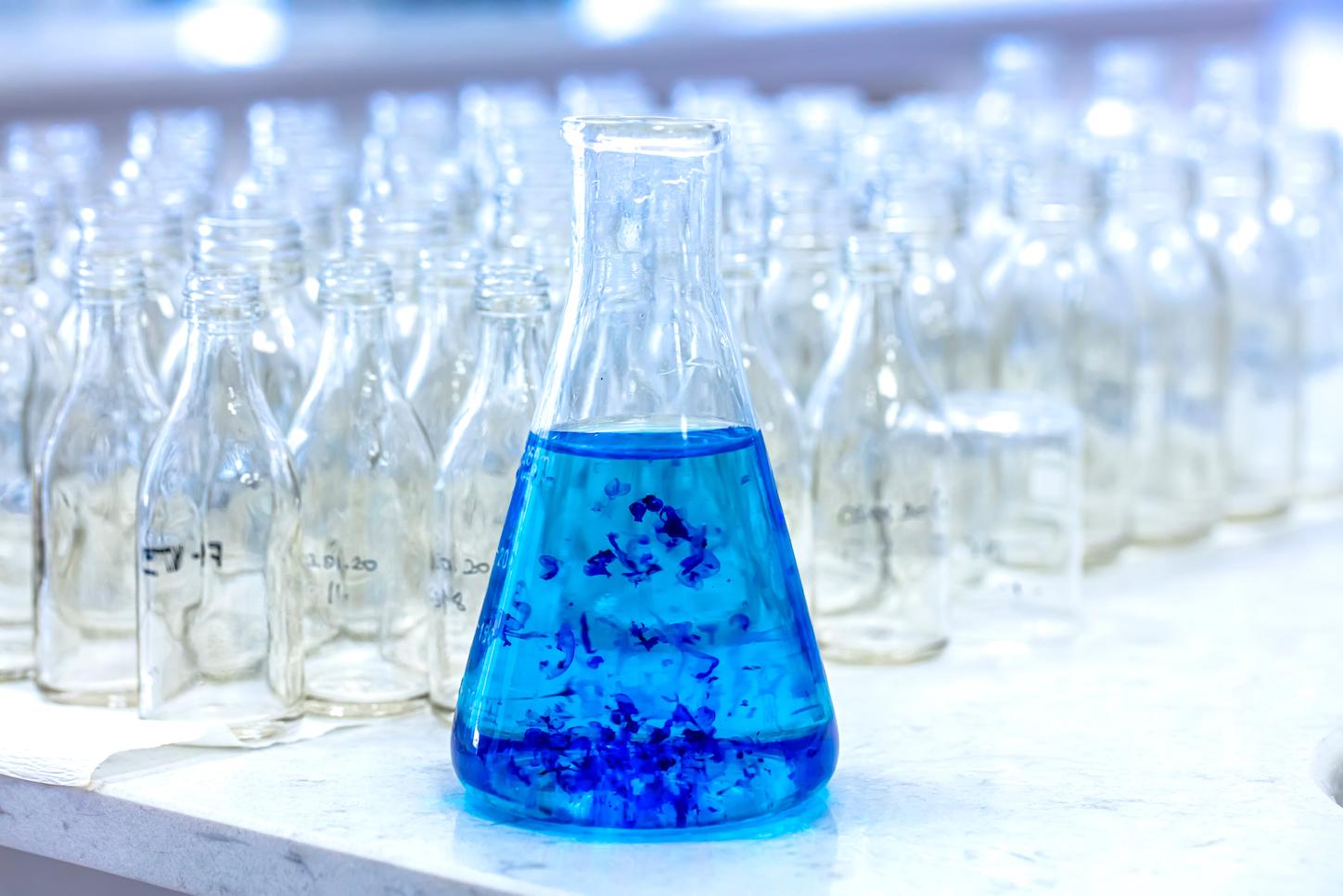
Methylene blue. (Mehmet Cetin/Shutterstock)
Mitochondrial-Specific Antioxidants Improve Skin Cell Aging
Antioxidants are well known to protect skin and slow aging.
According to a provisional study from the University of Maryland published in the journal Scientific Reports, methylene blue was better and safer than mitochondrial-specific antioxidants in reducing mitochondrial dysfunction and promoting new cell generation.
Researchers tested methylene blue using skin cells from healthy middle-aged donors and those diagnosed with a rare genetic disease, progeria, that causes children to age rapidly. Methylene blue outperformed three other antioxidants and improved age-related symptoms in the cells of both progeria patients and healthy donors.
Over the four-week treatment, skin cells treated with methylene blue had lower cellular damage due to oxidative stress, a reduced rate of cell death, and increased cell division. According to the researchers, the methylene blue stimulated mitochondrial health and addressed the root cause of skin aging.
“Our work suggests that methylene blue could be a powerful antioxidant for use in skin care products,” Kan Cao, senior study author and associate professor of cell biology and molecular genetics at the University of Maryland, said in a news release.
Not long after the study was published, Cao launched a line of skin care products based on the research. “Human aging is deeply connected to the function of the mitochondria and our cellular reproduction,” she said in a different press statement. “In fact, mitochondrial mutations [are associated] with many age-related diseases.”
While there is excitement about its anti-aging prospects, no long-term testing in humans has been done. Because it’s not regulated by the FDA, no standards have been set for topical use.
Brain Aging and Neurological Diseases
Methylene blue has been studied for its effects on the brain because of its ability to increase ATP in the brain and lower the concentration of free radicals.
The brain has approximately 86 billion neurons, and each neuron has as many as 2 million mitochondria. Since methylene blue can cross through the blood-brain barrier and reroute electrons, it may reduce brain aging by improving mitochondrial function.
Mitochondrial dysfunction, oxidative damage, and neuroinflammation are all hallmarks of brain aging and are linked to brain diseases such as Alzheimer’s, Parkinson’, and even traumatic brain injuries.
Alzheimer’s disease, one of the most common forms of dementia, involves abnormal protein accumulation that forms plaque around brain cells. Inflammation and oxidative stress are prime contributors to the disease.
A study published in the Journal of Alzheimer’s Disease reported unexpected results after scientists gave over 1,000 mild-to-moderate Alzheimer’s patients hydromethylthionine, a reduced form of methylene blue that improves absorption. Even at the lowest dose, hydromethylthionine produced “meaningful reductions” in cognitive decline and brain atrophy.
Another study published in The Journal of Prevention of Alzheimer’s Disease found that hydromethylthionine significantly slowed cognitive decline and brain atrophy compared to a placebo.
Dr. David Epstein, an osteopathic doctor and functional medical practitioner, uses methylene blue regularly for various neurologic problems, including dysautonomia, which is a disorder in the autonomic nervous system
“Patients with dysautonomia have various issues that relate to the regulation of the autonomic nervous system, including a racing heart when they sit up too quickly or food that won’t digest, even breathing becomes irregular,” he told the Epoch Times. “Methylene blue, which has this property of mitochondrial enhancement, has been remarkable for these patients.”
Additional Research
While methylene blue has been touted for multiple ailments, the research for most of its uses is still young.
During the COVID-19 pandemic, methylene blue was looked at as a viable COVID-19 treatment protocol. The interest stemmed from a clinical trial showing significant improvement in oxygen saturation and respiratory distress in COVID-19 patients with low blood oxygen, resulting in shorter hospital stays and lower mortality. That study included 80 hospitalized patients.
A later study of 376 COVID-19 patients found that treatment with methylene blue didn’t prevent the virus from worsening or reduce the amount of virus in the body.
Methylene blue has also been shown in preclinical trials to have anti-cancer effects on breast and prostate cancer cells, however, no human trials have yet confirmed its effectiveness.
What it has been confirmed to help is mapping out cancer that has spread from a tumor to a nearby lymph node and for diagnostic imaging.
Risks and Side Effects
Methylene blue should be taken under a doctor’s supervision, even though some forms are available without a prescription.
Besides more benign side effects like a blue tongue and blue urine, there are certain risks when taking methylene blue, especially in higher dosages.
Methylene blue is not advised for the following individuals:
Those taking any drug with serotonergic activity, such as SSRIs, SNRIs, MAOIs, or TCAs, due to possible serotonin syndrome, which is potentially fatal.
Those with glucose-6-phosphate dehydrogenase deficiency (G6PD), which could lead to severe anemia.
Women who are pregnant, breastfeeding, or who may become pregnant. The FDA has assigned it a pregnancy class X rating.
Those with known hypersensitivity to methylene blue or any thiazine dye.
Those with hepatic impairment, since methylene blue is extensively metabolized in the liver.
People with renal impairment.