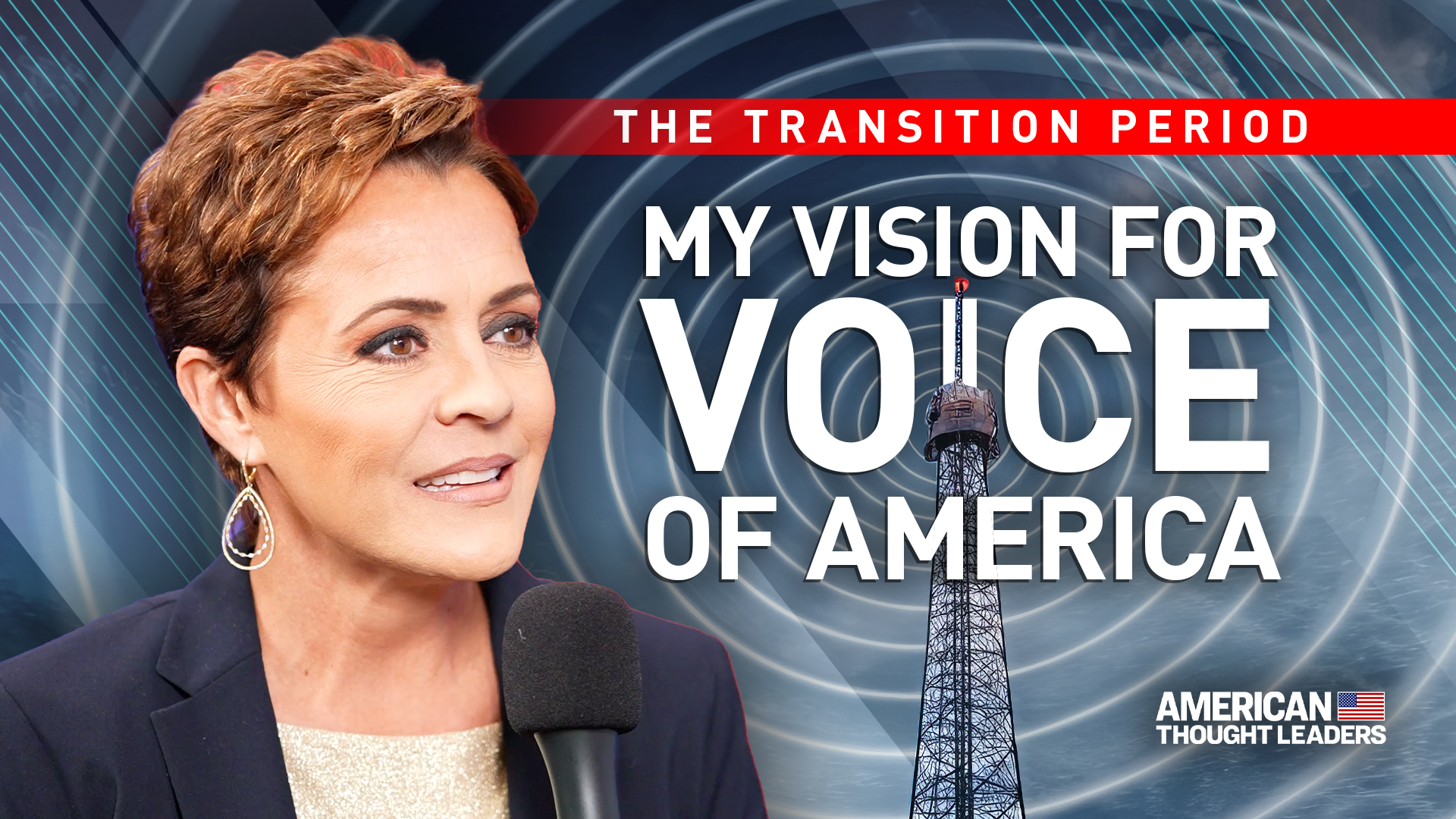
[RUSH TRANSCRIPT BELOW] At Turning Point USA’s AmFest conference in Phoenix, I sat down with former TV anchor Kari Lake, President-elect Donald Trump’s pick to head Voice of America (VOA).
VOA is an international broadcaster funded by Congress that releases content in nearly 50 languages to more than 300 million people weekly around the globe.
It was founded in 1942 to combat Nazi propaganda and share the “policies of the United States clearly and effectively.” VOA later played a major role in the ideological fight against communism during the Cold War.
The director of Voice of America is officially nominated by the head of the U.S. Agency for Global Media. After Senate approval, the candidate must also be approved by a majority vote of the International Broadcasting Advisory Board.
What would Voice of America look like under Kari Lake?
Views expressed in this video are opinions of the host and the guest and do not necessarily reflect the views of The Epoch Times.
RUSH TRANSCRIPT
Jan Jekielek:
Kari Lake, so good to have you back on American Thought Leaders.
Kari Lake:
I’m happy to be here. I’ve loved your work. This is such an important show, and I’ve enjoyed the interviews you do, so I’m honored to be here.
Mr. Jekielek:
You’ve said that Voice of America [VOA], which is your new nomination by President Trump, is going to become a nightmare for fake news, if I recall that correctly.
Ms. Lake:
I would like to make sure that Voice of America is doing an exemplary job telling the story of America to the world. And I’ve seen some really great pieces that I’ve been looking at in the last few days that have come out of VOA. And I want to make sure that we’re doing all really top-notch journalism. And I believe that we will be doing that.
I want to go in and improve it and make sure that the product is more compelling so that it’s actually reaching more people around the globe. We can change hearts and minds around the globe, bring information and journalism to people in countries that don’t have access to a free press. And we should be telling a true story of what America is and make sure that we’re not doing it in a biased fashion, but in a way that is fair and accurate. That’s all we want.
I love President Trump, because as a mother and a citizen of Arizona, I’ve seen what he did to make our state safer, to make our families safer. And so that’s why I love him. I think his policies are great. But somebody said to me, you’re just going to turn it into Trump TV. No, that’s not what I want. I don’t believe that’s what President Trump wants. I don’t think the American people want that. But what we do want is to be able to tune in, or we want the world to be tuning in and getting a fair and accurate portrayal of this great nation of ours.
There’s going to be a lot of news happening in the next four years. We’re going into what President Trump calls the golden era, the golden age. Great things will be happening, important stories are going to be transpiring, whether it be dealing with securing our border, doing a massive repatriation operation. And I want to make sure, and I think the American people expect this, that this is being covered accurately and fairly without bias.
Mr. Jekielek:
The corollary of that is you must believe that a lot of the media that has been done is somehow biased.
Ms. Lake:
Let’s just take President Trump and let’s look at how the corporate media has covered him. From the minute, almost the minute he came down the escalator. It’s been an eight, 10 year smear campaign on one man.
They haven’t covered his family fairly. They didn’t cover his policies fairly. They lied about Russiagate. They lied about COVID. They lied about so many things. And all you have to do is go back and look at what the media has done.
And I’m not lumping everybody in. I’ve seen some really good coverage out of Epoch Times, fair, balanced coverage, not pro-Trump, but coverage that’s balanced and fair. And I know it because I worked in a newsroom for 30 years. 95% of the newsroom, and this is across the board in corporate media, are journalists who are Left-leaning.
Now listen, I know everybody has opinions. I don’t believe there’s anybody who’s truly neutral out there because we all have our own opinions. The question is, as a journalist, can you set those opinions aside while you’re doing your job as a journalist and knowing where you stand on an issue? If you strongly feel one way about an issue, can you balance that out so that when you’re covering that issue, it’s covered fairly? And we need to work and strive for that in journalism.
I was really hoping, Jan, that the fake news, the corporate media would self-correct, realize the errors of their way and start to reform themselves and say, look, this is not sustainable. The bias reporting that they’re putting out is not sustainable. But I haven’t seen that. I’m still seeing non stop incessant attacks on President Trump. Every pick that he has put out, they’re attacking. I don’t recall that when Biden got into office.
I don’t recall criticizing every single one of his picks for cabinet positions, appointments that he was making. As a matter of fact, we had a guy who was a cross-dressing kleptomaniac who Biden put in charge of nuclear waste in our country. I didn’t see one person in the fake news media say a peep about that.
And yet right now with Trump, they’re just going at him. They’re going after his nominations and it’s already starting back up. But the good news and the difference between now and 2016 is that they have lost so much of their viewership and their readers over that time that they’ve almost made themselves obsolete. They’ve been replaced with new media, with new voices. Elon Musk is famous for saying, we are the news now. Twitter is the news, and we’re seeing a really big change in the landscape of journalism. Thank God.
Mr. Jekielek:
You started talking a little bit about your background. You’ve spent multiple decades in the news media. I know as a fact, you’ve won a number of Emmys actually for your reporting. But tell us a little bit about that background because I suspect a lot of people don’t know that.
Ms. Lake:
I think I’ve made a bigger name for myself in politics. But I was a well-known household name in Arizona for 27 years covering Arizona. Then a few years before that I was covering news back in my home state in Iowa and Illinois in the Quad Cities region along the Mississippi River. But I
spent so many years covering Arizona fairly in this beautiful state. So I’m already a household name here. And I became a household name with my fair coverage and my coverage where I think I was very successful, like connecting with the people of this state.
Journalism is more than just the facts, ma'am. It’s also being able to connect with people so that they’re willing to then share their story with you. And I had a background of doing that. I covered every issue from the border to water to, you know, everyday things that would happen naturally, crime, unfortunately, to really heartfelt, warm stories of people persevering here in our beautiful Arizona.
And I loved being a journalist. My favorite part, even though I eventually became the main news anchor, my favorite part of my job was always the reporting part, was telling the stories. Sitting at a news desk just reading the news is fine. But the real joy is in going out there and reporting the news.
And so I’ve had an illustrious career. It was during that career being number one that I helped bring our ratings to number one. We maintained those number one ratings for 27 years, 22 years at the last station that I worked
at, the Fox station. And we maintained those number one ratings. That’s not an easy task in the competitive world of news media. But we did that because I was fair.
I was balanced and covered everybody the way that I think they would want to be covered with a journalist who is going to listen to them. And they didn’t have to cringe and go, how is this story going to be played out? Is she going to twist my words? I never did that. And I took great pride in the way I covered and handled myself as a journalist.
But it was during COVID that I walked away. I just said, I can’t do this anymore. I’m realizing that the media has stopped asking questions, tough questions. They’ve stopped questioning the government. At a time when we needed to pin down the government on why their COVID response was the way it was, why they were forcing things like masks and unvetted shots on the people, when we needed journalism the most, the corporate media let us down.
They didn’t ask those questions. And when I realized that it was impossible to do my job in the manner in which I wanted to do it, which was pushing back against the government line, and I couldn’t do that, then I said, then I don’t want to do the job. And that’s why I walked away.
Mr. Jekielek:
That’s right. And you left with a very prominent viral video explaining some of the things. I remember watching it at the time.
Ms. Lake:
I didn’t know it was going to be a viral video. But after spending 27 years covering this state, I didn’t want to be the kind of person who just disappeared. You know, I covered, I was in the homes of people. I did three hours of live broadcasting a day. I was in the people’s homes for three hours a day, roughly 27 years. I didn’t want to just disappear. I felt that I owed it to the people of Arizona to tell them why I was leaving.
Why would I walk away in the middle of a seven-figure contract, walk away, and not to take another job just because I didn’t believe in what the product was any longer and I wanted them to know and so I put a video out basically saying you know journalism’s changed a lot in some ways I think it’s dead although since then I think it’s starting to revive and we’re seeing a new kind of a new vein of journalism but at the time I said it’s dead they’re not asking questions and I don’t want to take part in that and I don’t know what my next step will be but I think God will have my back and overnight overnight, I put that video out. It went viral.
That’s how I ended up in politics, Jan. I was just going to go. I was looking forward to living a quiet life out of the public eye because I’ve been in the public eye for so long in Arizona. But I was thinking, you know, it'll be nice to actually live a private life. I’m looking forward to that. I did that video. It went viral around the globe.
Thousands of people were reaching out saying, oh, my gosh, we knew something was wrong. We suspected something was wrong. We suspected something was wrong and you just verified it. We knew the media was lying to us. You know, thank you for your honesty and courage. And then one thing that started happening with the great people of Arizona is they started reaching out to me in droves.
Not one or two, dozens upon dozens of people said, we love you. Thank you for covering our state fairly. Would you please consider running for office? We need someone who understands the issues of our state, who understands the people of our state, and who we trust to get into politics.
And at first I laughed. I thought, oh, my gosh, they must think I’m crazy because who in their right mind would go into politics? It’s such an ugly, ugly field, I guess you can call it. But then after so many people kept saying it, I kind of felt like maybe God was tapping me on the shoulder saying, I freed you up for this moment.
When one person tells you something, and then a second person, and a third, you have to start listening. That’s when I talked to my husband, Jeff, and said, you know what? Why not? Isn’t that what our Founding Fathers expected? They expected that real citizens would step forward and run for office.
Little did I know in doing that, which is a very noble thing to do, the fake news lost their minds. They started attacking me relentlessly. It was 100% attack coverage. When I ran for governor, it was 100% attacks. No positive stories, all negative and filled with lies.
I understand President Trump because he and I have both been the victim of just a very deceptive, nefarious fake news coming after him, coming after me. We’ve seen elections that aren’t run fairly. Then we’ve watched as the media doesn’t ask any questions about that. My question is why aren’t they asking questions?
Mr. Jekielek:
The question on everybody’s mind is can you really come back from politics? As you become the person who runs the Voice of America,
can you really do that? Can you really push back against an administration that’s run by President Trump if that is needed?
Ms. Lake:
Absolutely. I’ve had many conversations with President Trump. We don’t agree on everything. I’ve actually said many things to him where I was pushing something and maybe he disagreed with me. And I think that might be why he likes me because I am somebody who says, you know, I actually think this, not that. But it’s not my job to go in there and make it Trump TV, as I said. But it’s also not our job to go in there and unduly criticize President Trump. I just want to see fair coverage. I think that’s what he wants.
When he offered me the job, he did not say go in there and turn it into MAGA TV. He said, make it fair and accurate. Make sure they’re fair and accurate. That’s what he said. And I want to do that. The beautiful thing is we’re here at this Turning Point event, and there’s so many incredible people, many of whom live in Arizona. Nobody here wants to see biased news. They want to see something fair.
The weird thing is, though, it’s so infrequent that you see the mainstream media and corporate news media cover anything Trump does fairly and with neutrality. When you do see one, it almost feels like a pro-Trump piece of journalism, when in fact it’s just being fair. So we’re going to strive to do that. I’m not going to be a journalist there. I’m going to be the director and I’m going to expect that the journalists there are able to cover this administration fairly, so that the story going out across the globe is a fair interpretation of what is happening in America.
Mr. Jekielek:
Kari Lake, it’s such a pleasure to have you on the show.
Ms. Lake:
Thank you so much. And thank you to the Epoch Times. I really believe that you have done an exemplary job at covering everything from COVID to the situation with the CCP in China to presidential elections. And I always appreciate it when I read a story from Epoch Times. I don’t always agree with everything, but I always know we’re not going to have sound bites that are twisted and words that are taken out of context. And so I really appreciate that, Jan.
Mr. Jekielek:
I greatly appreciate that comment, Kari. Thank you so much. Thank you all for joining Kari Lake and me on this episode of American Thought Leaders. I’m your host, Jan Jekielek.