Even as U.S. President Donald Trump and Chinese leader Xi Jinping exchanged visits in the most cordial manner, a major move by the Pentagon made one thing clear: Washington’s high-stakes technology war with Beijing is running on an entirely separate track from that of high-level diplomacy.
In June, the Department of War expanded what’s known as the Section 1260H list—a roster of companies the U.S. government considers to have ties to China’s military. By adding 65 new firms while removing 10 no longer operating in the United States, the Pentagon has expanded its count to 188 entities.
The expansion moves far beyond traditional defense contractors to target household commercial giants such as Alibaba and Baidu, electric vehicle (EV) makers BYD and NIO, and pharmaceutical leader WuXi AppTec.
This shift signals that in Washington’s eyes, the line between civilian and military technology has effectively vanished, especially when dealing with communist China, several experts told The Epoch Times. Officials increasingly view commercial innovations in artificial intelligence, cloud computing, EV batteries, and biotechnology as dual-use assets feeding Beijing’s military-civil fusion strategy.
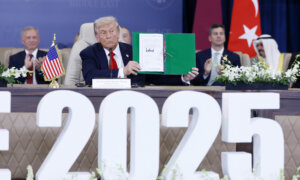
The timing—after Trump’s China visit and before Xi’s trip to Washington—demonstrates that economic handshakes and national security policy now proceed independently. Even as the White House pursues bilateral trade stabilization, standing defense mandates continue to tighten regulatory pressure on Chinese technology.
“The President wants to improve relations but he does not want to sacrifice security to achieve it,” said Carl Schuster, a retired U.S. Navy captain and former director of operations at U.S. Pacific Command’s Joint Intelligence Center.
While security prerogatives strain U.S.–China relations, “bilateral friction is better than a security breach,” he told The Epoch Times.
Inclusion on the 1260H list does not impose general commercial trade bans or freeze consumer assets. It has substantial impact however as it triggers mandatory procurement bans for the U.S. military and forces defense contractors to review their global supply chains. Additionally, it paves the way for broader legislative and capital-market restrictions.
The designation could also affect ordinary investors. A provision in the 2026 National Defense Authorization Act requires the president to review whether companies on the Pentagon’s 1260H list should be added to a Treasury Department investment blacklist. Placement on that list is not automatic, but if it happens, U.S. investors could be barred from buying or holding the company’s publicly traded shares.
What the Pentagon List Means
The Pentagon says the list is intended to address China’s strategy of military-civil fusion. In other words, U.S. officials say Beijing has built a system that enables the People’s Liberation Army to benefit from technology, research, and expertise developed by China’s private companies, universities, and other ostensibly civilian institutions.
That does not mean every product made by a listed entity is a military product. It means the Pentagon believes that the company’s capabilities, relationships, or technology could support China’s military and its modernization.
“Advanced science and technology can always assist military production and lethality,” said Anders Corr, a strategic risk analyst, principal at Corr Analytics, and contributor to The Epoch Times.
The listed companies have disputed that assessment. Denying any improper military ties, Alibaba, Baidu, BYD, and WuXi AppTec announced plans to contest their designations through legal and administrative avenues. So far, WuXi AppTec and Alibaba both have taken legal action, filing lawsuits on June 11 and June 23, respectively.
WuXi announced on its website that on Aug. 7, the U.S. District Court for the District of Columbia granted the company’s motion for a preliminary injunction, thus shielding it from the immediate effects of the 1260H designation.
“We believe that the facts, as demonstrated in our court filings, will prevail in the ongoing litigation on the merits of the designation after an objective and fair judicial review,” the company wrote.
Check out the full story for more details.
—Olivia Li, Petr Svab
BOOKMARKS
French authorities set curfews in parts of Paris on Monday in a bid to protect people and safeguard property after a weekend of riots, arson, and looting. French President Emmanuel Macron blamed the unrest on “seditious elements from ultra-left splinter groups” along with “many criminals.”
European companies could face “devastating” retaliation from Washington if Brussels restricts American tech companies, Ambassador Andrew Puzder said on Monday. “If the purpose is to make the United States less competitive, I think that that’s not a legitimate goal,” he said in an interview with the Financial Times.
The Trump administration will tap an emergency wartime law to build a 125-mile natural gas pipeline extending from Pennsylvania’s drilling fields to New York. Andrew Moran has more details in his latest report.
Vice President JD Vance said he will wait until after the November midterm elections before making a decision on running for president in 2028. “Of course there’s a chance,” he said, but added later “you know, anything can happen, man, anything.”
Eight Ebola cases have now been confirmed in Kenya, in an outbreak tied to the thousands of cases in another African country. Officials said all the new cases are believed or confirmed to have been exposed to the first patient, who lived in Congo for years and recently traveled to Kenya.
—Stacy Robinson