

Australia is moving to revive its push to make Big Tech pay for news, after earlier efforts began to unravel.
Under the proposed News Bargaining Incentive (NBI) digital platforms face a direct 2.25 percent tax on their Australian revenue if they do not ink a deal with local news companies.
Now according to an exposure draft released by the Labor government on April 28, firms like Google, Meta, or TikTok can “offset” part of this tax by signing deals to pay Australian media companies.
An agreement—for whatever value—with a major news outlet will trigger a 150 percent “offset” against the 2.25 percent levy, while a deal with a smaller publisher will result in a 170 percent offset.
In practice, this reduces the levy to 1.5 percent of local revenue, according to Prime Minister Anthony Albanese, likely to be worth about $200 million (US$142.5 million) to $250 million per year into government coffers.
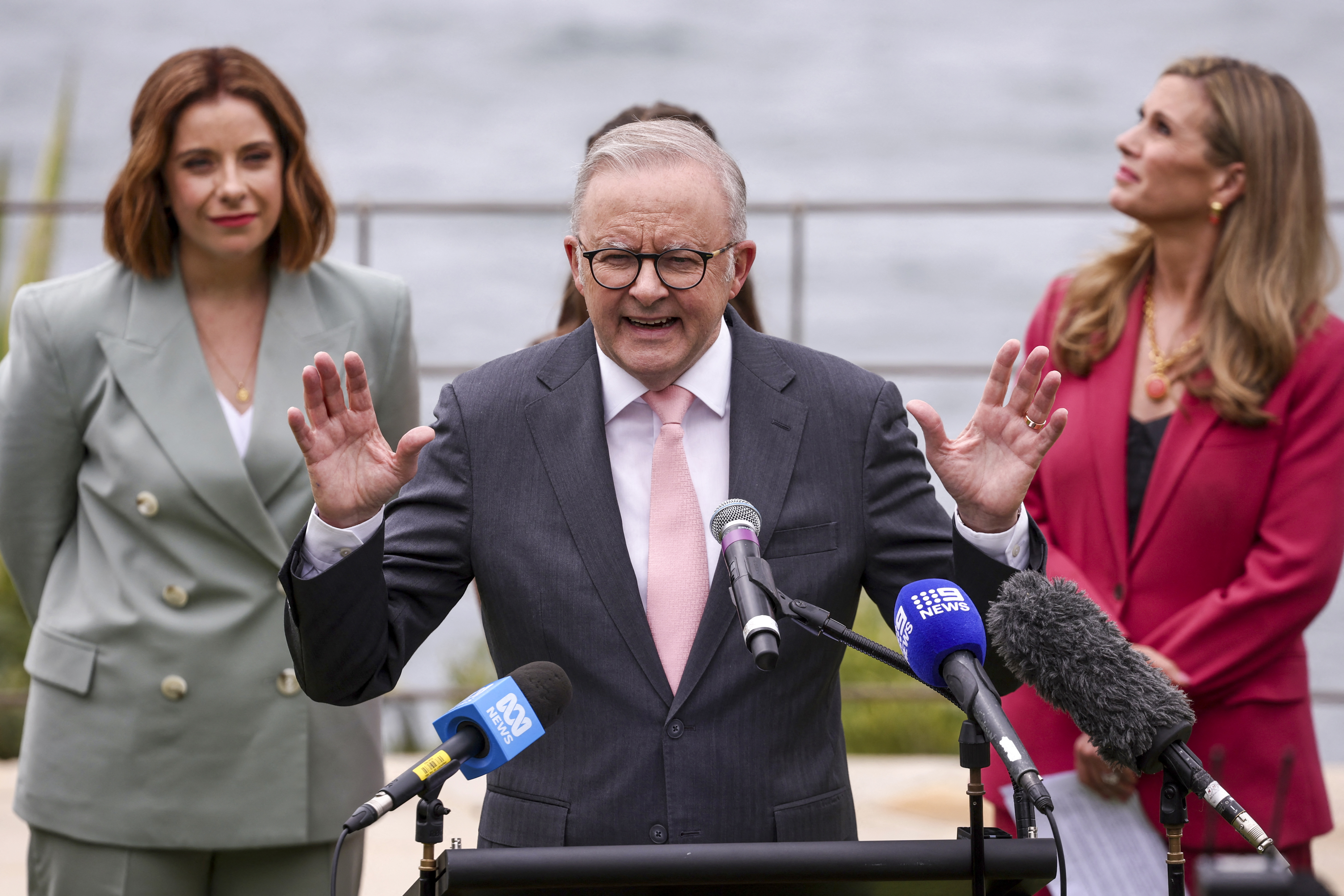
“Every single dollar will go back to journalists to pay for the journalism that you all produce here in the [Press] Gallery, but newsrooms right around the country produce as well,” Albanese pledged.
Submissions on the draft are open until May 18.

Social media apps are displayed on a phone screen in a photo illustration on Dec. 1, 2024. (Roni Bintang/Getty Images)
Which Companies Are Liable?
The scheme targets social media platforms with at least 5 million users, and search platforms with 10 million users.
This is expected to capture—for now—Meta (which owns Facebook, Instagram, and WhatsApp), Google, and the Chinese-owned TikTok.
Assistant Treasurer Daniel Mulino said the thresholds reflect their market power, with additional firms to be included over time.
The government has also pledged to handle artificial intelligence (AI) separately.
Platforms like Google AI Overview, which provide short summaries at the top of a search result page, have been found to channel traffic away from websites.
For example, major tech websites like ZDNet and Digital Trends have reported a 90 to 97 percent drop in traffic.

OpenAI's ChatGPT app (Center 2nd R) and icons of other AI apps on a smartphone screen in Oslo, Norway, on July 12, 2023. A common misconception is that AI is a high-level search engine providing information requested by users, like a digital encyclopedia, a lawyer said. (Olivier Morin/AFP via Getty Images)
Why Were the Rules Changed?
The NBI replaces the News Media and Digital Platforms Mandatory Bargaining Code introduced in 2021 under the Morrison government—a model later adopted by Canada.
That step-by-step framework encouraged negotiations to be entered into in “good faith” or risk a deal being made with an arbiter.
More than 30 commercial deals were concluded between Big Tech and news outlets like the Australian Broadcasting Corporation, Nine Entertainment, Seven West Media, and News Corporation Australia.
The total values was about $200 million to $250 million annually.
But in March 2024, Meta refused to renew its agreements worth about $70 million.
That forced the Labor government to embark on a long process that led to the creation of the current NBI.
The Australian Broadcasting Corporation (ABC) logo is seen in the press gallery at Parliament House in Canberra, Australia, on Feb. 25, 2025. (AAP Image/Mick Tsikas)
Big Tech Say Scheme Distorts and Out of Step With Market
Meta has rejected the proposal, arguing that the act of sharing content on its platform is voluntary.
“News organisations voluntarily post content on our platforms because they receive value from doing so. The idea that we take their news content is simply wrong,” a spokesperson told The Epoch Times.
“This proposed legislation, which would apply to platforms regardless of whether news content even appears on our services, is nothing more than a digital services tax.”
Meta warned the model risks distorting the market.
“A government-mandated transfer of wealth from one industry to another, with no connection to the value exchanged, will not deliver a sustainable or innovative news sector. Instead, it will create a news industry dependent on a government-administered subsidy scheme.”
The offices of Meta in Menlo Park, Calif., on July 31, 2025. (John Fredricks/The Epoch Times)
A Google spokesperson said the company already had agreements in place with media companies.
“While we are currently reviewing the draft legislation, we have been clear: we reject the need for this tax,” the spokesperson told AAP.
“[The proposal] misunderstands how the ad market has changed, and mandates payments from some companies while arbitrarily excluding platforms like Microsoft, Snapchat, and OpenAI, despite the major shift in how people consume news.”
What About the Trump Administration?
Big Tech has lobbied the Trump administration to take firm action against such schemes. The administration has previously pushed back against European Union anti-trust suits and misinformation laws.
The Computer and Communications Industry Association—a U.S.-based group representing Meta, Google, Apple, Amazon, Uber and Pinterest—has criticised Australia’s proposal as “discriminatory.”
The group urged the United States to challenge the measure, including through trade remedies, arguing it unfairly targets predominantly U.S. firms, distorts digital markets, and breaches obligations under the Australia-United States Free Trade Agreement.
CCIA CEO Matt Schruers said the proposal amounts to a “thinly veiled” tax on U.S. digital services and called on Washington to oppose it and push for non-discriminatory policies that support journalism without undermining the open internet.
The United States administration has not yet responded to the latest proposal.