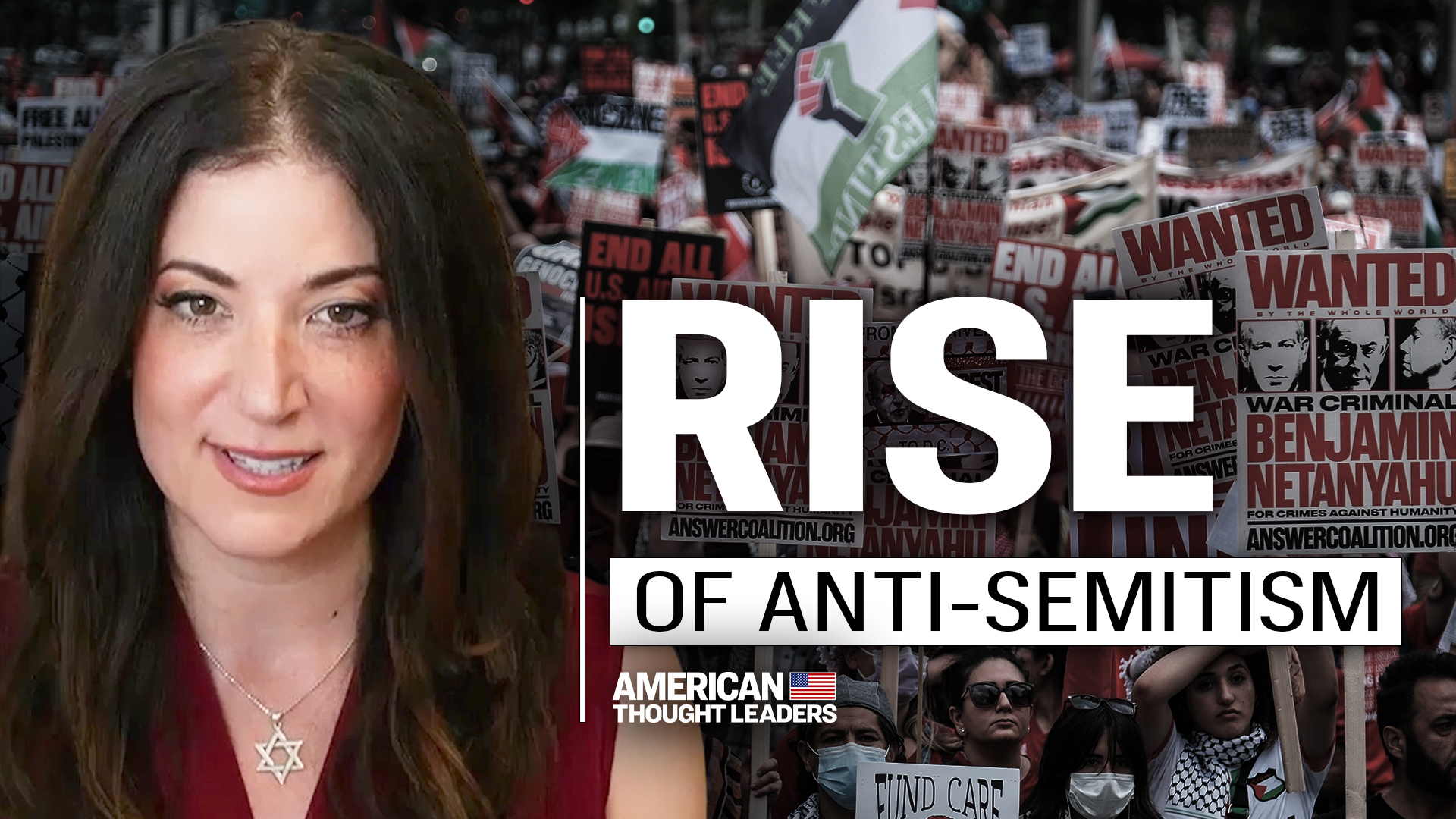

[RUSH TRANSCRIPT BELOW]Historically, America was always one of the friendliest countries towards Jews compared to many countries in Europe, says Batya Ungar-Sargon.
But in recent years, the host of “Batya!” on NewsNation argues, there’s a major shift on the left with anti-Semitism on the rise.
In this episode, the author of “The Jews and the Left” breaks down the ideological shifts reshaping American politics and explains why she rejects the modern “victimhood hierarchy.”
Views expressed in this video are opinions of the host and the guest, and do not necessarily reflect the views of The Epoch Times.
RUSH TRANSCRIPT
Jan Jekielek:
Batya Ungar-Sargon, such a pleasure to have you on American Thought Leaders.
Batya Ungar-Sargon:
I am so honored to be back with you. I think this is now the third time. Thank you so much, Jan.
Mr. Jekielek:
You keep writing excellent books, but let’s start here, okay? Recently, in the primary elections, the Democratic Socialists of America [DSA] did extremely well, unseating in some cases very well-established Democrats who you would consider more mainstream. You have a unique perspective on what happened here. Explain that to me.
Ms. Ungar-Sargon:
It’s funny because they call themselves socialists, and they talk about themselves as if what they’re pushing is an economic populist agenda. But the beating heart of this movement is Free Palestine. They’re obsessed with Israel. They talk about Medicare for all, but the incumbents that they unseated also support Medicare for all, right? So you can see how that’s not the animating feature of their campaigns. They talk about abolishing ICE. This is not a campaign message that resonates with working-class people.
And indeed, the voters who gave them their victory in every case were white, overeducated, and on the wealthier side. They won all the wealthier districts, in some cases by 30 points, while portraying themselves as these heroes of the working class. So, why is that? Why is it that these things go together, this Free Palestine, this obsession with Israel and demonizing Jews and demonizing Zionism? How has that become the litmus test for belonging on the Left, the sine qua non, the most important feature? And why are all of these pretend socialists actually overeducated elites? And of course, it’s two sides of the same coin.
All of my books have been about this—the way in which a credentialed caste that is very educated and oftentimes quite well-off uses. These vanity morals, like Free Palestine today, or like land acknowledgments, it was in 2019, or anti-racism in 2020, or the trans agenda in 2022, or climate. These are all vanity morals that flatter the egos of these upwardly mobile elites who are masquerading as being on the side of the little guy while actually themselves benefiting from the inequality that they pretend to abhor.
And to me, this Free Palestine agenda is just the latest land acknowledgment. It’s a way that the elites can distract from the fact that they are the beneficiaries of a system that they pretend to be fighting. And to me, this is why, in this moment in particular, we’re seeing the Palestinian cause and the demonization of Israel as being the only thing that matters in terms of whether or not. You can belong to the Left.
And my whole book, The Jews and the Left, is about how we got here and why this is such a huge betrayal. Because, of course, Jews were overwhelmingly Democrats for the last hundred years. Starting in the 1920s, the Jews became Democrats, and they really stayed Democrats up until now. I mean, two-thirds of Jews still are Democrats, which is something we can talk about, despite the fact that this is obviously communal self-sabotage.
Mr. Jekielek:
You basically said that Jews have taken on a kind of immigrant identity, right? And an immigrant identity, I mean, so there is this mantra here; hey, we’re all immigrants in America, right? But you’re looking at it a little bit differently. Explain that.
Ms. Ungar-Sargon:
Well, the first Jews arrived here in 1654, and from that moment, they knew that they were home. They thought that this was the promised land, and they were treated as equals. There were few instances of antisemitism, but wherever it reared its ugly head, it was instantly defeated by a mass rejection, like a virus by the American people. It’s like there was something in the soil here that just rejected hating Jews. And it’s utterly unique in the history of humanity.
American Christians developed a religion that was organized around protecting Jews rather than oppressing them. It’s a totally, totally unique, unique phenomenon. And we’ve just lost sight of that. And it’s devastating to me. So many Jews think of us as an immigrant community. You know, there were only 250,000 or something like that. And then at the turn of the century, you started to get a million Jews who came here who were fleeing mass pogroms and May laws and just radical violence against them in Russia and the Pale of Settlement.
And so many Jews think that’s kind of where our community began in earnest, but it’s not. We had 300 years of American history before that. And it was definitive, and it defined how Americans see us. And it was important, and it was unique and precious. And it set the tone for the 20th century, despite the fact that most people would trace their ancestry to that massive wave of immigration. And what then happened was because of the Holocaust, Jewish immigration really stopped. I mean, all the Jews who would have immigrated were murdered and were not let in because the State Department was so antisemitic during the war.
And so then what happened was you just had this massive upward mobility of the Jewish community, but there was no kind of working-class, proletariat immigrant community that kept coming, right? So that most of the community at some point became upper middle class. There were no new immigrants because they'd all been murdered. And what happened then was Jews started to sort of project this immigrant. History onto the community. And we really lost sight of the first 300 years.
Mr. Jekielek:
I mean, that’s fascinating. I can’t help but remember that there were, for example, in some of the top Ivy League universities, weren’t there quotas on Jews at one point? So there is some of this happening still, right?
Ms. Ungar-Sargon:
Yes, there were restricted neighborhoods where Jews could not buy property. There were quotas at the top universities. But, you know, this compared to what our ancestors faced in Europe, this is nothing. And it was short-lived. It was over by the 50s. And it was never state-sponsored. Wherever Jews fought it, they won. So this was like, yes, private property, private institutions, the elites in America. Wherever antisemitism existed in America, it existed in the elites.
But wherever it existed, there was a mass rejection of it. Yes, there were quotas at Harvard because at some point, 20 per cent of the incoming Harvard class was Jewish. I’m not justifying the quota. I’m just saying, you know, 20 per cent, like, that’s a lot, right? So then the Jews started their own universities, but it’s not like they were kicked out of Harvard, you know? And then they got rid of them.
So the quotas were bad, but they were short-lived, and they were the result of the fact that Jews were so upwardly mobile that they were wildly overrepresented at these universities. From the point of view of the state, from the point of view of the United States government, Jews were always treated as free and as white. And they always had that privilege in a way that black Americans really didn’t, in massive contrast.
Mr. Jekielek:
I think there are a lot of people, frankly, very well-intentioned people, who would take issue that the cause of Palestinians, given the amount of death in Palestine recently and so forth, is vanity morals. Can you, like, kind of break that down? Explain to me why you can say that, given, for example, the significant amount of deaths that have happened in Palestine over past years?
Ms. Ungar-Sargon:
Right. Obviously, those deaths are tragic. It’s not noticing the tragedy and feeling for the people of Gaza that is the thing that gets you entry to the Left. It’s lying about Israel and claiming that it perpetrated a genocide, which nobody believes. Nobody who says that thinks that what Israel did in Gaza is comparable to what the Nazis did to the Jews. They say it because it is a way to lay at the feet of the Jews the crime that was perpetrated against us, right? It’s a way of robbing Jews of their victim status.
Now, I don’t think Jews are victims today, but on the Left, victim status is virtue, and Jews are not allowed to have any of that. And so they have invented this piece of fiction in order to deprive Jews of the virtue that they on the left would have to give Jews if they acknowledged they had been uniquely targeted for genocide in the 20th century. Again, obviously, it is a tragedy that because Hamas are sociopaths, because they are terrorists, and because they delight in the murder of every child in Gaza, children were killed during what was effectively a just war.
I myself have my criticisms of how Israel waged the war. I myself have my criticisms of Israel’s treatment of the Palestinians. That’s the conservative position. Israel has the right to exist and the right to defend itself, and I can quibble with how exactly they go about doing that. That is not the position that gets you entry into the Left. That’s not the Free Palestine movement. That is not the view that the DSA, the Democratic Socialists of America, have. The view that the Democratic Socialists of America has is that violent resistance against Israeli civilians is justified.
Now, that is a despicable view. That is not a view that comes from empathy, genuine empathy for the suffering of the people of Gaza. With genuine empathy for the suffering of the people of Gaza, they would go out of their way to become an enemy of Hamas. But these people celebrate Hamas. They are on Hamas’ side because they’re not driven by the values that you and I are driven by. They’re not driven by Judeo-Christian values based on right versus wrong. They are driven by the woke ideology, which says there is no right vs. wrong. There’s only powerful vs. powerless, oppressor versus oppressed. And the oppressed have no moral responsibilities.
So, because Hamas has less power than Israel, they do not owe it to Israel and to Israeli civilians not to mass rape them, mass maim them, mass kill them, mass kidnap them, destroy the bodies of babies with rocks. They don’t owe anybody anything. The Left has to side with them because they are, quote unquote, oppressed. And this is the kind of godless view that has become the price of entry on the Left. It’s not just that a few people think this. If you don’t believe this, you cannot be on the Left. And that is just a devastating state of affairs. And it is one that we have to call out.
Mr. Jekielek:
Perhaps a surprising number of people that would never consider themselves Left, wouldn’t identify that way, or have, let’s say, left the Left, as I think you have, or as you say you have, might also take a similar view, though, that what Israel is doing is abhorrent in Gaza. They don’t hate Hamas. They assume, you know, there’s a whole kind of a range of things that they might say, which would be very similar to some of the things we hear are said on the Left.
Ms. Ungar-Sargon:
Are you talking about people like Tucker Carlson and Nick Fuentes and these kinds of figures?
Mr. Jekielek:
Yes.
Ms. Ungar-Sargon:
Yes. They are Leftists to me. So to me, like, if you subscribe to this view that Hamas were the good guys, because that is the price of entry to the Left, to me, that makes you a Leftist. And indeed, Nick Fuentes himself has come out as a Democrat recently, and Tucker Carlson has left the Republican Party. I mean, Trump kicked him out first, but then he left.
You know, China is one of the biggest boosters of these BS narratives about the Palestinians through TikTok, through social media, because of course they are part of this new axis of evil with Iran and Russia. And so they constantly, nonstop, are using information warfare to spread lies about Israel. You might say, well, China isn’t Leftist. It’s the Chinese Communist Party, right? So you’re right that there are interests, global interests beyond just American Leftists who have a problem with Israel.
In fact, I would even say, I think in Europe, this anti-Israel sentiment goes much deeper than it does here and stems from a much deeper antisemitism. These Leftists in America do not hate Israel more than they hate America.Their hatred of Jews and Israel stems from their hatred of white people in America and the West. In Europe, there are centuries of actual hatred of Jews. I mean, the cobblestones are soaked with it. And they also will agree with this view about siding with Hamas in this.
So, yes, Qatar sided with Hamas, and are not exactly Leftists. These are like the Muslim Brotherhood, right? They share a lot of the religious affiliations. Iran, funding Hamas, not Leftists, right? So there are many global reasons that this sort of confluence of negativity around Israel rose at the same time. My book is specifically about why it rose in America, in a country that, unlike Europe and unlike every other nation in the history of humanity, has always been very protective of Jews and very safe for Jews and has always cherished Jews. So that’s why it was shocking for so many American Jews when it came here.
Now, again, I keep trying to tell them like, it’s not really about us. They hate the West, you know, and they hate the West because they’re educated in universities where they’re taught to do that, you know, and so they'll move on, just like they moved on from trans to anti-Zionism. They will move on from this. But I don’t know that American Jews should forgive them for this.
Mr. Jekielek:
Why do you think that so many Jews still now vote in this direction, given everything you’ve just told me?
Ms. Ungar-Sargon:
It is very hard to admit that you’ve been wrong. It is very, very destabilizing. And it is existentially destabilizing to admit that the ideology and the political movement that you used to define your virtue and your moral superiority to your neighbors—which, as humans, let’s face it, that’s really important to us—is deeply flawed. And I remember the first time I realized that, and it was like an earthquake in my head and in my soul. I remember seeing this Yale study in 2018.
I’m sure we’ve discussed this before, but there was a study out of Yale in 2018 that found that there’s a difference between how white liberals and white conservatives talk to black people. And I was super woke at the time, and I was on the Left, like most American Jews. Ha, we got them, the proof that the conservatives are all racists. And I opened the study, and much to my horror, I found that white liberals, when they talk to black people, dumb down their vocabulary. The researchers called it presenting lower competence. They use fewer syllable words than when they talk to other white people. And white conservatives do not do this; they talk to blacks and whites exactly the same.
And I remember looking at that and thinking, this is not just obviously true about my entire milieu, but it is an indictment of my entire worldview. Like, it was just utterly obvious to me in a second. And I looked at that and I thought, I’m about to lose all my friends. And that is exactly what happened. You know, it’s not just the intellectual earth-shattering of everything you thought you knew, but you know, your social milieu. You know, if you’re a Democrat today, you only know Democrats because you’ve cut off everybody who voted for Trump. So there’s a lot, I think, of that in it psychologically.
Culturally, American Judaism for 100 years was very associated with the Democratic Party. I think also people really do hate Trump. And so they’re asking themselves, well, what’s the alternative? And they'll say, oh, look, Tucker Carlson’s on the other side. So the other side is just as bad. So it’s not that the Left is antisemitic; it’s that America’s become antisemitic. And this is, of course, false. And it is a canard. And it is a smear on our homeland because the vast majority of Republicans still totally back Israel and totally back the Jews. It is easier for them and more comforting for them to think that it is America than to realize that it is their side, which they supported and they backed. And it’s a big reckoning that’s happening. People are very upset.
Mr. Jekielek:
People think about these questions very, very kind of unilaterally. You mentioned the term, back Israel, right? And even myself, I know what you mean by this is just support Israel as a concept, as a nation, not every Israeli policy, as it happens. Yet that’s how we tend to, even for me, when you said that, I said, back Israel. Oh, wait a sec. I had to kind of talk myself down a little bit, if you understand what I mean. It’s something about the information ecosystem, which I’m becoming a little more and more obsessed with because I think it breeds this kind of thinking, even in myself, who’s incredibly skeptical. Does this ring a bell at all?
Ms. Ungar-Sargon:
I do think some people feel like, oh, God, I can’t say I’m pro-Israel. Like, you know, no one’s allowed to be pro-Israel right now. But it’s so, people in America just are like, people, yes, they’re critical of things Israel does, but like, do they want Israel or Hamas to win the war? They want Israel to win the war. Do they want the Christian holy sites to be under the control of Jews or Muslims? They want them to be under the control of Jews. Like, do they think Jews have a claim to their historic homeland, which was given to them by the Bible that Christians believe in? They do, right? Like, oh, we’re not against Israel. I mean, they won’t say this anymore. Now they'll just say, we’re against Zionism. Zionism is racism.
But you have like these moderate Democrats who are like, well, we don’t hate Israel. We just, you know, we’re just, you know, critical of Benjamin Netanyahu. And I’m like, no, no, that’s the Republican position. The conservative position is like, we support Israel’s right to exist. We support its right to defend itself. We criticize this or that, right? Like Trump, who obviously loves Israel and has his quibbles with Netanyahu and has no problem saying them.That’s what a healthy relationship looks like.
But the Left does not believe in Israel’s right to exist. Mayor Mamdani does not believe Israel has a right to exist as a Jewish state. He says this freely with no shame. Abdul El-Sayed does not believe Israel has a right to exist as a Jewish state. It’s insane. And these people are at the top of the Democratic Party. These people have been elevated to the status of celebrities in the Democratic Party. And of course, it’s Israel alone that has no right to exist as a Jewish state. Guys, they'll say, I revere the Jewish faith. It’s just the state of Israel that I have a problem with.
The problem with that thinking, Jan, is that the vast majority of the world’s Jews are not religious.They do not have a faith. Their religion is their historic, cultural, and spiritual connection to other Jews. That is their faith, their connection to Israel, to the people who live there, and to the land. That’s their religion. So, to say, well, our movement has room for, but not room for Zionists, is to say it has room for 5 percent of Jews, 8 percent of Jews, because 90 per cent of world Jewry are Zionists, which means we believe Israel has a right to exist. Full stop.
Obviously, many Jews, most Jews, are liberals, and they have a big problem with Netanyahu, and they have a big problem with Trump, and they have a big problem with what’s going on in the West Bank. And they probably had a big problem with how Israel waged the war in Gaza. But that doesn’t mean that they’re not going to support the existence of one single, sovereign Jewish state on planet Earth, on our ancestral homeland.
Mr. Jekielek:
You’re just making me think of something I pulled from your book. You wrote, we can’t successfully fight antisemitism by insisting we are an oppressed minority in need of protection. We aren’t in America. That’s fascinating, right? And probably obvious, but I hadn’t thought of it.
Ms. Ungar-Sargon:
Yes, it’s funny, because I will say, you know, antisemitism is definitely rising on the Left. It’s become, you know, basically the cost of entry. That doesn’t mean that we’re oppressed. They hate us, and it doesn’t matter because, like, our country loves us and will always protect us and was founded on freedom of religion and the protection of Jews as equal partners in the founding of this great nation. So they hate us, and it doesn’t matter.
I keep telling this to Jews: stop fighting antisemitism. Just keep Shabbos. Like, you don’t need to fight it. You know, it’s going to destroy them from the inside. It’s going to destroy their movement because average Americans hate this. You’re already seeing this in elections. They cannot stand this. I’m not talking about in the blue states of the blue states where you’ve got blue-on-blue violence, but in swing states, there’s just very little appetite for this. Americans are very protective of Jews.
And to me, so many Jews, because they are on the Left, and because they are very educated, and because they spend years and years of their life in higher education at fancy universities, they get inculcated into this view that to be oppressed is to have currency. In fact, it is to have the only kind of currency that matters. The only virtue that matters is oppression. And so they have come to see themselves as an oppressed minority in a country that always refused to treat us that way.
So, for example, the ADL’s [Anti-Defamation League] reaction to October 7th was, you know, why aren’t Jews being included in DEI [diversity, equity, inclusion]? You know, why aren’t Jewish students being protected the way that trans students and black students are, and protected from bad opinions? I find that to be appalling. The problem with DEI and the woke hierarchy of oppressor-oppressed is not that they put Jews on the wrong side of the hierarchy; they didn’t put us high enough on the oppression hierarchy. It’s that there’s an oppression hierarchy at all. It was never okay. It was not okay to treat white students this way. It was not okay to treat conservative students this way. It was not okay to treat Christian students this way. And it’s not okay to treat Jewish students this way.
Mr. Jekielek:
You said you’re sort of implying you’ve become conservative or you’ve called yourself a MAGA Leftist, which I don’t know what that means. But, so where do you land? And what are, you know, you have some kind of prescriptions. We’ve talked about one of them: stop viewing yourself as oppressed, right? This is, this is talking to fellow Jews, I guess. But where do you find your, where do people who are in your boat land?
Ms. Ungar-Sargon:
Well, I don’t really know that Left and Right makes any sense anymore. Like I said before, you have Tucker Carlson, Marjorie Taylor Greene, Thomas Massie, Megyn Kelly, and Nick Fuentes. These are people who all have much more in common with the Left now. Certainly, they’ve all turned on Trump, and he’s returned the favor. On the other hand, Trump’s economic policy is quite Left. He’s sort of an FDR [Franklin Delano Roosevelt] figure in my view. I really identify with his economic policy, with his social policy, which I wouldn’t call conservative, I'd call moderate.
So to me, he’s sort of like a moderate Democrat from, you know, the olden days. Like, you know, he believes in big government. He doesn’t believe in free trade. He thinks we need to destroy China. It’s kind of one of my top issues. So I don’t really know. Like, is Trump even on the Right? It’s really hard for me to say. Like, is someone who supports tariffs, could that person ever be considered to be like a Reaganite? Like, you know, the party of like, you know, free trade. So to me, the Left vs. Right does not really track so much anymore.
But with one push, I would say I’m a MAGA Lefty. Like, I really like Donald Trump. I think he’s really working hard to make America great and in ways that I would recognize as great, meaning where working-class people have sovereignty, have the ability to define their lives and determine their lives for themselves, which is, I guess, you know, the most important issue for me. Yes, so I don’t really know where that lands me. Like, I could see myself, there’s a lot of Democrats I could see myself voting for over some of the Republicans who are coming up after him. So I guess we'll see.
Mr. Jekielek:
Fascinating. And I mean, big government, I don’t fully understand when you say that because it’s sort of a, well, I suppose it’s like bigger government than a libertarian would like. But compared to other big government options, it seems smaller, you know, so to speak.
Ms. Ungar-Sargon:
Bernie Sanders has even had the chutzpah to suggest that the United States government take a 10 per cent stake in Intel. That’s pretty socialist, and I say that in an admiring way. That’s pretty cool. We did give them $8.5 billion for the CHIPS and Science Act. I think it’s cool for us to get a little bit back. This is the kind of thing that you would typically associate with the Left.
Mr. Jekielek:
Basically, you mean like having some sort of industrial policy.
Ms. Ungar-Sargon:
Industrial policy, or him sort of calling up CEOs and bullying them to get us most favored nation pricing. Like, that’s great stuff, you know? Like, just kind of being a mob boss on behalf of, like, you know, the American people. That’s great. But to me, that’s very associated with the Left. Like, him, you know, calling up the gas companies and threatening them that they better bring down the cost of gas now that, you know, the war is over.
Tariffs are big government to me, using ICE [U.S. Immigration and Customs Enforcement] very effectively to carry out mass deportations. This is not something that Reagan would have done. He gave amnesty to 3 million illegal immigrants. So it’s a very different type of agenda.
Mr. Jekielek:
Tell me about what happened on October 8th. Were you expecting the reaction from the Left?
Ms. Ungar-Sargon:
I was not surprised because I had seen this coming.But a lot of Jews were very surprised, very, very surprised, shocked, horrified. They call themselves October 8th Jews. Like they woke up and realized that they were Jewish on October 8th, and they expected to find support from all of the causes that they had marched alongside in their many years as a member in good standing of the Left, and were utterly appalled to find themselves standing completely alone and totally abandoned. And worse than that, to see people like our new New York City Congresswoman Darializa Chevalier out there marching on behalf of the Palestinians and Hamas on October 8th. It was devastating for many, many American Jews.
Mr. Jekielek:
You kind of started laying this out a bit, but you mentioned how Jews were sort of an integral part of the labor movement and also how Jews were disproportionately involved in the civil rights movement. Maybe you can kind of flesh that out for me a little bit.
Ms. Ungar-Sargon:
Well, when you had these millions of Jews coming here from Russia at the turn of the century, they arrived here penniless, and many of them found work in the needle trades, which were exploding because of this new hunger for ready-made clothing. And they could work these jobs because you didn’t really need to know English, but they were horribly exploited, mostly by other Jews who had arrived just a few years earlier and managed to amass a little bit of capital and open a sweatshop and employ them.
Basically, this was their job, and they ended up forming the labor movement because they were being treated horrifically. And they just decided, no, we didn’t cross an ocean to be treated this terribly at work. And so they started the labor movement, they started unions, they won strikes, they won the five-day work week. And when FDR came along with the New Deal, they liked that even more because the bosses that employed them were very upwardly mobile. They would save a little bit of money and suddenly find that they were no longer the proletariat, but suddenly they were the factory owners.
And so they were looking for a movement that had both a healthy respect for labor and a healthy respect for capitalism, because that was the character of the community at the time. And they found that in the New Deal. And so they wrote the New Deal. Many of the lawyers who wrote the New Deal legislation were Jews.
It was inspired by this horrific factory fire, the Triangle Shirtwaist Factory fire, which Frances Perkins, who went on to be FDR’s labor secretary, actually witnessed herself as 146 Jewish teenagers burned to death in this horrible fire. And she said, 60 years later, the New Deal was born out of the ashes of those girls, those martyrs, she called them. So they were really invested in the labor movement, really invested in the New Deal. FDR went on to defeat the Nazis; he became something of a god to American Jews.
And then they were very invested in the civil rights movement. So today, looking back, American Jews will anachronistically say, yes, they were invested in the civil rights movement because of intersectionality. And they understood that the same white supremacy that oppressed Jews oppressed blacks, and you only save yourself by helping black people. This was nonsense. And the Jews at the time thought it was nonsense.
They helped blacks and marched with blacks because we had never been oppressed here and they knew that. And they knew it doubly because they saw the survivors coming here. So they knew how Jews were treated everywhere else and they knew how Jews were treated here. And they wanted black Americans to have the same rights that we had always had here. And it was because we had never been oppressed that the civil rights movement became so important to American Jews.
Mr. Jekielek:
How do your opinions land with the community? I mean, let’s say the Jewish community is one area and your other community, well, again, I’m not 100 per cent sure. Is this the mugged by reality community, or you tell me?
Ms. Ungar-Sargon:
So I think MAGA people really love hearing about this because it’s all about why Americans love Jews. And the thing conservatives say to me the most when I travel, the thing that Republicans or Christians or conservatives ask me the most is, you know, why are the Jews Democrats when we love them and the Left hates them? Like they feel so sad about it that there’s this misconception that antisemitism is coming from the Right when it’s really coming from the Left.
And I wanted to write a book explaining this both for Christians and for Jews, where that misconception came from. I mean, when I post about my book, people are really enthusiastic about it. Jews who are more conservative have reached out to me. Jews who got mugged by reality on October 8th have loved it as well. As to the Leftist Jews, like, I have not heard much from anybody. They’re very good at ignoring things that sort of challenge their worldview.
Mr. Jekielek:
So, you have a great job being an anchor at News Nation, but what about, you know, kind of your professional prospects? How has that kind of played out given your, you know, very vocal kind of advocacy around all these things?
Ms. Ungar-Sargon:
I don’t know what it would be like to look for a job right now. I think News Nation is one of the few places where I can praise Trump when I think he’s worthy of it and criticize him when he’s worthy of it. Another outlet does that consistently. If I had stayed a Democrat and not sort of developed a really healthy admiration for Donald Trump, I think probably things would have been a lot easier for me. And, you know, this book would have done a lot better because I would have been from within the tent. But I just couldn’t.
I mean, the price of belonging to the Left is you have to denounce your own people. You have to basically get on your knees and beg for acceptance from people who hate you. And I consider that to be humiliating. As an American, I would never do that. And as a Jew, I would never do that. So, yeah, it’s tough because if you are a person who admires a lot of what Trump does and also criticizes him when you don’t like what he does, it’s not so easy to find a place in American media right now. But thank God, you know, for News Nation.
Mr. Jekielek:
What are you looking to do next?
Ms. Ungar-Sargon:
I want to write a romance novel. I’ve always wanted to. I probably won’t, but you know, there’s an alternative version of my life where I like to live on a goat farm upstate and write romance novels. And I want my show to be a success, to be honest. I want to just keep putting out great journalism. I have a Substack, and I write, you know, an op-ed every day.
Mr. Jekielek:
How we started talking about media, and you mentioned how, you know, for example, Chinese Communist Party narratives, which, by the way, I mentioned to comment earlier, you know, that’s absolutely peak Leftist. It’s just a different kind than the American, obviously. But, you know, how influential those narratives are when pushed through social media, the structure of media has changed, the ability to influence people, you know, basically without a lot of evidence and en masse, is profound, I think, today. And I guess I want to talk a little bit as we finish up about just the role of media in this and how powerful or not that is, and what to do about it.
Ms. Ungar-Sargon:
I think it’s less powerful than people think. I think when people encounter something on CNN, they assume it’s true. But when they encounter something on TikTok, they assume it’s probably not. Like, I think when people encounter something on TikTok, they think, wow, that’s so interesting. I wonder if it’s true.I think people don’t believe things as deeply. And I don’t think that’s a bad thing.
We’ve sort of returned to what, you know, media was like in the 19th century, where there’s sort of a mixture of like made-up stuff and true stuff. And people understood they were getting something that was kind of like slanted in the favor of like their people. And it was okay. And democracy thrived, you know? I just don’t know that everything is quite as bad as everybody says.
Mr. Jekielek:
Let me respond to that by just saying there are people, for example, that are still wearing masks after COVID because somehow they were taken over the edge by this kind of incessant programming, or people that believe that it has to be a natural origin of the virus, despite how much evidence there is in the other direction, even if it’s not kind of definitive. But I feel there’s some portion of the population that I don’t know if they wanted to believe things which are absurd, that have come to believe a lot of things which don’t make a ton of sense. And it only makes sense to me by just sort of just kind of mass pushing of these ideas through media. And frankly, I think the Trump hatred that you talked about earlier is kind of a part of that.
Ms. Ungar-Sargon:
I think a lot of it has to do with the fact that the Democrats convinced themselves that they would never have to compete for power again. They had it forever. So you have a lot of kind of well-off, well-educated people who are part of the elites who cannot stand the idea that their fellow Americans get to have a say. And this has made them deranged against Trump. They just can’t because they convinced themselves that they didn’t live in a democracy anymore, that they were the right and the good, and that their political preferences were, you know, somehow not just like their political preferences. You know what I mean?
They’re partisan ideas. They’re what’s in their interest, but we’re like some sort of like ideal, like objectively, you know, and that they would never have to fight for these ideas again. And I think that has made a lot of people who assume that they would have power forever very, very, very angry. And that’s what we’re seeing. And I do think that some of that will go down, you know, especially if they elect someone like Marco Rubio. He’s just not as hateable, you know?
Mr. Jekielek:
A final thought as we finish?
Ms. Ungar-Sargon:
I’m just so grateful for you and for the work that you do. And thank you so much for having me.
Mr. Jekielek:
Well, Batya Ungar-Sargon, it’s such a pleasure to have had you on.
Ms. Ungar-Sargon:
Thank you so much. All the best to you. God bless.
This interview was partially edited for clarity and brevity.