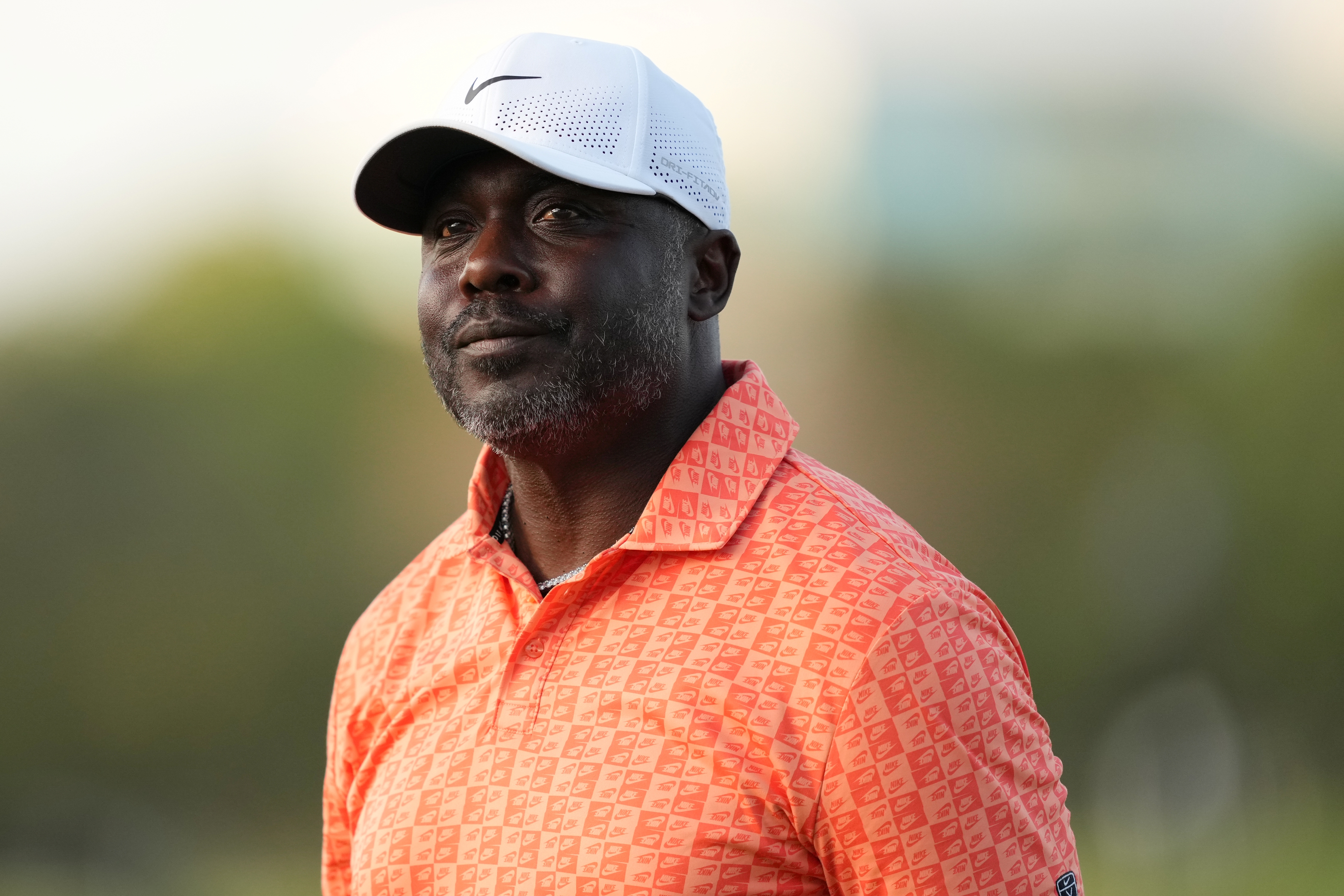

Pro Football Hall of Fame running back Marshall Faulk revealed Wednesday that he has Parkinson’s disease, but said he’s been dealing with it for about a year and a half and considers himself lucky because it was diagnosed early and can be managed.
Faulk, 53, disclosed his condition on “The Caring Neurologist” podcast hosted by Dr. Sandeep Thakkar, who specializes in Parkinson’s disease and other movement disorders. The former Colts and Rams great said he first noticed symptoms in his hands while playing golf.
“The rigidity in my hand, just sometimes after I play a lot or I practice a lot. I just thought it was, you know, normal nerves when putting and stuff like that,” Faulk said, adding that he told his doctor about it during a routine physical.
“I was like, ‘Wow, is that something? Is that normal?’ And the doctor was—he literally was like, ‘You need to go get checked.’”
Since receiving the diagnosis of Parkinson’s, a progressive disorder that affects the central nervous system, Faulk has received treatment and says his life is still relatively the same. At this point, the condition has not worsened, and now he knows the reason for his symptoms.
“The little tremors that I get, you know, they are what they are,” Faulk said. “I just pay attention to my gait, you know, while I walk, when I’m working out, my ability to balance. It’s still where it is.”
Several celebrities have been diagnosed with Parkinson’s, including actor Michael J. Fox, musician Ozzy Osbourne, and, from the sports world, boxer Muhammad Ali. Faulk remembered an exchange with Ali decades ago that gave him hope when he received his diagnosis.
“I was at a dinner with him, and it probably gave me the best feeling ever because I was at one of his dinners at Fight Night and I sat next to him,” Faulk said. “He leaned over to me, and he whispered, ‘You a bad boy.’
“And I was like, ‘He’s all there.’”
Recalling that, Faulk said, gave him a boost.
Other athletes who have been diagnosed with the condition include fellow former football players Brett Favre and Ahman Green, retired basketball player Brian Grant, and former baseball player Dave Parker.
Faulk made his condition public before he privately revealed it to his friends or family. Faulk is the father of six and says his condition hasn’t gotten to the point where he felt he needed to share the information with his loved ones.
“I haven’t really had the conversation with them about it,” Faulk said. “If it comes a time to where my lifestyle changes, then I will. Then that conversation could be had. I’m functioning. I’m good. You know, I just think I caught it early. I’m in a good place.”
Faulk’s disclosure comes 15 years after he was inducted into the Pro Football Hall of Fame and 21 years after his playing career ended. He was, arguably, the NFL’s most dynamic running back during his 12 seasons from 1994 to 2005.
A seven-time Pro Bowler and six-time All-Pro selection, Faulk won three NFL Offensive Player of the Year awards from 1999 to 2001, which is tied with Earl Campbell for the most ever. In 2000, he won the NFL MVP award, and he’s also a Super Bowl champion. Faulk spent the first five years of his career with the Indianapolis Colts and the last six with the St. Louis Rams.
Today, Faulk is head coach of the Southern Jaguars in Baton Rouge, Louisiana. A Louisiana native himself, Faulk was appointed to the position in November 2025 after spending last year on Deion Sanders’s coaching staff at the University of Colorado. The Jaguars sport a 3-4 record this season, already topping the two wins they had all of last year.
Faulk is the latest running back to publicly reveal health issues that could be football-related. One of his new cohorts in the Hall of Fame, Roger Craig, announced that he’d been diagnosed with dementia in August while giving his Hall of Fame induction speech.
Just weeks before that, in June 2026, Chris Johnson, a three-time Pro Bowler best known for his time with the Tennessee Titans, disclosed that he had been diagnosed with ALS.
Faulk has another link to both Craig and Johnson. Craig was the first player in NFL history to have 1,000 rushing yards and 1,000 receiving yards in the same year (1985), and Faulk became the second in 1999. That same year, Faulk set the all-time single-season record for scrimmage yards (2,429), a mark that would stand for 10 years until Johnson broke it with 2,509 yards in 2009.