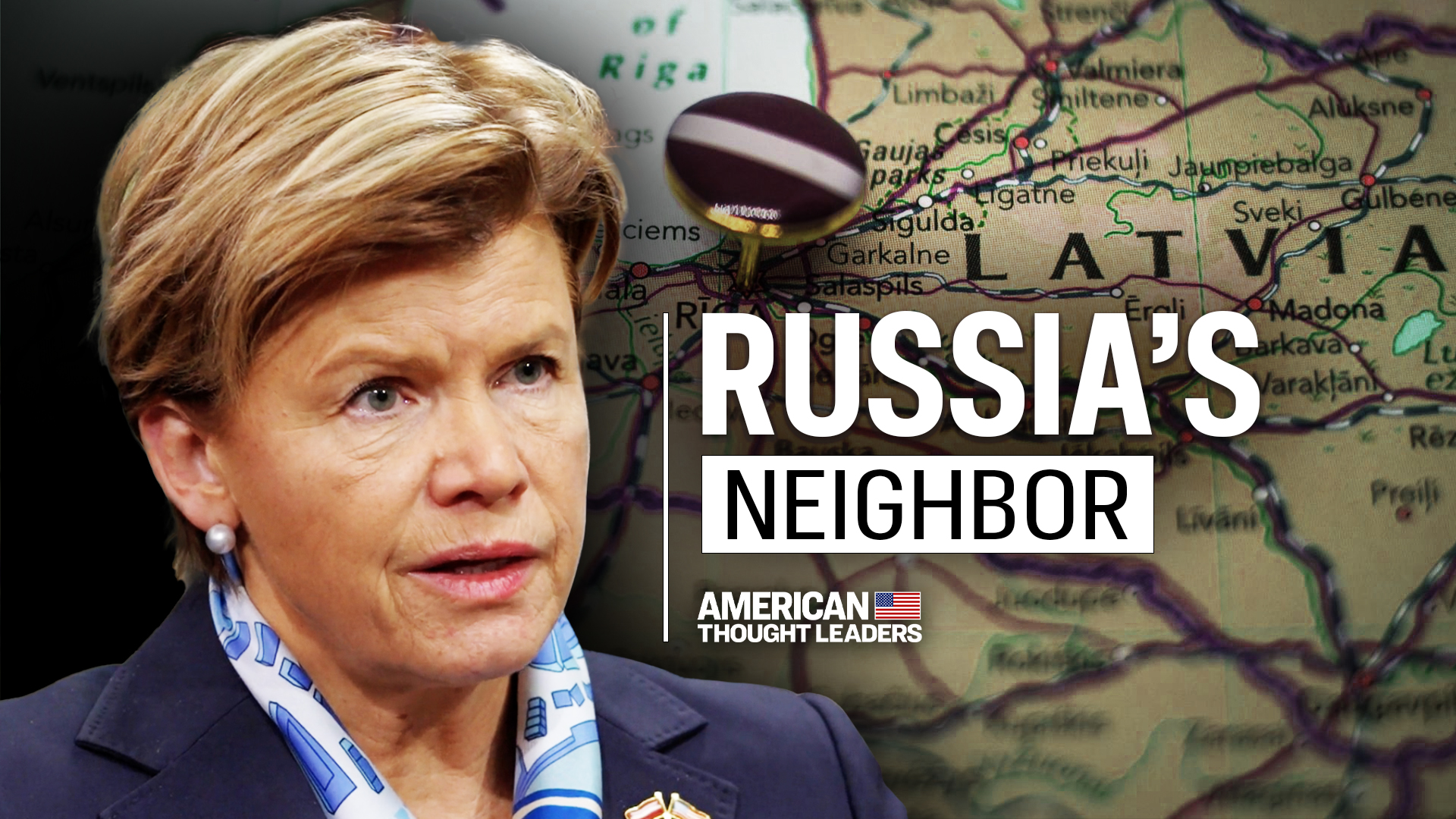
[RUSH TRANSCRIPT BELOW] Amidst ongoing U.S. efforts to mediate a Russia–Ukraine peace and the release of a new U.S. national security strategy that has sent shockwaves through Europe, I’m sitting down with the foreign minister of Latvia, Baiba Braze, to get her unique perspective.
Latvia is a small Baltic country bordering Estonia, Lithuania, Belarus, and Russia. In the 1940s, the Soviets occupied Latvia and its neighboring countries—a reality that has made Latvia hyper-vigilant against potential Russian expansionism.
Latvia joined both the EU and NATO in 2004, alongside Lithuania and Estonia.
Latvia is one of the few NATO countries that spends considerably more than 2 percent of its GDP per year on its military.
“We keep reminding [other NATO countries] that it’s possible to do that, and we are showing you as our example. In our case, it’s 5 percent hard defense capabilities,” Braze said.
Latvia is working to reallocate state funding to hit a target of 4.91 percent of GDP in defense spending by 2026 and 5 percent in subsequent years.
In our wide-ranging interview, Braze discusses the Ukraine war, how she sees a potential peace agreement taking shape, and how pressure can be mounted on Russia. She’s traveled four times to Ukraine in the 18 months since her appointment as Latvia’s minister of foreign affairs.
Views expressed in this video are opinions of the host and the guest, and do not necessarily reflect the views of The Epoch Times.
RUSH TRANSCRIPT
Jan Jekielek:
Minister Baiba Braze, such a pleasure to have you on American Thought Leaders.
Minister Baiba Braze:
Thank you so much for having me.
Mr. Jekielek:
Let’s talk about NATO. And let’s talk about the new U.S. national security strategy. I’m going to read something that the Deputy Secretary of State Landau wrote recently. And he said, the U.S. has long failed to address the glaring inconsistency between its relations with NATO and the EU. He’s talking now about his NATO ministerial meeting that he was at. And he says, when these countries wear their NATO hats, they insist that transatlantic cooperation is the cornerstone of our mutual security. But when these countries wear their EU hats, they pursue all sorts of agendas that are utterly adverse to U.S. interests and security. What’s your reaction?
Minister Braze:
Well, on the national security strategy, I think one needs to look at it as a whole, because, of course, as always on social media commentary and here and there, there are bits and pieces that are taken out and some impression is created that there are some things that are not acceptable for Europeans or this and that. So we actually took a look, and it’s a pretty solid document.
And also, with regard to addressing U.S. concerns, whether that’s with regard to China and the Indo-Pacific, or technology, but also on Europe, clearly recognizing the role of Europe, that Europe needs to take more responsibility, which is what we fully say. When we invest in defense or security, we believe that everybody needs to do that because we depend on each other in the end. But also, with regard to technological advances, simplification of regulation, there’s a whole set of steps that we need to take to be more competitive, to be stronger, to be out there in the world where we want to be.
Because once you look at the overall economic development in the world, we clearly see that Asia is leading in the creation of GDP. And we clearly see that we’ve been squeezed out, whether the U.S. or Europeans, out of certain markets in the Indo-Pacific, in the Western Hemisphere. And that’s not the position where we want to be.
So we believe that we need to work together with the U.S. to make sure that we leverage that in the world. So, with regard to Chris Landau’s comments, I met him last night, and we discussed it a little bit. This sort of Euro-Atlantic partnership is something that is part of the global security architecture. When we look at NATO itself, on one hand, it’s a regional organization in the sense of the UN definition. It’s based on the self-defense clause. But, of course, it’s a transatlantic organization.
The EU, in that respect, is also part of the post-Second World War security architecture de facto, even though it started from the connection of economic interests, you know, to be able to trade certain goods without internal barriers, without internal trade tariffs, and so on and so forth, but it was very much to create that technological and economic base after the destruction of the Second World War. Because whereas the Soviet Union was still able to produce stuff, Europe was so destroyed that there was nothing left. So actually merging the markets, merging the industrial base made a lot of sense. So, in a way, NATO and the EU are interrelated; they’re not opposing each other.
But Secretary Landau is right in that respect, that very often the same countries who sit around the NATO table and the EU table sometimes have different statements, and then when you go to the OSCE [Organization for Security and Co-operation in Europe] or certain other organizations, there’s still a third identity. But I guess that is natural, because again, the EU is the organization that has very much prevented EU member states from directly competing with each other, against each other. But pooling the resources to make sure that the internal market is solid, that there is one single market where you can move goods, services, and people within, instead of fighting against each other.
So from that respect, it is indeed a very important sort of entity, I think, for all of us in Europe. That’s why so many countries want to join the EU, even now, starting from Montenegro, Albania, Serbia, Ukraine, and Moldova. So it’s an understandable development. But yes, there is something that Secretary Landau has touched upon that resonates, I think, in all of us.
Mr. Jekielek:
Well, something that’s interesting is I know that Latvia has actually, you know, stepped up in terms of its, you know, defense spending. That’s something that’s kind of, well, let’s just say it’s not unique, but it’s rare up to now. So that’s interesting. My question is, from the perspective of a smaller country, and maybe I want to talk a little bit about Latvia to introduce Latvia to our audience because they may not be as familiar, from the point of view of a smaller country in Europe, it’s obvious that the EU kind of, it seems obvious like the EU presents a lot of benefits. But from the perspective of these larger countries, does it still present that kind of benefit? I’m curious what you think about that.
Minister Braze:
Yes, we have been strong on security and defense, basically as long as we exist, because our geographical position is what it is. We border not only Estonia, Lithuania, and Sweden on the west, on the Baltic Sea, but on the east, both Russia and Belarus. So we have a 450-kilometer long border. So investing in our national capacities, capabilities, both defense and also internal security, external borders of EU-NATO. Then regional collaboration, so around the Baltic Sea.
And it’s great that Finland and Sweden joined NATO, because, of course, in defense planning, in practical collaboration terms, that makes a huge difference, a huge difference also for defense plans, NATO’s defense plans. We are very pro-American. I think the Nordic-Baltic region is as pro-American as you would get in Europe. There’s no bigger club of countries working with the U.S.
Mr. Jekielek:
Maybe Poland is in that a little bit there.
Minister Braze:
Poland is also on the Baltic Sea.
Mr. Jekielek:
Yes, that’s right.
Minister Braze:
So, of course, Poland is in that, then also within the EU. So we bring in the security defense issues within the EU agenda. Because again, we have NATO’s defense plans, NATO’s defense capabilities, and capability targets for each and every country within that. So there are only four EU member states outside of NATO, which are Austria, Malta, Cyprus, and Ireland. So all the rest of us are in NATO.
And, of course, the EU plans for security and defense, whether that’s funding for the defense industrial base, whether those are various projects in the EDF [European Defense Fund], European Defense Industry Program, so on and so forth, they have to support NATO’s defense capability targets because, in the end, we are there to make sure that security and defense are strong because prosperity will not be possible without the first precondition, which is that countries are safe and secure.
So in the Baltics, you’re right. We do what we say or we plan, then we decide and then we do it. And only then do we say it. So, like Poland, we’re doing 5 percent next year, actually already this year is
Mr. Jekielek:
In terms of defense spending. Just, yes, that’s right.
Minister Braze:
In terms of defense spending, right. Yes, in terms of defense spending. And very much also working with the U.S. on what needs to be achieved with our U.S. partners. We have long-term defense industry programs where we buy U.S. weapons. They fund a small part of it, and the U.S. gets back about $3 per $1 that they give us as seed money. And now we add on our own.
Mr. Jekielek:
How does that money, how does that equation work?
Minister Braze:
There is a specific program called the Baltic Security Initiative and then for military sales which allocates certain resources for the Baltic states to buy U.S. weapons and U.S. capabilities. So it’s like seed money and then you know we do the full procurement whether that’s Blackhawks or HIMARS [M142 High Mobility Rocket System] or naval strike missiles and howitzers and so on and so forth. So U.S. industry gets back three, four times more than is sort of given through those support programs.
Mr. Jekielek:
This might sound like an obvious question, but why is the military so important to you?
Minister Braze:
Well, because of deterrence, the approach that we have in NATO is deterrence, but also planning for defense, but deterrence comes first. And deterrence is formed by defense capabilities, political intent, so political will, and strategic communications that you actually also demonstrate certain capabilities and that political will. So in short, it cannot just be achieved through talking; you need actual capabilities. So that’s why and also learning from Russia’s war in Ukraine.
Mr. Jekielek:
I guess the thing that here in the U.S. a lot of people might not understand is, you know, what that kind of proximity feels like, right? Because the U.S. is separated by big oceans on either side. And also kind of the historical perspective, right, where Latvia came from, you know, after the fall of the Berlin Wall and so forth. Maybe you can kind of flesh that out a little bit for me.
Minister Braze:
I think all the countries on Russia’s borders, up from Norway to Finland, the Baltic states, Poland, and then down to the Black Sea, are serious about defense. And in our case, we established, like all the countries mentioned, our republics in 1918, 1718. So that was a period of the republics. And we were going strong up until 1940, when Stalin’s Russia, you know, totalitarian, authoritarian Soviet communist regime, associated itself with Nazi Germany.
And in 1939, they concluded a secret pact to divide Europe, which de facto allocated Western Europe to Nazi Germany and Eastern Europe to the Soviets. So that’s how they started the Winter War in Finland. That’s how the Second World War started with the invasion of Poland; that’s the Nazis. That was the partitioning of Poland between the Nazis and the Soviets. In 1940, the Soviets occupied the Baltic states, and then for 50 years they didn’t leave. So it actually required bringing down the Soviet Union to become free again.
And the U.S. was really crucial, like in Poland, like in the Baltic states. The U.S. was the land of the free, the big shining light that was not recognizing the occupation of the Baltic states, not recognizing the USSR’s illegitimate claim for any country in the world. And that kept us going. We had big communities here, both the Polish and the Baltic communities in the U.S., working hard with all the U.S. administrations, not letting them forget. We were active in the United Nations, making sure that the United Nations wouldn’t forget that the Baltic states were the founders of the League of Nations, the predecessor of the United Nations, but were not founders of the UN because the Soviets occupied them.
So then with the reestablishment of independence, and I was a student in the Popular Front, where it was very much again sort of inspired, and we were listening to the reports of Radio Free Europe, an American voice in Latvian, you know, which the Soviets tried to suppress and not let it broadcast. And in the evenings, we could catch it on the shortwave radio. So we always listened to that. And that was a shining light of freedom that inspired us and made sure that we were able to reinstate our independence and regain it and also become successful again. So for us, that sort of security defense importance also relates to freedom, and the U.S. has been an inspiration for us in that respect.
Mr. Jekielek:
Let’s talk about the Russia-Ukraine war. The president has recently said that he feels like they’re getting close to some kind of peace agreement. The peace agreement is contentious. Some people think that Russia shouldn’t be allowed to keep any Ukrainian territory. Others believe that getting peace is of paramount importance. And so it’s unclear how much to give. I’m curious where Latvia stands on this point.
Minister Braze:
So I was appointed at the end of April 2024. So I’ve been in office for one and a half years, and I’ve been to Ukraine four times, two times to Kyiv, once to Lviv and to Odessa on the Black Sea. And on this last trip last week, I also went to Chernihiv, which is close to the front, about 60 kilometers from the front. And I speak everywhere, not only to the officials but also to the soldiers, to the private sector, to people, you know, in the shops and elsewhere. And nowhere have I felt that they want capitulation or that they are ready to give up territories or something.
At the same time, obviously, we also are realists in various quarters and realize that to achieve a ceasefire, you need to freeze the front at a certain point. On one hand, Ukrainians have their will and agency, and I don’t think they will accept something that is imposed on them. So they have to own that peace and ceasefire. And I think the red line for them would be sort of recognizing the legitimacy of the occupied territories as being Russian. I think that is one thing: to seize the front and to say, okay, those are Russian-occupied territories.
And the other part is actually recognizing the incorporation into Russia. I think that’s a big, big sort of difference. But again, it’s a Ukrainian decision. We will support Ukrainian choices from our side. We know they want peace. That’s for sure. They want peace. And they have fought really hard for it. Russia was trying to get through this war, which they couldn’t achieve somehow.
Because remember, before 2014, they tried to stop the European ambitions of Ukrainians. The whole Maidan sort of revolution started from the fact that corrupt President Yanukovych refused to sign an association agreement with the EU. That was not about membership. It was an association agreement. So people rose up and said, listen, this is not acceptable. We want to have a European future.
And then the Russians invaded for the first time in 2014, illegally occupying and annexing Crimea, started the war in the eastern part of Ukraine, but they have not been able to break down the Ukrainian nation’s will to have a sovereign democratic state and to be a legitimate member of the EU and also NATO. Actually, when the Russians first invaded in 2014, Ukraine didn’t want to be a member of NATO. It was officially a neutral country.
And so, you know, they have achieved the strengthening of Ukrainian sort of sovereignty, democracy, and institutions, which then leads me to think that for Ukraine to own that peace, it will have an effect on all European security because the only country that doesn’t want peace, what we see, is Russia, because all the instruments of power.
In NATO, we always analyze the instruments of power that a country has. It has a military instrument of power. It has a political instrument of power, economic, you know, private sector instrument of power, religion, media, and so on and so forth. We don’t see a single instrument of power in Russia that would be oriented towards peace. It’s all about war.
Mr. Jekielek:
How do you measure that? That’s very interesting.
Minister Braze:
Well, when you look, for example, at the military instrument of power, it’s actively employed to try to crush Ukrainian self-defense and not even achieve its objectives, because like this year they have occupied below 1 percent of Ukrainian territory. And they have lost around 280,000 soldiers this year alone. Altogether, 1.2 million soldiers lost and severely wounded in Russia.
But they are continuing. There is no indication that they want to stop the bombings, nightly missile attacks, you know, trying to advance on the front. So very clear, the military instrument of power is fully employed to continue the war. The economic instrument of power is the same thing. Military production is prioritized over any civilian economy.
So the civilian sector is cannibalized, prioritizing resources, prioritizing production, labor, machinery, tools, and so on and so forth. Which means that together with the restrictive measures that the U.S., Europe, and others have imposed on Russia to stop the war, it’s leaving the Russian economy in tatters because military production is not a productive economy. It doesn’t create growth of GDP.
Mr. Jekielek:
Well, unless you keep at war, I suppose, for the time being.
Minister Braze:
That sort of produces stuff that is then eliminated on the battlefield. But it’s not a productive economy.
Mr. Jekielek:
It doesn’t stick around.
Minister Braze:
No. And it doesn’t create GDP growth per se. It pays salaries and so on and so forth, but that’s not the economy like, you know, companies that we have, you know, that produce either stuff or services or exports and so on and so forth. And then, religion is part of the authoritarian regimes’ tools to control society. There is no free media, there is no social media, including X, Facebook, and Instagram; anything is banned in Russia.
You need to use a VPN or whatever, which is also prohibited, actually, to post anything. So, they use closed Telegram groups to, you know, sort of communicate and so on. So there are a couple of Russian networks, but those are also controlled. So you go through one by one, and you clearly see they are all oriented towards the war.
And that’s why when, yes, we fully support the U.S. efforts to achieve peace, and we are the staunchest supporters of President Trump in that effort. But in our calculation, it’s the pressure on Russia that needs to be increased for them to feel more pain to actually come to the table seriously. And so we admire the resilience of the negotiators. They’ve sat down for three days, four days, doing round after round.
And it’s good that things are not leaked, that it’s sort of kept in the negotiation circle. And it’s not easy. It’s not easy either for Ukrainians or the U.S. But to be successful, we need that pressure on Russia. That is what will achieve the peace deal.
Mr. Jekielek:
And there’s sort of here, there’s different viewpoints about Russia’s intentions, right? In Poland, for example, it’s actually, you know, there’s a lot of political differences between the political parties, for example. But they both believe, from the people I’ve spoken to, that if it doesn’t go well with Ukraine, they might be next. What does Latvia think about that?
Minister Braze:
Well, first of all, in any peace deal, the important part is the Ukrainian ability to ensure their future self-defense, so that there is a sufficient Ukrainian self-defense force at a certain level with certain capabilities to provide deterrence for Ukraine. And it’s the same for everyone in the Euro-Atlantic zone because I agree with certain assessments that say that Russia cannot stop the military production, and again it’s a sort of authoritarian regime where there are no internal checks and balances, which will continue its existence in the way as it is, and that continues posing a threat to all of us, to all the democratic countries.
You feel it’s inherently expansionist; it will try. They have shown in the past that indeed, instead of internally doing reforms to be successful. Economy, a force for good globally, which it could be, to have a competitive sort of structure, positive agenda; unfortunately, it has been the opposite. And so having no illusions about that is, in our view, the best recipe to be safe and secure.
Having said that, for now, none of the NATO states, from Norway to Finland to the Baltics and further south, have direct military threats. Because one thing that we did collectively in NATO after 2014 was to work on a new military strategy, to be open-eyed and recognize that what Russia did in Ukraine, in Crimea, and in the eastern part of Ukraine is a big turning point. So NATO’s new military strategy, adopted in 2019, provides for the need not only to conduct out-of-area operations like we did in Afghanistan, where we had a choice to send 500 troops for half a year or not, or to send 130 troops to KFOR or not. But to turn to collective defense, to make sure that both territories and populations are defended. And that is a completely different type of work that was done.
So what we did was to really combine the civil-military intelligence capabilities with NATO to make sure that information and intel are shared, but also that tech capabilities increased, space capabilities, and that gives you that early warning ability to monitor and understand what is happening. And then also changing the whole defense planning, developing those defense plans where you have the forces that you need, the enablements that you need, rapid reinforcement, authorities for commanders, and the presence on the ground where you need.So that all is a deterrent to make sure that we are safe and secure.
And that is a basis, again, for having successful economies, because if security and safety are threatened, the prosperity, the future hopes of all of us will not be there. And that has worked. That has worked. So, yes, a strong force for Ukraine for self-defense and deterrence, but also Ukraine is a successful democratic country with strong institutions, a lively democracy, sovereignty, independence, and it has a perspective—a European perspective. It has a NATO perspective once political conditions are there. And yes, I think we are okay in Europe. But the leadership of the US is something that, of course, we all highly appreciate, whether it’s in the peace process or in defense spending and reform of NATO collaboration.
Mr. Jekielek:
Well, one of the arguments that I’ve heard, which was compelling, is that the Trump administration is very keen to try to foster peace in Europe, peace in the Middle East, so that it can focus on the real threat, which is communist China. What do you think?
Minister Braze:
Yes, the U.S. assessment has been there for a while. I mean, we know that well. Officially, in the NATO strategic concept, the official threat is Russia for Euro-Atlantic security and Allied security, and China is a challenge whose behavior and whose lack of transparency on nuclear and conventional capabilities, of course, presents a challenge to us all. But also what we have seen—the assertive behavior in the region, certain types of exercising, certain types of threatening behavior to the neighbors in the sea and so on and so forth—has presented valid questions.
Mr. Jekielek:
And also the funding, of course, of Russia by purchasing a lot of the oil, a big chunk of the oil.
Minister Braze:
Absolutely. You’re totally right on that. And also the no-limits partnership between Russia and China was, you know, whatever issues covered there. So quite clearly, we understand that for the US, it is a big strategic issue. And I think working closely within various organizations between the EU and the US to try to also see what economic tools can be used, how we can sort of work together, not to let ourselves be squeezed out from the markets that I mentioned earlier, but we also have other partners in the Indo-Pacific who are as bothered by all this behavior as we are.
Mr. Jekielek:
Notably Japan recently.
Minister Braze:
Japan, Korea, Australia, New Zealand, but also the Philippines and others. So economic interests are there. So remember, there is a theory that believes that trade stabilizes relationships and that economic interdependencies create more stable relationships, which is partially true, because if you do have an authoritarian regime, they will disregard these relationships to achieve the political objectives that can be achieved by military or other means.
And at the same time, engaging with China, like President Trump has done or like European leaders have done, and making sure that there is that open dialogue, open relationship is very important—very important—because that helps avoid misunderstandings; it helps to prevent miscalculations that can arise. But yes, we understand the US sort of challenge and worry about China, but also about Russia. So we work together with them.
Mr. Jekielek:
I mean, I know Latvia. There isn’t a lot of love for communism in Latvia.
Minister Braze:
No. In Latvia? No, and we have actually discussed with Secretary Rubio that because we very much welcome this anti-communism week initiative that the administration has announced to have joint initiatives on that. So we are supporting the Victims of Communism Museum here. There’s a monument also there that we have contributed to. And that’s because these ideas disregard the realities.
Communist ideas are ideology above everything, above freedom, above human rights, above any sort of other issues. They are ready to sacrifice countries, literally, for the fulfillment of their ideas. Yes, we fully support the administration on this one. We have suffered ourselves through that. I mean, when you visit Latvia, you can visit the Museum of the Occupation of Latvia, to see what the communists meant for us, the KGB house, the so-called corner house, where we as children were always walking around, you know, a whole distance away from it, just not to be near that, because we knew that’s where the people were killed. That’s where, you know, our parents and grandparents suffered and were tortured. So communism is a poison, yes.
Mr. Jekielek:
So just going back to the national security strategy, I see, you know, it’s interesting. You have a very measured response to it. I’ve seen a lot of—I mean, I’m looking on social media, different parliamentarians, different people responding. I mean, many people were saying things like America is leaving us alone. We don’t want—you have a much more measured view of this. One thing I’m curious about is, you know, Europe has had a very difficult time reaching those, you know, basic spending needs for NATO to actually create the deterrence we’ve been discussing so much during this interview. Do you think this could possibly, you know, motivate them if they really believe that they’re going to be alone, right, as many people have said, to actually step up that deterrent spending?
Minister Braze:
We all together made a decision at the NATO Hague Summit this summer to raise the spending on defense to 5 percent.
Mr. Jekielek:
But just, it’s one thing to say it. It’s another thing, you’re rare, as I said, right?
Minister Braze:
But actually, we see very clearly that it’s rising. European allies and Canada have doubled defense expenditure over the last few years. So it’s a significant commitment. And also what we see is the allocations for the next year, the budgets being published, are very significant. Again, it goes against the background of having financial discipline. In our case, we have had that very clearly, making sure that the public sector is not too big and that our debt is low and that our budget deficit is low. So we have that space like Germany does and Poland and the Baltics, other Baltics.
So not only are we reforming the administration and cutting spending, but we also have that space where, if necessary, we can borrow for investing in these capabilities. Other countries have been quite different in that respect, so for them, it’s much more difficult, so much more gradual. So we keep reminding ourselves that it’s possible to do that, and we are showing with our example; in our case, it’s 5 percent hard defense capabilities; it’s covering up, you know, sports fields or something else, you know, under that. It’s a real defense.
And on top of that, as I said, we have the external border of the EU and NATO, where we have invested significant amounts, because it’s both the civilian capacities, like for border guards, but it’s also military defense, so all the infrastructure that is needed. It’s also the customs services, because that’s the external border of the EU. We control the exiting goods so that sanctions are respected. So more than 80 percent of goods—80 percent of goods crossing the Latvian border on the way to Central Asia or other destinations are non-Latvian. So they come from elsewhere in the EU and other countries.
Mr. Jekielek:
Because this is a big issue, actually. I’m going to mention that; that transshipment, there’s a lot of goods that are—of course, there’s a lot of sanctions against Russia. There’s a lot of goods heading there, nonetheless, through this transshipment. So you’re saying you’re making a point of making sure that none of this is happening through Latvia.
Minister Braze:
So there are goods that are still allowed to be exported to Russia, like alcohol and a few others. And also those travel via our border. And then there are goods that are prohibited, and so we work in two ways. One is to make sure that our export controls, our strategic goods system, is very, very robust because we have also seen companies trying to squeeze under certain civilian capabilities certain items that can be used for military purposes. And so we are very strict there.
But then also regarding the goods going, for example, to Central Asia. We clearly work, and we are clearly committed to working with other European countries to ensure that what they declare—because export declarations are filled out in other EU countries if they export them—means that they know what customs codes to insert, how to check final destinations, and how to establish a due diligence system on sanctions like we have established.
Because otherwise, it’s our customs officers at the borders who have to discover that these goods are going to some type of yurt in Kazakhstan. So, you know, what does that have to do with the final destination, right? But that could have been checked in other countries where the exports originated. It’s not our border; it’s not our customs officers who have to discover that. There have to be due diligence systems at the national level in each of the countries.
So that is the other part of how we work with other countries. So it’s a lot of investment also in internal security. We have strengthened our internal security services, and the way they work with each other is the way they work with other Baltics and Nordics. The whole shadow fleet issue: Russia is transporting its oil through the Baltic Sea to India, to China, and to other parts.
Mr. Jekielek:
Just explain that very briefly, the shadow fleet, what that is.
Minister Braze:
So there are old vessels that are not properly maintained or registered that had to be scrapped, but Russia bought them and is using them to ship its oil to squeeze under the oil cap and to maintain income in its budget, in its federal budget. Okay, so these ships, these vessels, as I said, had to be scrapped. They are badly maintained; they have crews that are not properly trained because that’s again to make it cheaper. There is fake insurance, and then they change the flags of convenience; they can do it several times a day. Sometimes those are flagless vessels. There’s a whole ecosystem enabling this.
And so in the EU, we have sanctioned them. We have sanctioned particular ships. We have sanctioned these services and service providers. So we will keep going after them. The U.S. has done its share too. So I think currently what we are discussing with the administration here is how to align properly what we all have done because then it has much more effect. And the aim is to decrease income in Russia’s budget because they are financing the war from the federal budget.
Mr. Jekielek:
Just on this point, this is another thing that Deputy Secretary Landau mentioned. This was also through his ex-account that he asked the State Department to provide some information about basically how much money is going towards Ukraine from various European countries and how much money is going to buy Russian oil from various countries. And in many cases, he found that there are quite a lot of countries buying quite a lot of Russian oil. What do you make of that?
Minister Braze:
Well, we have actually stopped importing Russian oil and gas. We made that decision after the invasion of Ukraine. It took a while to stop the agreements. Obviously, the companies had agreements with Russia. So currently, we don’t import any oil or gas from Russia. The only thing that is still there in our case is these propane gas balloons, you know, these smaller things where there were, as I understand, longer-term agreements, but that’s insignificant. And providing aid to Ukraine, it’s about 1percent of GDP.
Mr. Jekielek:
Per year. I’m just thinking more in general. I mean, not Latvia specifically, but it’s just kind of surprising to learn that there are many European countries.
Minister Braze:
I think there are a number of allies that are questioning those numbers, and they are engaging with the State Department, but I’m not going to comment on that.
Mr. Jekielek:
Okay, well, no, that’s good to know as well.
Minister Braze:
In our case, we know what we are doing. We know that it was a political decision to stop that. It took a few months to actually end, but now we actually import 70 to 80 percent of our LNG from, guess where? The United States.
Mr. Jekielek:
Well, I’m sure they’re very happy about that.
Minister Braze:
But also quite a bit of diesel. We just had a big ship of 13,000 tons coming into the ports. And we are also learning quite a bit from the Ukrainian reaction to Russian attacks on their energy infrastructure because the Russians have tried to eliminate the main producers of electricity in Ukraine. So the Ukrainian response has been quite significant. They’ve been able to restore quite a bit of production, moving from the big nuclear stations to more decentralized models, especially for smaller cities, settlements, districts, you know, with a lot of generators, cogeneration stations, renewables, and so on and so forth.
So there is also something around those models where, in developed economies, we depend largely on these big centralized electricity suppliers, but actually during times of crisis, we have to think about how we can continue operating and be resilient with alternative plans. And that’s another lesson learned. But yes, we have raised issues about oil and gas from Russia, especially LNG. We have raised those issues also with our European allies.
And then there are issues such as Rosatom and nuclear fuel, where Russia still holds a dominating position, which is, again, something that we need to work on with many countries in the world. There is no lack of uranium in the world, right? So we need to ensure there are alternative supplies so that we don’t have to rely on one source.
Mr. Jekielek:
Minister, this has been an absolutely fascinating conversation for me. I just bid on a lighter note. We’ve covered a lot of very heavy things. I mean, I personally am a regular consumer of Riga Sprats, smoked Sprats. I love them.
Minister Braze:
Oh, good. I will ask the embassy to provide you with a new collection. We actually have some producers.
Mr. Jekielek:
I mean, it’s a unique thing. It’s really quite wonderful. Absolutely. I love smoked fish. But just tell me a little bit about what people might find interesting through this interview in Latvia, what they might find there.
Minister Braze:
Oh, it’s one of the most beautiful countries, I think, in Europe, with a lot of untouched nature, 500 kilometers of sandy beach, clean waters, lakes, and rivers. At the same time, there are highly developed cultural and entertainment possibilities. There’s a special genre of hiking in marshes. You know, you get a special flat shoe so you wouldn’t sink, so you can hike in marshes, which is very unique at sunrise, for example. You know, or you can do stand-up paddling at sunrise in the sea or in the marshes. You can skate and ski, do literally anything.
But at the same time, it’s a very tech-savvy country. So we have U.S. investments; some of our best drone producers are U.S. investments, and they’re doing very well. The Department of War is one of the biggest consumers, but also the armed forces of Latvia, and there is quite a bit of export from that. We have a very highly developed digital infrastructure because the country seems small on the map, but it’s twice as big as Belgium, with 1.8 million inhabitants only, right? Which means that we don’t want people queuing up in local governments, spending time, you know, traveling distances, for example, to sit in queues for some local services.
So everything is online. We submit taxes in about 10 to 15 minutes because the information is already there, so it’s pretty straightforward. I sign my cabinet documents from here online, so cabinet meetings are open to the public, and they can watch them online. So there’s quite a bit of transparency in that respect. So it’s a great country. We are open, happy, and transparent.
Mr. Jekielek:
Minister Braze, a final thought as we finish, perhaps? Do you have a final thought you'd like to share?
Minister Braze:
We would like more Americans in Latvia, more American troops, more American investment, and more relationships. We love the United States.
Mr. Jekielek:
Minister Baiba Braze, it’s such a pleasure to have you on.
Minister Braze:
Thank you so much. It was a pleasure being here.
This interview was partially edited for clarity and brevity.