Early on in Harper Lee’s “To Kill a Mockingbird,” attorney Atticus Finch gives his first-grade daughter, Scout, this advice: “You never really understand a person until you consider things from his point of view … until you climb into his skin and walk around in it.”
Atticus was trying to make his daughter see things from the perspective of her teacher, who was also new to the school. It’s a wise way to approach people, an act of intentional imagination, and works as well with historical figures. We put ourselves in the shoes of George Washington making his momentous decision to attack the British at Trenton, or slip into the heart and mind of Dwight Eisenhower on the eve of D-Day, and we understand them better.

During her first month as a medical reviewer, Frances Kelsey resisted intense pharmaceutical industry pressure and blocked the U.S. approval of thalidomide, demanding rigorous scientific evidence to guarantee patient safety. (Public Domain)
Let’s run this exercise with Dr. Frances Kelsey.
In 1960, this well-educated, experienced pharmacologist and physician was newly employed by the Food and Drug Administration, tasked with reviewing applications for marketing new drugs. In her first month on the job, Kelsey received an application from a major pharmaceutical manufacturer seeking approval of a sedative that also relieved nausea during pregnancy. After reviewing the application, this newcomer to the FDA and her team turned it down because of inadequate data and tests.
Over the course of the next year and a half, anxious to cash in on the huge profits to be gained from this drug, the pharmaceutical company pushed again and again for approval of its application.
So, what would you do if you were Kelsey? Would you fold or would you stick to your guns?
A Well-Trained Mind
Born in Cobble Hill, British Columbia, Frances “Frankie” Oldham Kelsey (1914–2015) met a visiting biology teacher as a teenager and decided from an early age to pursue science. After graduating from high school at 15, she first entered Victoria College, then McGill University, and graduated in 1934 with a degree in biochemistry. While an undergraduate, she took what she later called “a quaint little course called pharmacology.” With the Great Depression in full swing, she found few job opportunities and remained another year at McGill to earn her master’s degree.
Good fortune followed this lack of employment opportunities. A McGill professor encouraged Kelsey to take her doctorate in pharmacology at the University of Chicago, a program founded by eminent physician and pharmacologist Eugene Geiling. In responding to Kelsey’s application, Geiling addressed her as “Mr. Oldham,” probably mistaking her “Frances” for “Francis.”
She debated whether to write back explaining that she was female, but as she later remembered, her pharmacology professor told her, “‘Don’t be ridiculous. Accept the job, sign your name, put Miss in brackets afterwards, and go!’ That is what I did, and to this day, I do not know if my name had been Elizabeth or Mary Jane, whether I would have gotten that first big step up.”
Under Geiling’s tutelage, Kelsey earned a doctorate in pharmacology. While in that program and afterward for a time, Kelsey worked closely with Geiling on a case involving Sulfanilamide, a drug used successfully to treat pneumonia and streptococcus. To render the drug a liquid, making it easier for children to swallow, a manufacturer had added diethylene glycol, or antifreeze, causing deaths after it came on the market. Kelsey and Geiling were responsible for solving the mystery behind the deaths, a lesson in science and analysis that served Kelsey well throughout the rest of her professional life.
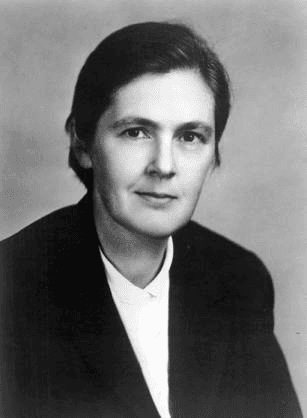
Dr. Frances Kelsey, the FDA reviewer whose commitment to rigorous data prevented a thalidomide tragedy in America. (Public Domain)
Kelsey remained at the university, pursuing antimalarial research during World War II. In 1943, she married another member of the faculty, Dr. Fred Kelsey. Because university policy forbade the employment of spouses, she then earned a degree in medicine while raising two daughters. During the 1950s, the Kelseys and their daughters moved to South Dakota, where her husband headed up the pharmacology department at the state’s medical school, while Kelsey continued research at the university and with a drug manufacturer.
The Payoff
In 1960, the Kelseys moved again, this time to Washington. There, Fred found a position with the National Institutes of Health, while Kelsey went to work in September for the FDA as a reviewer of new drug applications. One of the first applications to arrive on her desk was from the William S. Merrell Company, also known as Richardson-Merrell, looking to market thalidomide, a drug prescribed as a sedative, a stress reliever, and a treatment for morning sickness in pregnant women. Developed in Germany, thalidomide had already met with success and high sales throughout Europe, Canada, and other parts of the world.
If given the FDA stamp of approval, Merrell would benefit a huge financial coup. Kelsey and her team were under pressure to approve thalidomide not only from the company but also from time itself. The FDA then had 60 days to issue or deny approval of a new drug, at which point the drug was automatically deemed safe for sale.
Kelsey scrutinized the company’s report and found it inadequate, in part because of anecdotal evidence touting the efficacy of thalidomide, as well as its initial reports citing no ill effects or risks. Kelsey later said, “It was just too positive; this couldn’t be a perfect drug without risk.”
Further investigation by Kelsey raised suspicions that the drug might cause harm to fetuses as well as to adults. It was an intense 18-month battle between Merrell and Kelsey. Journalist Stephen Phillips pointed out:
“Merrell executive F. Joseph Murray, peppered Kelsey with phone calls, letters, and visits. Based on thalidomide’s distribution elsewhere, Merrell regarded approval to sell it in America—under the brand name Kevadon—as a formality. But Kelsey insisted on hard evidence to back Merrell’s claims for the drug’s safety and refused to be browbeaten.”
Murray even went so far as to telephone Kelsey’s superior, Dr. Ralph Smith, to lodge his complaints and to ask whether the refusal to approve the drug was subject to reconsideration. Fortunately, Smith backed his colleague, telling Murray that Kelsey had the agency’s support. In the fall of 1961, reports of birth defects, mostly of newborns with missing or malformed limbs, began breaking in the European press.
Soon a major disaster was in the making, with thalidomide linked to thousands of these and other defects, as well as to undetermined numbers of fetal deaths. Phillips wrote:
“Four times Kelsey had invoked the regulatory lever available to her under the 1938 legislation to reject Merrell’s application on the grounds of insufficient data. Now on the company’s fifth attempt to secure approval, Merrell notified Kelsey it was rescinding its application.”
The 18-month war of words had come to an end.
Kelsey followed the science. She demanded hard data rather than relying on a manufacturer’s glowing reports and what her husband, having read some of the documents, termed “an interesting collection of meaningless pseudoscientific jargon apparently intended to impress chemically unsophisticated readers.”
The Gratitude of a Nation
Many Americans know nothing today about the bullet they missed 60 years ago. Had Kelsey, a newcomer to the FDA, simply approved the drug or crumbled from the intense pressure exerted by its manufacturer, an untold number of American babies would have suffered birth defects, even in that short window of time when Kelsey kept refusing to grant approval. As it was, Merrell did legally release Kevadon to some 1,200 physicians in an investigational trial, resulting in at least 10 cases of birth defects.
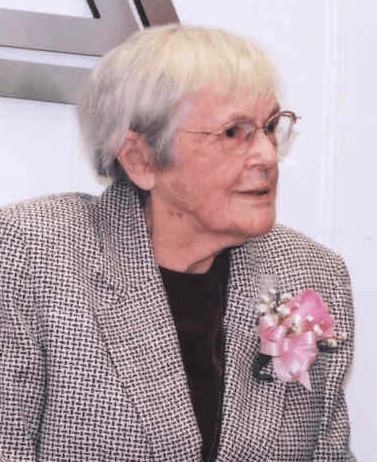
Public health pioneer Dr. Frances Kelsey is inducted into the National Women's Hall of Fame in 2000. She was honored for her steadfast dedication to medical ethics. (Public Domain)
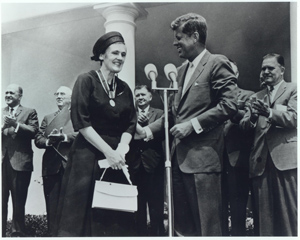
In August 1962, President John F. Kennedy honored Kelsey with the President’s Medal for Distinguished Federal Civilian Service.
Frances Kelsey’s resolute stance inspired changes and stricter guidelines within the FDA. At one point, she was chosen to head the newly established Division of Scientific Investigation, whose employees referred to themselves as “Kelsey’s Cops.”
The young woman who had once enrolled in that “quaint little course in pharmacology” continued working for the FDA until the age of 90. She died in her daughter’s house in London, Ontario, age 101, and lies buried beside her husband in a Pennsylvania cemetery.
What arts and culture topics would you like us to cover? Please email ideas or feedback to features@epochtimes.nyc.