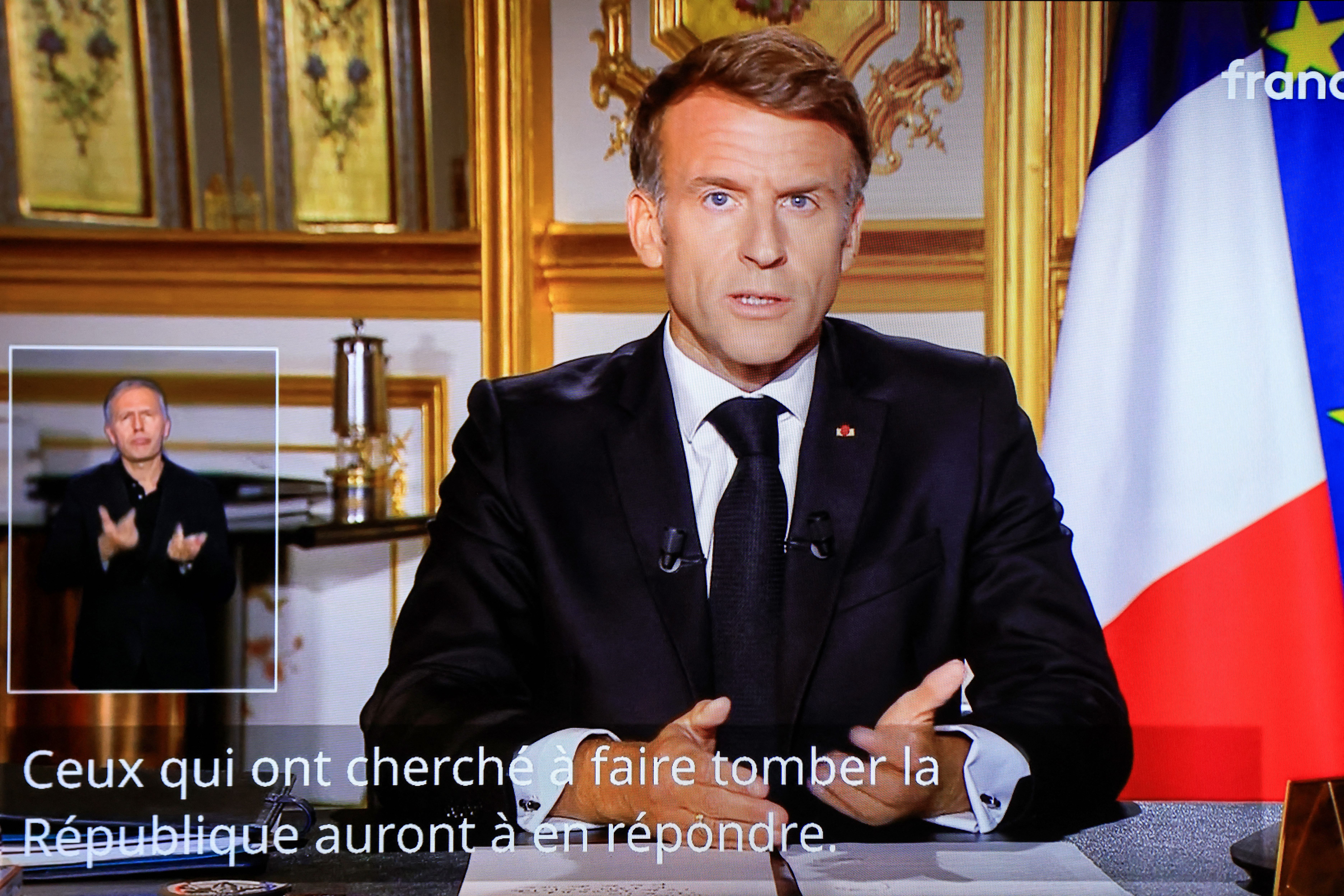

French President Emmanuel Macron on Sunday condemned violence and destruction as nationwide protests descended into the worst rioting the country has seen in years.
“Those who destroyed must pay, those who looted must repay, and those who sought to bring down the Republic will have to answer for it,” Macron told the French in a televised address on the evening of Oct. 18, a day after the unrest, which led to nearly 2,400 arrests.
Speaking of “a moment of extreme gravity,” Macron blamed the destruction on “seditious elements from ultra-left splinter groups, joined by many criminals,” and singled out the burning of the 19th-century City Hall in central France’s Limoges.
“How can French people do this to France?” he asked. “Tonight, we all feel anger and shame.”
He promised that shopkeepers “will not be left alone,” said prefects could ban “certain gatherings,” and warned that “the country needs order, not escalation.”
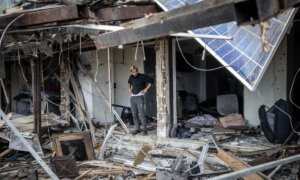
Hours earlier, spent tear-gas cartridges still littered Place de la République, where crews swept up glass around the Marianne monument, its stone base torn apart from projectiles.
Nearby, Yoni, who gave only his first name, found the display pieces of his marble showroom, Pierres Exclusives, smashed.
“We expected this kind of thing and had done everything we could to protect the shop,” he told The Epoch Times. “But here there was nothing to steal, only things to break.” A marble table worth 25,000 euros ($28,000) lay in pieces.
“This morning, when we arrived, there were still people inside the store,” he said.
In the 3rd arrondissement, pharmacist Fabien Carême stood amid the remains of his shop.
“I don’t understand why anyone would ransack a pharmacy, which is, after all, a first point of care,” he told The Epoch Times, putting the value of lost stock alone at close to 150,000 euros (about $168,000). “They’ve cut off my little business, and for a long time.”
Camille Michelin, whose optician’s shop Opti’Shop sells only French-made frames, spoke of “isolation and dismay.”
“It’s a company going in the right direction, and they loot everything, they smash everything,” he told The Epoch Times, estimating his losses at more than 50,000 euros (about $56,000). He and his three employees were inside until 5 p.m. on Oct. 17 as the crowd passed.
“There were messages of hate, throat-slitting gestures aimed at us,” he said.
The looting did not end with daylight.
By the afternoon of Oct. 18, the Paris police prefecture had counted three more stores looted and 25 arrests, describing those detained as “essentially young people from the suburbs looking for looting opportunities.”
A boutique on Rue Beaurepaire was stripped in seconds. Hundreds of protesters gathered again at République. Police fired tear gas, brought in a water cannon, and sent in the CRS 8 riot unit while barricades of trash cans burned on Boulevard Voltaire and rental bikes went up in flames on nearby streets.
The Oct. 17 march capped a month of unrest that began with high school students protesting dilapidated buildings and teacher shortages in the immigrant suburbs. Anger soon spread to rising prices and government spending cuts, and online calls urged people to revive the 2018 Yellow Vest movement, which protested the high cost of living.
The Interior Ministry put the turnout at 550,000 nationwide. Organizers, including the General Confederation of Labor union, said 800,000 marched.
Police said 110,000 people marched peacefully in Paris, while several thousand others rioted.
Paris police said the violent contingents were far larger than usual, numbering between 500 and more than 1,000. When the march broke up, small groups dressed in black pried open shop shutters between République and Bastille, and others followed to loot.
“Entire streets were methodically ravaged,” Mayor Emmanuel Grégoire told reporters. Police made 855 arrests in the capital, a record, and said one marcher had died of cardiac arrest on Boulevard Magenta.
The most shocking images came from Limoges, in central France, where the 1883 town hall, a listed monument, was set ablaze while elected officials and staff were still inside, the prefecture said; its bell tower collapsed into the flames.
Limoges Mayor Guillaume Guérin told reporters on Oct. 18 that about 700 hooded, “overtrained, armed” far-left militants had infiltrated a march of 5,000 and that police holding them on the boulevards “had no more ammunition” by 3:30 p.m. He said the intruders told elected officials, “We’re going to kill all of you.”
“It was a premeditated arson,” he said. “An attempted murder of the Republic’s elected officials.” About 7,000 people marched through Limoges on Oct. 18.
In Marseille, protesters forced the doors of city hall; knocked a bust of Marianne, the national personification of the French Republic, to the floor; and tried to set fire to a municipal police station. The police prefecture said it counted more than 30,000 “looters” at the height of the disorder, 8,000 of them classed as rioters; 118 officers were injured, and 4,000 tear-gas grenades were fired.
In Bordeaux, rioters ransacked the prefect’s residence and looted up to 100 stores, the mayor said; Lille’s city hall was briefly invaded.
By the evening of Oct. 18, the Interior Ministry counted 2,397 arrests and 997 police officers, gendarmes, and firefighters injured, seven of them seriously. Interior Minister Laurent Nuñez said groups of rioters had formed “at the very clear instigation of the ultra-left,” joined in the afternoon by looters and “opportunistic criminals.”
“Demonstrating is a fundamental right,” he wrote in a post on X. “Sowing disorder with violence and in a concerted manner is not.”
READ MORE HERE
—Etienne Fauchaire
BOOKMARKS
President Donald Trump said on Oct. 18 that the Department of the Interior’s plans to redevelop East Potomac Golf Links in Washington into a public championship golf course designed to host major tournaments, The Epoch Times’ Tom Gantert reported. In a post on Truth Social, Trump said the department, led by Interior Secretary Doug Burgum, developed the plan with famed golf course architect Tom Fazio.
Even as Trump and Chinese leader Xi Jinping exchanged visits in the most cordial manner, a major move by the Pentagon made one thing clear: Washington’s high-stakes technology war with Beijing is running on a track entirely separate from high-level diplomacy. The Epoch Times’ Olivia Li and Petr Svab reported that, in June, the War Department expanded its roster of companies the U.S. government considers to be tied to China’s military, adding 65 new firms while removing 10, expanding the total count to 188 entities, exposing deeper truths about the U.S.–China rivalry.
The United States’ war in Afghanistan began with special forces on horses. The Epoch Times’ Ryan Morgan spoke with several of those who took part in the conflict’s early days. “The next generation needs to know what we did, so they remember what we sacrificed,” Green Beret Chris Spence said.
Trump has postponed a final decision on reinstating sanctions and tariffs on Russian exports and is taking up to 60 days to review the economic impact of the delay, U.S. Secretary of State Marco Rubio said on Oct. 17. The Epoch Times’ Tom Gantert reported that Trump had earlier waived newly authorized Russia-related sanctions and tariffs, including penalties targeting the five largest buyers of Russian oil and gas. The law allowed tariffs of up to 100 percent on goods from those countries and up to 500 percent on Russian imports.