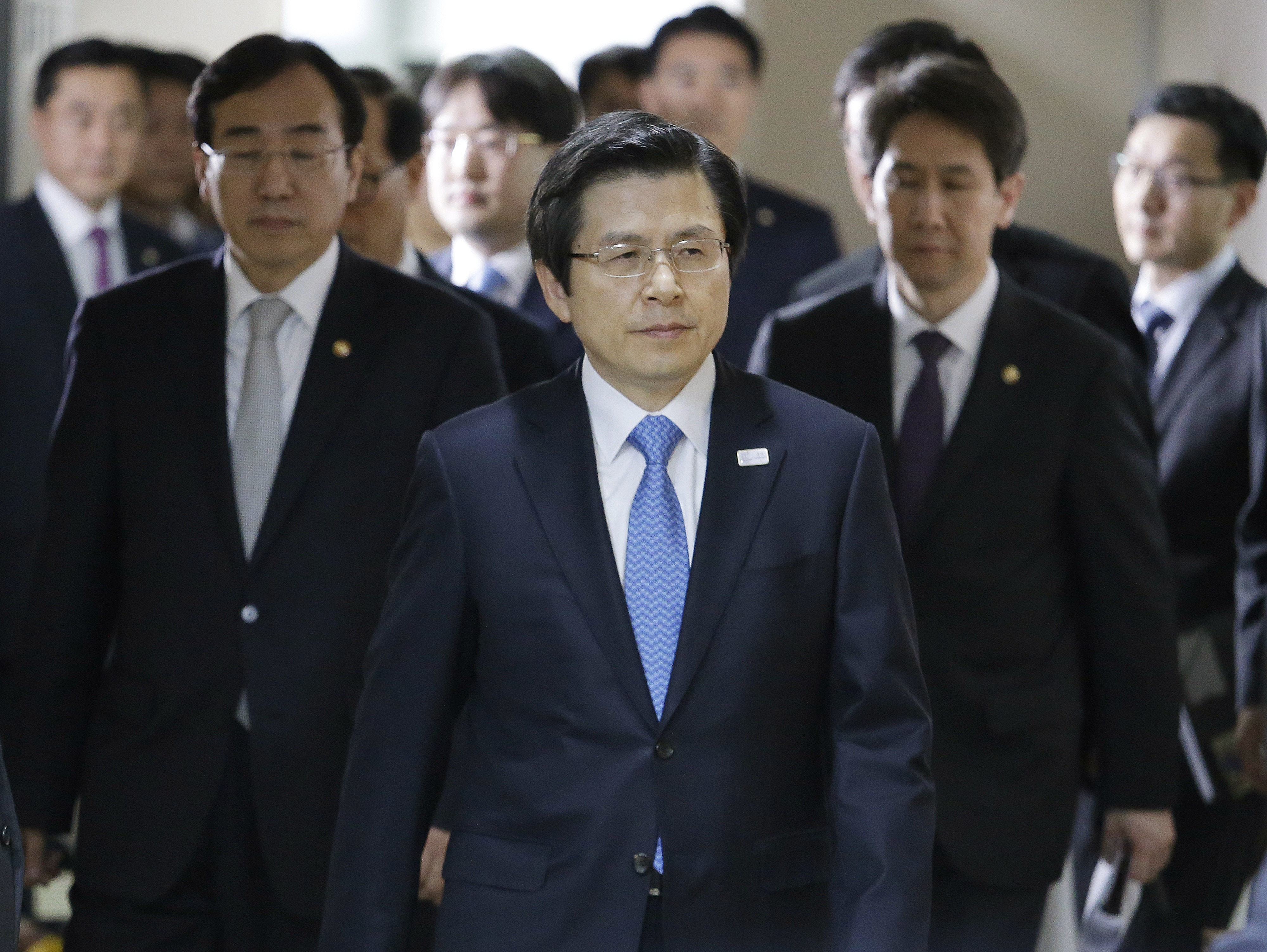

A former South Korean prime minister has told The Epoch Times that he believes that the Chinese Communist Party (CCP) is influencing South Korea’s government and is behind a surge in Chinese immigrants.
Hwang Kyo-ahn, a former South Korean prime minister who spoke last week at the Conservative Political Action Conference in Texas, said through an interpreter that his country’s normally strict immigration rules have been relaxed to allow more Chinese into the country.
This shift in policy, he said, has not been well-received by many South Korean conservatives, who fear the growing influence of the CCP.
He contends that left-wing leaders in his country, such as former President Moon Jae-in and current President Lee Jae Myung, were behind allowing the entry of more immigrants, who are mainly Chinese of Korean descent.
“They are opening borders, mainly for the Chinese, and the conservatives are opposing this,” he said.
Hwang said many people in South Korea are suspicious that some of the Chinese immigrants may be working as CCP spies.
According to Hwang, Chinese immigrants offer a strategic way for the CCP to influence South Korea’s government, which has traditionally been considered a strong American ally.
Although Chinese nationals of Korean heritage began returning in the 1980s, the flow has accelerated in recent years.
According to data from the South Korean government, in October 2025, the number of foreign nationals living in the country reached a record high of 2.8 million, or more than 5 percent of the total population.
This 2025 record surpassed the previous all-time high of 2.65 million foreign nationals in November 2024, with most being Chinese of Korean descent.
Challenges related to mass migration are not unique to South Korea. Democracies in Europe and the United States have also grappled with anti-immigration sentiments and enforced stricter rules to stop borders from being overrun. For instance, U.S. President Donald Trump pledged to shut down the southern U.S. border after an estimated 11 million illegal immigrants entered the country under the previous administration.
Progressive activists argue that tight border enforcement is incompatible with human rights.
As in South Korea, in the United States, the foreign-born population is at its highest point in history, at about 16 percent, according to the U.S. Census Bureau’s January 2025 Current Population Survey.
The last time the U.S. foreign-born population was that high was in 1890, when immigrants, mainly from Eastern Europe, pushed it to 14.8 percent, according to the Census Bureau.
According to Hwang, the current government led by Lee is welcoming foreign nationals through policy changes.
Under Lee’s government, residents of 14 Chinese cities, including Beijing, will see their multiple-entry visa validity extended from the current limit of five years to up to 10 years. Critics argue that China does not extend the same benefits to South Koreans. Multiple-entry visas for South Koreans to China usually last six months to one year, with a maximum of three years based on travel history.
In October 2025, Lee ordered a crackdown on rallies seen as anti-Chinese and anti-foreigner in South Korea, calling them “self-destructive and totally useless behavior that damages [South Korea’s] national interests and national image.”
The South Korean government did not respond to a request for comment.
Liberals such as Moon, who served as South Korea’s president from 2017 to 2022, have been open to foreign workers and multiculturalism. They argue that more foreign nationals are needed to ease labor shortages, make up for low birth rates, and achieve global integration.
Conservatives such as former South Korean President Yoon Suk Yeol called for stronger ties with the United States, secure borders, and the prioritization of Korean citizens.
According to Hwang, conservatives fear that Chinese influence operations have become rooted in large Chinese communities within the country. Conservative lawmakers under Yoon pushed for tighter controls on the voting rights of foreign permanent residents, especially Chinese.
This political climate led to significant upheaval. In December 2024, Yoon became the first sitting president of South Korea to be impeached after he declared a state of emergency and martial law, citing the need to protect the nation from “anti-state” forces and gridlock in the opposition-controlled Parliament.
Yoon was formally removed from office in April 2025. As of early 2026, he was sentenced to life in prison following his impeachment and conviction for insurrection.
Hwang was caught up in the controversy when he was detained and investigated in 2025 for alleged incitement to insurrection related to the Dec. 3, 2024, incident; however, a judge later dismissed the warrant.
Hwang said during his Conservative Political Action Conference speech that many of his citizens’ liberties have been stifled and that the National Assembly “has been taken over by pro-Chinese forces.”
Court reforms, including the expansion of South Korea’s Supreme Court under the Lee administration, have sparked concerns that the move compromised judicial independence.
The separation of powers has broken down and freedom of expression is at risk, Hwang said.
Left-wing lawmakers in South Korea attempted but failed to pass legislation that would penalize those who criticized the voting process with up to 10 years in prison.
More than 90 percent of Koreans are against the CCP, according to Hwang, who said China’s communist regime interfered in South Korean elections.
He called on the U.S. Congress to pass a resolution urging the immediate release of Yoon, attributing the impeachment to CCP influence within the government.
He also asked for a joint U.S.–Korean investigation into the possibility that China hacked into the election systems in both countries.
Reuters contributed to this report.