
The U.S. Department of Justice has filed two federal complaints against the California Air Resources Board (CARB) over the state’s enforcement of emissions standards voided by the Trump administration, officials said on Aug. 15.
The DOJ said federal law preempts CARB from enforcing emissions rules governing heavy-duty trucks and engines. The department sued after a House of Representatives committee said it recently learned that staff at CARB won’t let auto manufacturers bring vehicles to market unless they comply with California’s standards.
“President Donald Trump and Congress have invalidated the Clean Air Act waivers that were the basis for California’s actions. CARB must respect the democratic process and stop enforcing unlawful standards,” acting Assistant Attorney General Adam Gustafson of the DOJ’s Environment and Natural Resources Division said in a statement.
California’s rules governing light-duty vehicles are also preempted, the department stated.
On Aug. 11, four major truck manufacturers also asked a judge to block California from enforcing emissions standards declared void by President Donald Trump in June.
The truck companies Daimler Truck North America, International Motors, PACCAR, Inc., and Volvo Group North America claim that they are “caught in the crossfire” between California’s rules and the federal government’s laws.
The four companies control up to 99 percent of the heavy-duty truck market in the United States, according to the Federal Trade Commission.
In the complaint, the truck manufacturers say California was violating a prohibition in the federal Clean Air Act that bars states from adopting or attempting to enforce any standard relating to the control of emissions from new heavy-duty vehicles and engines without a waiver from the federal government.
The truck makers also claim that the state has demanded compliance with its emission standards and has threatened heavy-duty truck and engine manufacturers with civil sanctions and unfair regulatory treatment if they don’t comply.
CARB adopted strict rules in 2023 to reduce emissions created by commercial trucks.
The state’s Advanced Clean Fleets rule called for phasing out medium- and heavy-duty combustion trucks by 2036, paving the way for all fleets in the state to be zero-emission by 2045. The rule mandates drayage trucks, or big rigs, to be zero-emission by 2035.
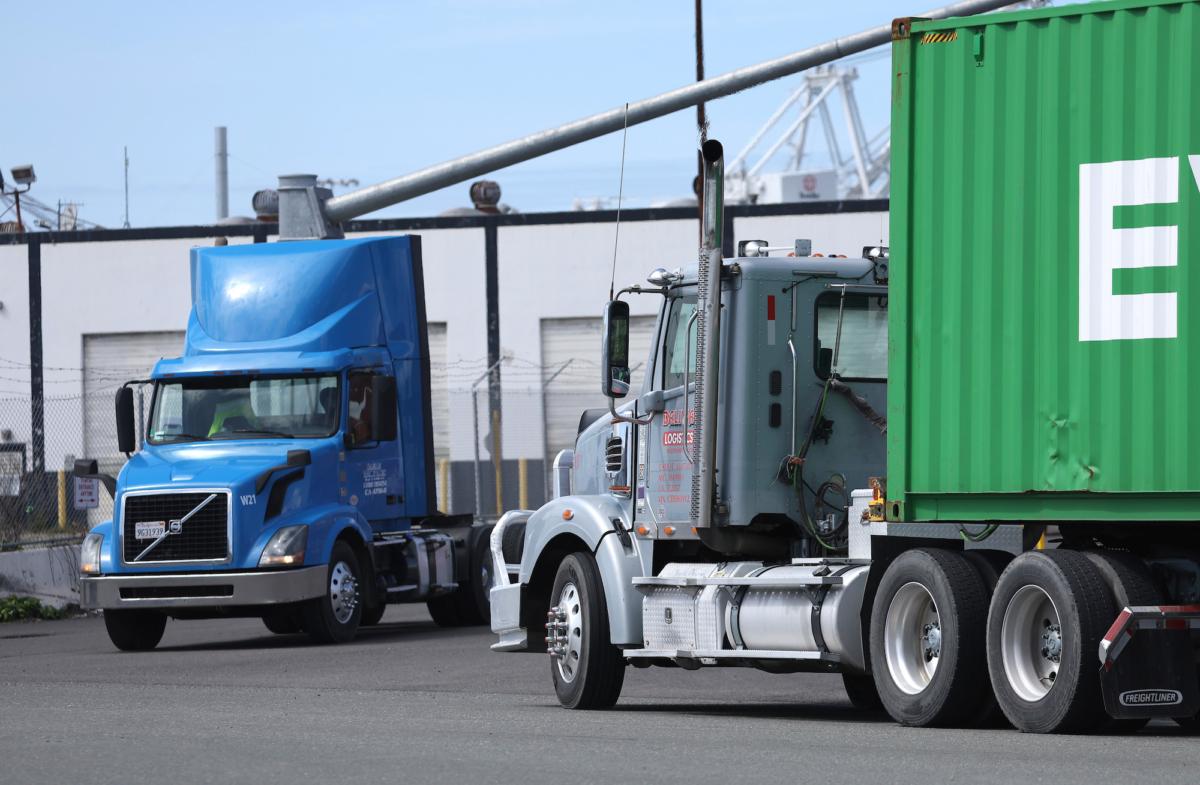
Trucks drive through the Port of Oakland in Oakland, Calif., on March 31, 2023. (Justin Sullivan/Getty Images)
During President Joe Biden’s term, California received a waiver from the Environmental Protection Agency (EPA) to allow the state to pass its strict emissions rules that exceeded federal laws.
Trump signed a package of resolutions in June that, in part, rescinded the EPA waiver granted in December 2023 that allowed the state to enforce its standards.
California joined 10 other states in an ongoing federal lawsuit filed in June to challenge the legality of the resolutions.
CARB was unable to comment on pending litigation, an agency spokeswoman told The Epoch Times.
FTC Investigation
In 2023, California entered a Clean Truck Partnership with truck manufacturers that aimed to provide the companies with enough lead time to comply with future regulations.
As a condition for the relief, CARB required that manufacturers comply with the state’s emissions standards, despite any litigation over CARB’s authority to implement the standards.
On Aug. 12, the Federal Trade Commission (FTC) ended a probe into the Clean Truck Partnership and whether several truck and engine manufacturers and a trade association violated antitrust laws.
FTC said Daimler, Volvo, PACCAR, and International Motors agreed to act independently and avoid future anticompetitive agreements with CARB.
“CARB’s regulatory overreach posed a major threat to American trucking and, in our view, presented serious antitrust concerns,” Taylor Hoogendoorn, deputy director of the FTC Bureau of Competition, said in a statement.
The four truck manufacturers recently told the FTC that the Clean Truck Partnership is unenforceable and that they had never planned to enforce its terms.
Reuters contributed to this report.