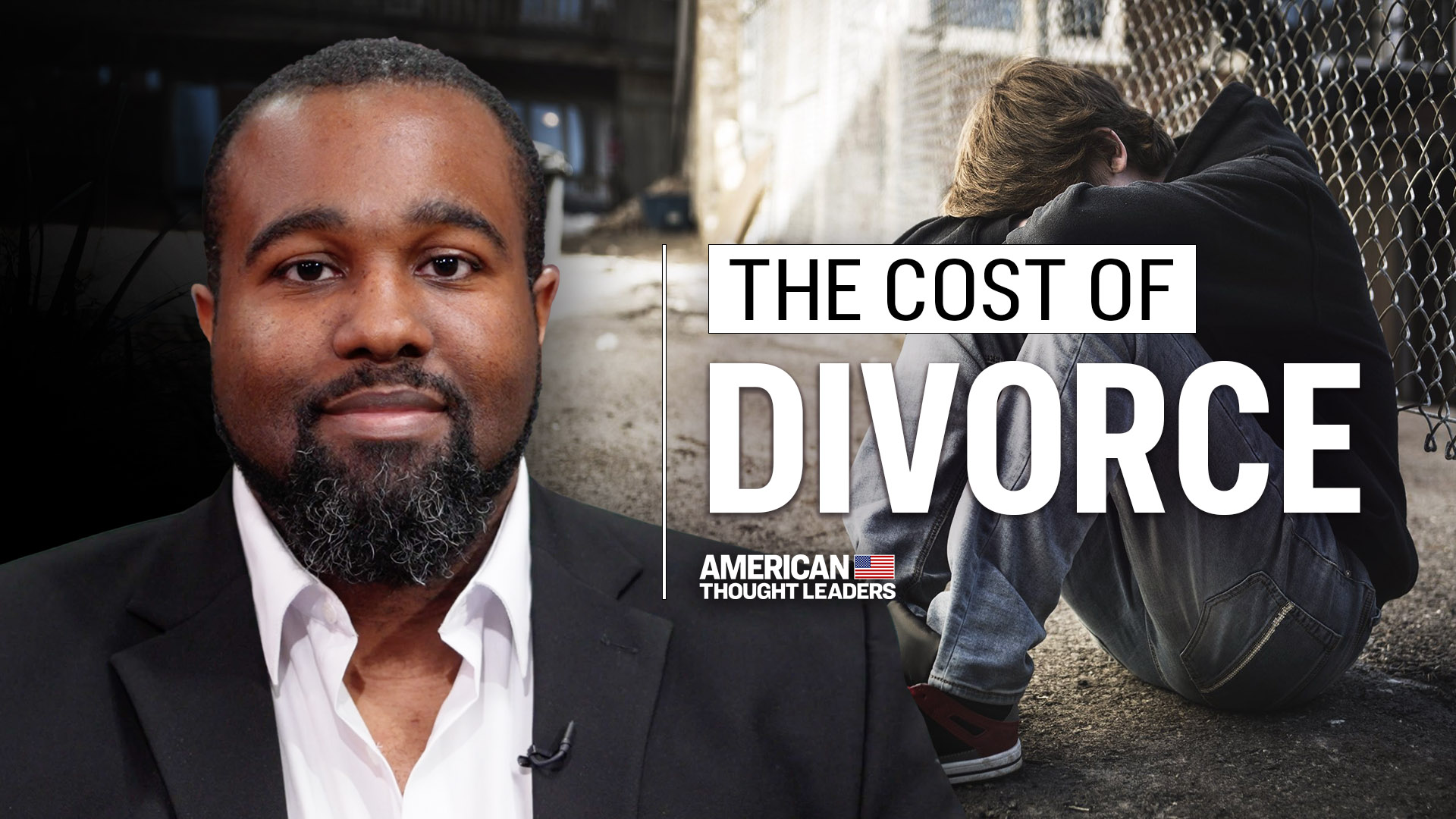

[RUSH TRANSCRIPT BELOW] When Adam Coleman was 8 years old, he was institutionalized after contemplating suicide. He shares his struggles—and the struggles of so many others in America—of growing up without a father in his new book, “The Children We Left Behind: How Western Culture Rationalizes Family Separation and Ignores the Pain of Child Neglect.”
“I went through a lot when I was a kid, and I want my story to be an example that, yes, certain things happen to you when you’re a child, but when you’re an adult, you make life happen for you. So, it is possible to overcome these circumstances,” he says.
Only 60 percent of children in America live with married biological parents. Among black children, it’s 33 percent.
What’s fueling the rise of divorce and family separation in the West? How do we make resilient, two-parent families the norm?
“There are a lot of people who are afraid of marriage, afraid of having children, afraid of being alone with the opposite sex because of their childhood situation,” says Coleman.
“If we demonstrate a household that is proper, that is healthy, then you have more kids who grow up with a good, positive image of having children, wanting a bigger family, of having marriage as the priority.”
Views expressed in this video are opinions of the host and the guest and do not necessarily reflect the views of The Epoch Times.
RUSH TRANSCRIPT
Jan Jekielek:
Adam Coleman, such a pleasure to have you on American Thought Leaders.
Adam Coleman:
Thank you for having me.
Mr. Jekielek:
Adam, as the child abandonment is, I guess, the key driver in your mind of some of the worst social malaise that we’re experiencing in society. Tell me why you think that.
Mr. Coleman:
I think it is because I’ve seen it. I’ve seen it up close. I’ve seen it with people who are struggling with drug addiction. And I’ve heard their stories of people who end up in prisons, things of that nature. And there’s always this common link between them, whether it was physical abuse, sexual abuse, or abandonment. There’s something happening within their home when they were children. And so for me, I’m also looking at my situation.
We talk about mental health a lot in America, but every time I see people who are struggling with mental health and you start digging a little bit deeper, you find out they’re coming from a dysfunctional household when they were kids, and it created this anxiety, this instability in their mind. And that’s much of my story of questioning myself, questioning my mental state, whether I’m of value or not, stemming from being abandoned by my father and watching my mother struggle. And sometimes even asking, am I the reason why my mother is struggling? So it’s not just that I saw it around me and was just anecdotally talking to people that I know and am familiar with, but I’m also looking at my story and what I experienced.
Mr. Jekielek:
It’s kind of unbelievable even to think about. You were actually institutionalized when you were eight years old because people thought you were going to kill yourself. That is very hard for me to fathom, but give me a little bit of your background. How did it get to that, and what happened there?
Mr. Coleman:
For much of my life, I kind of blocked out these memories until my sister brought it up to me, I want to say almost a decade ago, in my early 30s. And when she did, all these memories came rushing back to me as far as what happened. But essentially, we had moved from Virginia to upstate New York to live with a family member. And it wasn’t working out there. There was yelling between us. It was kind of like a verbally abusive environment, specifically towards me, between my family member and myself.
Mr. Jekielek:
Okay.
Mr. Coleman:
My mother was trying to go to school. She was working as well. So there was a lot of time that we were home either by ourselves or under the care of family members. That situation went awry. And suddenly one day I came off the bus and my mother was like, we’re leaving. From there, we didn’t really have any place to go. So we ended up in hotel rooms. We stayed with a woman who offered a room in a trailer.
It’s the three of us, myself, my mom, and my sister staying in a trailer. Eventually, after about two to three months, my mother had enough money. We got our own apartment. But by then, the amount of instability that was happening on top of the fact that I don’t think really anybody in my school knew what was going on. You know, I’m going to school every day, but coming not home, but to a hotel room. So by the time we got into the apartment, you'd think everything would be fine.
But for me, it was just incredibly chaotic and I didn’t know how to handle it. I didn’t know how to express myself. My sister, she’s four years older than me, so she remembers it a little bit more vividly, but she remembers one specific day I was underneath the kitchen table and I was like in a fetal position, just screaming. And it was like I was having a mental break. And my mother remembers me telling her that if she loved me, she'd help me die.
From my memory, I don’t remember those specific moments of saying that, but I remember how I felt. I remember feeling in distress. I do remember one day getting into a car, heading somewhere that I’ve never been before in upstate New York, going into some facility and my mother handed me off to somebody and I didn’t know where I was. You know, no one explained to me what exactly was going on. It took me a little bit to realize where I was, and I was in a mental hospital. And subsequently, I was there for three months.
The way I explain it to people is that when you go to jail, you know how long you’re going to be there for. Generally speaking, you’re sentenced. But when you go to a mental hospital, it’s up to them as to when you leave. So you don’t know. And as a kid, you know, when you see your mother coming to visit you, you think today might be the day I get to go home. And she has to tell you no.
Within the book, I reveal that talking to my sister about this was the first time I heard my mother’s perspective. You know, after those visits to see her son, the entire drive home, she’s crying because her little boy is locked away. And I never really thought about my mother’s perspective of what she went through, especially now as a parent. I understand, you know, the difficulties my mother faced and how hard that must be to have her little boy locked away like that.
Mr. Jekielek:
You struggled with your lack of relationship with your father, who basically was completely absent aside from some semblance of child support or something. Just tell me about that a little bit.
Mr. Coleman:
Yes. I was born in Detroit. My father always lived in Detroit. He was married, but he was just married to somebody else. You know, my mother left because she needed support. She wasn’t getting much of any support. And Detroit was getting worse crime-wise and things of that nature. So that’s why we ended up leaving the city.
But after we left, I didn’t really see him. I would see him once every couple of years, something of that nature. I might get a phone call. But, you know, as a kid, it felt like the phone call wasn’t really for me. It was for somebody else. You know, it was just like an obligation. You should talk to your kids kind of thing. I could be wrong, but that’s how I felt as a kid. But nevertheless, I didn’t really hear from him.
Even if I did talk to him, it was always, how was school? School’s fine. Okay. Two-minute conversation. My father didn’t know anything about me. And still to this day, I don’t really know anything about my father. You know, he would come through living in, you know, the Northeast in New York and New Jersey. He might come through to go to New York City to get fabric because he was a tailor. But he would stay with us for a few days. But it wasn’t really to see us. It was a place to stay.
Every time he would come, I remember feeling somewhat excited to see him but then quickly feeling like he wasn’t engaging with me, and he would always leave in the middle of the night. If that was me and my son, I would be like, hey, I’m leaving in the morning, give me a hug before I go to bed or something like that. I would just wake up and he was gone.
The last time I saw my father I was 16. He took me to the mall and bought me some clothes; that was the extent of it. And the last time I talked to him, I was 21. I called him after my son was born, but I didn’t talk to him for very long because it didn’t seem like he was interested in speaking with me. So I never told him that he has a grandson. And I never closed the door if he attempted to call me. I allowed for it to happen, but he never tried. And he died some years ago. So there was never any sort of establishment or reconciliation.
Mr. Jekielek:
Just a moment comes to my mind where you’re describing sort of seeing him happy in photos with other people.
Mr. Coleman:
Yes. While I was writing this book, it allowed me to talk to my mother when she told me that my father died. He had died a few months before my mother found out. She just happened to Google his name and found the funeral home and found his pictures. So while writing this, I was like, you know what? I’ve never Googled my father’s name.
I went to the funeral home website and I saw his pictures. I just saw a bunch of people around him, but I had no idea who they were. I don’t know if they’re family, friends, no idea. But my next thought was, I wonder if any of them know that he has children that he abandoned. And I think that was much of the motivation for writing the one chapter in the book, Socially Comfortable Terrible Parents.
How many people do we have in our lives that get to be comfortable around us adults while we actively know that they’ve abandoned their kids or they’re treating their kids terribly? They yell at them, scream at them. They treat them like dirt and they get to hang out with us, go to the movies, come to the family gatherings, and no one ever says anything to them. And so outside of my father, I’ve seen that, you know, in different families that I’ve gotten to know. And I’m like, wait, that’s a situation? Is that a secret? No, everybody knows. Oh, so everyone knows, you know, and it’s shocking how common that is.
Mr. Jekielek:
There are two things here. One is that when you describe child abandonment, it’s not necessarily where the parents are entirely absent. They can just be absent because of selfishness. I want to touch on that in a moment. Or narcissism. This is kind of a bizarre feature of our current age. Well, let’s focus on that.
Mr. Coleman:
Yes, the narcissism part, or if you just want to call it selfishness, putting yourself ahead of your children, making detrimental choices that you know are going to negatively impact your kid, but you’re going to do it anyway. Now, I’m not saying that these people are evil or anything like that, but we just have a culture of rationalizing things to kind of swallow the outcome that’s about to happen, how it’s going to affect their kids.
We say, well, mommy and daddy are getting a divorce because we’re not in love with each other. But if I’m happy, my kids will be happy. That puts the parent as the primary focus, not the child, right? The child becomes secondary in that type of rationalization. But that’s enough for people to split up their family, blow up the world for their child. And it’s not to say that I’m anti-divorce or anything like that, but there are parents who are choosing themselves over their kids periodically, and especially for really big monumental choices.
Mr. Jekielek:
You fit that into the broad concept of abandonment. And I found that very interesting. But this is a broader societal issue. I mean, just look at our birth rate, right? In basically every free nation in the world, right? It’s below replacement. That is shocking to me. When you really think about it, it just means we don’t really value our children enough to have enough to actually replenish the society. That seems kind of crazy and nihilistic almost. I don’t know what your thoughts are on this.
Mr. Coleman:
There are a lot of people who are afraid of marriage, afraid of having children, afraid of being alone with the opposite sex because of their childhood situation. You know, marriage to them is what their parents did. And if you grow up in a happy, healthy household, of course, marriage looks fine. Right. You have a blueprint. It feels good. It looks good. You learned a lot.
But if you grew up in chaos or your parents got divorced, you know, when you were 10 and you saw that marriage doesn’t last forever and it hurts people and all this pain associated with family, then I understand why people don’t want to procreate, don’t want to get married. They don’t want to do any of that stuff because they don’t see it as a guarantee. They don’t see it as overall productive. All they do is associate hurt with it.
For me, it’s rational to see someone make that choice. And often when I see people who make that choice, it’s not just, I decided not to get married. It’s that I’ve decided not to get married because of a whole slew of very personal anecdotes to them. I think that exists throughout the West. Obviously, there’s economic means. You know, people don’t feel like they can afford it. You have to have two incomes these days.
There’s a lot of things that kind of contribute to it, but I don’t think we talk enough about the young people who may be getting into relationships who are afraid. They’re operating off of fear because of what they saw. They saw chaos. And if we demonstrate a household that is proper, that is healthy, then you have more kids who grow up with a good, positive image of having children, wanting a bigger family, of having marriage as their priority.
Mr. Jekielek:
I’ve had some thoughts about this. My parents were divorced right around the time I finished high school. And when I was younger, I, you know, they had a difficult relationship. And I often wondered why it made sense for them to be together. As I look back, right, over the years, I find myself incredibly grateful for the fact that they clearly chose to maintain the relationship for the benefit of the kids, despite it being very difficult. And that’s interesting because that’s changed over the course of my life as I look back. And it really is a very different way of looking at the world. I don’t know how many people would do that anymore, right? Based on the social zeitgeist.
Mr. Coleman:
Not too many people would choose to do that, especially if they tell other people, I’m struggling within my marriage, right? Because the first response is that you got to leave. If you have a good friend, they'll tell you like, well, you know, I’m here for you. You know, here’s how you might be able to resolve it. It’s usually you’re right, they’re wrong. And ultimately leading towards, well, nothing’s being resolved. I guess you got to go. And it’s difficult.
Relationships are difficult. Maybe in certain circumstances, you got to leave, right? There is the obvious, you know, some sort of abuse. Very clearly, this is not healthy for the partner or for the children to be around, right? That’s far more detrimental. So I don’t know if a lot of people consider these things.
Divorce isn’t just signing a piece of paper and then everyone goes on their merry way. There’s an emotional impact that happens for the kids. There’s an emotional impact that happens for the person who’s being divorced. It’s not always amicable. You know, one person might be trying to hold on to it while the other person is trying to let it go.
Maybe there is infidelity; there are a lot of emotions that are tied up in it on top of just the general sense that a lot of people who get divorced feel like they failed, and that sense of failure stays with them on top of you trying to raise kids who are now starting to feel rejected. It’s very much so far more detrimental than people acknowledge.
Mr. Jekielek:
I’m going to read something that jumped out at me from the book. Okay. I mean, exactly in this vein, right? The single most important duty of parents is the preparedness to sacrifice themselves for the benefit of their children. That includes sacrificing their pride.
Mr. Coleman:
Yes. You have to sacrifice your pride sometimes. You have to be willing to say, you know what? I was wrong, right? Instead of trying to fight something or maybe it’s not about being right and wrong; maybe it’s just finding a resolution. If you’re looking at your partner as a combatant, if you’re looking at them as someone you’re competing against, right, which is a common mentality if you’re measuring things, well, I do more than they do, right? If that’s the constant back and forth rather than figuring out, well, what is my role in this relationship? Maybe the role is a little bit lopsided, but that’s the role that we agreed upon. And we’re told there are no roles. You know, everyone just does what they want.
But very clearly, there are relationships that start falling apart because one party feels like they’re doing more than the other party. And they’re measuring, I’m working hard. This person doesn’t appear to be working hard. And it happens in both sexes. If we lowered our pride and actually talked to each other, then you have to find some sort of resolution from that.
But this is also honestly, I think this goes back to choosing the right partner, and I think a lot of people fall into relationships; they start having sex and they like each other, so, you know, then they just kind of get married because they’ve been together for so long, and oh, someone’s pregnant, right? It’s not a conscious choice; it’s just things that are happening to them rather than them dictating how their life goes, and they’ve never really talked to each other in any sort of deep way. So I see that very often. You know, I got married later in my life, but I got married to the right person because she’s my friend, and I could talk to her about anything.
Mr. Jekielek:
It’s interesting that you say that because you had a son who I’ve met. and he seems like a wonderful young man. You played a role in choosing to have him alone.
Mr. Coleman:
Yes, I’ve always been there. I’ve always been active in his life. I thought maybe one day I want to get married. It’s not that I shied away from it; I just didn’t know even how to approach it. There were a lot of shortcomings for me as a young man to figure out how to even approach relationships from a male perspective, and so I just got with someone that I liked, and she eventually got pregnant, right? I wasn’t thinking I’m the very case of the scenario that I was talking about, but it stems from ignorance. It stems from ignorance and it stems from not being shown this as a kid, and I didn’t have an example.
I didn’t have a stepfather. My mom really didn’t even have any boyfriends. My mother never got married. I never really saw what a relationship looked like within my household, so I was kind of going at it with a blank canvas. Like I didn’t know how to approach this. So it’s no sort of regret. I love my son, but you know, every parent makes a mistake.
They make several mistakes, but I tell him that what you should do is get married first, then have children. You need to improve yourself. Right now, you’re 19. You need to work on yourself and improve yourself. Don’t chase women, right? When you improve yourself, the women will be there. It will all, you know, they'll be fine.
But I’ve had these conversations with him that I never had when I was younger. No one ever explained these things to me. And so my son’s not lost in the world chasing girls to try to feel good about himself. My son is focused, as he should be as a 19-year-old who’s trying to build a career, who’s trying to build himself and discover himself.
So that’s why I ended up in a circumstance where I did have a child out of wedlock. I never got married to his mother. But one thing I told myself when my son was born was that I was always going to be there. I wasn’t going to be my father. He always knew who his father was.
His mother got married at one point, so he had a stepfather for a period of time. But when they went through their divorce, he always knew he could come to me and we could talk about it. I built a relationship with him based on communication, based on honesty, and we talk about things. When he wants advice, he can always reach out to me.
Mr. Jekielek:
So many vantage points here. One is the incredible setup for success when you actually grow up in a two-parent household. That’s very interesting. And that actually speaks a bit to what we were talking about earlier, which is parents choosing. I suspect even when that relationship is fraught, when those parents stay together, that still creates a lot of opportunity. That’s one side.
The other side is being there for your kid when that’s not possible, nonetheless. And that, of course, is a whole different level than the third option, which is neither of those things. You talk about discipleship, and this is kind of the first time that I’ve seen it discussed in the context of parenting. Tell me about that.
Mr. Coleman:
You know, one of the most controversial things that you can talk about as a parent is discipline because the question becomes, do you hit your child or do you not hit your child? And discipline or, well, yeah, discipline comes from discipleship, right? It means to teach. And by hitting your child, what are you teaching your child? You know, you'll hear some people say it’s to get a reaction out of them. Well, you can get a reaction out of a child multiple ways without putting your hands on them.
And for me, that’s not an expression of love. In no circumstance would we say, well, it’s okay that you hit your wife because you love her. I was like, no, you don’t hit people that you love. Nevertheless, a child who’s defenseless, who’s a third of your size, who has no recourse for anything that you do. So for me, I’m about teaching my son. It doesn’t mean I haven’t yelled at my son or anything like that, but it means that my focus was always about teaching him. I think we get too carried away with punishment, right? You can punish him. You’re grounded.
Mr. Jekielek:
Or frankly, lack of it, if I may, right? I think like when I hear you talking, I don’t think the problem is that people are giving out too much punishment. Like at least, you know, from everything I’ve read and seen, it’s over this, the lack of boundaries, the lack of discipline, right? That seems to be more of the incredible permissiveness, if I may, but please continue.
Mr. Coleman:
You’re absolutely right. It’s both, right? At the end of the day, we’re talking about an imbalance. For the people who are disciplining, I sometimes see that they’re going above and beyond what they should be doing. But then there’s also an imbalance where they’re not doing anything. And for the people who aren’t doing anything, they want to be their child’s friend, right?
But being your child’s friend puts you at an equal level, right? I can’t tell you what to do. I have no authority over you if you’re my friend. But if I’m your parent, I have authority over you, which means I have to tell you what to do. But if you reduce that authority and always see yourself as your child’s friend, well, they won’t listen to you. You don’t punish them. You give them everything that they want, right? You’re trying to be a quote-unquote good friend.
You need to be a good parent. And there’s a difference between not being your child’s friend and not being friendly. Of course, you'd be friendly with your child. I respect my son. He respects me. There’s a certain level of authority that I have over you and a certain level of respect that I want exemplified for me. In the same way, I don’t overshare with my son. He doesn’t engage. Well, when he was a child, he didn’t engage in adult conversations, right?
I do think for the people who are avoiding discipline, being a parent is a far greater status than being a friend. And they’ve yet to realize that. We have friends who are here for five years and disappear. You never talk to them again. But when you’re a parent, that’s for life. And so there is something that is honorable and beautiful about being a parent. There is something fleeting about being a parent, and there’s something fleeting about being a friend.
Mr. Jekielek:
What do you think is the single most important thing you could do when you know you have a fraught relationship with your child?
Mr. Coleman:
Do you mean in a circumstance where your child is still a child or they’re an adult now?
Mr. Jekielek:
When they’re still a child.
Mr. Coleman:
With accountability and acknowledging that you are hurting your child, that’s the pathway towards healing. So it doesn’t necessarily mean that you acknowledge it. I am sorry. I know I hurt you. They still may put the wall up and ignore you.
But here’s the thing, when they do that, it’s because they want you to hurt like they’re hurting. And they want you to fight to get back into a relationship because all they’ve seen is that you’ve given up. And so if they put that wall up and you’re like, well, I tried and you walk away, you validate that you’ve abandoned them, right? See, he wasn’t serious. He’s not even trying.
I do think that reunification is really important, which is why I talk about forgiveness in the book. If you’re a child who’s been abandoned, speaking of myself, even though my father’s not alive, when he was alive, I forgave him, right? Always left that door open if he did want to call and say, you know what, I was wrong. I was a young man, or he wasn’t really a young man, but, you know, in the past, I made mistakes. I’ve come to realize these things and I’m sorry, and I just want to get to know my son because I don’t know who you are, I would have allowed for that to happen.
A lot of kids would allow that to happen, but the mistake of parents, and I’ve talked to fathers in this situation especially, who are trying to get back into their children’s lives, the child has a version of what happened, he has a version of what happened, and so when the child says, well, you did X, Y, and Z, he’s like, no, no, no, you don’t understand because your mother did. It becomes obvious that they’re missing the point. And it sounds like the only reason you’re talking is so you can validate what you did and try to legislate all these different components of the situation that maybe the child wasn’t aware of, rather than they just want you to acknowledge that you didn’t do the best thing and that they’re hurting. That’s it.
And so sometimes the parents who are trying to get back in their kids’ lives are debating the issue. Or if it’s the father, he’s like, you don’t understand, your mother was doing X, Y, and Z. Well, guess what? That child loves that mother. And trying to build a case against someone that they love is going to be a losing battle, especially if you’re coming from the weak position of not being in their life. So that stuff becomes the noise when it comes to reunification.
Whatever they say that you did, it doesn’t matter what you did. That’s how they feel. That’s what they believe. And maybe one day they'll be open enough to actually hear your perspective, and then they will make a decision. You know what? Maybe I am misremembering that. But battling them on details is a losing battle, and giving up on them when they do push back will ultimately validate their feelings.
Mr. Jekielek:
What about in situations where a parent really abused the child in terrible ways? Is it reasonable to expect someone to forgive in that sort of situation? Is it necessary?
Mr. Coleman:
We also have to look at the word forgiveness, or actually the meaning of forgiveness because forgiving means for you to release your anger and animosity, right? The forgiveness is for the person who was victimized. It’s not for the person who’s the perpetrator looking for some sort of clemency or something like that.
Ultimately, when I say I forgive my father, I forgive my father. So I let go of my anger, my depression, my feeling of rejection to let all that stuff go. So I don’t have anything dragging me back and I can move forward in my life. And so if you were abused in some particular way, is it beneficial to hold on to anger, that feeling when you were a child that was abused? Is it beneficial to hold on to that, or is it beneficial to release it?
The forgiveness is to release that, right? It’s not to excuse their behavior. It’s not to rationalize their behavior, say it was fine. Now from there, if they want to get into a new relationship with that parent, despite them abusing them, then that’s purely up to them. In those situations, I would never say, no, you must take them back or anything like that. These are very difficult, extenuating circumstances. So I would purely leave that up to the person who was victimized.
Forgiveness, the core of it is for the person who was victimized. Whether you choose to let the person who victimized you know this is completely up to you. But I do think that forgiveness is the starting point if there is going to be some sort of reunification with abuse or not abuse. Forgiveness is at the core of it.
Mr. Jekielek:
You talk a lot about people or children recreating the trauma they see from their parents or the people in their lives. And then there’s this sort of chain. The idea is to break that chain and that makes sense to me. There are also what we now call people with antisocial personality disorder. It’s not an insignificant portion of the population. And that particular, those people get some sort of weird benefit from traumatizing people actively. What about, how do those types of people factor in? It’s not like they’re not that way because someone traumatized them necessarily.
Mr. Coleman:
I’m not a psychologist. Let’s say someone who’s a legit narcissist, right? That stems from insecurity, and more often than not, that stems from childhood insecurity, but it just gets exaggerated as they get older. They don’t believe anyone will look out for them, and so they can’t trust anyone. They are highly insecure about anyone else, so if you’re insecure, it’s going to come out in a particular way. Specifically for narcissists, they lash out when you hurt their image. So they usually are these types of people who want to get you before you get them because they’re highly afraid of being vulnerable.
Mr. Jekielek:
One area that you seem to focus on in particular, even though you yourself were not in that, I guess, setup, is the foster care system and significantly higher rates of abandonment or abuse or these chains of abuse being formed while being in that system. Someone recently has been talking to me about this. I’ve just been learning about the levels. I’m more familiar with incredible success stories of the foster care system, of which there are some unbelievable ones.
But actually, there are some huge, huge problems. In some cases, people will bring more children in because there’s a financial dimension to it, and they don’t actually care for the kids as much. And so there are these success stories, but there’s also a lot of trauma, generational trauma created. So tell me about that. You have actually a specific interview that you decided to feature in your book, even though this wasn’t your experience.
Mr. Coleman:
Yes, and you’re absolutely right. When it comes to the foster care system, it’s one of those things that we know is bad, but we don’t know to what extent, right? A lot of people either don’t tell their story, maybe they feel embarrassed, insecure, or something of that nature. Or maybe it’s just too traumatic to talk about, which I completely understand, especially publicly.
But I coincidentally came across someone who became a friend of mine by the name of Cari Bartholomew, and I featured her story. I interviewed her. Her mother hated her. She treated her as such. She was physically abusive. She was grooming her to become a prostitute at one point. She’s mixed race; her mother is white, and her father is black.
But she had a grandfather who was part of the KKK. She basically had sex with a black man to piss off her father, and she got pregnant. So here she has this child. She doesn’t really like black people like that, and so she sees her child almost like a dirty child, and she treats her as such. She’s just a thing within the home. She was subsequently raped at the age of five by her mother’s friend.
Her stepfather was in the process of starting to molest her and was going down that route. She describes having to hide in the basket from her mother because her mother was so physically abusive that she would hide. She ultimately turned herself in to the authorities at the age of eight, and she thanks God every day for giving her enough of a mental understanding to do such a thing.
Mr. Jekielek:
Talk about the courage of an eight-year-old kid to do something like this. That is just astonishing, right? You know, unbelievable.
Mr. Coleman:
Yes, but she had no family that she could really turn to. Funny enough, her grandfather, who’s part of the KKK, after she was born, left the KKK because of her. He ultimately died when she was young. So the one family member that actually loved her, and she remembers very fondly, was the former KKK member grandfather. That’s how weird the world is sometimes. But she had no one.
So she had to turn herself in at the age of eight, and she stayed in the foster care system until she aged out. She talks about how, within the foster care system, she was placed from house to house. Yes, she had kids who were violent that she would live with or kids who were attempting to do something sexual with her, more than likely because something sexual was done to them, right? Just repeating this type of behavior. She had to hide in the bathroom because her foster brother was trying to do something to her.
This is the type of stuff that she did have to go through within the foster care system. She had no one to turn to, and actually, the person that she gives the most thanks to is her social worker. She explained that most kids have cycling social workers and therapists and stuff like that, but for a long time, she had the same one. He gave her hope and was actually looking out for her, and she remembers his name and remembers him fondly.
If you met her today, you would have no idea all the things that she went through. She has a child, she’s married, she’s a happy person, and she’s a believer in God as a Christian. For a lot of people, they think to themselves, and I went through that when I was younger, like all these bad things are happening to me. You know, why would God let this happen?
But for her, she’s like, yes, these bad things happened to me, but God gave me enough intelligence and courage to get up at the age of eight and turn myself in. You know, that’s how she sees it. For me, she’s remarkable in that. Also, because she worked through all the things that happened to her. When I’m talking to her and she’s telling me all these things, she’s not crying; she’s not sobbing. She’s being very matter-of-fact because she did the hard work of actually resolving how she felt.
To me, it is beautiful to see that she was able to have reflection, self-reflection, but lean on God and improve herself because of it. The reason I talk about the foster care system within this book is that that’s the ultimate child that’s left behind, right? They don’t have extended family, or if they do, they don’t want them. They don’t have their immediate family. No one wants them. They’re literally just put into a system that will take anything. These are all forgotten children who are all experiencing abandonment issues.
At the very least, often their parents are drug addicts. Molestation is happening, right? All these different things. Their parents are choosing drugs or choosing a partner over their kids. The state takes them away, so the state ultimately wants to reunify kids with their parents. They don’t want to take on these kids, but they have no choice because no one is suitable or no one wants them.
Mr. Jekielek:
Ultimately, how do you view that system now? I mean, because it also sounds like something that’s needed, actually, even though it’s very fraught. I think about my feelings about it—I found a little bit more detail as far as not just the foster home but the foster care facility. I was talking to Pamela Garfield about this because she worked with foster kids at one point when she was in California.
She was detailing a facility that sounds like a jail, right? They’re the most aggressive, the most misbehaved, completely destructive children, right? They’re all minors, and they literally have to be locked away in their own cells by themselves because they cannot be trusted to not just be in society, but to be around other foster kids too. How much has to happen to a child before they get to that point?
Mr. Coleman:
If they’re in the foster care system for a period of time, they have some sort of trauma. They’re being displaced, constantly moved. They’re abandoned. But there are other things on top of that. These kids are essentially the worst of the worst that she’s describing of what they’re going through. For these kids, they don’t have any hope. Hope tethers us to life. Otherwise, what’s the point?
For these kids, they don’t have any hope, and they’re just being tossed around. All the adults in their lives don’t really care about them, or they feel like they’re an inconvenience. They’re just being shuffled around. Even their own parents, who brought them into this world, mistreat them, abuse them, neglect them, molest them, you name it.
Mr. Jekielek:
You know, something you mentioned about Cari, of course, is that she found faith, and that was very important to her. I know it was an important part of your own process, of course. I’ve spoken with many people, whether Jewish or Christian or Falun Gong practitioners or a number of different groups, where rediscovering that connection to God or the divine more broadly was a central part of figuring out the forgiveness thing or being able to move on. Maybe as we finish up, let’s talk a little bit about that.
Mr. Coleman:
Last year, I was baptized. I was able to get baptized in front of my mother, my sister, my uncle, and my nephew. Unfortunately, my son wasn’t able to make it, but it meant a lot to make a promise to God in front of my family. Subsequently, after that, I had a conversation with my mother, and she told me that when I was very young, I would wear these little suits, and I would walk around with the Bible, and I'd tell people about Jesus and Scripture.
I asked her, well, what happened? Because I don’t remember any of that. She really didn’t have an answer for me. If I were to try to answer that question, I think that life was happening to me, and I lost focus on God. I was feeling more and more abandoned by my father. And I think that I also thought my heavenly Father was abandoning me too.
If there’s a God, why would these bad things happen to me? So there must be no God. That was the kind of thing that would run through my head, but I wasn’t sure enough to say there was no God, right? So I was agnostic for many years. I hated faking that I was a Christian because I wasn’t sure. I had a lot of doubt in my life about myself and about faith.
And through a series of events, it’s too long for this interview to go into, but I detail in the book, but especially coming from being an IT guy to a writer and doing all these things, I just kept coming across all these Christians who would say stuff to me that didn’t just sound nice, but I felt it. Like, I felt it in my heart. And over and over, people were placed in my life for a particular reason.
Even getting baptized, I just started working with the person, her name is Monica Matthews, who helped to baptize me. I started working with her randomly. She had an idea and we were working together, and she just happened to live in Atlanta. I was like, oh, all my family’s now in Atlanta, and she’s an ordained minister. And my instinct is to ask her, would she do this for me? And she said, of course, I'd do that for you. And helped to plan it and even hosted the party at her house afterwards.
So I just kept coming across all these people. I kept listening to my instincts. For many years, I didn’t listen to my instincts because I had insecurity issues. I had anxiety issues. You don’t trust yourself when you’re in that mental state. At this point, I wanted to tell my testimony because especially every time I see a testimony of someone coming to Christ, every single one of them started out with Christianity or something of that nature, started off believing in God, and they had a broken family situation, and they spent decades struggling, addiction, or feeling lost, or whatever it might be, and they eventually came back to Christ, but that family separation issue was what slowed them down as far as developing that relationship well.
Mr. Jekielek:
You don’t dwell on this so much in the book, but how important do you think this, you know, secularism in our culture is to, you know, basically all these realities that you’re describing.
Mr. Coleman:
At the end of the day, you’re going to worship something, right? So if there’s no God that you’re worshiping for, you’re sacrificing for, right? You’re developing a relationship for that is above yourself. It does not shock me when certain people replace God with themselves and say, I will do as I want to do. It’s my life, and I will sacrifice for no one but me. It’s that kind of secularism that I am a bit worried about.
But in the same way, if it’s not yourself in that particular way of just making choices for yourself, it’s money, right? The idolatry of money is the idolatry of sex, all of these different things, right? Go out there and sleep with whoever you want. That’s what’s fun. Make as much money as you want. That’s the ultimate point of this life, but it’s empty. It’s all empty. It is miserable chasing these things. And I think it’s miserable because that’s not what they’re here for. They’re here to establish a relationship with God.
Mr. Jekielek:
Adam, this has been an absolutely wonderful conversation. A final thought as we finish up?
Mr. Coleman:
My final thought is I went through a lot when I was a kid, and I want my story to be an example that, yes, certain things happen to you when you’re a child, but when you’re an adult, you make life happen for you. So it is possible to overcome these circumstances. You are of value if you were abandoned. It does not mean that you offer nothing to this world. And that’s why I do think that faith is really important, because we are made in the image of God. But say you don’t want to deal with any of that. Whatever you have going on, you can overcome those situations. You don’t have to be a victim. You can always be a victor.
Mr. Jekielek:
Adam Coleman, it’s such a pleasure to have you on the show.
Mr. Coleman:
Thank you. I appreciate it.